
Automotive Oil Filter Market Outlook: Size, Share, Trends, Growth Analysis, Competitive Landscape & Forecast, 2026-2033

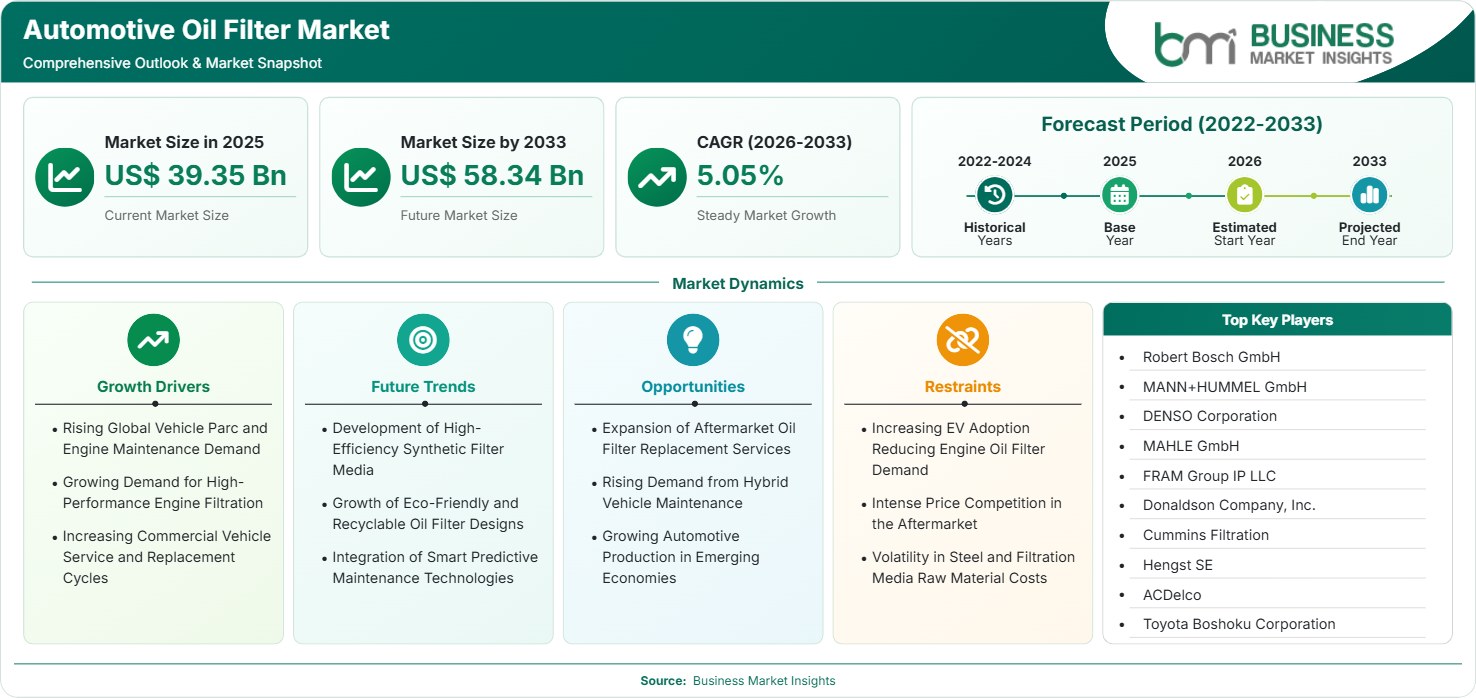
The Automotive Oil Filter Market size was valued at US$ 39.35 Billion in 2025 and is projected to reach US$ 58.34 Billion by 2033, growing at a CAGR of 5.05% during 2026–2033. Rising global vehicle parc, increasing vehicle maintenance requirements, expanding aftermarket demand, and advancements in high-efficiency filtration technologies continue creating growth opportunities for manufacturers worldwide.

Report Coverage
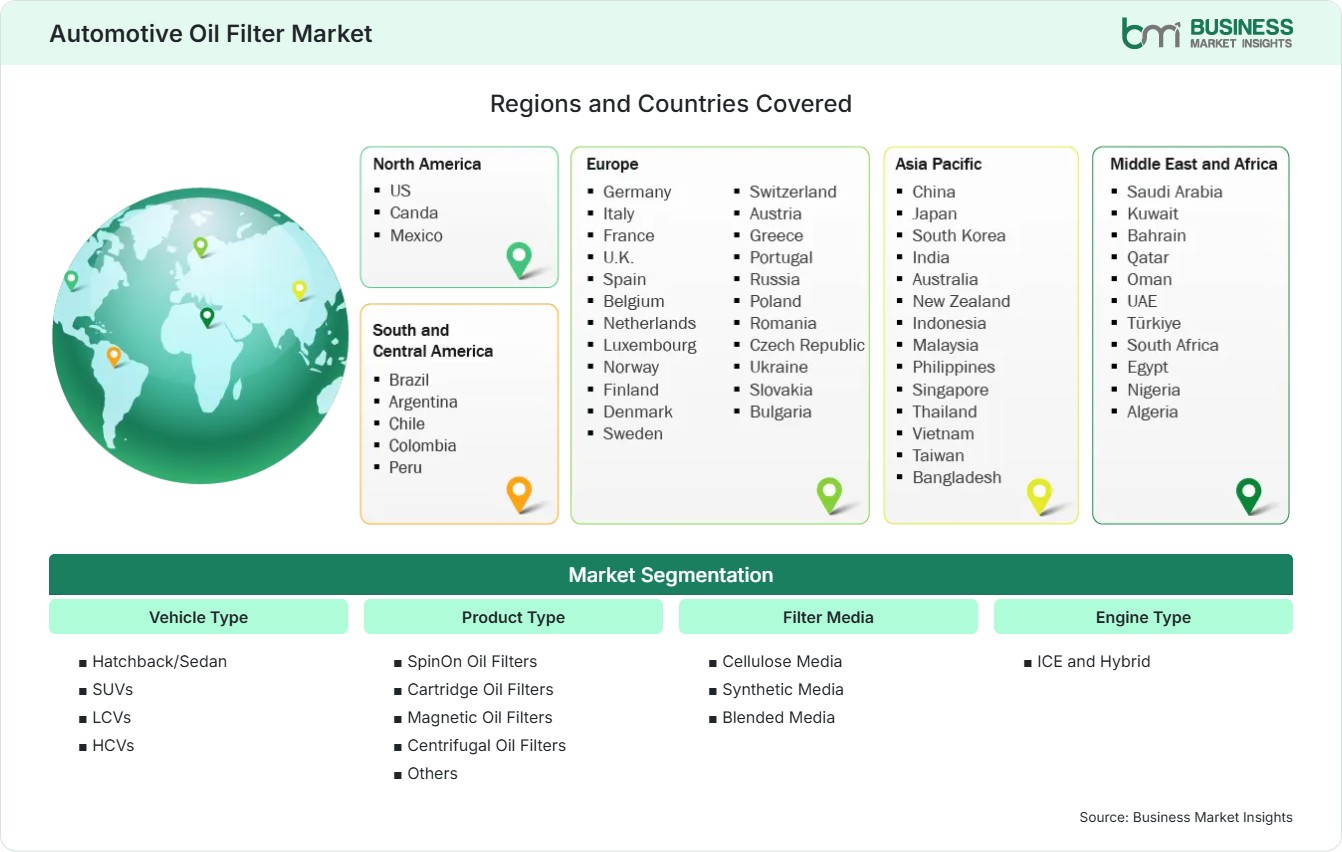
  • Vehicle Type: Hatchback/Sedan, SUVs, LCVs, HCVs
  • Product Type: SpinOn Oil Filters, Cartridge Oil Filters, Magnetic Oil Filters, Centrifugal Oil Filters, Others
  • Filter Media: Cellulose Media, Synthetic Media, Blended Media
  • Engine Type: ICE and Hybrid
  • Sales Channel: OEM and Aftermarket
US$ 39.35 Bn Market size in 2025
US$ 58.34 Bn Market Size by 2033
5.05% CAGR, 2026 - 2033
2026-2033 Forecast Period

AI Overview

Automotive Oil Filter Market Summary

  • North America Region: North America holds 28%–31% automotive oil filter market share in 2025 and is projected to expand at a CAGR of 4.8%–5.2% during 2026–2033. Strong vehicle ownership, established aftermarket networks, growing pickup truck demand, and routine maintenance practices continue supporting regional market expansion. The U.S. dominates regional demand through its extensive vehicle fleet, mature aftermarket ecosystem, and consistent maintenance culture, registering a CAGR of 4.9%–5.3% during the forecast period.
  • Fastest Growing Region: Asia Pacific accounts for 38%–41% market share in 2025 and is anticipated to grow at a CAGR of 5.5%–5.9%. Rising vehicle production, expanding automotive ownership, increasing service networks, and growing replacement demand continue accelerating regional growth.
  • Leading Segment: Aftermarket accounts for 63%–66% market share in 2025 while expanding at a CAGR of 5.2%–5.6%. Growing replacement cycles, independent service centers, and increasing vehicle age continue supporting segment leadership.
  • High Growth Segment: Synthetic Media represents 29%–32% market share in 2025 and is projected to register a CAGR of 5.8%–6.2%. Rising demand for longer service intervals, improved engine protection, and premium filtration performance continues driving adoption.
  • Key Market Opportunity: Development of high-performance filtration media, environmentally sustainable filter materials, and premium aftermarket products is creating long-term opportunities for industry participants.
  • Major Market Players: Robert Bosch GmbH, MANN+HUMMEL International GmbH & Co. KG, DENSO Corporation, MAHLE GmbH, FRAM Group IP LLC, Donaldson Company, Inc., Cummins Filtration, Hengst SE, ACDelco, and Toyota Boshoku Corporation.
Strategic Insights

Automotive Oil Filter Market: Strategic Insights

Automotive Oil Filter Market Strategic Framework
FREE PDF
Request your free sample
Request free sample
Stakeholder View

Key Takeaways

  • The industry benefits from an integrated ecosystem comprising automotive OEMs, filter manufacturers, component suppliers, distributors, and independent aftermarket service providers.
  • Premium aftermarket products and synthetic filter media present attractive long-term revenue opportunities as consumers prioritize engine protection and extended maintenance intervals.
  • Innovation increasingly focuses on advanced filtration materials, lightweight filter construction, recyclable components, and improved contaminant capture efficiency.
  • Asia Pacific offers significant investment potential owing to expanding automotive production, increasing vehicle ownership, and growing organized service infrastructure.
  • Strategic partnerships between automakers, aftermarket distributors, and filtration technology companies continue strengthening competitive positioning.
  • Companies investing in sustainable filter materials and digital aftermarket distribution channels are expected to enhance long-term automotive oil filter market competitiveness.
Geographic Outlook

Automotive Oil Filter Market Regional Highlights

North America Automotive Oil Filter Market

North America accounted for approximately 28%–31% of global revenue during 2025 and is projected to expand at a CAGR of 4.8%–5.2% through 2033. Strong vehicle ownership, mature aftermarket infrastructure, and consistent maintenance practices continue supporting regional demand. The Automotive Oil Filter Market share benefits from high replacement rates, expanding service networks, and growing demand for premium filtration products.

  • Independent service centers continue driving aftermarket oil filter replacement across passenger and commercial vehicles.
  • Pickup trucks and SUVs contribute significantly to replacement filter demand because of larger vehicle fleets.
  • Premium synthetic filtration products continue gaining adoption among consumers seeking longer service intervals.
  • Digital aftermarket platforms improve product availability and streamline distribution across the region.

US Automotive Oil Filter Market

The United States represents approximately 85%–88% of North American demand and is projected to register a CAGR of 4.9%–5.3% during the forecast period. Large vehicle fleets, established maintenance culture, and broad aftermarket distribution continue supporting sustained market expansion.

  • Mature aftermarket networks ensure widespread availability of replacement oil filters.
  • Aging vehicle fleets continue increasing routine maintenance requirements.
  • Commercial fleet operators prioritize high-efficiency filtration products to improve engine durability.
  • Premium filter adoption continues increasing across passenger vehicle segments.

Europe Automotive Oil Filter Market

Europe accounted for approximately 23%–26% of global revenue during 2025 and is expected to expand at a CAGR of 4.7%–5.1% through 2033. Strong automotive manufacturing, stringent emission regulations, and premium vehicle ownership continue supporting demand. Germany leads regional consumption, while Poland records one of the fastest growth rates through expanding automotive servicing activities.

  • Germany maintains leadership through its extensive automotive manufacturing and aftermarket ecosystem.
  • Poland experiences rapid growth owing to expanding automotive repair and maintenance services.
  • Premium vehicle ownership encourages adoption of high-performance filtration technologies.
  • Sustainability initiatives promote recyclable filter materials and environmentally responsible manufacturing.

Asia Pacific Automotive Oil Filter Market

Asia Pacific represented approximately 38%–41% of global revenue during 2025 and is forecast to grow at a CAGR of 5.5%–5.9% through 2033, making it the fastest-growing regional market. Expanding vehicle ownership, rising automotive production, and growing service infrastructure continue driving demand. China leads regional revenue, while India records the fastest growth.

  • China dominates regional demand through large vehicle production and ownership levels.
  • India experiences strong replacement demand supported by increasing vehicle parc and organized servicing.
  • Japan and South Korea continue emphasizing premium automotive maintenance products.
  • Southeast Asia strengthens aftermarket growth through expanding dealership and service center networks.

Rest of World Automotive Oil Filter Market

The Rest of World accounted for approximately 8%–10% of global revenue during 2025 and is projected to expand at a CAGR of 5.0%–5.4% through 2033. South & Central America experience rising replacement demand, while the Middle East and Africa benefit from increasing vehicle ownership and aftermarket expansion. Brazil leads Latin America, whereas Saudi Arabia records the fastest regional growth.

  • Brazil continues strengthening automotive aftermarket distribution and maintenance services.
  • Saudi Arabia records increasing demand due to expanding passenger and commercial vehicle fleets.
  • Independent workshops improve availability of replacement filtration products.
  • Fleet maintenance activities support steady consumption of automotive oil filters.
Global Market Geography
FREE PDF
Request your free sample
Request free sample
Segment Analysis

Automotive Oil Filter Market Segmentation

Vehicle Type

The Vehicle Type segment accounted for approximately 49%–52% of the market in 2025 and is projected to expand at a CAGR of 5.3%–5.7% during 2026–2033. Increasing vehicle ownership, rising average vehicle age, and routine engine maintenance continue driving oil filter demand across passenger and commercial vehicles. The Automotive Oil Filter Market scope continues expanding as global vehicle fleets require regular lubrication system maintenance.

  • Hatchback/Sedan: Hatchbacks and sedans account for substantial oil filter demand owing to their large global vehicle population, routine maintenance requirements, and frequent replacement cycles across developed and emerging markets.
  • SUVs: SUVs continue generating significant demand because of increasing global sales, higher engine capacities, longer travel distances, and regular preventive maintenance schedules.
  • LCVs: Light commercial vehicles require frequent oil filter replacement due to intensive operating conditions, urban logistics applications, and higher annual vehicle utilization.
  • HCVs: Heavy commercial vehicles generate consistent replacement demand through scheduled fleet maintenance, extended operating hours, and stringent engine reliability requirements.

Product Type

Product innovation continues supporting improved engine protection and maintenance efficiency. This segment represented approximately 54%–57% of market revenue in 2025 and is anticipated to expand at a CAGR of 5.2%–5.6% during the forecast period. The Automotive Oil Filter Market trends indicate increasing adoption of premium filtration technologies for longer engine life.

  • Spin-On Oil Filters: Spin-on oil filters remain widely adopted because of simple installation, cost-effectiveness, reliable sealing, and extensive compatibility across passenger and commercial vehicles.
  • Cartridge Oil Filters: Cartridge oil filters are increasingly preferred due to reduced environmental impact, easier recycling, lightweight construction, and growing adoption by modern vehicle manufacturers.
  • Magnetic Oil Filters: Magnetic oil filters improve engine protection by capturing metallic wear particles, extending lubricant life, and reducing internal engine component wear.
  • Centrifugal Oil Filters: Centrifugal oil filters efficiently remove fine contaminants using centrifugal force, making them suitable for heavy-duty commercial and industrial engine applications.
  • Others: Additional product types include performance oil filters, reusable filters, specialty filtration products, and application-specific solutions designed for demanding operating environments.

Filter Media

Filter media technologies continue evolving to improve contaminant retention, oil flow, and service life. The segment accounted for approximately 41%–44% of market revenue during 2025 and is projected to grow at a CAGR of 5.4%–5.8% through 2033.

  • Cellulose Media: Cellulose media remains widely utilized because of affordability, dependable filtration efficiency, and compatibility with routine passenger vehicle maintenance requirements.
  • Synthetic Media: Synthetic media delivers superior filtration performance, higher contaminant retention, extended replacement intervals, and improved durability under demanding operating conditions.
  • Blended Media: Blended media combines cellulose and synthetic fibers to balance filtration efficiency, durability, oil flow performance, and manufacturing costs.

Engine Type

Engine technology continues influencing oil filter demand patterns as vehicle electrification gradually progresses. This segment represented approximately 88%–91% of the market in 2025 while registering a CAGR of 4.9%–5.3% during the forecast period.

  • ICE: Internal combustion engine vehicles dominate oil filter demand because every engine requires periodic lubrication system maintenance throughout its operational lifespan.
  • Hybrid: Hybrid vehicles continue supporting oil filter demand since internal combustion engines remain integral to their propulsion systems despite partial electrification.

Sales Channel

Sales channels remain dominated by replacement demand from existing vehicle fleets. The segment accounted for approximately 63%–66% of the market in 2025 and is expected to expand at a CAGR of 5.2%–5.6% through 2033.

  • OEM: OEM demand remains supported by new vehicle production, factory-installed filtration systems, and long-term supply agreements with automotive manufacturers.
  • Aftermarket: The aftermarket dominates demand through routine maintenance, independent workshops, dealership servicing, fleet maintenance programs, and replacement filter sales.
Market Forces

Automotive Oil Filter Market Dynamics

Key Market Drivers

Rising Global Vehicle Parc and Engine Maintenance Demand

Growing global vehicle ownership and increasing average vehicle age continue supporting demand for engine maintenance products, including oil filters. Internal combustion engine vehicles require scheduled oil and filter replacement to maintain engine efficiency, reduce wear, and comply with manufacturer maintenance recommendations. The Automotive Oil Filter Market growth remains supported by expanding passenger vehicle fleets, commercial transportation activity, and greater consumer awareness regarding preventive vehicle maintenance. Developing economies continue adding millions of vehicles annually, creating sustained long-term replacement demand across organized service centers, dealerships, and independent automotive workshops.

Growing Demand for High-Performance Engine Filtration

Automotive manufacturers and car owners are increasingly preferring high-performance filters that can retain fine dirt particles while ensuring that the oil flows in the most efficient manner. High-quality filter material, along with better sealing techniques and improved durability, have contributed to increased engine life, better fuel economy, and lower costs of maintenance. The current generation of turbocharged engines and sports cars needs highly developed filters that work efficiently at higher pressures and temperatures.

Increasing Commercial Vehicle Service and Replacement Cycles

The commercial vehicles are subjected to harsh working conditions necessitating frequent changes of engine oils and filters. Many fleet managers nowadays employ preventive maintenance policies to lower repair costs and increase the usage of the vehicles. An increase in logistic operations, e-commerce operations, constructions projects, and industrial transportation has led to an increase in operating time of the commercial vehicles. Therefore, there is a high demand for robust oil filters for the various commercial vehicles.

Key Market Opportunities

Expansion of Aftermarket Oil Filter Replacement Services

Rapid growth of organized automotive aftermarket networks is creating significant opportunities for oil filter manufacturers and distributors. Independent workshops, dealership service centers, online automotive retailers, and quick-service maintenance providers continue expanding their geographic presence and product offerings. The Automotive Oil Filter Market Forecasts remain favorable as aging vehicle fleets increase replacement frequency across both developed and emerging economies. Manufacturers investing in premium replacement products, digital distribution channels, and technician training programs are expected to strengthen their competitive position within the expanding global aftermarket ecosystem.

Rising Demand from Hybrid Vehicle Maintenance

The use of engine lubrication in hybrid cars is still required since these cars feature internal combustion engines along with an electric propulsion system. While the operation of engines may be different from other traditional engines, the process of oil and filter changes is still necessary to ensure efficient operation. This fact provides the reason why more sales of filters suitable for hybrid cars can be expected worldwide. The development of such filters will bring success in the market.

Growing Automotive Production in Emerging Economies

The automotive manufacturing industry continues to grow in developing countries, where governments are pushing for local automobile manufacturing and attracting direct foreign investment. The growth in the manufacture of cars, trucks, and hybrids is contributing to the growth of oil filter demand by original equipment manufacturers while at the same time creating aftermarket potential. Growth in dealership chains, components manufacturing, and service structure improves market access. Companies that are setting up production and distribution plants in regional locations should benefit from industry growth.

Market Restraints and Challenges

Increasing EV Adoption Reducing Engine Oil Filter Demand

Factor: Battery electric vehicles do not require conventional engine lubrication systems, eliminating the need for engine oil filters throughout normal vehicle operation.

Impact: As electric vehicle adoption accelerates, long-term demand for conventional oil filters may gradually decline, particularly across passenger vehicle segments. Manufacturers increasingly diversify product portfolios toward cabin air filters, battery cooling filters, transmission filtration, and other advanced automotive filtration technologies to reduce dependence on traditional internal combustion engine applications while maintaining long-term business growth.

Intense Price Competition in the Aftermarket

Factor: The automotive aftermarket includes numerous regional and international manufacturers offering similar replacement oil filters across multiple vehicle categories and price ranges.

Impact: Strong pricing competition places pressure on manufacturer margins while increasing the importance of product differentiation, brand reputation, and distribution efficiency. Companies continue investing in premium filtration technologies, extended service-life products, digital sales channels, and value-added customer support to strengthen competitiveness while maintaining profitability in highly competitive aftermarket environments.

Company Analysis

Competitive Landscape

The Automotive Oil Filter Market analysis remains highly competitive, with global filtration manufacturers focusing on advanced filter media, extended service life, lightweight designs, and environmentally sustainable products. Leading companies continue investing in aftermarket expansion, OEM partnerships, manufacturing localization, and filtration technology innovation to strengthen their competitive positions across global automotive markets.

Company Name

Overview

Products and Services Relevant to this Market

Robert Bosch GmbH

Robert Bosch GmbH is a leading automotive technology company supplying filtration products and engine components to vehicle manufacturers and aftermarket customers worldwide.

Oil filters, fuel filters, air filters, cabin filters, engine components, and automotive aftermarket solutions.

MANN+HUMMEL International GmbH & Co. KG

MANN+HUMMEL is a global leader in filtration technologies serving automotive, industrial, and environmental applications through innovative filtration solutions.

Automotive oil filters, air filters, fuel filters, cabin filters, filtration media, and engine protection technologies.

DENSO Corporation

DENSO Corporation develops advanced automotive components and aftermarket products supporting vehicle efficiency, reliability, and engine performance globally.

Oil filters, automotive components, engine management systems, thermal systems, filtration products, and replacement parts.

MAHLE GmbH

MAHLE GmbH specializes in advanced automotive systems and filtration technologies for passenger and commercial vehicle manufacturers worldwide.

Oil filters, filtration systems, engine components, thermal management products, air intake systems, and aftermarket solutions.

FRAM Group IP LLC

FRAM Group IP LLC is a well-established aftermarket filtration manufacturer recognized for high-performance automotive maintenance products.

Spin-on oil filters, cartridge oil filters, premium synthetic filters, engine filtration products, and automotive maintenance solutions.

Donaldson Company, Inc.

Donaldson Company develops filtration technologies for automotive, industrial, heavy-duty, and off-road equipment applications worldwide.

Heavy-duty oil filters, filtration systems, hydraulic filters, fuel filters, engine filtration technologies, and industrial filtration solutions.

Cummins Filtration

Cummins Filtration specializes in filtration technologies designed for commercial vehicles, heavy-duty engines, and industrial equipment applications.

Heavy-duty oil filters, lube filtration systems, fuel filters, coolant filters, engine protection products, and fleet maintenance solutions.

Hengst SE

Hengst SE develops advanced filtration technologies supporting automotive manufacturers and industrial customers with premium filtration products.

Automotive oil filters, filter media, air filters, fuel filters, cabin filters, and engine filtration systems.

ACDelco

ACDelco is a leading aftermarket automotive parts supplier providing maintenance products for passenger and commercial vehicles worldwide.

Replacement oil filters, engine maintenance products, filtration systems, automotive components, and aftermarket service parts.

Toyota Boshoku Corporation

Toyota Boshoku Corporation manufactures automotive components and filtration technologies supporting vehicle performance and reliability.

Automotive filtration products, oil filters, interior components, engine filtration systems, and OEM automotive solutions.

Trust & Transparency

Research Methodology

The market analysis combines proprietary research with secondary data from government agencies, company disclosures, regulatory filings, industry databases and expert interviews. Market estimates are validated through data triangulation, cross-market benchmarking and analyst review.

View Full Research Methodology

Questions Answered

Frequently Asked Questions

What does an Automotive Oil Filter Market Report provide?

The report provides detailed analysis of market size, competitive landscape, segmentation, regional outlook, technological developments, supply chain trends, growth opportunities, and future industry forecasts.

Which region is expected to witness the fastest growth?

Asia Pacific is projected to record the fastest growth due to increasing vehicle production, expanding automotive ownership, rising disposable income, and the rapid development of organized automotive servicing infrastructure.

Why is synthetic filter media gaining popularity?

Synthetic media offers superior contaminant retention, higher durability, improved oil flow, and longer service intervals compared to conventional cellulose media, making it suitable for modern high-performance engines.

Which sales channel dominates the market?

The aftermarket holds the largest share because every internal combustion engine vehicle requires periodic oil filter replacement throughout its operational life, creating recurring demand across service centers and independent workshops.

What is the primary function of an automotive oil filter?

An automotive oil filter removes contaminants, metal particles, sludge, and impurities from engine oil, helping maintain proper lubrication, reduce engine wear, and improve overall engine performance and longevity.

Access the Full Automotive Oil Filter Market Report

Get segment-level forecasts, regional estimates, competitive benchmarking, company profiles and downloadable Excel datasets.

Access the full Automotive Oil Filter Market Report
350 pages PDF & Excel | 2026-08-07
Similar Research

Related Market Reports