
Automotive Engine Oil Market Outlook: Size, Share, Trends, Growth Analysis, Competitive Landscape & Forecast, 2026-2033

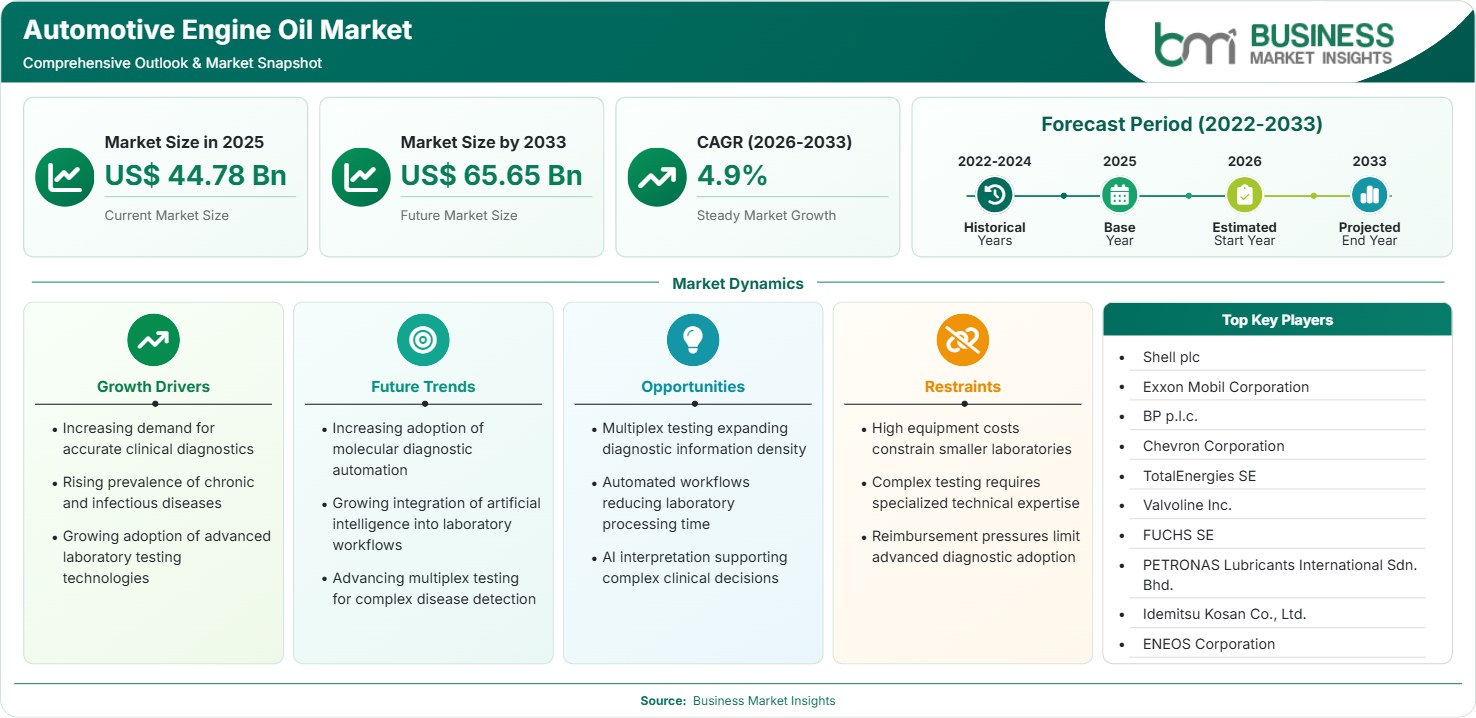
The Automotive Engine Oil Market size was valued at US$ 44.78 Billion in 2025 and is projected to reach US$ 65.65 Billion by 2033, growing at a CAGR of 4.90% during 2026–2033. Key drivers include vehicle parc expansion, stricter engine-efficiency requirements, premium synthetic adoption, longer drain intervals, and rising commercial mobility.

Report Coverage
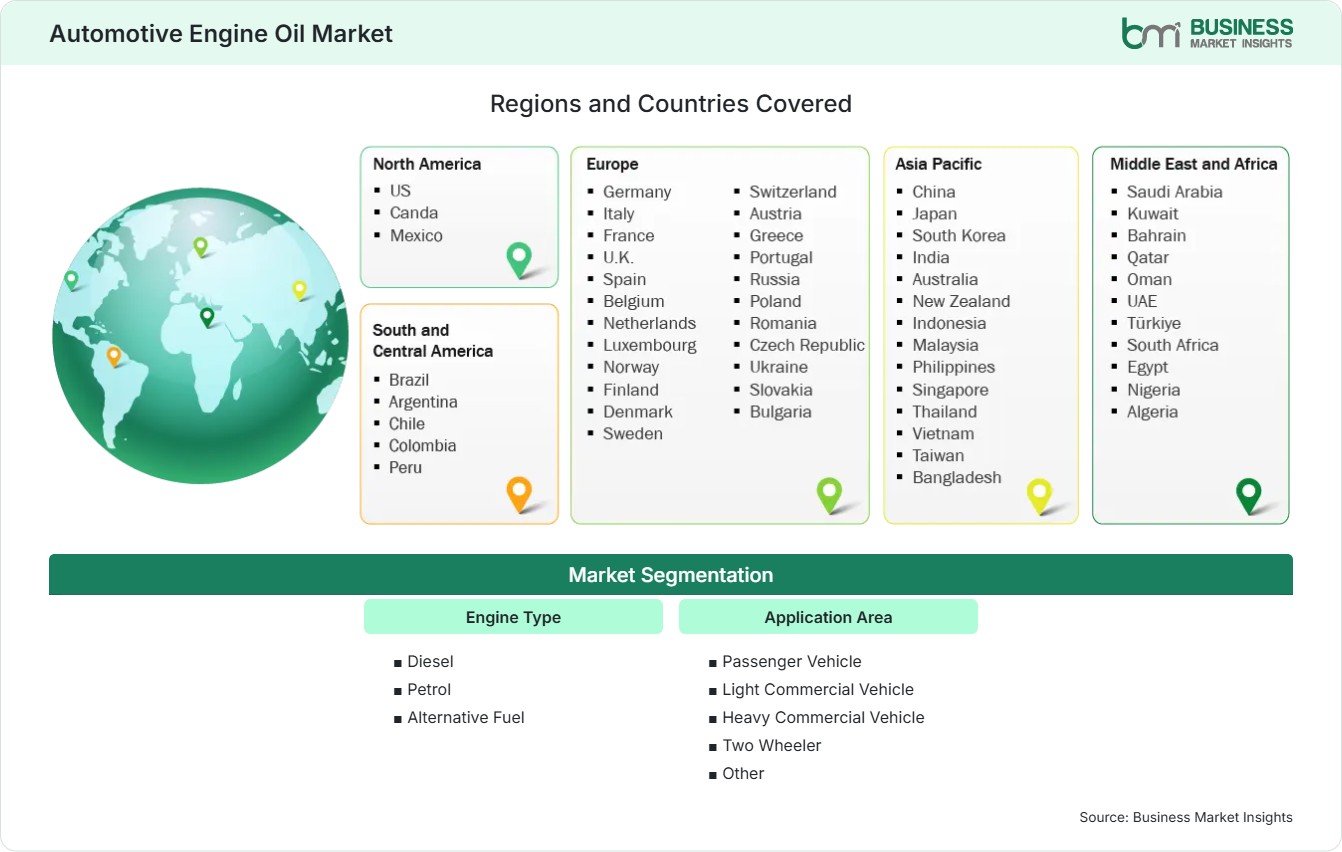
  • Engine Type: Diesel, Petrol, Alternative Fuel
  • Application Area: Passenger Vehicle, Light Commercial Vehicle, Heavy Commercial Vehicle, Two Wheeler, Other
US$ 44.78 Bn Market size in 2025
US$ 65.65 Bn Market Size by 2033
4.9% CAGR, 2026 - 2033
2026-2033 Forecast Period

AI Overview

Automotive Engine Oil Market Summary

  • North America Region: North America holds a 24%–27% share in 2025, growing at a 3.8%–4.3% CAGR, driven by aging vehicle fleets, premium lubricants, high-mileage vehicles, OEM specifications, and expanding service networks. US demand remains resilient through fleet age, maintenance intensity, and premium oil adoption, with a 3.6%–4.1% CAGR during 2026–2033.
  • Fastest Growing Region: Asia Pacific holds a 36%–40% Automotive Engine Oil Market in 2025 and advances at a 5.4%–6.0% CAGR, supported by expanding vehicle ownership, two-wheeler populations, commercial fleets, industrialization, localized blending, and increasing adoption of synthetic and semi-synthetic formulations.
  • Leading Segment: Passenger Vehicle applications hold a 46%–50% share in 2025 and expand at a 4.5%–5.0% CAGR, supported by growing vehicle parc, routine servicing, higher lubricant specifications, premiumization, longer drain intervals, and increasing consumer awareness of engine protection.
  • High Growth Segment: Synthetic grade holds a 23%–27% Automotive Engine Oil Market share in 2025 and records a 6.2%–6.8% CAGR, supported by low-viscosity requirements, turbocharged engines, fuel-efficiency targets, extended drain intervals, tighter emissions standards, and premium vehicle penetration.
  • Key Market Opportunity: Premium low-viscosity formulations, OEM-approved factory-fill contracts, digitally managed aftermarket servicing, and lubricant solutions for hybrids create opportunities to increase value per vehicle despite declining lubricant intensity.
  • Major Market Players: Shell plc; Exxon Mobil Corporation; BP p.l.c.; Chevron Corporation; TotalEnergies SE; Valvoline Inc.; FUCHS SE; PETRONAS Lubricants International Sdn. Bhd.; Idemitsu Kosan Co., Ltd.; ENEOS Corporation.
Strategic Insights

Automotive Engine Oil Market: Strategic Insights

Automotive Engine Oil Market Strategic Framework
FREE PDF
Request your free sample
Request free sample
Stakeholder View

Key Takeaways

  • The value chain is becoming more specification-driven. Base-oil suppliers, additive companies, lubricant formulators, OEMs, distributors, workshops, and fleet operators increasingly coordinate around viscosity, emissions compatibility, drain intervals, and warranty requirements.
  • The strongest upside lies in synthetic and semi-synthetic grades, commercial fleets, and premium passenger-vehicle applications. These categories can generate higher revenue per liter even where total lubricant consumption grows more slowly.
  • Formulation development is moving toward lower viscosity, improved oxidation resistance, reduced volatility, deposit control, and compatibility with turbocharged gasoline engines, particulate filters, start-stop systems, and hybrid powertrains.
  • Asia Pacific provides the strongest investment case because large vehicle populations coexist with new vehicle production, two-wheeler dependence, commercial transport expansion, and accelerating premium lubricant adoption across India and Southeast Asia.
  • Investment is increasingly directed toward premium portfolios, regional blending, OEM partnerships, digital workshops, and distribution optimization. Shell’s 2025 results illustrate the industry's emphasis on premiumization and disciplined capital allocation.
  • Suppliers must manage the transition from volume-led engine oil sales toward value-led formulations. Electrification will reduce engine-oil demand in selected vehicle categories, making premiumization, hybrid compatibility, commercial vehicles, and aftermarket penetration increasingly important.
Geographic Outlook

Automotive Engine Oil Market Regional Highlights

North America Automotive Engine Oil Market

North America accounts for 24% to 27% of the Automotive Engine Oil Market Share in 2025, with a CAGR of 3.8% to 4.3% from 2025 to 2033. Demand is driven by an extensive vehicle fleet, aftermarket activities, high-end passenger-car oils, pick-up trucks, and commercial-fleet segments. The preference here lies in high-performance products with increasing standards from OEMs. North America, the US in particular, remains the key regional driver, with Canada and Mexico contributing on the aftermarket and production front, respectively.

  • Mature vehicle ownership sustains replacement demand because older passenger cars, pickups, and commercial vehicles require regular lubrication despite slower new-vehicle additions. Premium high-mileage formulations strengthen supplier value capture across established aftermarket channels.
  • OEM specification changes encourage suppliers to upgrade additive packages and low-viscosity products. API SQ and ILSAC GF-7 reinforce formulation differentiation as manufacturers target fuel economy and protection in modern gasoline engines.
  • Mexico provides manufacturing-linked demand through vehicle production and supplier localization, while Canada supports premium lubricant consumption through passenger vehicles, commercial fleets, and extensive independent service networks.
  • Digital vehicle maintenance platforms are improving lubricant recommendation and replenishment. Workshop networks can use service records, mileage data, and vehicle specifications to improve product matching while increasing repeat aftermarket purchases.

US Automotive Engine Oil Market

The US accounts for 68%-72% of North America's demand in 2025, with a CAGR of 3.6%-4.1% through 2033. The automotive engine oil market demand drivers include a substantial installed fleet, the popularity of pick-ups and SUVs, an established service network, and high penetration of synthetics. The premiumization trend is bolstered by OEM approvals and customer interest in fuel economy. Fleets are more focused on optimizing drain intervals, engine protection, and the predictability of the maintenance cycle.

  • The aging vehicle population supports high-mileage oils and maintenance products because owners retain vehicles longer, increasing the importance of deposit control, seal conditioning, oxidation resistance, and viscosity stability.
  • Pickup trucks and commercial vehicles create disproportionate lubricant demand because larger engines require greater oil volumes and intensive operating conditions. Fleet maintenance programs therefore remain important channels for premium heavy-duty formulations.
  • API SQ and ILSAC GF-7 encourage product upgrades for modern gasoline engines. Suppliers with broad OEM approvals can defend premium pricing by linking formulation performance to warranty and maintenance requirements.

Europe Automotive Engine Oil Market

Europe is expected to capture a market share of 20% to 23% in 2025 with a CAGR of 3.4% to 3.9% in the Automotive Engine Oil Market till 2033. The primary markets are Germany, France, Italy, Spain, and the United Kingdom; however, Poland and Turkey offer greater growth opportunities. Stringent emission standards, fuel-efficiency mandates, DPFs, turbocharged engines, and long drain intervals are expected to drive the development of advanced engine oil formulations. Hybrid vehicles will reduce engine oil sales in the future.

  • Germany remains a major automotive manufacturing and lubricant technology center, with premium OEM specifications supporting demand for advanced synthetic formulations designed for turbocharged and high-efficiency engines.
  • France and Italy retain substantial aftermarket demand because established passenger-car fleets require recurring servicing. Premium products gain traction where consumers and workshops prioritize manufacturer approvals, engine cleanliness, and longer service intervals.
  • Spain and Poland provide opportunities through vehicle parc expansion, commercial mobility, and aftermarket modernization. Independent workshops remain influential channels for lubricant brands competing on specification, availability, and service relationships.
  • Türkiye provides a strategic bridge between European and Middle Eastern markets. Its vehicle manufacturing base, commercial transportation activity, and aftermarket scale support demand for both passenger-car and heavy-duty engine oils.

Asia Pacific Automotive Engine Oil Market

The Asia Pacific region is projected to hold a market share of 36% to 40% in 2025 and to grow at a CAGR of 5.4% to 6.0% through 2033. China, India, Japan, South Korea, Indonesia, Thailand, and Vietnam influence the regional demand. China remains the largest market for Automotive Engine Oil, while India and Vietnam offer greater growth potential. High two-wheeler numbers, commercial fleets, increased vehicle ownership, and local production fuel usage.

  • China drives regional demand due to its large vehicle fleet and manufacturing base. Suppliers, both local and multinational, operate in the region using OEM partnerships, premium offerings, localized blending, and more advanced distribution and workshop networks.
  • India offers passenger vehicle expansion, two-wheelers, commercial transport, and increased adoption of premium lubricants. Castrol India sees potential for growth in commercial and mobility lubricants and seeks greater geographical coverage and a stronger presence in workshops.
  • Japan and South Korea focus on high-specification lubricants due to complex vehicle engineering, hybrid penetration, and high standards of OEM requirements, which favor low-viscosity and thermally stable formulations.
  • Indonesia, Thailand, and Vietnam offer attractive growth prospects because demand for motorcycles, delivery fleets, commercial vehicles, and manufacturing activity remains strong. Vietnam is particularly attractive for lubricant suppliers targeting the rapidly developing automotive infrastructure.

Rest of World Automotive Engine Oil Market

Rest of World is estimated to account for about 14%-17% of global demand by 2025, growing at a 4.6%-5.1% CAGR in the Automotive Engine Oil Market until 2033. South and Central American countries will have the advantage of a growing number of vehicles, as well as agriculture, logistics, and maintenance services. Brazil and Mexico will be supported by their supply chain networks, while Argentina and Colombia will add further demand. Premium demand in the Middle East and Africa is supported by countries such as Saudi Arabia, the United Arab Emirates, South Africa, and some Gulf countries, while developing countries in Africa are price-sensitive.

The Middle Eastern countries of Saudi Arabia, the United Arab Emirates, and South Africa, and certain Gulf markets, provide a base for premium products; however, developing nations in Africa are relatively price-sensitive. Weather conditions, dust-filled environments, foreign automobiles, and high-powered transportation require sturdy lubricants with regular maintenance.

  • Brazil has size potential in passenger cars, commercial vehicles, farm equipment, and an established domestic lubricants market. Synthetic lubricant consumption in Brazil is primarily driven by new cars and wealthier consumers.
  • Argentina and Colombia offer aftermarket sales opportunities through commercial and passenger car fleets. Reach and price are crucial, as independent workshops play a role in selecting lubricants.
  • Saudi Arabia and the UAE prefer premium lubricants due to the need for thermal stability and deposit control, driven by the hot climate, long-distance driving, performance cars, and large commercial fleets.
  • South Africa remains an important African market, supported by passenger vehicles, logistics, mining-linked activity, and established lubricant distribution. Heavy-duty formulations remain important where operating conditions impose higher thermal and contamination loads.
Global Market Geography
FREE PDF
Request your free sample
Request free sample
Segment Analysis

Automotive Engine Oil Market Segmentation

Grade

Grade choice is now based more on vehicle technology, OEM approval, operational conditions, and the ability to pay. Mineral grades hold a 52%-56% market share in 2025, with a 4.0%-4.5% CAGR, while premium synthetics derive their added value from improved efficiency and drain life. Semi-synthetics represent an alternative approach to the problem. Consequently, the Automotive Engine Oil Market scope covers both low-cost mineral oils and technology-based premium oils.

  • Mineral: The use of mineral oils remains common in older cars, industrial applications, and low-priced segments due to their well-established supply chain and low acquisition costs.
  • Synthetic: The use of synthetic oils is increasing in advanced engines, where low viscosity, improved oxidation stability, protection for turbochargers, and extended drain intervals are needed.
  • Semi-synthetic: Semi-synthetic oils lie between mineral and synthetic oils, offering enhanced properties at affordable prices, making them popular for passenger cars and motorcycles.

Engine Type

Engine type influences the oil's viscosity, additive package, compatibility with the emissions system, and stress environment. The use of diesel engines is a major factor in the installed base, while petrol engines could be provided with better oils for turbocharged or direct-injected engines. Oils required by alternative-fuel engines differ because of distinct combustion and temperature conditions. Market trends for the Automotive Engine Oil market are shifting towards powertrain diversity more than a uniform formulation approach.

  • Diesel: Soot treatment, oxidation resistance, wear prevention, and compatibility with emission after-treatment systems form the demands of the diesel engine category; hence, there is continued demand in the segment.
  • Petrol: The growing demand for low-viscosity lubricants from petrol engine manufacturers, driven by the need for turbochargers, direct injection, start-stop technology, and fuel economy, represents an opportunity for more sophisticated additive blends and synthetics approved by original equipment manufacturers (OEMs).
  • Alternative Fuel: CNG, LPG, biofuel, and other alternative-fuel engines present unique lubricant requirements related to oxidation, fuel dilution, combustion temperature, and deposits.

Application Area

Applications will be dominated by passenger cars, which account for 46%-50% of the market and are projected to grow at a CAGR of 4.5%-5.0% in 2025. Commercial vehicles will have higher intensities owing to greater oil consumption and operating hours. Two-wheelers are also an important segment in Asia. Hence, the Automotive Engine Oil market share depends on vehicle numbers, maintenance intervals, engine size, and engine operating intensity.

  • Passenger Vehicle: Passenger vehicles generate recurring aftermarket demand through scheduled servicing, with premium products gaining adoption as consumers seek fuel efficiency, engine cleanliness, OEM compliance, and longer service intervals.
  • Light Commercial Vehicle (LCV): LCVs support demand through delivery, logistics, and small-business transportation. High utilization creates recurring oil changes, while fleet operators increasingly value products that reduce downtime and improve maintenance predictability.
  • Heavy Commercial Vehicle (HCV): HCVs consume greater lubricant volumes because of larger engines, high operating hours, and demanding loads. Fleet maintenance programs favor durable formulations offering wear, oxidation, and contamination control.
  • Two Wheeler: Two-wheelers remain essential mobility assets across India and Southeast Asia. Frequent usage, large vehicle populations, and relatively short service intervals support sustained lubricant demand across mineral, semi-synthetic, and synthetic products.
Market Forces

Automotive Engine Oil Market Dynamics

Key Market Drivers

Rising Vehicle Parc and Recurring Aftermarket Maintenance

The growing fleet of vehicles in operation is an underlying demand pull, since all internal combustion engines require regular lubrication. There is an ongoing need for lubricant changes in passenger cars, commercial fleets, and two-wheelers, regardless of fluctuations in new-vehicle sales. Asian developing countries offer a combination of vehicle ownership growth and significant motorcycle usage, resulting in frequent servicing needs. Preventing failures is crucial for fleet owners, as they cause immediate production stoppages and repair-related expenses. These factors underpin the Automotive Engine Oil Market growth through both factory filling and after-sales services. Manufacturers with a wide network of service shops can leverage more vehicles to increase profits. Premium products also enable value capture through customers' desire for better engine protection.

Stricter Efficiency Standards and Advanced Engine Architectures

Turbocharging, direct injection, start/stop technology, downsizing, and reduced-viscosity specifications are among the technologies automakers are employing to improve efficiency and emissions compliance. Such technologies make engines more susceptible to oxidation, deposits, low-speed pre-ignition, heat, and lubricant evaporation. Lubricant suppliers have therefore been developing additive packages and base oil blends that maintain their protective capabilities despite lower viscosities. The arrival of API SQ and ILSAC GF-7 is in line with this trend, through new specifications for advanced gasoline engine performance. Shell launched API SQ-ready Helix Ultra oils on global markets starting from March 2025, demonstrating how specification changes translate into product development and commercialization.

Premiumization Through Synthetic and Extended-Drain Formulations

More consumers and fleet owners are making lubricant purchase decisions based on engine protection, service intervals, fuel efficiency, and OEM requirements, in addition to price. The use of synthetic oils is helpful in this regard, as they offer lower viscosity and better performance due to their molecular structure and additives. Shell increased profit margins in 2025 by focusing on premium products and value creation. It is evident from the Automotive Engine Oil Market trends that the preference for high-value oils will continue even if less oil is used per car. Supplier profitability can be increased through premium products, OEM approval, and workshop-specified lubricants.

Key Market Opportunities

Localized Blending and Distribution in High-Growth Asian Markets

India, Vietnam, Indonesia, and other Asian countries represent good prospects for regional blending owing to the coexistence of many vehicles, fragmented distribution channels, and increasing demand for high-end products, according to the Automotive Engine Oil Market Forecast. Local production will help avoid logistics-related risks, shorten replenishment periods, and respond to regional viscosity requirements. The supplier could conduct blending and work in workshops, OEMs, and e-commerce. India is particularly interesting for passenger cars, trucks, and two-wheelers that drive demand. Castrol India has already formulated its priorities, such as geographic expansion, product portfolio expansion, workshop development, an emphasis on premium brands, and cooperation with OEMs for automotive lubricants.

OEM Factory-Fill and Authorized Service Partnerships

OEM deals will ensure continuous lubricant sales and increase the brand's credibility, since certified products are part of the vehicle maintenance schedule. Factory fill agreements will also create downstream market presence, as vehicle owners continue to use the same specification at service centers even after the warranty period. The company signed its first aftermarket service fill deal with Mahindra in June 2025, under which it became the exclusive supplier of vehicle fluids for Mahindra's South Zone, comprising 50 SKUs. Such deals help create a commercial ecosystem that integrates lubricant manufacturing, authorized workshops, logistics, and vehicle formulation needs into a single system.

Hybrid-Compatible Lubricants and Next-Generation Mobility Fluids

Hybrid vehicles create an intermediate opportunity because their combustion engines remain dependent on engine oil while operating under frequent start-stop cycles and distinct thermal conditions. Formulations can be tailored for low-speed operation, fast lubrication at start-up, fuel dilution, and long drain intervals. This is especially relevant in markets such as Japan, Europe, China, and North America, where hybrids have been accepted. It is possible to defend the high-value engine oil business by considering hybrid compatibility alongside electrification as a volume threat. Formulations can also integrate traditional engine oils into thermal management and drivetrain fluids.

Market Restraints and Challenges

Electrification Reduces Long-Term Engine-Oil Volume Intensity

Factor: Battery-powered automobiles don’t have any traditional engine oil needs, and hybrid automobiles usually have lesser lubricant needs compared to their equivalent conventional powertrains. Impact: More electrification means fewer engine oils to be addressed in developed economies where automobile sales are quickly tilting towards electric drivetrains. However, the impact varies significantly due to the large number of internal combustion vehicle fleets that will need servicing for a long time. Manufacturers have to strike a balance between premiumization and declining unit usage in certain passenger-vehicle markets. Commercial vehicles, motorcycles, older automobiles, and hybrid powertrains may partly mitigate the decline.

Base-Oil and Additive Cost Volatility Pressures Margins

Factor: The economics of engine oils depend heavily on base oil grades, additives used, refining facilities, transportation costs, and regional supply and demand. Impact: Cost flexibility can erode margins if suppliers cannot immediately raise prices to cover the higher costs of inputs used by distributors, workshops, fleets, or customers. High-end products are even more exposed because group II and group III base stocks, synthetic base stocks, and advanced additive systems may be associated with higher input costs. Regional blending helps mitigate logistics risk, but not feedstock risk. However, overstocking would increase working capital needs and could expose risks associated with changes in specifications and preferences.

Company Analysis

Competitive Landscape

Automotive Engine Oil Market analysis indicates competition is shifting from broad product availability toward specification leadership, OEM approvals, premiumization, distribution depth, and application-specific formulation. Global integrated energy companies compete with lubricant specialists and regional manufacturers across factory-fill and aftermarket channels.

Company Name

Overview

Products and Services relevant to this market

Shell plc

Global energy and lubricants supplier with broad OEM relationships and extensive aftermarket reach across passenger and commercial mobility.

Shell Helix passenger-car oils, Shell Rimula heavy-duty engine oils, Shell Advance motorcycle oils, OEM services, and workshop solutions.

Exxon Mobil Corporation

Integrated energy company with a major premium lubricants portfolio and established distribution across developed and emerging automotive markets.

Mobil 1 synthetic oils, Mobil Super products, commercial engine lubricants, OEM-approved formulations, and automotive maintenance solutions.

BP p.l.c.

Global energy company operating Castrol as a major automotive lubricant brand across consumer, commercial, and industrial applications.

Castrol EDGE, MAGNATEC, GTX, commercial lubricants, motorcycle oils, OEM partnerships, and workshop support.

Chevron Corporation

Integrated energy company with strong lubricants capabilities serving passenger vehicles, commercial fleets, and industrial customers.

Havoline passenger-car oils, Delo heavy-duty lubricants, OEM formulations, fleet products, and maintenance support.

TotalEnergies SE

Multinational energy and lubricant supplier with broad passenger-car, commercial, and motorcycle product coverage.

Quartz passenger-car oils, Rubia heavy-duty oils, Hi-Perf motorcycle oils, OEM-approved formulations, and service solutions.

Valvoline Inc.

Automotive service and lubricant company with strong recognition in vehicle maintenance and aftermarket channels.

Valvoline full synthetic, synthetic blend, high-mileage, conventional engine oils, maintenance services, and fleet support.

FUCHS SE

Specialist lubricant manufacturer with a broad automotive portfolio and strong formulation expertise.

TITAN passenger-car lubricants, commercial-vehicle products, OEM-specific formulations, specialty fluids, and technical support.

PETRONAS Lubricants International Sdn. Bhd.

Global lubricant business of PETRONAS with strong OEM, motorsport, aftermarket, and Asian market capabilities.

PETRONAS Syntium, Urania heavy-duty oils, Sprinta motorcycle lubricants, OEM service-fill programs, and technical solutions.

Idemitsu Kosan Co., Ltd.

Japanese energy and lubricant company with strong automotive OEM relationships and Asian market exposure.

Apolloil and Idemitsu automotive oils, motorcycle lubricants, OEM formulations, and specialized lubrication technologies.

ENEOS Corporation

Japanese energy company with extensive lubricant manufacturing, automotive partnerships, and Asian distribution capabilities.

ENEOS motor oils, premium synthetic formulations, motorcycle oils, commercial lubricants, OEM products, and maintenance solutions.

Trust & Transparency

Research Methodology

The market analysis combines proprietary research with secondary data from government agencies, company disclosures, regulatory filings, industry databases and expert interviews. Market estimates are validated through data triangulation, cross-market benchmarking and analyst review.

View Full Research Methodology

Questions Answered

Frequently Asked Questions

How can lubricant companies offset declining engine-oil volumes?

Companies can prioritize premium synthetics, hybrid-compatible products, commercial lubricants, OEM service-fill agreements, digital maintenance channels, and adjacent mobility fluids. Regional blending and stronger workshop networks can improve margins and distribution efficiency while helping suppliers retain customer relationships as vehicle powertrains diversify.

What role will low-viscosity oils play in future engine development?

Low-viscosity oils support reduced internal friction and fuel-efficiency objectives while maintaining protection in modern engines. Their adoption is linked to tighter efficiency requirements, downsized turbocharged engines, start-stop systems, and advanced additive chemistry. Product development will increasingly balance friction reduction against wear, volatility, and thermal stability.

Why are OEM approvals important for lubricant suppliers?

OEM approvals provide technical validation and influence factory-fill, warranty servicing, and aftermarket recommendations. They also help premium lubricant brands differentiate products from lower-priced alternatives. Suppliers with broad approval portfolios can compete more effectively where workshops and vehicle owners follow manufacturer-specific lubricant requirements.

How does electrification affect automotive engine oil demand?

Battery-electric vehicles remove conventional engine-oil requirements, creating a structural volume risk in markets with rapid EV adoption. However, the existing internal-combustion fleet remains large, while hybrids continue using combustion engines. Commercial vehicles, motorcycles, and older passenger vehicles can sustain demand during the transition.

What factors determine the choice between mineral, semi-synthetic, and synthetic engine oil?

Engine design, OEM specification, vehicle age, operating conditions, viscosity requirement, drain interval, and consumer budget determine grade selection. Modern turbocharged and efficiency-focused engines increasingly require advanced low-viscosity formulations, while older vehicles and price-sensitive applications continue using mineral or semi-synthetic products.

Access the Full Automotive Engine Oil Market Report

Get segment-level forecasts, regional estimates, competitive benchmarking, company profiles and downloadable Excel datasets.

Access the full Automotive Engine Oil Market Report
350 pages PDF & Excel | 2026-09-10
Similar Research

Related Market Reports