Market Summary
Executive Summary and Global Market Analysis
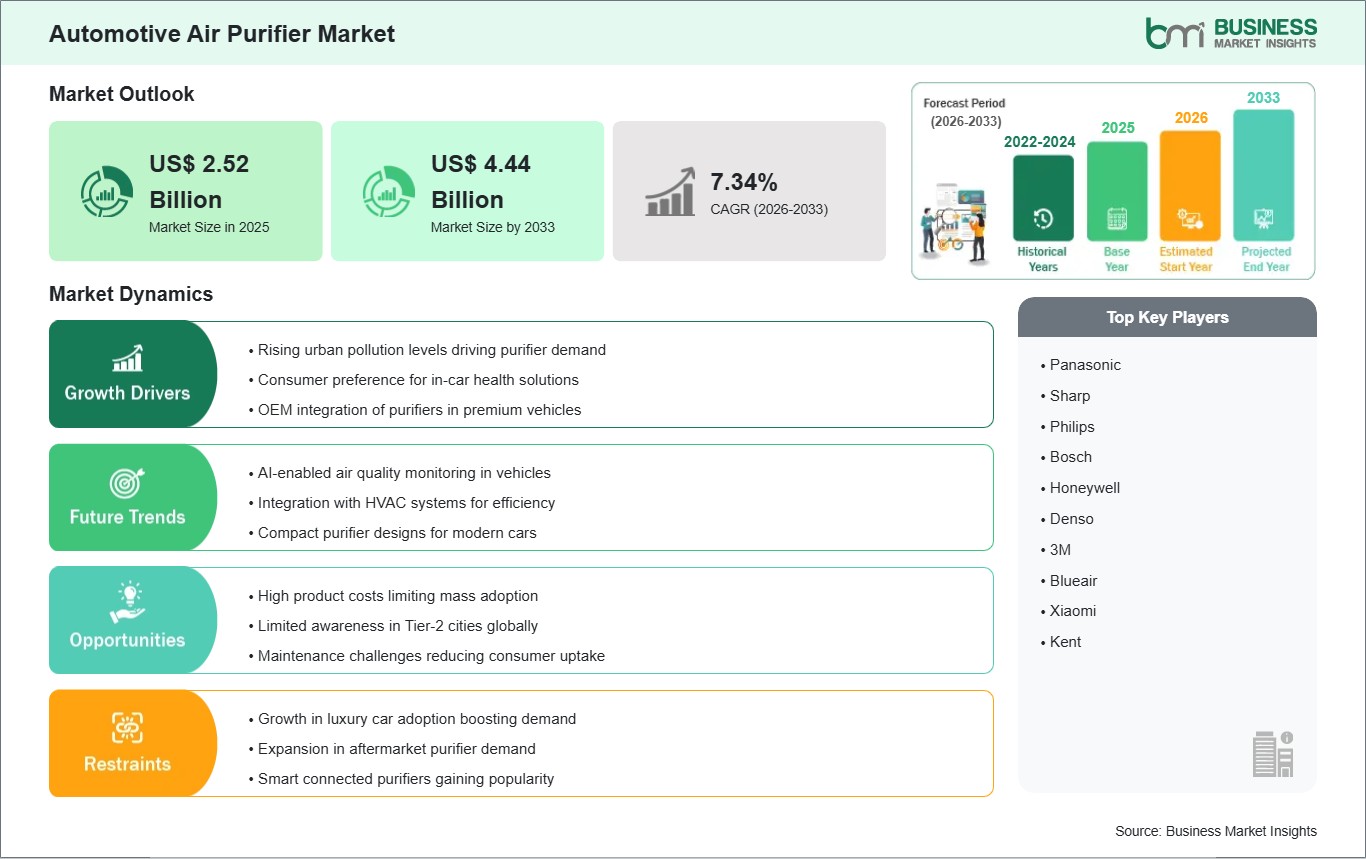
Automotive air purifiers are used to improve air quality inside vehicles by removing dust, allergens, bacteria, odors, and other airborne contaminants. Common technologies include HEPA filters, activated carbon filters, and ionizers. These systems help create a cleaner and healthier cabin environment for drivers and passengers. They are widely used in passenger cars and commercial vehicles, particularly in regions with high levels of air pollution. The market is growing as consumers become more aware of health and wellness, urban air quality concerns increase, and vehicle manufacturers focus on enhancing in-cabin comfort and safety features.
There are some challenges that could slow market growth. Advanced air purification systems can increase vehicle costs, making them less attractive in price-sensitive markets. Regular maintenance and filter replacement requirements can also add to ownership expenses. In some regions, consumers are still unaware of the long-term benefits of in-vehicle air purification systems. Additionally, integrating advanced purification technologies into compact vehicle designs can be technically challenging. These factors may limit adoption in certain vehicle segments and developing markets.
Even with these challenges, the market is expected to grow as the automotive industry places greater emphasis on passenger health and smart cabin technologies. New opportunities are emerging through the development of high-efficiency filtration systems, real-time air quality monitoring, and intelligent purification solutions connected to vehicle electronics. Electric vehicles are also creating demand for enhanced cabin experiences, including cleaner air and improved comfort. The use of advanced filtration materials and energy-efficient purification technologies supports broader sustainability goals while improving passenger well-being, creating a positive outlook for the Automotive Air Purifier market.
Segment Analysis
Automotive Air Purifier Market Segmentation
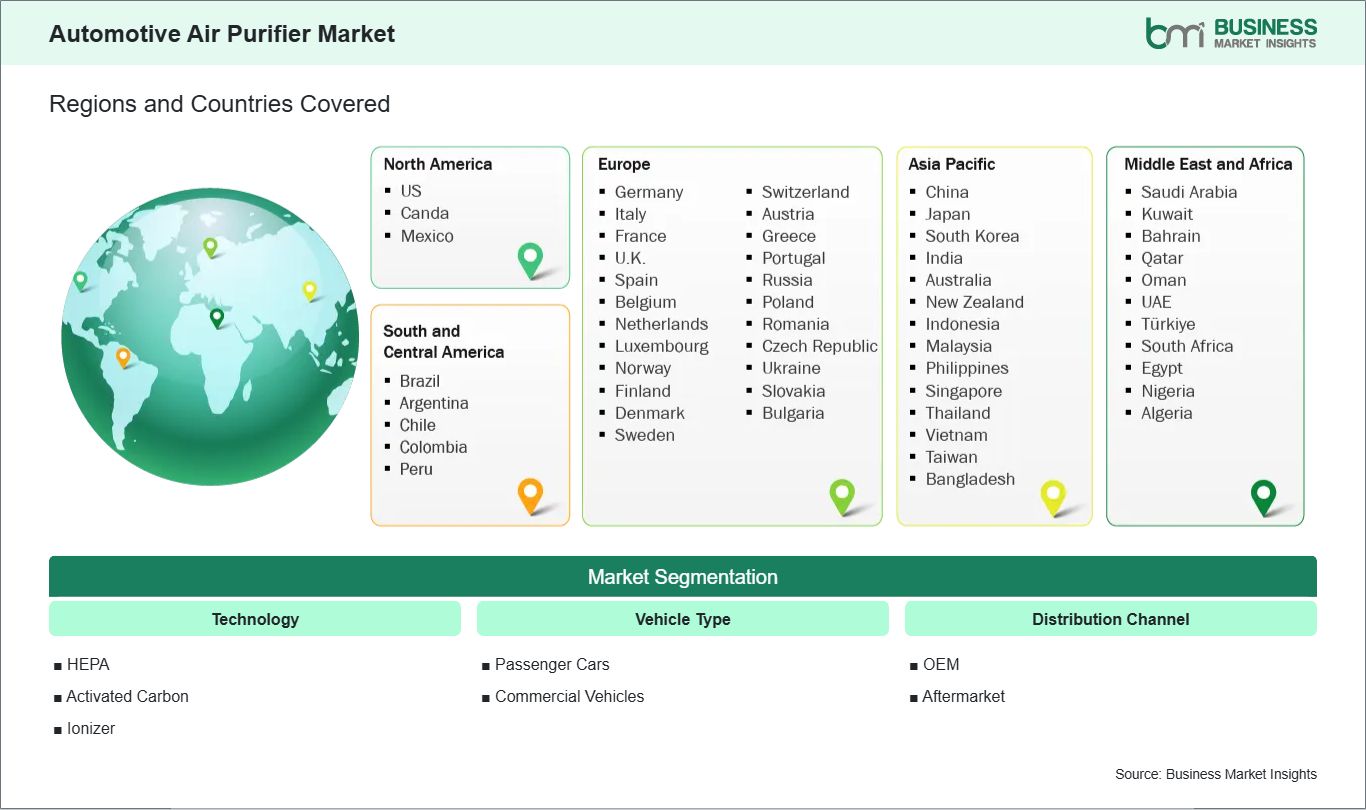
The Automotive Air Purifier market is segmented based on technology, vehicle type, and distribution channel, reflecting varying consumer requirements and vehicle applications.
By Technology
- HEPA: Provides high-efficiency filtration of fine particles, allergens, and pollutants
- Activated Carbon: Removes odors, gases, and volatile organic compounds from cabin air
- Ionizer: Uses electrically charged ions to reduce airborne contaminants and improve air freshness
By Vehicle Type
- Passenger Cars: Represents the largest demand segment due to high vehicle ownership and growing health awareness
- Commercial Vehicles: Increasing adoption to improve driver comfort and cabin air quality during long operations
By Distribution Channel
- OEM: Air purifiers installed during vehicle manufacturing and integrated into cabin systems
- Aftermarket: Standalone and replacement products sold through retailers, distributors, and service centers
Market Forces
Automotive Air Purifier Market Drivers and Opportunities
Growing Awareness of In-Vehicle Air Quality and Health Protection
The demand for automotive air purifiers is increasing as consumers become more aware of the health risks associated with poor air quality and prolonged exposure to airborne pollutants. Urbanization and rising pollution levels in major cities are encouraging vehicle owners to seek solutions that improve cabin air quality. Automotive air purifiers help reduce dust particles, allergens, bacteria, and unpleasant odors, creating a healthier environment for passengers. Vehicle manufacturers are also recognizing the importance of in-cabin wellness features as part of the overall driving experience.
Governments and environmental organizations continue to highlight the health impacts of air pollution, further increasing public awareness. Commercial vehicle operators are also adopting air purification technologies to improve driver comfort and support longer operational hours. As consumers increasingly prioritize health, safety, and comfort, demand for advanced air purification systems is expected to strengthen across multiple vehicle categories.
Advancements in Smart Cabin Technologies and Filtration Systems
The Automotive Air Purifier market is creating new opportunities through the integration of smart cabin technologies and advanced filtration solutions. Modern air purification systems are increasingly equipped with sensors that monitor cabin air quality in real time and automatically adjust purification levels based on environmental conditions. These innovations improve user convenience and overall effectiveness.
The growth of electric and connected vehicles is also creating opportunities for intelligent cabin management systems that combine air purification, climate control, and occupant comfort functions. Manufacturers are investing in advanced HEPA filtration, activated carbon technologies, and energy-efficient purification systems that provide improved performance without significantly increasing power consumption. Sustainability trends are encouraging the development of recyclable filter materials and environmentally friendly designs. As vehicle interiors become more technology-focused, automotive air purifiers are expected to become an increasingly important component of the in-cabin experience.
Size and Share Analysis
Automotive Air Purifier Market Size and Share Analysis
The Automotive Air Purifier market size is expected to reach US$ 4.44 billion by 2033 from US$ 2.52 billion in 2025. The market is estimated to record a CAGR of 7.34% from 2026 to 2033.
By technology, HEPA filters account for a significant share due to their ability to capture fine particulate matter and improve cabin air quality. Activated carbon systems are gaining popularity for their effectiveness in eliminating odors and harmful gases, while ionizer technologies continue to expand through advancements in compact and energy-efficient designs.
By vehicle type, passenger cars dominate the market owing to growing consumer demand for enhanced comfort, safety, and wellness features. Commercial vehicles are witnessing increasing adoption as fleet operators focus on improving driver comfort and cabin environments during extended vehicle usage.
Report Coverage
Automotive Air Purifier Market Report Coverage and Deliverables
The "Automotive Air Purifier Market Size and Forecast (2022-2033)" report provides a detailed analysis of the market covering below areas:
- Market size and forecast at global, regional, and country levels for all the key market segments covered under the scope
- Market trends, as well as market dynamics such as drivers, restraints, and key opportunities
- Market analysis covering key market trends, global and regional framework, major players, regulations, and recent market developments
- Industry landscape and competition analysis covering market concentration, heat map analysis, prominent players, and recent developments for the market
- Detailed company profiles, including SWOT analysis
Geographic Insights
Automotive Air Purifier Market Geographic Insights
The Automotive Air Purifier Market shows diverse regional adoption patterns influenced by air pollution levels, vehicle ownership trends, consumer health awareness, and advancements in automotive cabin technologies.
North America, being a developed region, has a well-established automotive sector and a high rate of adoption of advanced in-cabin comfort technologies. The region comprises the United States and Canada, where consumers are increasingly focused on health, wellness, and air quality. The region emphasizes passenger comfort and the integration of smart vehicle technologies. It has strong automotive manufacturing capabilities and a mature aftermarket ecosystem, enabling widespread adoption of automotive air purifiers across passenger and commercial vehicles.
Asia Pacific is growing significantly, driven by rapid urbanization, increasing vehicle ownership, and rising concerns regarding air pollution. The region comprises countries such as China, India, and Japan, where deteriorating air quality in urban centers is creating strong demand for vehicle air purification systems. The region focuses on improving passenger health and enhancing the overall in-cabin experience. Growing automotive production, expanding middle-class populations, and increasing awareness of air quality issues are supporting market growth across both OEM and aftermarket channels.
Both regions are contributing significantly to the growth of the Automotive Air Purifier Market, focusing on improving cabin air quality, increasing adoption of advanced vehicle technologies, and enhancing passenger health and comfort.
Industry Activity
Recent Developments
The Automotive Air Purifier Market is analyzed using a mix of primary and secondary research sources, including corporate publications, industry associations, and verified databases. This approach ensures accurate tracking of innovation trends and strategic developments influencing the market.
- In January 2026, Garmin introduced Unified Cabin 2026, a next-generation automotive cabin platform featuring advanced air-quality and passenger-comfort technologies integrated with intelligent cabin management systems. The platform supports a more personalized and healthier in-vehicle environment through connected cabin technologies and advanced sensor integration. The development highlights increasing innovation in smart cabin solutions that complement automotive air purification systems.
- In December 2025, Premium Guard Inc. announced a licensing partnership with Procter & Gamble to develop and launch Febreze Cabin Air Filters powered by PUREFLOW Air Filtration Technology. The collaboration combines advanced particulate filtration, activated charcoal, and odor-neutralizing technology to improve vehicle interior air quality. The development reflects growing industry focus on healthier cabin environments and advanced automotive air purification solutions.
Trust & Transparency
Research Methodology
The market analysis combines proprietary research with secondary data from government agencies, company disclosures, regulatory filings, industry databases and expert interviews. Market estimates are validated through data triangulation, cross-market benchmarking and analyst
review.
View Full Research Methodology
Key Sources Referred:
World Bank - Global Trade IndicatorsWorld Trade Organization (WTO)International Monetary Fund (IMF)International Trade Administration (ITA)Company WebsitesCompany Annual ReportsCompany Investor Presentations