Market Summary
Executive Summary and Global Market Analysis
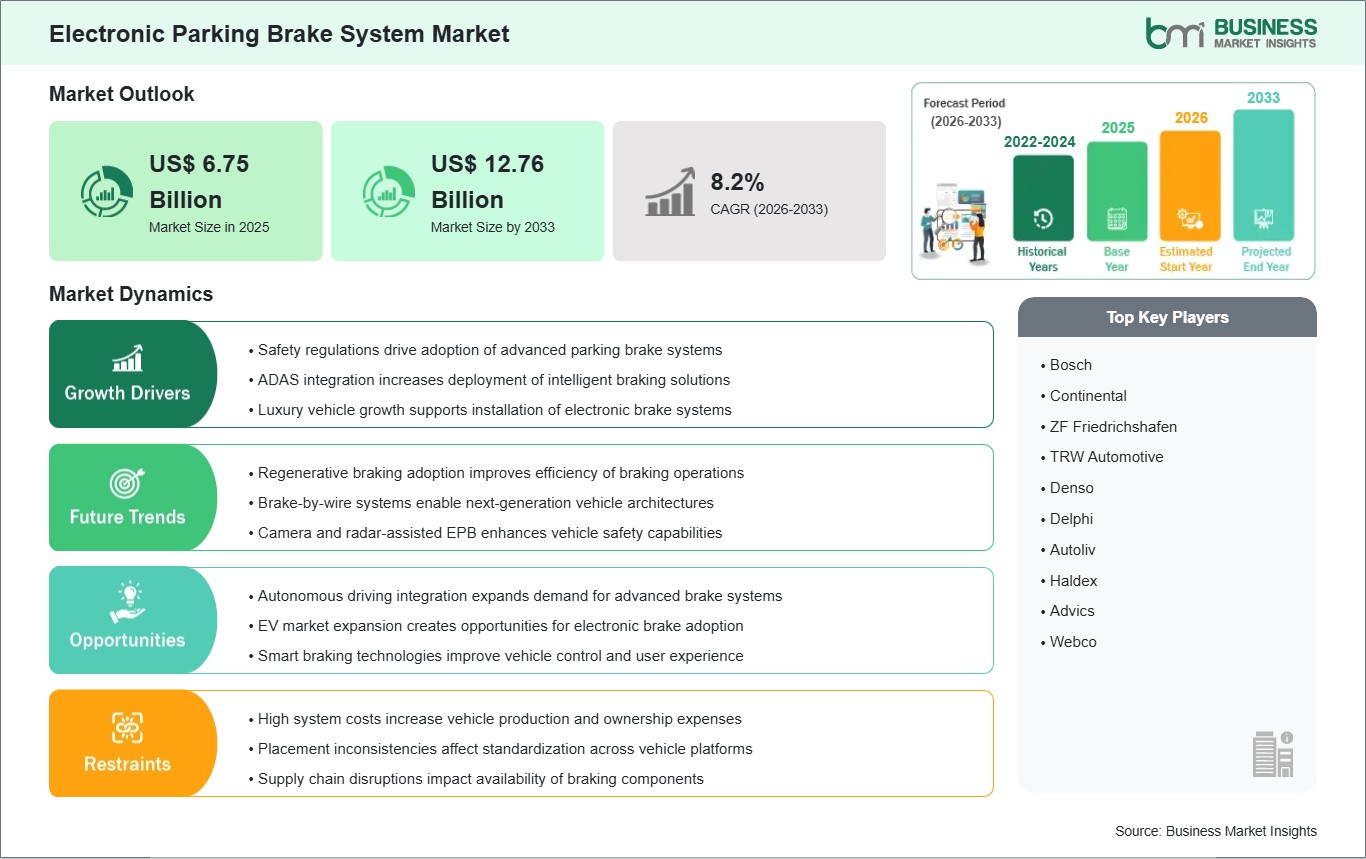
Electronic parking brake's (EPB) system market is an increasingly important segment within automotive braking technologies, driven by the rapid shift toward vehicle electrification, advanced driver assistance systems, and interior space optimization. EPB replaces conventional mechanical handbrakes with electronically controlled actuators that engage and release the braking system at the push of a button. This transition supports improved cabin ergonomics, enhanced safety functionality, and seamless integration with modern vehicle control architectures across passenger cars and light commercial vehicles.
A key driver of market growth is the rising adoption of electronic and software-driven vehicle platforms, where EPB systems are integrated with broader braking and stability control technologies. EPB is instrumental in supporting functions like auto brake hold, hill hold assist, and self-parking capabilities. As vehicles become more connected and automated, EPB technology is considered a fundamental part of a modern driving system, especially in the mid-to-premium classes of vehicles that emphasize safety and convenience.
The market is also supported by strong demand for lightweight and compact automotive components that contribute to overall vehicle efficiency. The introduction of electronic parking brakes eliminates the requirement of using the conventional cable and lever system, thereby giving more freedom to designers with regard to interior design. The automobile industry is combining EPB technology with the electronic stability control system and brake-by-wire technology in order to develop more efficient brake systems.
However, the market faces challenges related to higher initial costs compared to conventional parking brakes and the dependency on electronic systems, which increases complexity in diagnostics and maintenance. In addition, issues associated with system failures as well as repair costs within lower cost vehicles may affect their implementation. However, despite all these challenges, rising trends towards electric vehicles and increasing emphasis on safety automation continue to support growth in the Electronic Parking Brake market globally.
Segment Analysis
Electronic Parking Brake System Market Segmentation
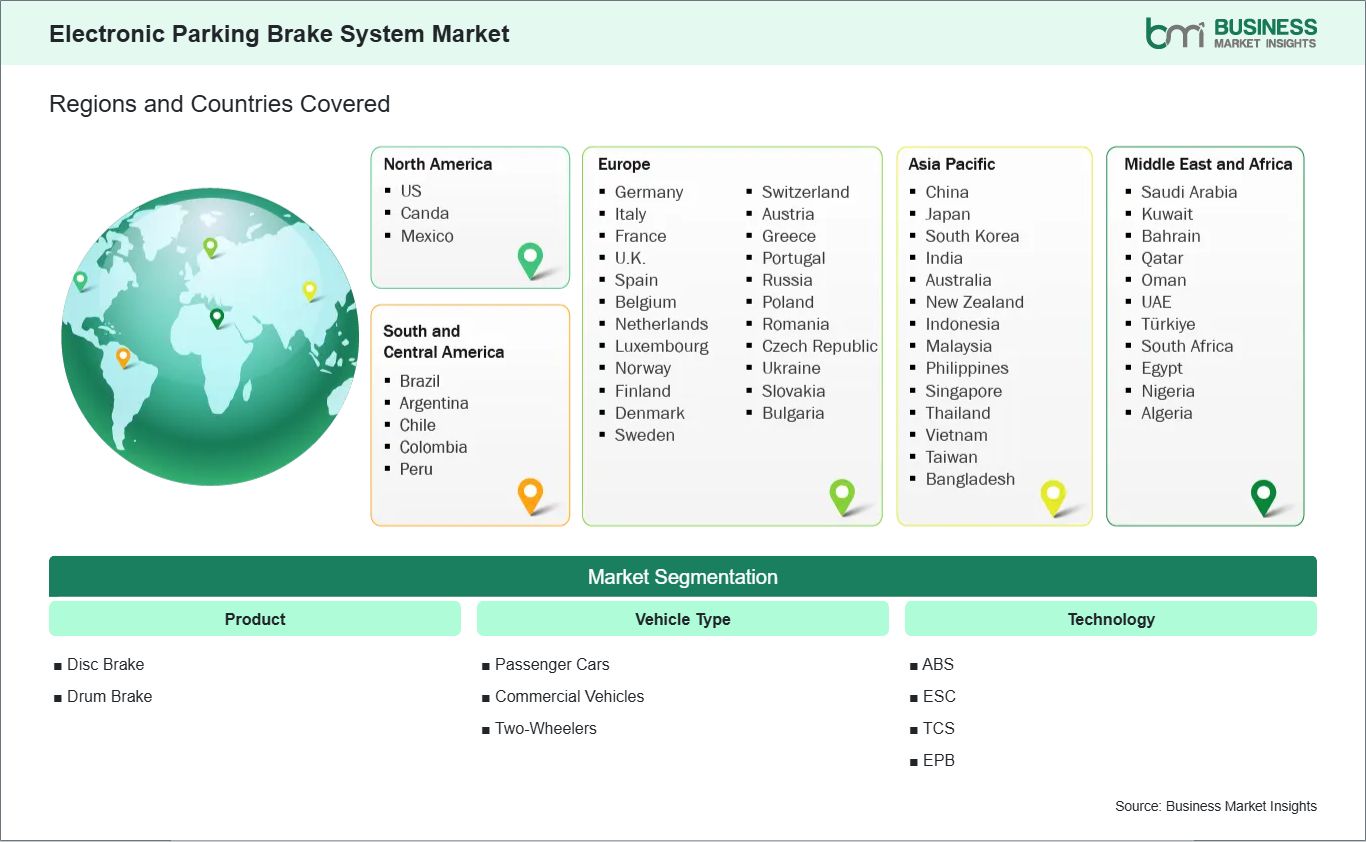
The electronic parking brake (EPB) system market is segmented based on product, vehicle type, and technology, driven by increasing vehicle electrification, demand for advanced safety systems, and the shift toward lightweight, automated braking solutions that enhance driving comfort and efficiency.
By Product
- Disc Brake: Most commonly integrated with EPB systems, disc brakes offer strong braking performance, better heat dissipation, and compatibility with electronic actuation mechanisms, making them widely used in modern passenger and commercial vehicles.
- Drum Brake: Typically used in cost-sensitive and rear-wheel applications, drum brakes with EPB integration are less common but still relevant in entry-level vehicles and certain commercial applications due to lower manufacturing costs.
By Vehicle Type
- Passenger Cars: The largest segment, driven by high adoption of safety and comfort features such as automatic parking, hill-hold functionality, and reduced cabin space requirements.
- Commercial Vehicles: Includes light and heavy commercial vehicles where EPB systems improve safety, load handling stability, and reduce driver effort during parking operations.
- Two-Wheelers: An emerging segment, especially in premium scooters and motorcycles, where electronic braking systems enhance safety and control in urban mobility environments.
By Technology
- ABS (Anti-lock Braking System): Prevents wheel lock-up during braking, improving vehicle control and safety, and often integrated with EPB for coordinated braking performance.
- ESC (Electronic Stability Control): Enhances vehicle stability by detecting and reducing loss of traction, working alongside EPB systems to improve overall safety.
- TCS (Traction Control System): Helps prevent wheel spin during acceleration, ensuring better grip and stability in varying road conditions.
- EPB (Electronic Parking Brake): Core technology enabling electronic actuation of parking brakes via a switch or control unit, replacing traditional mechanical handbrakes and improving convenience and cabin space utilization.
Market Forces
Electronic Parking Brake System Market Drivers and Opportunities
Rising Safety Regulations
The electronic parking brake (EPB) system market is growing steadily as global automotive safety regulations become more stringent and focused on vehicle control systems. The government agencies have started to regulate the use of advanced brake systems that would increase stability in vehicles and prevent any cases of roll-back. The electronic park brake replaces the conventional handbrake system with electric actuators that enable precise braking power.
Automakers are adopting EPB systems as part of broader vehicle safety upgrades, particularly in passenger cars and light commercial vehicles. The systems work together with the anti-lock braking systems, ESC, and hill-hold features in order to enhance safety on the roads. Additionally, the feature of automatic application of brakes when a car is stopped is another way that helps minimize errors that are very critical in road safety approaches today.
Another important driver is the increasing demand for enhanced vehicle ergonomics and cabin space optimization. The removal of the lever-based hand brake mechanism in EPB technology creates additional space inside the car and allows the vehicle interior to adopt more contemporary designs. This is in line with customer needs regarding an uncluttered dashboard and ease of use while driving.
Integration with Autonomous Driving
A major opportunity in the electronic parking brake system market lies in its integration with autonomous driving technologies. The advancement towards increased automation in cars makes the EPB system indispensable in providing reliable vehicle control for such automated operations as autonomous parking and start-stop maneuvers. The electronic nature of their functioning renders them especially suitable for use with a software-controlled vehicle system.
In autonomous and semi-autonomous vehicles, EPB systems can be activated automatically by onboard control units without driver intervention. This function is necessary for functions like automated valet parking, remote parking support, and coordination of the autonomous emergency braking system. The combination of EPB and sensors of the car improves efficiency and effectiveness in complicated driving situations.
Furthermore, as vehicles evolve into fully connected mobility platforms, EPB systems are increasingly being linked with centralized vehicle control systems. This makes cooperative functioning with powertrain, steering, and braking systems. With the increasing degree of autonomy within the automotive industry, Electronic Parking Brake (EPB) systems will be essential for developing a more intelligent braking and mobility control system architecture.
Size and Share Analysis
Electronic Parking Brake System Market Size and Share Analysis
The electronic parking brake system market is projected to grow from US$ 6.75 billion in 2025 to US$ 12.76 billion by 2033, registering a CAGR of 8.2% from 2026 to 2033.
By product, the disc brake segment dominates the market due to its superior braking performance, better heat dissipation, and widespread adoption in modern vehicles. The integration of electronic parking brake (EPB) systems is more seamless with disc brake architectures, making them the preferred choice for automakers, especially in mid-range and premium vehicles.
By vehicle type, passenger cars dominate the market owing to high global production volumes and increasing consumer demand for advanced safety and convenience features. The rising adoption of electronic parking brakes in compact, mid-size, and luxury passenger vehicles further strengthens this segment's leadership.
By technology, Electronic Parking Brake (EPB) technology itself dominates the market as it is the core system replacing traditional mechanical parking brakes. Its advantages such as space efficiency, automatic engagement, integration with driver assistance systems, and enhanced safety features drive its rapid adoption across modern vehicle platforms.
Report Coverage
Electronic Parking Brake System Market Report Coverage and Deliverables
The "Electronic Parking Brake System Market Size and Forecast (2022-2033)" report provides a detailed analysis of the market covering below areas:
- Market size and forecast at global, regional, and country levels for all key market segments covered under the scope
- Market trends, along with market dynamics such as drivers, restraints, and key opportunities
- Market analysis covering key trends, global and regional frameworks, major players, regulations, and recent developments
- Industry landscape and competitive analysis covering market concentration, heat map analysis, prominent players, and recent developments
- Detailed company profiles, including SWOT analysis
Geographic Insights
Electronic Parking Brake System Market Geographic Insights
In terms of geographical distribution of the Electronic Parking Brake System Market, there is a varied pattern of adoption based on factors such as rising production of passenger and commercial vehicles, increasing integration of advanced safety and comfort features, stringent vehicle safety regulations, and the growing shift toward electrification and electronic control systems in modern automobiles.
North America is a significant market for electronic parking brake systems, supported by strong automotive manufacturing capabilities, high adoption of premium and mid-range vehicles, and increasing consumer preference for advanced driver assistance and safety technologies. Integration of electronic parking brake systems in passenger vehicle models, especially those of SUV, luxury car, and electric vehicle categories, is steadily increasing in the USA and Canada. Regulatory focus on the safety of passenger vehicles and rising inclination towards electronic vehicle control system is another factor aiding market expansion in the region.
Asia Pacific is the fastest-growing region in the electronic parking brake system market, driven by large-scale automotive production, rising disposable incomes, and increasing adoption of advanced automotive technologies. Some of the major contributors are countries like China, India, Japan, and South Korea, especially China, which is a dominant player in automobile manufacturing and electrification. The market is supported by the high demand for passenger cars in the area, as well as the fast pace of urbanization in addition to the growth in local brands using electronic parking brakes.
Both North America and Asia Pacific play a key role in the expansion of the electronic parking brake system market, driven by rising vehicle electrification, increasing integration of advanced braking technologies, and growing demand for enhanced safety, convenience, and space-efficient automotive designs across modern vehicle platforms.
Industry Activity
Recent Developments
The electronic parking brake system market is evaluated by gathering qualitative and quantitative data post primary and secondary research, which includes important corporate publications, association data, and databases. Recent developments and news in the market include:
- In July 2025, ZF Friedrichshafen, announced that it had commenced start of production (SOP) of its Electric Park Brake (EPB) system in India for a newly launched all-electric vehicle platform by a leading Indian OEM, marking a key milestone in expanding its EPB deployment across EV platforms and strengthening its localization strategy in the passenger vehicle segment.
- In January 2026, ZF Group, announced that it had expanded its passenger car braking operations in India with local production of EPB systems at its Oragadam facility near Chennai, with planned capacity of up to 800,000 units annually and increased localization to support rising EV and safety-driven vehicle demand.
Trust & Transparency
Research Methodology
The market analysis combines proprietary research with secondary data from government agencies, company disclosures, regulatory filings, industry databases and expert interviews. Market estimates are validated through data triangulation, cross-market benchmarking and analyst
review.
View Full Research Methodology
Key Sources Referred:
World Bank World Trade Organization (WTO) International Monetary Fund (IMF) International Trade Administration (ITA) International Energy Agency (IEA) Organisation for Economic Co-operation and Development (OECD) International Organization for Standardization (ISO) Society of Automotive Engineers (SAE International) United Nations Economic Commission for Europe (UNECE) European Commission S. Department of Transportation (USDOT) S. National Highway Traffic Safety Administration (NHTSA) Japan Automobile Standards Internationalization Center (JASIC) Company Websites Company Annual Reports Company Investor Presentations