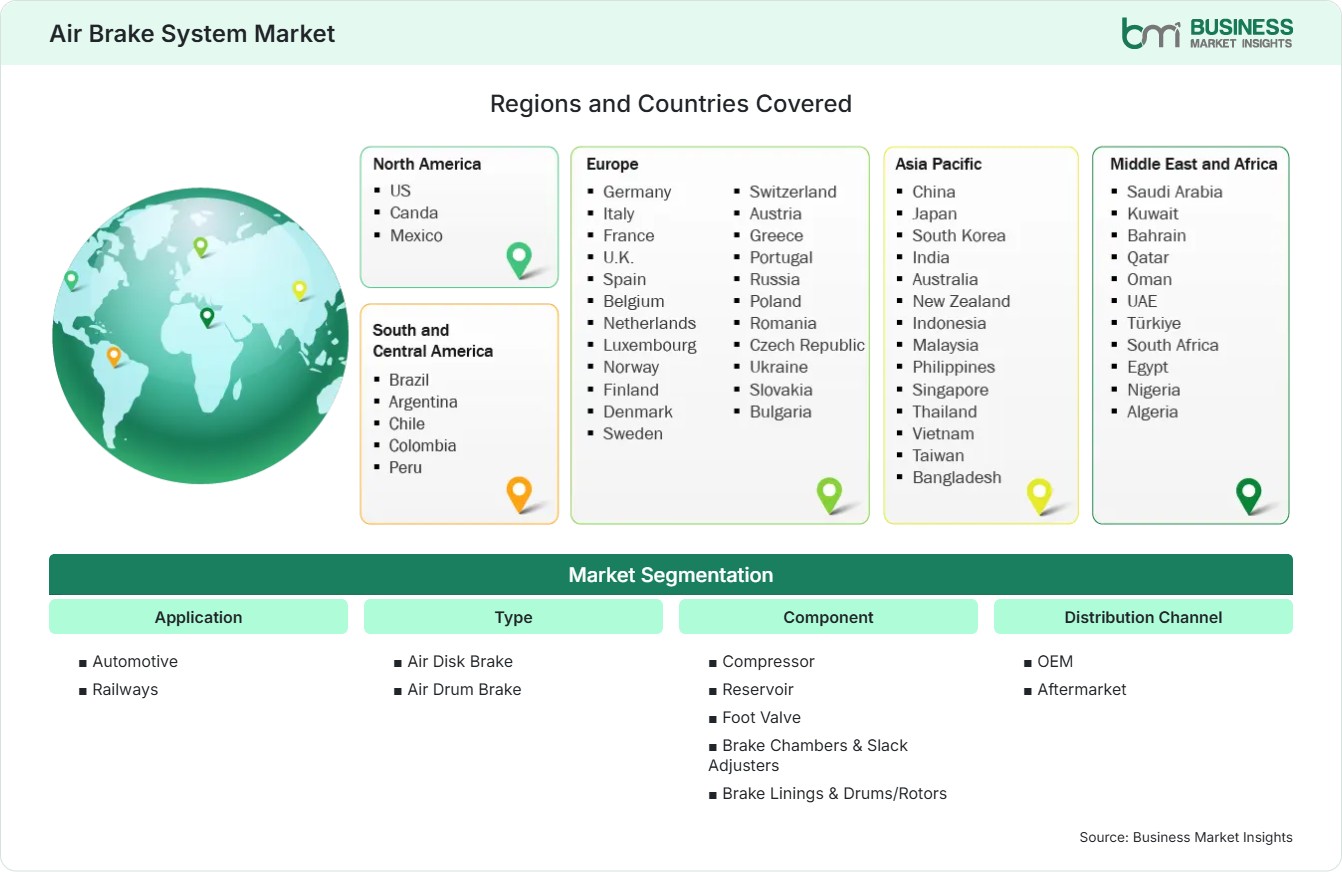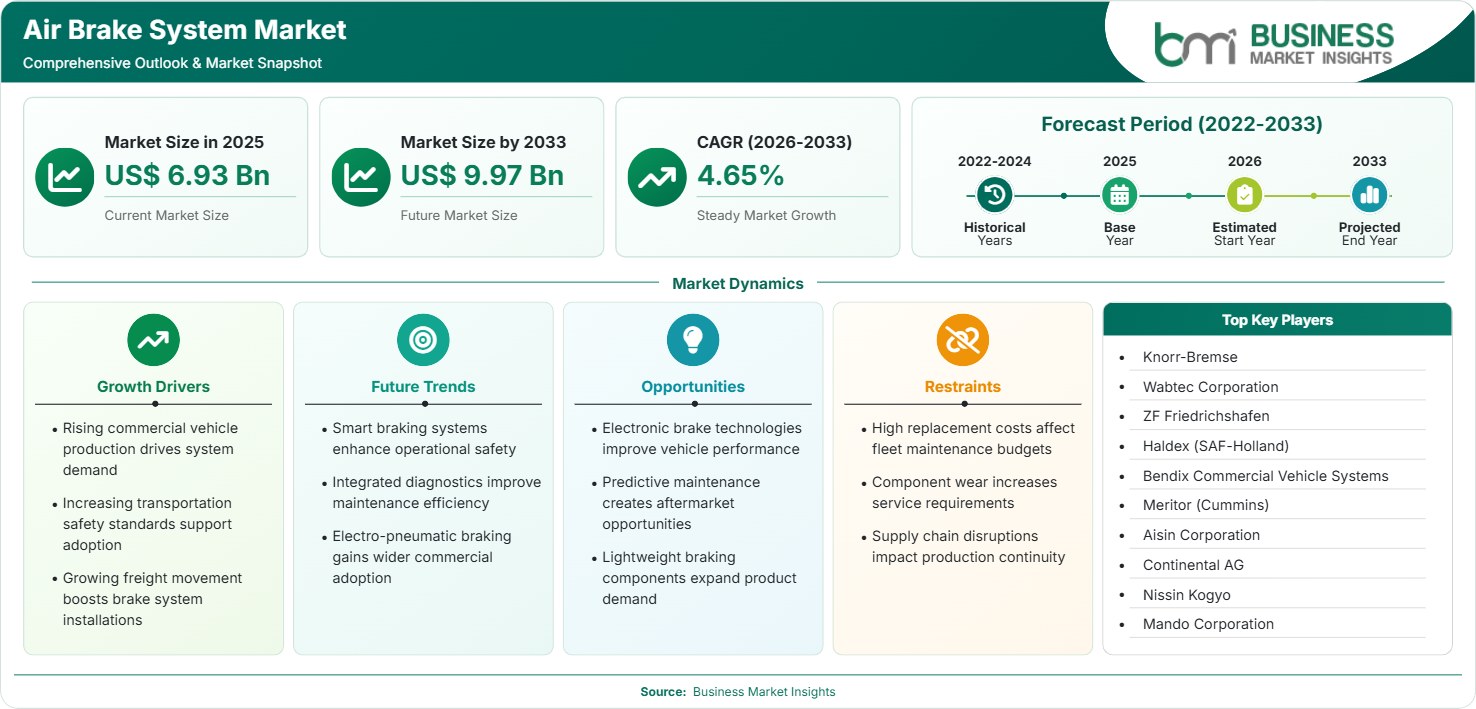
Air Brake System Market Regional Highlights
North America Air Brake System Market
North America accounted for 31%–34% Air Brake System Market share in 2025 and is expected to grow at a CAGR of 4.2%–4.7% during 2026–2033. Regional demand is supported by strong commercial vehicle fleets, advanced freight transportation networks, and strict transportation safety standards. The United States remains the leading contributor due to large trucking operations, replacement demand, and increasing adoption of advanced braking technologies across heavy-duty vehicles.
- Commercial truck operators are upgrading braking systems to improve safety, efficiency, and regulatory compliance.
- Fleet modernization programs are increasing demand for advanced braking components and maintenance solutions.
- Rail transportation investments continue supporting air brake adoption across freight and passenger networks.
- Manufacturers are introducing electronic braking technologies to enhance vehicle monitoring capabilities.
US Air Brake System Market
The United States contributes 83%–86% of North American demand and is projected to register a CAGR of 4.3%–4.8% during 2026–2033. The market benefits from extensive freight movement, large commercial vehicle fleets, and continuous investment in transportation safety technologies. Replacement demand from aging fleets also supports aftermarket growth.
- Expansion of logistics networks continues increasing demand for heavy-duty vehicle braking systems.
- Safety regulations encourage adoption of advanced braking components among fleet operators.
- Truck manufacturers are integrating improved air braking technologies into new vehicle platforms.
- Maintenance providers are expanding service capabilities for commercial fleet customers.
Europe Air Brake System Market
Europe represents 24%–27% air brake system market share in 2025 and is anticipated to grow at a CAGR of 4.0%–4.5% during 2026–2033. Germany remains the leading market due to strong automotive manufacturing capabilities, while France and the United Kingdom contribute through commercial transportation and railway applications. Increasing focus on transportation safety and vehicle efficiency continues supporting market development.
- European truck manufacturers are adopting advanced braking technologies to meet safety requirements.
- Railway modernization projects continue generating demand for reliable air brake systems.
- Regulatory initiatives encourage adoption of efficient and electronically controlled braking solutions.
- Commercial fleet operators are investing in replacement and maintenance programs.
Asia Pacific Air Brake System Market
Asia Pacific holds 36%–39% air brake system market share in 2025 and is projected to achieve the highest 5.1%–5.6% CAGR during 2026–2033. China dominates regional demand due to large vehicle production volumes, while India demonstrates strong growth through expanding logistics networks and infrastructure development. Increasing freight movement and transportation modernization continue driving adoption.
- Rising commercial vehicle production supports continuous demand for braking system components.
- Railway infrastructure expansion increases adoption across freight and passenger networks.
- Growing manufacturing activities strengthen regional automotive supply chains.
- Safety regulations are encouraging technology upgrades among fleet operators.
Rest of World Air Brake System Market
The Rest of World region accounts for 5%–8% air brake system market share in 2025 and is expected to expand at a CAGR of 4.4%–4.9% during 2026–2033. Latin America, the Middle East, and Africa are witnessing increasing transportation investments, commercial fleet expansion, and railway development initiatives. Brazil, Saudi Arabia, and South Africa represent important markets due to infrastructure growth and freight transportation demand.
- Infrastructure development projects are increasing commercial vehicle and railway equipment requirements.
- Logistics expansion across emerging economies supports demand for reliable braking systems.
- Fleet operators are improving maintenance practices to enhance vehicle availability.
- Regional suppliers are strengthening distribution networks to capture aftermarket opportunities.