
Automotive Brake Systems Market Outlook: Size, Share, Trends, Growth Analysis, Competitive Landscape & Forecast, 2026-2033

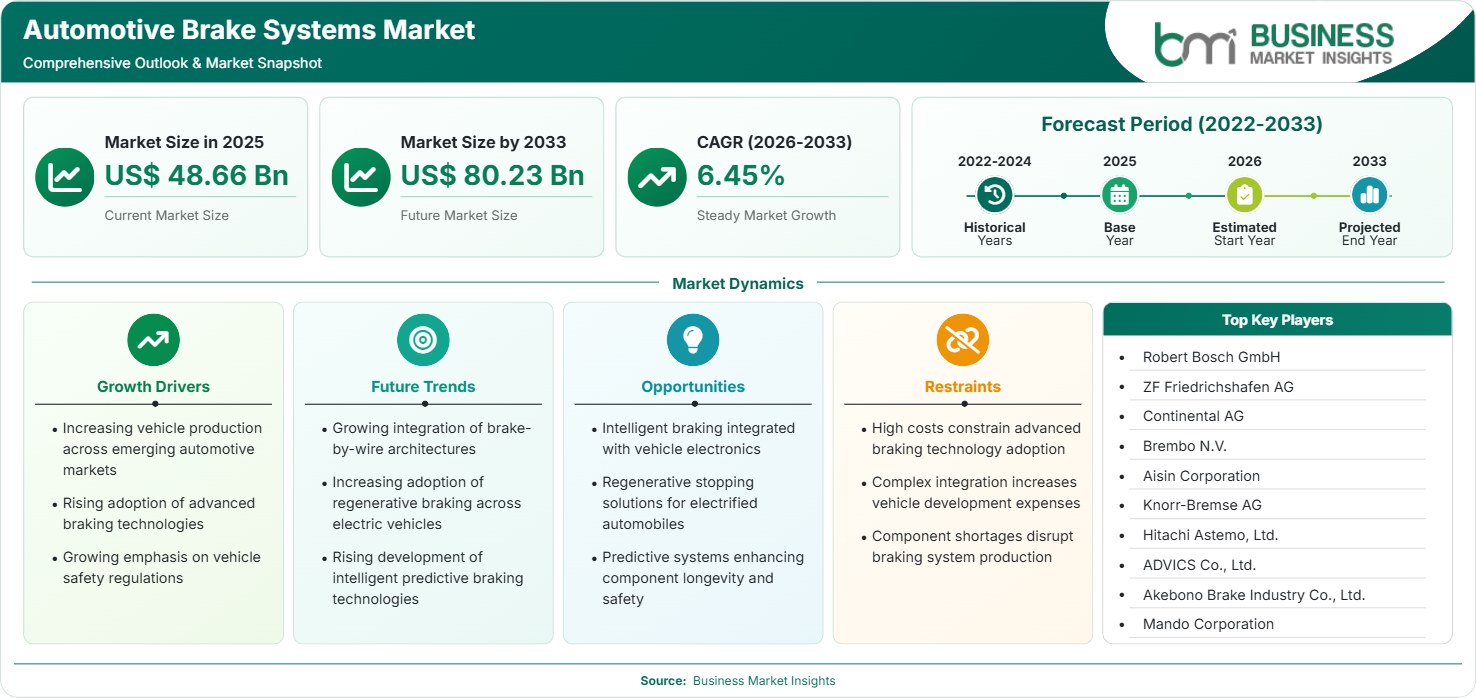
The Automotive Brake Systems Market size was valued at US$ 48.66 Billion in 2025 and is projected to reach US$ 80.23 Billion by 2033, growing at a CAGR of 6.45% during 2026–2033. Rising vehicle production, increasing safety regulations, electronic braking integration, electrification of mobility, and demand for advanced driver assistance systems continue creating strong growth opportunities across global automotive ecosystems.

Report Coverage
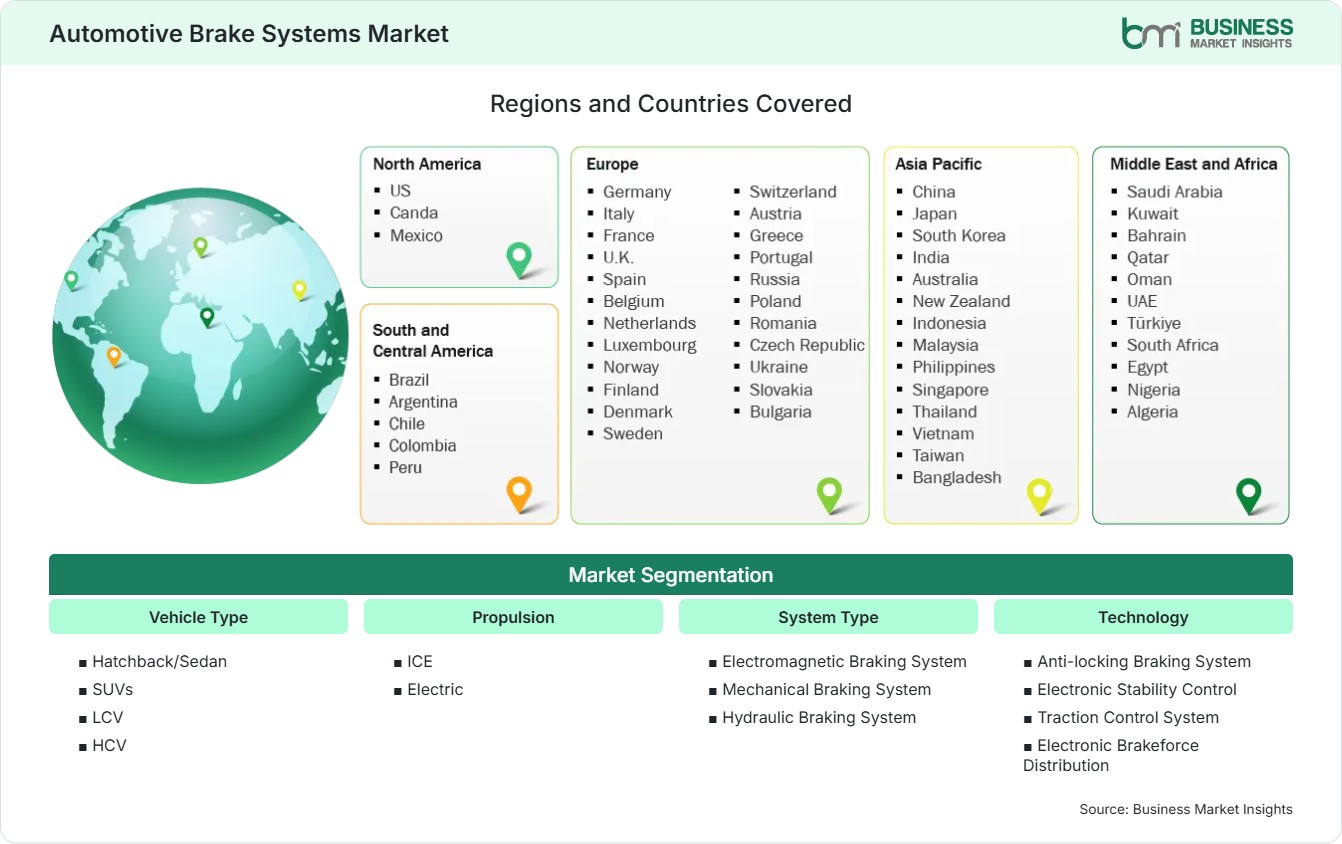
  • Vehicle Type: Hatchback/Sedan, SUVs, LCV, HCV
  • Propulsion: ICE, Electric
  • System Type: Electromagnetic Braking System, Mechanical Braking System, Hydraulic Braking System
  • Technology: Anti-locking Braking System, Electronic Stability Control, Traction Control System, Electronic Brakeforce Distribution
  • Component: Disc Brakes, ABS Control Module, Drum Brakes, Emergency Brakes, Master Cylinder, Others
US$ 48.66 Bn Market size in 2025
US$ 80.23 Bn Market Size by 2033
6.45% CAGR, 2026 - 2033
2026-2033 Forecast Period

AI Overview

Automotive Brake Systems Market Summary

  • North America Region: North America holds a market share of 23%–26% in 2025, growing with a CAGR of 5.8%–6.3% during 2026–2033. Vehicle safety mandates, SUV penetration, brake-by-wire deployment, commercial vehicle modernization, and fleet replacement programs support growth, while electrification investments expand opportunities across OEM networks. The U.S. dominates regional demand through strong vehicle production and safety technology adoption, advancing at 5.9%–6.4% CAGR.
  • Fastest Growing Region: Asia Pacific holds a market share of 39%–42% in 2025, growing with a CAGR of 7.2%–7.8% during 2026–2033. Passenger vehicle expansion, EV manufacturing capacity, local supplier development, urbanization, export-driven production, government incentives, aftermarket demand growth, and technology localization strengthen long-term investment opportunities regionally.
  • Leading Segment: Hydraulic Braking System holds a market share of 48%–52% in 2025, growing with a CAGR of 5.8%–6.3% during 2026–2033. Mature infrastructure, cost efficiency, reliable performance, widespread OEM integration, service familiarity, replacement demand, commercial vehicle applications, and established supply chains support segment leadership worldwide.
  • High Growth Segment: Electromagnetic Braking System holds a market share of 10%–13% in 2025, growing with a CAGR of 9.0%–10.0% during 2026–2033. Connected vehicles, autonomous driving development, brake-by-wire architectures, software-defined platforms, energy optimization, EV compatibility, advanced safety requirements, and premium vehicle adoption accelerate deployment momentum.
  • Key Market Opportunity: Expansion of brake-by-wire systems for electric and autonomous vehicles creates opportunities through software integration, weight reduction, predictive maintenance capabilities, regenerative braking compatibility, and enhanced vehicle control performance.
  • Major Market Players: Robert Bosch GmbH, ZF Friedrichshafen AG, Continental AG, Brembo N.V., Aisin Corporation, Knorr-Bremse AG, Hitachi Astemo, Ltd., ADVICS Co., Ltd., Akebono Brake Industry Co., Ltd., Mando Corporation.
Strategic Insights

Automotive Brake Systems Market: Strategic Insights

Automotive Brake Systems Market Strategic Framework
FREE PDF
Request your free sample
Request free sample
Stakeholder View

Key Takeaways

  • The industry value chain is becoming increasingly interconnected, with software providers, sensor manufacturers, brake component suppliers, and vehicle OEMs collaborating to develop integrated safety and control systems that extend beyond conventional braking functions.
  • Electromagnetic and brake-by-wire technologies present the highest long-term commercial opportunity as electric vehicles and autonomous mobility platforms require greater electronic control, diagnostics capability, and system responsiveness.
  • Product innovation is moving toward predictive braking systems utilizing real-time vehicle data, sensor fusion, artificial intelligence, and over-the-air update capabilities to improve safety performance and maintenance efficiency.
  • Asia Pacific offers the strongest investment case due to its concentration of automobile manufacturing facilities, expanding electric vehicle ecosystem, and rapidly growing domestic vehicle ownership base.
  • Strategic acquisitions and technology partnerships are increasing across the supply chain as major component suppliers seek expertise in electronic controls, software integration, autonomous driving compatibility, and energy recovery systems.
  • The aftermarket remains an important revenue stream, supported by rising vehicle parc levels, replacement cycles for brake components, growing safety awareness, and expanding service network penetration worldwide.
Geographic Outlook

Automotive Brake Systems Market Regional Highlights

North America Automotive Brake Systems Market

North America accounted for approximately 23%–26% of global demand in 2025 and is projected to expand at a CAGR of 5.8%–6.3% during 2026–2033. Strong adoption of advanced safety technologies, high SUV and pickup truck ownership, and rigorous vehicle safety regulations underpin market development. OEM investments in electric vehicle production are generating demand for regenerative and electronically controlled braking platforms. The region benefits from mature automotive manufacturing capabilities, well-established aftermarket networks, and increasing integration of brake-by-wire technologies across premium and mainstream vehicle categories.

  • Federal safety regulations continue encouraging installation of advanced braking technologies across passenger and commercial vehicle fleets, improving safety performance while driving consistent demand for electronic braking control solutions.
  • Growing sales of electric SUVs and light trucks are increasing demand for regenerative-compatible braking platforms, supporting adoption of intelligent braking architectures among leading vehicle manufacturers.
  • Fleet modernization initiatives among logistics operators are strengthening replacement demand for high-performance braking systems, particularly in light commercial and heavy-duty vehicle categories.
  • Domestic manufacturers continue investing in software-defined vehicle platforms, increasing integration of electronically controlled braking systems that support advanced driver assistance functionality.
  • The Automotive Brake Systems Market share remains supported by strong aftermarket demand generated by aging vehicle fleets and continuous maintenance requirements across the transportation sector.

US Automotive Brake Systems Market

The United States represents approximately 78%–82% of North American demand in 2025 and is expected to register a CAGR of 5.9%–6.4% through 2033. The high level of vehicle penetration, considerable light truck production, and the adoption of safety technology play significant roles in sustaining growth. Electrification initiatives by local and foreign automobile manufacturers are increasing the use of integrated braking systems. The emphasis by the government on the safety performance of automobiles and the adoption of ADAS technology creates a conducive environment.

  • OEM investments in electric vehicle manufacturing are creating demand for integrated braking solutions combining electronic control, regenerative braking support, and advanced diagnostics functionality.
  • Premium vehicle penetration continues increasing adoption of brake-by-wire systems, enabling improved safety performance and vehicle dynamics management capabilities.
  • Commercial fleet operators prioritize reliability and lifecycle cost optimization, supporting demand for durable braking components and predictive maintenance solutions.
  • Technology suppliers increasingly collaborate with automakers to develop scalable software-enabled braking architectures designed for future autonomous mobility applications.

Europe Automotive Brake Systems Market

Europe accounted for approximately 24%–27% of global demand in 2025 and is projected to expand at a CAGR of 5.9%–6.5% during 2026–2033. Strengths within the region include tough vehicle safety standards, well-developed automobile manufacturing infrastructure, and robust levels of innovation. Germany continues to be the top player in the industry, with 5.8% - 6.3% growth, but production facilities in Eastern Europe, along with rising markets for EVs, also contribute to growth. Sustainable mobility and intelligent vehicles are increasingly driving demand for advanced brakes.

  • Germany maintains regional leadership through strong automotive exports, premium vehicle manufacturing, and significant investments in next-generation electronic braking technologies.
  • France and the United Kingdom continue increasing electric vehicle adoption, creating favorable conditions for regenerative braking and electronic control system deployment.
  • Eastern European manufacturing facilities support regional production capacity expansion, strengthening supply chain efficiency and component localization.
  • Commercial vehicle modernization programs increase demand for intelligent braking systems that improve operational safety and regulatory compliance.
  • Autonomous mobility research initiatives encourage development of highly responsive braking architectures compatible with advanced vehicle control platforms.

Asia Pacific Automotive Brake Systems Market

Asia Pacific represented approximately 39%–42% of global demand in 2025 and is forecast to grow at a CAGR of 7.2%–7.8% through 2033. High vehicle production levels, rising middle-class demographics, and increasing electric vehicle adoption will provide an advantage in regional leadership. China still maintains the largest market growing in the range of 7.5%-8.1%, and India is exhibiting one of the fastest growth rates at around 8.0%-8.7%. Manufacturing ecosystems, government policies, and localization initiatives maintain their competitive edge.

  • China leads regional demand through large-scale automobile manufacturing capacity, rapid electrification initiatives, and increasing deployment of intelligent vehicle technologies.
  • India benefits from rising vehicle ownership, expanding automotive manufacturing investments, and stronger implementation of vehicle safety requirements.
  • Japanese and South Korean automakers continue advancing development of integrated braking technologies designed for connected and autonomous vehicles.
  • Growing automotive exports from Southeast Asia strengthen demand for standardized braking solutions meeting international performance requirements.
  • The Automotive Brake Systems Market growth trajectory remains strongest in Asia Pacific because of expanding production capacity and accelerating EV ecosystem development.
Global Market Geography
FREE PDF
Request your free sample
Request free sample
Segment Analysis

Automotive Brake Systems Market Segmentation

Vehicle Type

Vehicle Type accounted for approximately 31%–34% of overall demand in 2025 and is projected to expand at a CAGR of 6.4%–6.9% during 2026–2033. The segment remains influenced by changing consumer mobility preferences, vehicle safety requirements, and regional production patterns. The Automotive Brake Systems Market scope continues expanding as manufacturers tailor braking architectures for passenger and commercial vehicle categories with varying load capacities, performance standards, and regulatory compliance requirements.

  • Hatchback/Sedan: Passenger cars continue adopting advanced braking technologies to improve driver safety, vehicle control, and regulatory compliance. Increased incorporation of ABS, ESC, and electronic controls supports continued demand across developed and emerging markets.
  • SUVs: Growing consumer preference for SUVs is increasing demand for larger, performance-oriented braking systems capable of handling greater vehicle weight while maintaining safety, stability, and braking efficiency under varied driving conditions.
  • LCV: Expanding logistics, e-commerce, and urban delivery networks support adoption of durable braking components in light commercial vehicles, emphasizing reliability, operating efficiency, and extended service intervals.
  • HCV: Heavy commercial vehicles require advanced braking systems to manage significant payloads and long-distance operations. Safety regulations and fleet modernization initiatives continue driving technology upgrades within this category.

Propulsion

Propulsion represented approximately 28%–31% of Automotive Brake Systems Market demand in 2025 and is forecast to grow at a CAGR of 6.8%–7.3% through 2033. Electrification trends are reshaping braking requirements as regenerative technologies become increasingly integrated into vehicle platforms. Vehicle manufacturers are optimizing braking performance, energy efficiency, and system responsiveness to meet evolving mobility and sustainability objectives.

  • ICE: Internal combustion engine vehicles continue generating substantial demand for traditional braking technologies owing to their large installed base and steady production across numerous global markets.
  • Electric: Electric vehicles increasingly utilize regenerative braking and electronically controlled systems, creating opportunities for advanced braking solutions that enhance efficiency, safety, and energy recovery performance.

System Type

System Type accounted for approximately 34%–37% of Automotive Brake Systems Market demand in 2025 and is anticipated to grow at a CAGR of 6.5%–7.0% during the forecast period. Technological evolution is encouraging transition from purely mechanical systems toward electronically assisted and intelligent braking architectures. OEMs continue evaluating system reliability, cost structures, and vehicle integration requirements.

  • Electromagnetic Braking System: Rising adoption of brake-by-wire platforms, autonomous vehicle technologies, and software-defined vehicle architectures supports accelerated deployment of electromagnetic braking technologies across advanced vehicle segments.
  • Mechanical Braking System: Mechanical configurations remain prevalent in cost-sensitive vehicle categories because of low maintenance complexity, operational reliability, and established service infrastructure.
  • Hydraulic Braking System: Hydraulic systems maintain widespread use across passenger and commercial vehicles due to proven effectiveness, affordability, and compatibility with modern safety technologies.

Technology

Technology contributed approximately 24%–27% of Automotive Brake Systems Market revenue generation in 2025 and is expected to register a CAGR of 7.0%–7.6% through 2033. Manufacturers are prioritizing intelligent braking capabilities that improve vehicle stability, driver control, and accident prevention. Safety regulations worldwide continue accelerating the installation of sophisticated braking technologies across vehicle segments.

  • Anti-locking Braking System (ABS): ABS remains a foundational safety technology by preventing wheel lockup, improving steering control, and supporting braking efficiency across varying road conditions.
  • Electronic Stability Control (ESC): ESC helps maintain vehicle stability during cornering and emergency maneuvers, becoming increasingly important as regulators strengthen vehicle safety standards.
  • Traction Control System (TSC): TSC enhances vehicle grip and acceleration performance under challenging road conditions, contributing to improved safety and driver confidence.
  • Electronic Brakeforce Distribution (EBD): EBD optimizes braking force allocation among wheels, enhancing control, shortening stopping distances, and improving overall braking effectiveness.

Component

Component represented approximately 29%–32% of market activity in 2025 and is projected to expand at a CAGR of 6.3%–6.8% during 2026–2033. Product innovation focuses on durability, lightweight materials, thermal performance, and compatibility with intelligent braking systems. The Automotive Brake Systems Market trends indicate increasing integration of sensors and electronic modules within traditional braking components.

  • Disc Brakes: Disc brakes remain preferred across passenger vehicles because of strong stopping performance, heat dissipation capabilities, and compatibility with advanced electronic safety technologies.
  • ABS Control Module: Rising installation of electronic braking systems supports increased demand for ABS control modules capable of processing real-time vehicle and braking data.
  • Drum Brakes: Drum brakes remain utilized in selected passenger and commercial vehicle applications where cost efficiency and maintenance considerations drive purchasing decisions.
  • Emergency Brakes: Enhanced vehicle safety expectations continue encouraging development of improved emergency braking systems capable of supporting automated intervention functionalities.
  • Master Cylinder: Master cylinders remain critical to hydraulic braking performance, ensuring reliable pressure generation and consistent braking response across vehicle platforms.
Market Forces

Automotive Brake Systems Market Dynamics

Key Market Drivers

Global Vehicle Safety Regulations Accelerating Technology Adoption

The trend towards enhancing road safety laws in all countries with substantial vehicle markets will contribute to increased demand for intelligent braking systems. The regulatory requirement to install ABS, ESC, and other electronic safety measures is pushing car makers to adopt new braking systems in their designs. According to international agencies, road accidents continue to be a major public health and safety issue, hence the need for stricter vehicle safety laws.  The Automotive Brake Systems Market growth is highly correlated with regulatory compliance expenditures, especially in the Asia Pacific and developing countries, where vehicle numbers are growing, and vehicle safety regulations are continually evolving.

Expansion of Electric Vehicle Manufacturing Capacity

Electric vehicle production is driving demand for intelligent braking platforms that integrate regenerative functionality with conventional braking performance. Efficient energy use, lightweight system design, and the use of software-controlled vehicles characterize EV producers' production processes, enabling braking suppliers to develop technology-based products. Big names in the industry are expanding their production lines for battery-electric vehicles worldwide, thereby increasing the need for braking systems with electronic management. Increased penetration rate of electric vehicles boosts the development of brake-by-wire systems and predictive braking.

Growing Integration of ADAS and Autonomous Technologies

Responsive and electronically controlled braking is critical to advanced driver assistance systems. Technologies such as emergency braking, adaptive cruise control, collision avoidance, and lane-keeping rely on seamless coordination among all components of the vehicle system. Manufacturers continue to focus their research on autonomous mobility programs, hence, the need for accurate braking technology. The Automotive Brake Systems Market trends indicate the need for intelligent control systems instead of independent mechanical systems. Manufacturers are designing software and breaking ecosystems to meet the future demands of self-driving cars while improving safety performance for existing vehicles.

Key Market Opportunities

Commercialization of Brake-by-Wire Platforms

Brake-by-wire is a significant long-term investment opportunity for automotive manufacturers who have started shifting towards software-defined vehicle architectures. Brake-by-wire helps reduce mechanical complexity, enables quick electronic enhancements, and facilitates greater compatibility with autonomous vehicles. Premium manufacturers are already incorporating advanced brake-by-wire systems, but their adoption will become widespread as these systems become cheaper. Automotive Brake Systems Market Forecasts increasingly reflect higher penetration of electronically managed braking systems within both passenger and commercial vehicle categories. Suppliers with expertise in sensors, actuators, control software, and safety validation processes are expected to benefit from expanding demand throughout the forecast period.

Growth Potential Across Emerging Automotive Manufacturing Hubs

Countries including India, Indonesia, Vietnam, Mexico, and Brazil continue attracting automotive production investments from global manufacturers. The growth of local assembly plants increases demand for brakes and brake parts, as well as for technological collaborations. Safety regulatory improvements in such regions further enhance the adoption of advanced braking technologies. Local manufacturing reduces logistics costs and increases supply chain stability, which further facilitates the use of technology. Businesses that build strong manufacturing and distribution channels in such developing countries can profit from this growth as the number of automobiles increases over the forecast period.

Integration of Predictive Maintenance and Connected Services

Increasing vehicle connectivity enables the development of predictive maintenance solutions that can monitor brake wear, system performance, and operational reliability in real time. Fleet companies are searching for new technologies that can help reduce downtime, improve safety performance, and minimize maintenance costs. Intelligent brake system technology, with sensors and analytics capabilities, helps achieve these goals by providing insights from operations. The connected-vehicle environment is providing recurring service-based revenue streams to parts manufacturers and technology companies. With the advancement of digitalization in the transport sector, predictive maintenance will become an important differentiating element.

Market Restraints and Challenges

High Development Costs for Advanced Electronic Braking Systems

Factor: The increasing integration of sensors, software platforms, electronic control units, and validation requirements significantly increases research, development, and testing expenditures. Impact: Increased costs will impede smaller suppliers, resulting in higher vehicle manufacturing costs. It is a dilemma for manufacturers to strike a balance among ensuring safety, meeting regulatory standards, and keeping costs low. However, this becomes more complex in developing countries, where price sensitivity is a major factor. For suppliers, heavy investment in technology for innovative brake systems takes time to pay off in the market.

Supply Chain Complexity and Semiconductor Dependence

Factor: Modern braking architectures increasingly rely on electronic components, sensors, controllers, and semiconductor devices sourced from globally dispersed supply networks. Impact: Component shortages, geopolitical issues, and logistical instability may delay production schedules and increase procurement costs. Auto manufacturers continue to implement the supplier diversity and localization strategy to minimize risks. Nevertheless, the availability of electronic components is an important issue for braking systems. The more sophisticated the system, the more complicated the supply problem becomes.

Company Analysis

Competitive Landscape

The competitive environment remains moderately consolidated, with global leaders focusing on software-defined braking, brake-by-wire technologies, lightweight components, and integrated safety solutions. The Automotive Brake Systems Market analysis indicates that suppliers with strong electronic control capabilities, ADAS integration expertise, and EV-compatible braking technologies are gaining strategic advantages as vehicle architectures evolve toward electrification and automation.

Company Name

Overview

Products and Services relevant to this market

Robert Bosch GmbH

Global mobility technology provider with extensive expertise in vehicle safety, software-defined mobility, and integrated chassis control solutions serving leading automotive manufacturers worldwide.

ABS, ESC, brake boosters, brake-by-wire systems, integrated vehicle motion management, electronic braking controls, sensors, and advanced safety technologies.

ZF Friedrichshafen AG

Leading automotive technology company specializing in chassis systems, vehicle control technologies, and advanced mobility solutions across passenger and commercial vehicles.

Integrated brake control systems, electro-mechanical braking technology, brake-by-wire platforms, chassis solutions, steering integration, and safety control systems.

Continental AG

Major automotive supplier focused on intelligent mobility, electrification, vehicle safety, and next-generation braking architectures for software-defined vehicles.

Future Brake System, brake-by-wire technologies, ABS modules, electronic braking systems, electric calipers, hydraulic braking solutions, and motion control platforms.

Brembo N.V.

Global leader in premium braking technologies known for innovation, performance-oriented solutions, and advanced intelligent braking platforms.

Disc brakes, calipers, brake pads, brake-by-wire solutions, Sensify intelligent braking platform, performance braking systems, and EV-compatible technologies.

Aisin Corporation

Automotive systems manufacturer providing powertrain, chassis, and safety solutions for vehicle manufacturers across global markets.

Hydraulic braking systems, master cylinders, brake actuators, brake components, electronic control technologies, and integrated vehicle safety systems.

Knorr-Bremse AG

Leading supplier of braking technologies primarily focused on commercial vehicles, rail systems, and transportation safety solutions.

Air braking systems, electronic braking controls, commercial vehicle safety technologies, braking modules, and fleet performance solutions.

Hitachi Astemo, Ltd.

Advanced mobility supplier delivering integrated vehicle control technologies, electrification solutions, and safety-focused automotive systems.

Brake actuators, ABS technologies, ECU platforms, motion control systems, regenerative braking integration, and electronic vehicle safety products.

ADVICS Co., Ltd.

Specialized automotive braking manufacturer serving major global automobile producers with advanced braking technologies and safety systems.

Disc brakes, drum brakes, ABS modules, ESC solutions, brake control units, hydraulic systems, and advanced vehicle braking components.

Akebono Brake Industry Co., Ltd.

Established braking technology company supplying OEM and aftermarket products to passenger and commercial vehicle manufacturers globally.

Disc brake assemblies, friction materials, calipers, brake pads, commercial vehicle brakes, and performance braking solutions.

Mando Corporation

Global automotive component supplier focusing on chassis technologies, vehicle electronics, autonomous mobility, and safety systems.

Electronic braking systems, ABS, ESC, brake actuators, integrated chassis controls, ADAS-compatible braking technologies, and mobility solutions.

Trust & Transparency

Research Methodology

The market analysis combines proprietary research with secondary data from government agencies, company disclosures, regulatory filings, industry databases and expert interviews. Market estimates are validated through data triangulation, cross-market benchmarking and analyst review.

View Full Research Methodology

Questions Answered

Frequently Asked Questions

What does an Automotive Brake Systems Market Report typically evaluate?

An Automotive Brake Systems Market Report generally examines industry size, competitive positioning, technology trends, regulatory influences, segmentation performance, investment patterns, and regional market dynamics that shape future industry development.

How are commercial vehicles influencing industry demand?

Fleet modernization initiatives, safety compliance requirements, growing freight activity, and demand for predictive maintenance capabilities continue driving advanced braking system adoption across commercial vehicle segments.

Why are brake-by-wire systems gaining industry attention?

Brake-by-wire systems improve responsiveness, reduce mechanical complexity, support autonomous driving functions, enhance regenerative braking integration, and enable greater software control over vehicle safety performance.

Which region offers the strongest long-term expansion potential?

Asia Pacific presents the strongest long-term opportunity because of expanding vehicle production, supportive EV policies, increasing domestic vehicle ownership, and growing localization of automotive component manufacturing.

What factors are accelerating demand for advanced automotive braking technologies?

Growing vehicle safety regulations, increasing electric vehicle production, rapid ADAS adoption, and development of autonomous mobility platforms are creating strong demand for intelligent, software-enabled braking systems globally.

Access the Full Automotive Brake Systems Market Report

Get segment-level forecasts, regional estimates, competitive benchmarking, company profiles and downloadable Excel datasets.

Access the full Automotive Brake Systems Market Report
350 pages PDF & Excel | 2026-09-15
Similar Research

Related Market Reports