Market Summary
Executive Summary and Global Market Analysis
Automotive brake friction products are components used in vehicle braking systems to create the friction needed to slow down or stop a vehicle safely. These products include brake discs, pads, drums, shoes, liners, and shims that are installed across passenger cars, commercial vehicles, electric vehicles, and off-highway vehicles. The Automotive Brake Friction Products market is growing due to increasing vehicle production, rising awareness of road safety, and the need for regular replacement of braking components. Manufacturers are also focusing on developing advanced friction materials that offer better durability, reduced noise, and improved braking efficiency. The adoption of electric and hybrid vehicles is further supporting demand for innovative braking solutions that work alongside regenerative braking systems.
There are some challenges that could slow market growth. Strict environmental regulations regarding brake dust emissions are increasing the complexity of product development and manufacturing. The fluctuating prices of raw materials used in metallic, ceramic, and composite friction materials can affect production costs and profitability. In addition, the increasing use of regenerative braking systems in electric vehicles can reduce wear on traditional brake components, potentially lowering replacement frequency. Manufacturers must also balance performance, durability, and environmental compliance while maintaining competitive pricing, which can create additional operational challenges.
Even with these challenges, the market is expected to grow as braking technologies continue to evolve. New opportunities are emerging through the development of low-emission friction materials, advanced ceramic formulations, and environmentally sustainable manufacturing processes. Increasing investments in electric mobility and vehicle safety technologies are encouraging innovation in brake friction products. The aftermarket sector also continues to create growth opportunities due to the large global vehicle fleet requiring maintenance and replacement components. As automotive manufacturers focus on improving safety, efficiency, and sustainability, demand for advanced brake friction products is expected to remain steady across both developed and emerging markets.
Segment Analysis
Automotive Brake Friction Products Market Segmentation
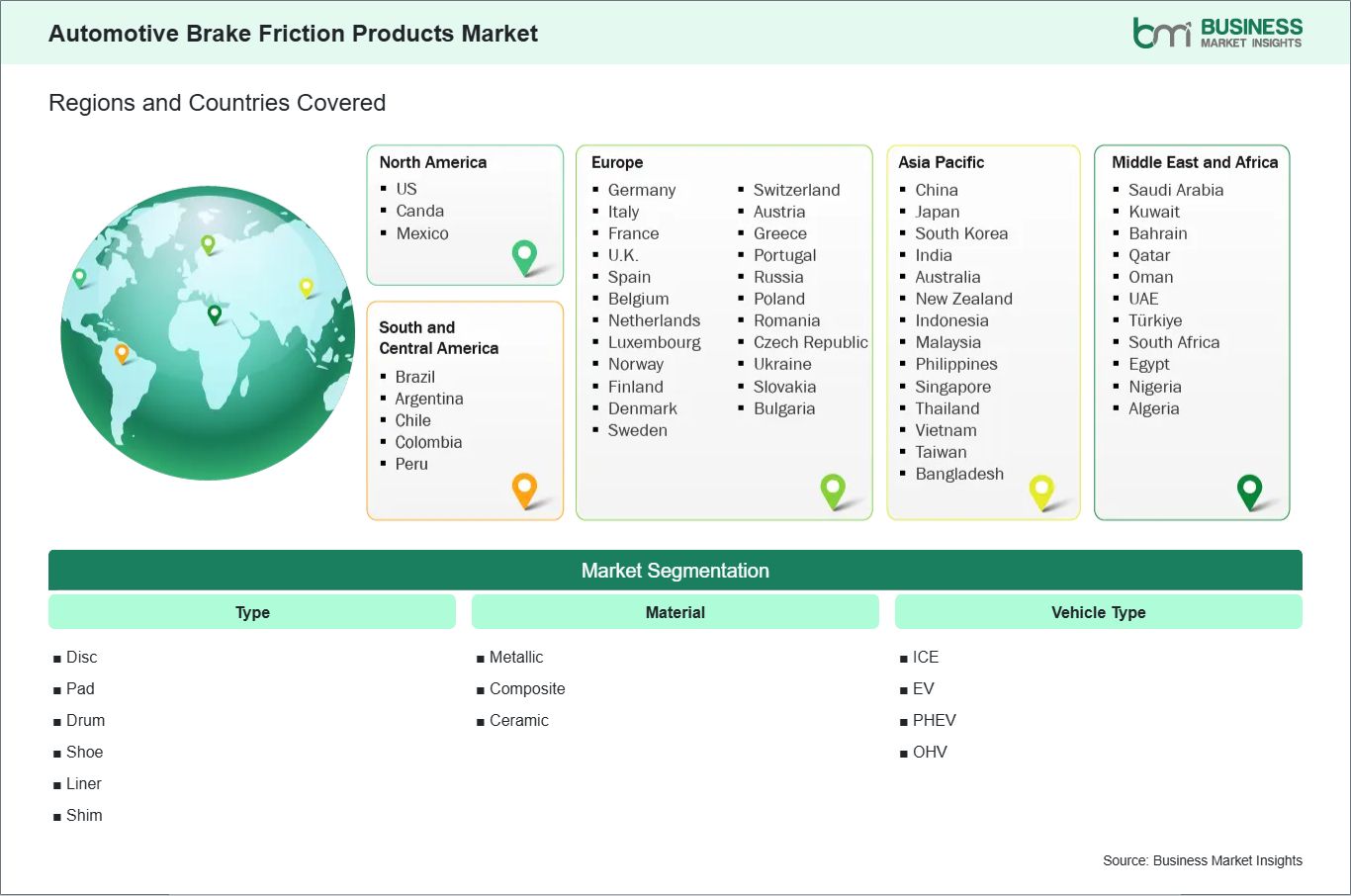
The Automotive Brake Friction Products market is segmented based on type, material, and vehicle type. These segments help address varying braking requirements across different vehicle categories and operating conditions.
By Type
- Disc: Widely used in modern vehicles due to effective heat dissipation and reliable braking performance.
- Pad: Essential friction components that directly contact brake discs to generate stopping force.
- Drum: Commonly used in rear braking systems and certain commercial vehicle applications.
- Shoe: Operates within drum brake systems to create friction and support braking efficiency.
- Liner: Provides friction surfaces for heavy-duty and industrial braking applications.
- Shim: Helps reduce vibration, noise, and uneven brake wear.
By Material
- Metallic: Offers high durability, strength, and heat resistance for demanding applications.
- Composite: Provides balanced performance, wear resistance, and cost effectiveness.
- Ceramic: Delivers quieter braking, lower dust generation, and stable performance.
By Vehicle Type
- ICE: Represents significant demand due to the large installed base of conventional vehicles.
- EV: Requires advanced friction products that work alongside regenerative braking systems.
- PHEV: Uses hybrid braking technologies requiring durable and efficient friction materials.
- OHV: Supports off-highway equipment operating in challenging environments.
Market Forces
Automotive Brake Friction Products Market Drivers and Opportunities
Increasing Focus on Vehicle Safety and Regulatory Compliance
Vehicle safety remains one of the most important priorities for automotive manufacturers, regulators, and consumers. Governments across many countries continue to strengthen safety standards related to braking efficiency, stopping distance, and component durability. These requirements are encouraging vehicle manufacturers to adopt high-quality brake friction products that can deliver consistent performance under different operating conditions. The growing number of vehicles on roads has also increased attention toward accident prevention and reliable braking systems. Fleet operators, commercial transportation providers, and individual vehicle owners are investing more in maintenance and timely replacement of braking components to ensure safe vehicle operation. In addition, regular inspections and compliance requirements are driving replacement demand in the aftermarket sector.
Advancements in vehicle performance, increasing vehicle weight due to additional safety and comfort features, and changing driving conditions further support the need for durable friction materials. Manufacturers are therefore focusing on improving thermal stability, wear resistance, and braking consistency. These developments continue to strengthen the role of advanced brake friction products in supporting global road safety objectives and maintaining regulatory compliance.
Development of Sustainable and Advanced Friction Materials
The automotive industry is increasingly exploring environmentally responsible technologies, creating new opportunities for innovation in brake friction products. Regulatory attention toward particulate emissions from braking systems is encouraging the development of friction materials that produce lower dust and reduced environmental impact without compromising braking performance. Research activities are focusing on advanced ceramic compounds, lightweight composites, and alternative material formulations that improve durability while supporting sustainability goals. These materials can help reduce maintenance requirements and improve overall vehicle efficiency. The growing adoption of electric and hybrid vehicles is also creating opportunities for friction products optimized for regenerative braking environments.
Digital manufacturing techniques, material engineering advancements, and improved testing capabilities are enabling the production of more precise and reliable braking components. Manufacturers are increasingly investing in products that offer longer service life, reduced noise, and enhanced performance under varying temperatures and operating conditions. As sustainability and efficiency become central priorities across the automotive industry, innovative friction materials are expected to create substantial growth opportunities for the Automotive Brake Friction Products market in the coming years.
Size and Share Analysis
Automotive Brake Friction Products Market Size and Share Analysis
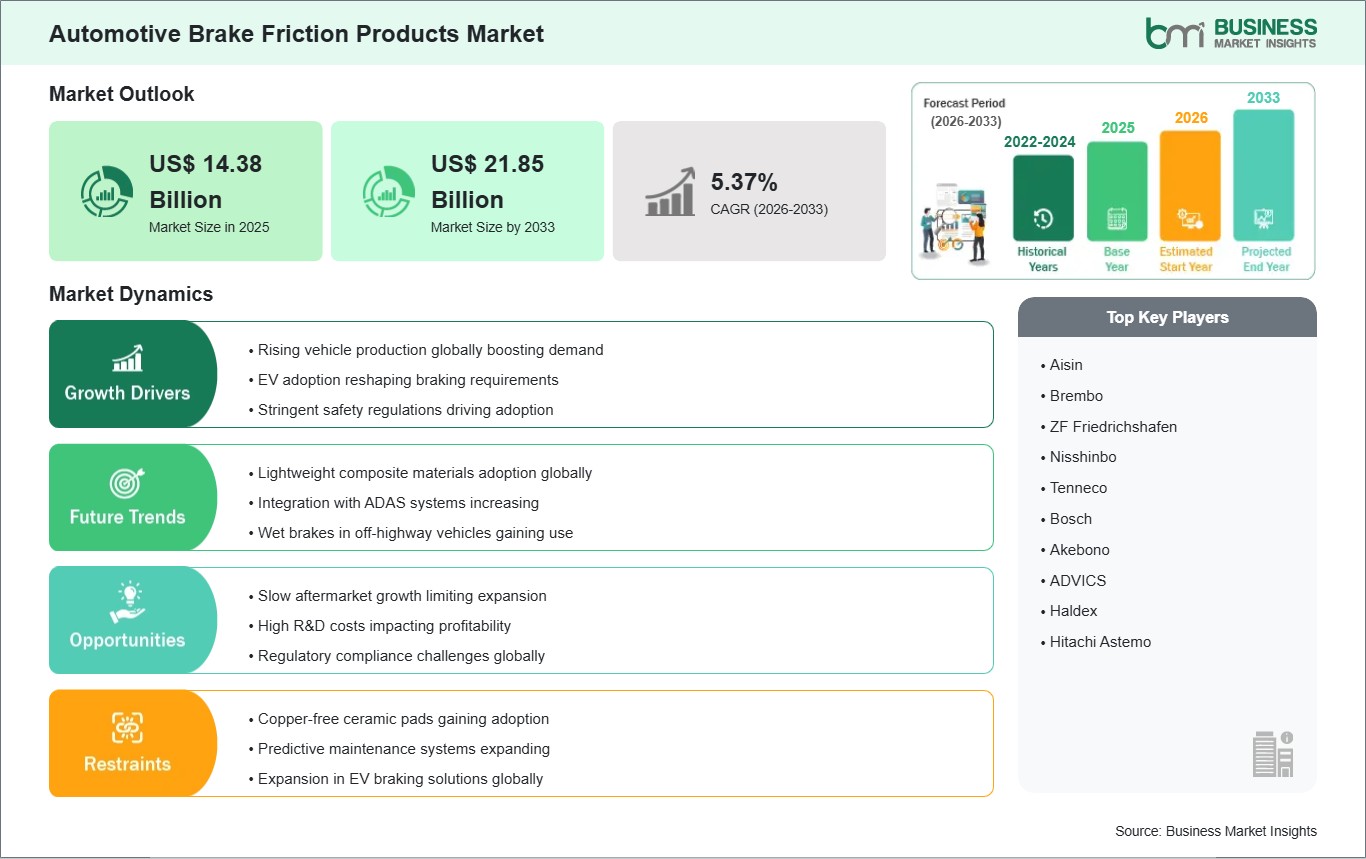
The Automotive Brake Friction Products Market size is expected to reach US$ 21.85 billion by 2033 from US$ 14.38 billion in 2025. The market is estimated to record a CAGR of 5.37% from 2026 to 2033.
By type, brake pads and discs account for a significant share due to their widespread use in modern braking systems and regular replacement requirements. Drums and shoes continue to maintain demand in commercial vehicles and cost-sensitive vehicle segments, while liners and shims play an important role in improving braking performance, durability, and noise reduction.
By material, metallic friction materials dominate the market owing to their strength, durability, and ability to withstand high operating temperatures. Composite materials are widely used because they offer a balance between performance and cost, while ceramic materials are gaining popularity in premium vehicle applications due to their low noise characteristics, reduced brake dust generation, and enhanced braking consistency.
By vehicle type, ICE vehicles hold a substantial share because of their large global vehicle population and established replacement market. EVs and PHEVs are witnessing increasing adoption of specialized brake friction products designed to complement regenerative braking systems, while OHVs continue to generate steady demand due to their operation in harsh environments requiring durable and reliable braking solutions.
Report Coverage
Automotive Brake Friction Products Market Report Coverage and Deliverables
The "Automotive Brake Friction Products Market Size and Forecast (2022-2033)" report provides a detailed analysis of the market covering below areas:
- Market size and forecast at global, regional, and country levels for all the key market segments covered under the scope
- Market trends, as well as market dynamics such as drivers, restraints, and key opportunities
- Market analysis covering key market trends, global and regional framework, major players, regulations, and recent market developments
- Industry landscape and competition analysis covering market concentration, heat map analysis, prominent players, and recent developments for the market
- Detailed company profiles, including SWOT analysis
Geographic Insights
Automotive Brake Friction Products Market Geographic Insights
The Automotive Brake Friction Products Market shows diverse regional adoption patterns influenced by vehicle production activities, safety regulations, aftermarket demand, and advancements in braking technologies.
North America, being a developed region, has a mature automotive industry and strong adoption of advanced braking technologies. The region comprises the United States and Canada, where vehicle safety regulations and consumer awareness support consistent demand for high-performance brake friction products. The region focuses on vehicle reliability, preventive maintenance, and compliance with evolving environmental standards. A well-established aftermarket network and strong commercial vehicle sector further contribute to the adoption of brake discs, pads, and advanced friction materials. Continuous investments in electric vehicle manufacturing are also creating opportunities for next-generation braking solutions designed for modern mobility requirements.
Asia Pacific is growing significantly, driven by expanding automotive manufacturing activities and increasing vehicle ownership. The region comprises countries such as China, India, Japan, and South Korea, where large-scale vehicle production supports substantial demand for brake friction components. The region focuses on improving vehicle safety standards and strengthening automotive supply chains. Rapid urbanization, infrastructure development, and rising consumer purchasing power continue to support demand for passenger and commercial vehicles. Growth in electric vehicle production is also encouraging the adoption of advanced friction materials and innovative braking technologies across the region.
Both regions are contributing significantly to the growth of the Automotive Brake Friction Products Market, focusing on vehicle safety, technological advancements, expanding automotive production, and increasing demand for reliable braking systems across multiple vehicle categories.
Industry Activity
Recent Developments
The Automotive Brake Friction Products Market is analyzed using a mix of primary and secondary research sources, including corporate publications, industry associations, and verified databases. This approach ensures accurate tracking of innovation trends and strategic developments influencing the market.
- In February 2026, Brembo announced the expansion of its GREENTELL braking technology portfolio. The solution is designed to reduce brake dust emissions while maintaining braking performance and durability. The development supports evolving environmental regulations and the industry's transition toward more sustainable brake friction products.
- In September 2025, Tenneco introduced new advanced friction material solutions under its braking portfolio for passenger and commercial vehicle applications. The products were developed to improve wear resistance, braking consistency, and operational efficiency while meeting changing market requirements.
Trust & Transparency
Research Methodology
The market analysis combines proprietary research with secondary data from government agencies, company disclosures, regulatory filings, industry databases and expert interviews. Market estimates are validated through data triangulation, cross-market benchmarking and analyst
review.
View Full Research Methodology
Key Sources Referred:
World Bank - Global Trade IndicatorsWorld Trade Organization (WTO)International Monetary Fund (IMF)International Trade Administration (ITA)Company WebsitesCompany Annual ReportsCompany Investor Presentations