
Automotive Hydraulic Brake Systems Market Outlook: Size, Share, Trends, Growth Analysis, Competitive Landscape & Forecast, 2026-2033

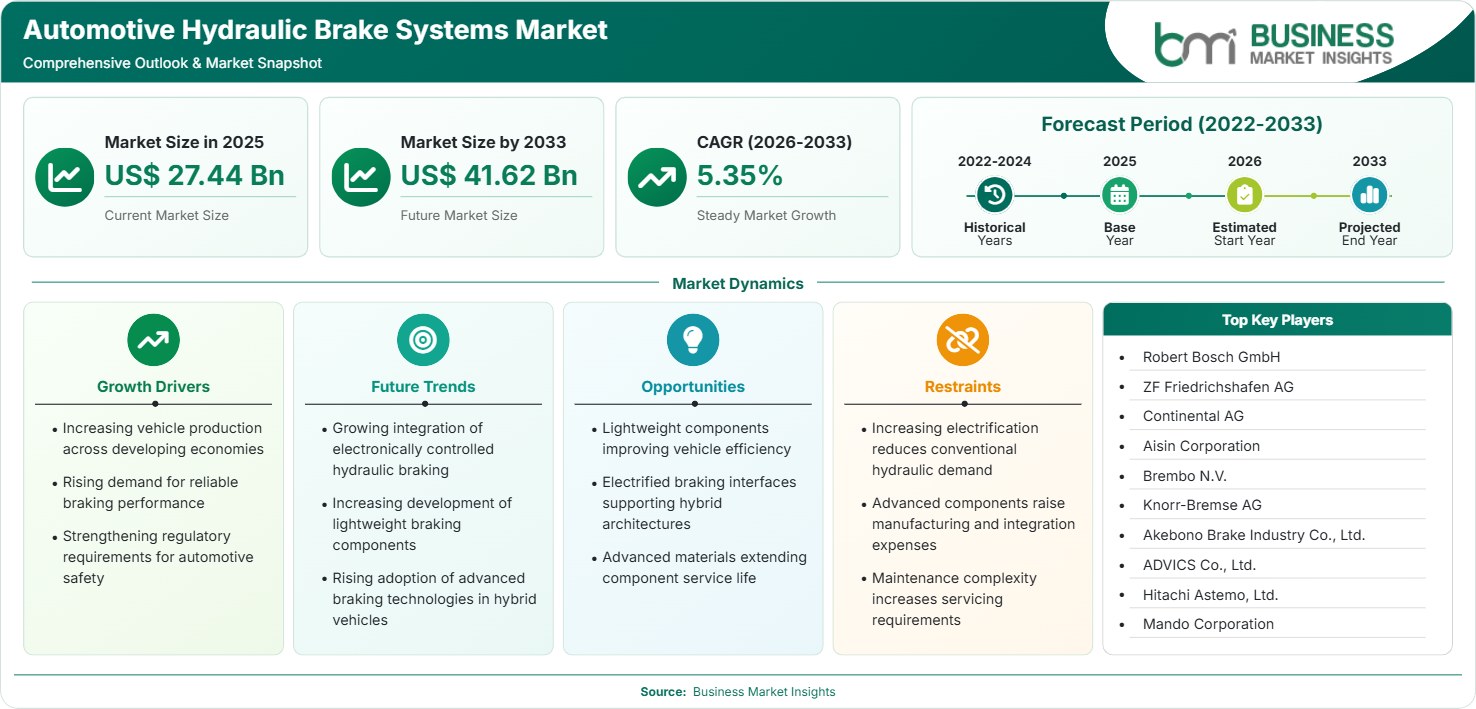
The Automotive Hydraulic Brake Systems Market size was valued at US$ 27.44 Billion in 2025 and is projected to reach US$ 41.62 Billion by 2033, growing at a CAGR of 5.35% during 2026–2033. Growth is supported by stricter vehicle safety regulations, rising SUV production, ABS integration, fleet modernization, commercial vehicle demand, and expanding electrified vehicle platforms requiring advanced hydraulic brake architectures.

Report Coverage
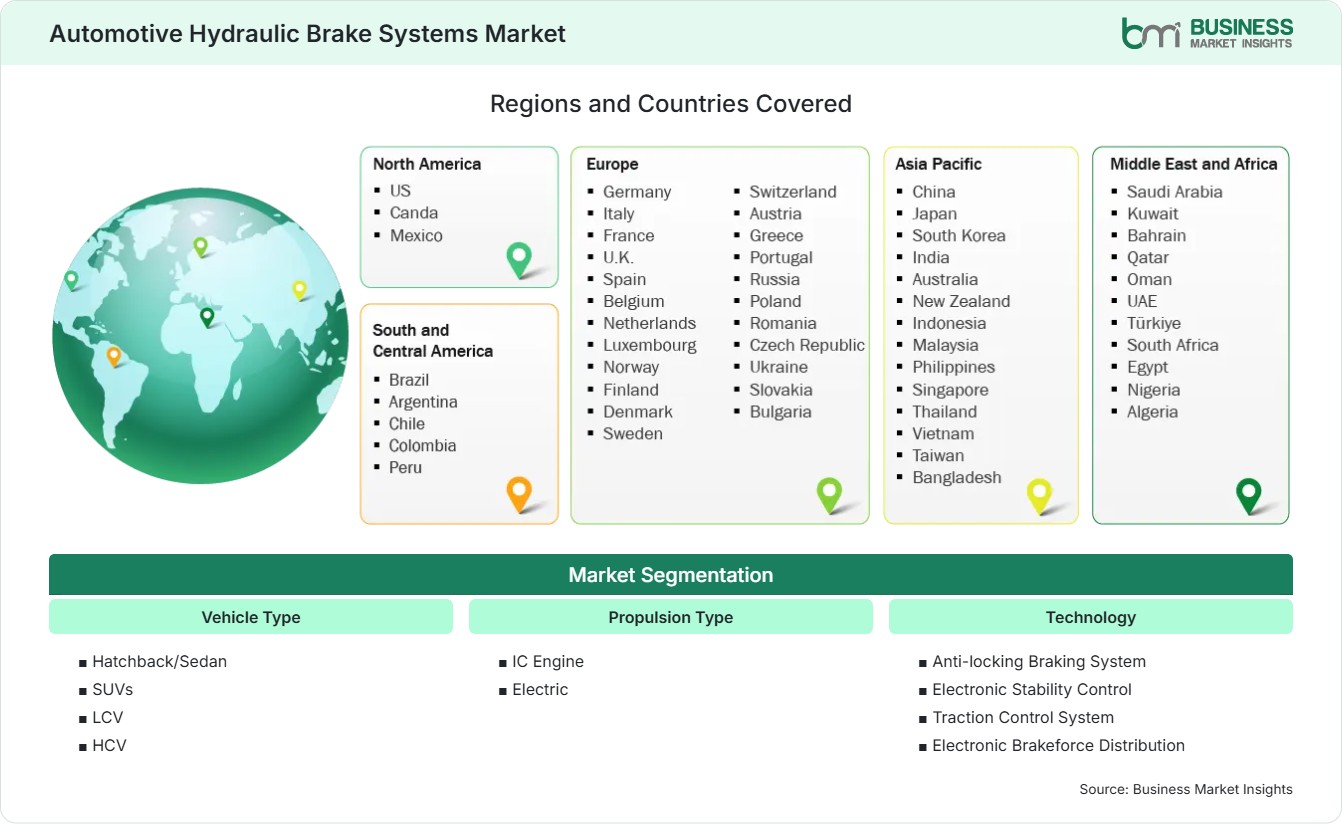
  • Vehicle Type: Hatchback/Sedan, SUVs, LCV, HCV
  • Propulsion Type: IC Engine, Electric
  • Technology: Anti-locking Braking System, Electronic Stability Control, Traction Control System, Electronic Brakeforce Distribution
US$ 27.44 Bn Market size in 2025
US$ 41.62 Bn Market Size by 2033
5.35% CAGR, 2026 - 2033
2026-2033 Forecast Period

AI Overview

Automotive Hydraulic Brake Systems Market Summary

  • North America Region: North America holds a market share of 34%–37% in 2025, growing at a CAGR of 4.8%–5.2% during 2026–2033, supported by pickup and SUV demand, safety mandates, fleet replacement, and advanced braking integration. The U.S. remains the largest regional market, expanding at 4.9%–5.3% CAGR through OEM innovation and strong vehicle parc demand.
  • Fastest Growing Region: Asia Pacific holds 28%–31% share in 2025, advancing at 6.2%–6.8% CAGR during 2026–2033, driven by vehicle production expansion, localization initiatives, rising safety awareness, accelerating electrification, and increasing adoption of advanced braking technologies.
  • Leading Segment: Hatchback/Sedan accounts for 42%–45% share in 2025, registering 4.8%–5.2% CAGR, supported by high production volumes, mature supply chains, regulatory compliance requirements, aftermarket replacements, and widespread hydraulic braking deployment.
  • High Growth Segment: Electric propulsion represents 18%–21% Automotive Hydraulic Brake Systems Market share in 2025 and records 7.2%–7.8% CAGR, encouraged by EV production growth, regenerative braking integration, lightweight component development, software-enabled safety systems, and platform electrification investments.
  • Key Market Opportunity: Integration of electro-hydraulic architectures with EV platforms creates opportunities for intelligent braking, predictive maintenance, reduced stopping distances, energy optimization, enhanced safety compliance, and differentiated OEM vehicle performance.
  • Major Market Players: Robert Bosch GmbH, ZF Friedrichshafen AG, Continental AG, Aisin Corporation, Brembo N.V., Knorr-Bremse AG, Akebono Brake Industry Co., Ltd., ADVICS Co., Ltd., Hitachi Astemo, Ltd., Mando Corporation.
Strategic Insights

Automotive Hydraulic Brake Systems Market: Strategic Insights

Automotive Hydraulic Brake Systems Market Strategic Framework
FREE PDF
Request your free sample
Request free sample
Stakeholder View

Key Takeaways

  • Hydraulic braking supply chains are increasingly integrated with electronics, sensors, software controls, calipers, master cylinders, and aftermarket service networks, creating a multilayered value ecosystem.
  • Electric vehicles and safety-equipped SUVs offer the strongest volume upside due to increasing penetration of advanced braking modules and regulatory compliance requirements.
  • Innovation is shifting toward electro-hydraulic control, brake-by-wire compatibility, predictive diagnostics, lightweight materials, and intelligent brake management systems.
  • Asia Pacific offers the most compelling manufacturing expansion opportunity due to large-scale vehicle production growth and supportive industrial policies.
  • Strategic acquisitions and technology partnerships are focused on electronic braking controls, ADAS compatibility, and integrated vehicle safety platforms.
  • Aftermarket demand remains resilient as aging vehicle fleets generate recurring replacement requirements for hydraulic pumps, cylinders, brake lines, and control components.
Geographic Outlook

Automotive Hydraulic Brake Systems Market Regional Highlights

North America Automotive Hydraulic Brake Systems Market

North America accounts for 34%–37% of the Automotive Hydraulic Brake Systems Market share in 2025 and is projected to expand at 4.8%–5.2% CAGR through 2033. Demand is supported by SUV and pickup dominance, strong aftermarket activity, and advanced safety technology adoption. Vehicle manufacturers increasingly integrate electronic stability and braking functions into hydraulic architectures. Fleet replacement cycles, logistics activity, and stricter safety standards continue supporting regional component demand. The region also benefits from established supplier networks and technology-intensive automotive manufacturing operations.

  • Advanced ABS and ESC penetration continues to strengthen demand for sophisticated hydraulic components across passenger and commercial vehicles.
  • Electrified vehicle platforms increasingly incorporate integrated hydraulic systems supporting regulatory compliance and braking efficiency.
  • Aftermarket replacement demand remains elevated because of large vehicle fleets and extensive road transportation activity.
  • Manufacturing localization strategies improve supply resilience and strengthen regional procurement ecosystems.

US Automotive Hydraulic Brake Systems Market

The United States represents 78%–82% of North American share and advances at 4.9%–5.3% CAGR. Strong light-truck sales, logistics sector expansion, and safety technology penetration support sustained demand. OEMs continue integrating hydraulic braking systems with ADAS functions to improve vehicle performance and regulatory compliance. Electrification investments and domestic manufacturing initiatives further enhance opportunities for component suppliers serving passenger and commercial vehicle applications. Technology partnerships are accelerating product innovation across braking architectures.

  • Pickup trucks and SUVs remain primary demand generators for advanced hydraulic braking technologies.
  • Federal safety requirements encourage adoption of electronically controlled braking functions.
  • EV manufacturing investments create opportunities for electro-hydraulic system integration.
  • Domestic supplier ecosystems support responsive production and aftermarket distribution.

Europe Automotive Hydraulic Brake Systems Market

Europe captures a 26%–29% share in 2025 and records 4.7%–5.1% CAGR of the Automotive Hydraulic Brake Systems Market during the forecast period. Regulatory emphasis on vehicle safety and emissions compliance encourages widespread deployment of advanced braking systems. Germany leads regional demand owing to its automotive manufacturing base, while Eastern European markets represent faster-volume expansion. Premium vehicle production, electrification strategies, and continued investments in intelligent vehicle technologies support adoption. Strong engineering expertise sustains innovation across braking performance, reliability, and integration capabilities.

  • Germany remains the leading country market, supported by large-scale vehicle production and advanced supplier infrastructure.
  • Poland and Romania demonstrate higher expansion rates through manufacturing investments and export-oriented operations.
  • Safety-focused regulations increase adoption of ESC, ABS, and brake-force technologies.
  • Premium and luxury vehicle segments drive sophisticated braking system requirements.

Asia Pacific Automotive Hydraulic Brake Systems Market

Asia Pacific holds 28%–31% share in 2025 and represents the fastest-growing region with 6.2%–6.8% CAGR. China, Japan, India, and South Korea dominate regional demand through large-scale vehicle production and expanding safety feature adoption. Rising incomes, urbanization, and regulatory upgrades support installation of advanced braking technologies. Suppliers continue expanding localized manufacturing footprints to improve cost competitiveness. Rapid EV growth reinforces opportunities for hybrid hydraulic-electronic braking architectures across passenger and commercial vehicles.

  • China remains the largest market due to unparalleled vehicle production volumes and safety technology implementation.
  • India exhibits strong acceleration driven by regulatory upgrades and expanding passenger vehicle sales.
  • Local manufacturing investments strengthen component availability and cost efficiency.
  • Increasing EV penetration supports demand for integrated braking solutions.
  • OEM competition accelerates platform-level braking innovation.

Rest of World Automotive Hydraulic Brake Systems Market

Rest of World maintains 8%–10% share and grows at 5.5%–6.0% CAGR through 2033. South & Central America benefit from fleet modernization and improving vehicle safety standards. Brazil remains the largest regional Automotive Hydraulic Brake Systems Market while Mexico serves as a critical export manufacturing hub. In the Middle East and Africa, infrastructure expansion, commercial vehicle demand, and industrial development support adoption. Growing investments in assembly operations create incremental opportunities for hydraulic braking suppliers serving diverse vehicle categories.

  • Brazil leads South American demand through automotive production and replacement component consumption.
  • Mexico benefits from export-oriented manufacturing and supplier investments.
  • GCC countries support commercial vehicle demand through construction and logistics activity.
  • South Africa remains a significant automotive production center in Africa.
  • Safety awareness improves deployment of advanced braking technologies.
Global Market Geography
FREE PDF
Request your free sample
Request free sample
Segment Analysis

Automotive Hydraulic Brake Systems Market Segmentation

Vehicle Type

Vehicle Type accounted for the largest Automotive Hydraulic Brake Systems Market scope, with Hatchback/Sedan applications representing the dominant category. The segment contributes approximately 42%–45% share in 2025 and expands at 4.8%–5.2% CAGR, supported by global passenger vehicle production, replacement demand, safety compliance requirements, and established manufacturing ecosystems.

  • Hatchback/Sedan: High production volumes and broad consumer adoption sustain demand for reliable hydraulic braking architectures integrated with safety technologies and efficient maintenance requirements.
  • SUVs: Growing preference for larger vehicles increases demand for enhanced hydraulic systems capable of managing higher vehicle weight and performance requirements.
  • LCV: Fleet expansion and e-commerce logistics activities strengthen adoption of durable braking systems optimized for utilization-intensive operations.
  • HCV: Commercial transportation growth supports advanced braking demand emphasizing reliability, load-handling capability, and regulatory compliance.

Propulsion Type

IC Engine vehicles retain the largest installed base; however, electrified platforms are expanding rapidly. The segment represents a key area of Automotive Hydraulic Brake Systems Market trends, with electric vehicles showing stronger adoption momentum. Overall, propulsion-driven demand reflects evolving braking integration strategies and technology upgrades.

  • IC Engine: Extensive global vehicle parc creates sustained OEM and aftermarket opportunities for hydraulic braking manufacturers and service providers.
  • Electric: Regenerative braking compatibility, software integration, and platform modernization drive stronger demand for advanced electro-hydraulic solutions.

Technology

Technology acceptance is gradually becoming a factor of competitive distinction. This category represents 35%-38% of the market in 2025, growing at a 5.8%-6.3% CAGR owing to safety regulations, vehicle autonomy, and the incorporation of intelligent braking control technology across multiple vehicle classes.

  • Anti-locking Braking System (ABS): Widespread regulatory compliance and safety benefits maintain strong adoption across passenger and commercial vehicle categories.
  • Electronic Stability Control (ESC): Growing emphasis on accident prevention encourages integration with hydraulic braking architectures across modern vehicle platforms.
  • Traction Control System (TCS): Enhanced vehicle stability under challenging road conditions supports deployment across premium and utility vehicle segments.
  • Electronic Brakeforce Distribution (EBD): Improved braking efficiency and optimized stopping performance encourage broader implementation alongside ABS platforms.
Market Forces

Automotive Hydraulic Brake Systems Market Dynamics

Key Market Drivers

Mandatory Safety Regulations and Vehicle Assessment Programs

Governments across the globe continue to reinforce vehicle safety regulations and advocate for the standardization of ABS, ESC, and related braking systems. The impact of testing organizations like Euro NCAP and regional testing programs is increasingly shaping the design priorities of automotive manufacturers. Hydraulic braking systems remain important for their reliability and for their integration into electronic control systems. Vehicle safety is part of the consumer’s awareness as well. The rising number of cars and trucks equipped with safety systems in developing countries is increasing demand for new braking systems.

Expansion of SUV and Commercial Vehicle Production

SUVs and commercial vehicles are increasing their share of global automotive production. The increased mass and the need for greater braking capacity require stronger hydraulic systems, more developed brake calipers and brake-force control systems, and improved heat dissipation. Growing logistics, increased e-commerce, infrastructure development, and freight transport in cities make light and heavy commercial vehicles more widely used. As a consequence, there is an increase in the adoption of new braking systems for improving safety and durability. It supports growth in component sales and replacement demand across multiple vehicle categories worldwide.

Integration of Electronic Controls with Hydraulic Systems

Vehicle platforms nowadays more often integrate hydraulics with modern electronics. The use of ABS, ESC, TCS, and EBD systems not only improves handling and safety but also enables ADAS capabilities. Modern brake system suppliers continue to focus on developing software-based brake management, diagnostics, and electro-hydraulic control technologies to enhance accuracy and performance. With the development of connected cars and vehicle electrification, smart brake systems are becoming a major distinguishing factor for vehicle manufacturers. Consequently, technology-driven upgrades support long-term industry expansion and broader adoption of sophisticated hydraulic braking products.

Key Market Opportunities

Electro-Hydraulic Braking Platforms for Electric Vehicles

Electric vehicle adoption opens up immense opportunities for suppliers that can integrate hydraulic and regenerative braking systems. Braking systems in EVs require optimization of braking management, coordination of energy recovery, and other software-enabled functionalities. Suppliers that develop lightweight components, predictive diagnostics capabilities, and control technologies will stand to gain from the rapid electrification. Based on long-term Automotive Hydraulic Brake Systems Market forecasts, there is increasing demand for systems that improve efficiency, performance, and platform capabilities. The collaboration between Original Equipment Manufacturers and braking specialists is expected to facilitate the introduction of new technologies.

Growth Potential Across Emerging Automotive Manufacturing Hubs

Countries such as India, Vietnam, Thailand, Mexico, and Indonesia continue to attract investment in automotive manufacturing. Growth in assembly plant capacity is driving increased demand for locally manufactured brake system components. Localizing component manufacturing can increase cost-effectiveness and responsiveness. Growing compliance of domestic legislation with international safety requirements contributes to increasing the adoption of advanced brake systems. Manufacturers that set up local manufacturing sites have an opportunity to establish stable partnerships with OEMs while benefiting from sustained growth in vehicle output across these economies.

Digital Aftermarket and Predictive Maintenance Services

The number of vehicles worldwide continues to grow, creating opportunities beyond the sale of original equipment. Diagnostics in the digital age, connectivity in maintenance, and predictive scheduling of parts replacement allow suppliers to increase their income from the aftermarkets. Fleet owners care more about uptime and optimization of lifecycle costs. Brake producers can benefit from sensor-based monitoring, making service more efficient while retaining customers. This opportunity extends across passenger, commercial, and electrified vehicle segments, making aftermarket innovation an increasingly important competitive differentiator.

Market Restraints and Challenges

Raw Material Volatility and Margin Compression

The hydraulic braking system uses steel, aluminum, rubber compounds, and other engineered materials to manufacture parts. Variations in raw material prices affect manufacturing costs and make it difficult to plan sourcing. The manufacturer will be forced to squeeze margins and reduce price flexibility. The disruption in the global supply chain increases uncertainty because input availability is affected. Small manufacturers are likely to have greater exposure to such issues since they lack bargaining power and diversified sourcing networks, making cost management increasingly difficult.

Transition Toward Brake-by-Wire and Technology Adaptation Costs

Innovation in brake-by-wire technology has led to competition among conventional braking technology providers. The development of new vehicle structures requires companies to invest in electronics, software integration, and validation processes. Failure to adjust results in a company becoming irrelevant with respect to its products due to the new intelligent vehicles being developed by automakers. Costs in developing the new technology could be quite high, especially for companies supplying to cost-sensitive markets. Balancing innovation requirements with profitability, therefore, remains a critical industry challenge as the industry transitions toward increasingly digitized braking systems.

Company Analysis

Competitive Landscape

The competitive environment remains technology-driven, with suppliers investing in safety integration, intelligent controls, and manufacturing localization. Ongoing Automotive Hydraulic Brake Systems Market analysis highlights competition across OEM contracts, innovation capabilities, aftermarket reach, and braking system efficiency.

Company Name

Overview

Products and Services relevant to this market

Robert Bosch GmbH

Global automotive technology leader with strong braking and vehicle safety portfolio.

ABS, ESC, brake control modules, hydraulic braking systems, safety electronics.

ZF Friedrichshafen AG

Major driveline and chassis specialist serving global vehicle manufacturers.

Integrated braking systems, electro-hydraulic modules, vehicle control technologies.

Continental AG

Automotive supplier focused on safety, connectivity, and mobility technologies.

Hydraulic brakes, ABS, ESC, electronic braking controls, sensors.

Aisin Corporation

Japanese automotive systems manufacturer with broad OEM relationships.

Brake master cylinders, hydraulic assemblies, safety system components.

Brembo N.V.

Premium braking specialist recognized for performance and engineering excellence.

Brake calipers, discs, hydraulic braking solutions, performance systems.

Knorr-Bremse AG

Leading braking technology provider with strong commercial vehicle exposure.

Hydraulic and electronic braking systems, fleet safety solutions.

Akebono Brake Industry Co., Ltd.

Renowned brake manufacturer serving passenger and commercial vehicles.

Brake pads, calipers, hydraulic braking components, aftermarket products.

ADVICS Co., Ltd.

Specialized automotive braking supplier with global manufacturing presence.

Brake control systems, hydraulic modules, integrated safety technologies.

Hitachi Astemo, Ltd.

Mobility technology company supporting electrified and connected vehicles.

Brake actuators, control units, hydraulic braking technologies.

Mando Corporation

South Korean supplier focused on vehicle safety and chassis systems.

Hydraulic brakes, ESC solutions, electronic brake control systems.

Trust & Transparency

Research Methodology

The market analysis combines proprietary research with secondary data from government agencies, company disclosures, regulatory filings, industry databases and expert interviews. Market estimates are validated through data triangulation, cross-market benchmarking and analyst review.

View Full Research Methodology

Questions Answered

Frequently Asked Questions

Why are electronic braking technologies important?

Electronic technologies improve vehicle stability, braking precision, accident prevention capability, and compatibility with ADAS functions while enhancing overall system performance.

How does the Automotive Hydraulic Brake Systems Market Report support business decisions?

The report identifies growth segments, technology priorities, regional opportunities, competitive positioning, and investment trends that assist manufacturers, suppliers, and investors in strategic planning.

Which region offers the strongest growth potential?

Asia Pacific presents the strongest growth outlook due to vehicle production expansion, regulatory upgrades, localization investments, and accelerating electrification programs.

What role do electric vehicles play in market development?

Electric vehicles require advanced braking architectures that coordinate hydraulic and regenerative systems, creating opportunities for electro-hydraulic innovation and intelligent control platforms.

What factors are increasing demand for hydraulic brake systems?

Safety regulations, rising SUV production, commercial vehicle expansion, and integration of electronic control technologies continue driving adoption across OEM and aftermarket channels.

Access the Full Automotive Hydraulic Brake Systems Market Report

Get segment-level forecasts, regional estimates, competitive benchmarking, company profiles and downloadable Excel datasets.

Access the full Automotive Hydraulic Brake Systems Market Report
350 pages PDF & Excel | 2026-09-10
Similar Research

Related Market Reports