
Air Cargo Market Outlook: Size, Share, Trends, Growth Analysis, Competitive Landscape & Forecast, 2026-2033

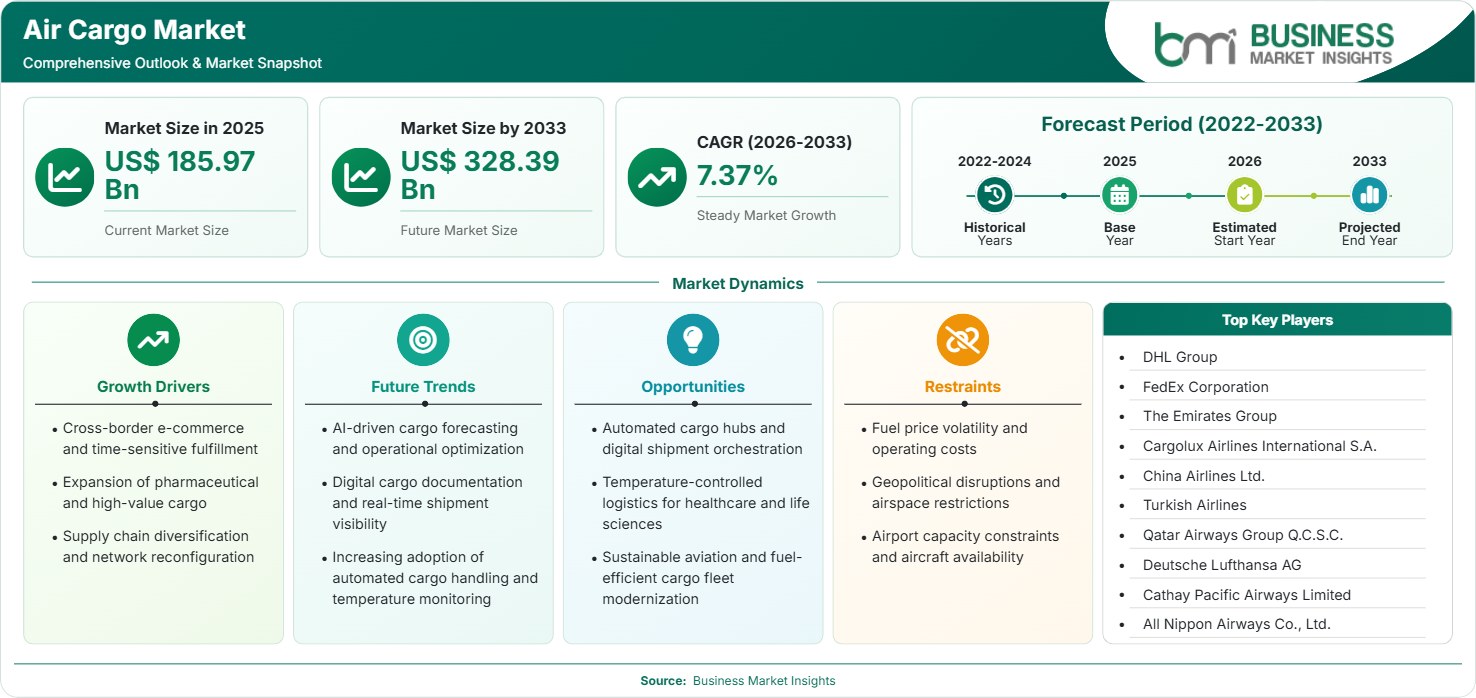
The Air Cargo Market size was valued at US$ 185.97 Billion in 2025 and is projected to reach US$ 328.39 Billion by 2033, growing at a CAGR of 7.37% during 2026–2033, driven by e-commerce, pharmaceutical logistics, semiconductor trade, supply-chain diversification, and expanding time-sensitive international commerce.

Report Coverage
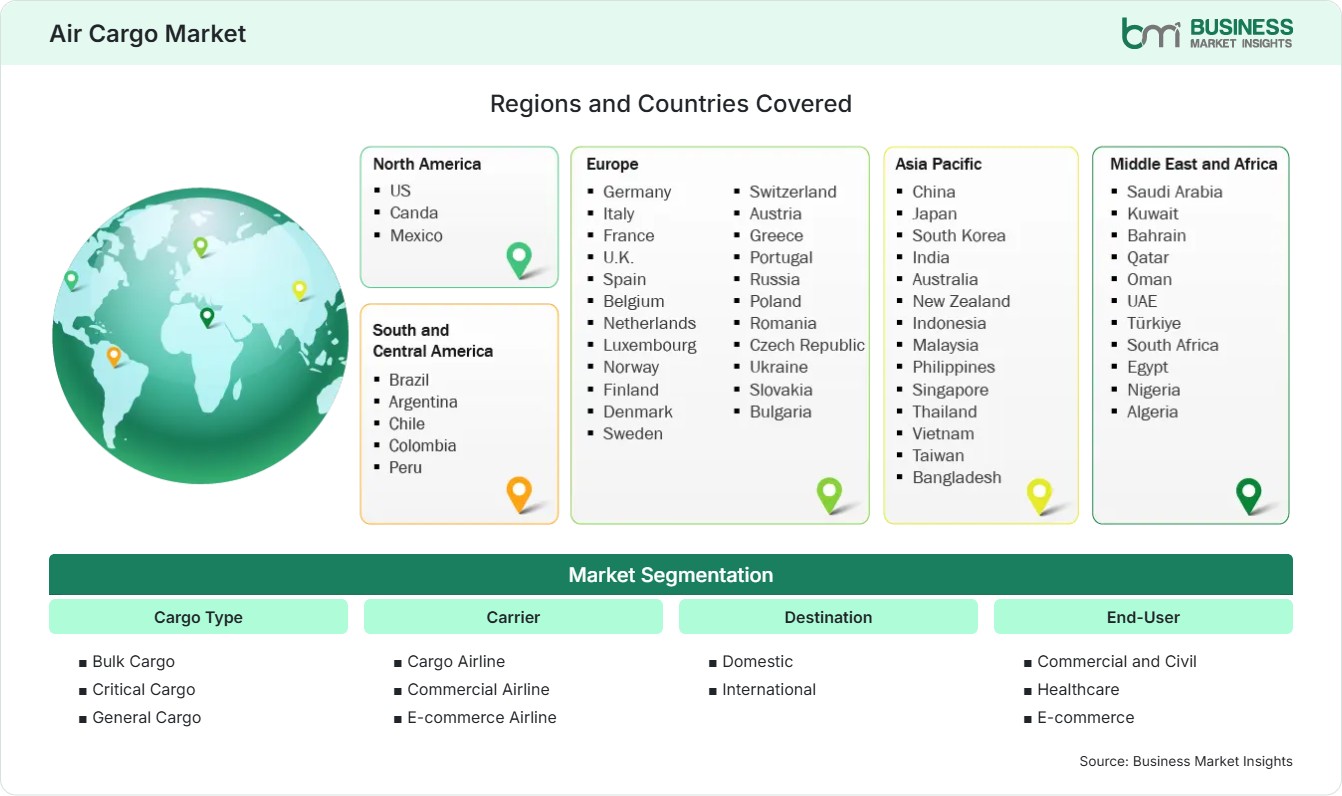
  • Cargo Type: Bulk Cargo, Critical Cargo, General Cargo
  • Carrier: Cargo Airline, Commercial Airline, E-commerce Airline
  • Destination: Domestic, International
  • End-User: Commercial and Civil, Healthcare, E-commerce
US$ 185.97 Bn Market size in 2025
US$ 328.39 Bn Market Size by 2033
7.37% CAGR, 2026 - 2033
2026-2033 Forecast Period

AI Overview

Air Cargo Market Summary

  • North America Region: North America holds a 24%–25% share in 2025 and is projected to grow at a 5%–7% CAGR, supported by e-commerce, pharmaceuticals, aerospace, semiconductor logistics, nearshoring, and resilient transatlantic trade. The US accounts for 65%–70% of regional activity, advancing at a 5%–7% CAGR through 2033 as e-commerce, healthcare shipments, and industrial reshoring strengthen demand. IATA reported North American carrier cargo demand declined 1.3% in 2025, creating a recovery opportunity.
  • Fastest Growing Region: Asia Pacific holds a 35%–37% share in 2025 and is advancing at an 8%–10% CAGR, supported by electronics exports, cross-border e-commerce, semiconductor shipments, manufacturing relocation, intra-Asian trade, and expanding international cargo capacity.
  • Leading Segment: General Cargo holds a 45%–48% share in 2025 and is growing at a 6%–8% CAGR, supported by diversified industrial shipments, consumer products, machinery, electronics, retail replenishment, manufacturing trade, and broad carrier-network utilization across major international corridors.
  • High Growth Segment: E-commerce Airline holds a 9%–11% share in 2025 and expands at a 10%–12% CAGR, driven by cross-border online retail, rapid fulfillment requirements, marketplace expansion, integrated logistics networks, digital tracking, and direct-to-consumer international shipping.
  • Key Market Opportunity: Strategic opportunities center on automated cargo terminals, temperature-controlled healthcare logistics, digital customs, cross-border e-commerce, sustainable aviation fuel, regional freighter networks, and integrated multimodal solutions.
  • Major Market Players: DHL Group, FedEx Corporation, The Emirates Group, Cargolux Airlines International S.A., China Airlines Ltd., Turkish Airlines, Qatar Airways Group Q.C.S.C., Deutsche Lufthansa AG, Cathay Pacific Airways Limited, and All Nippon Airways Co., Ltd.
Strategic Insights

Air Cargo Market: Strategic Insights

Air Cargo Market Strategic Framework
FREE PDF
Request your free sample
Request free sample
Stakeholder View

Key Takeaways

  • The value chain increasingly combines airlines, integrators, freight forwarders, airport operators, ground handlers, customs authorities, technology providers, and e-commerce platforms. Competitive advantage is shifting toward integrated control of capacity, data, warehousing, customs, and last-mile connections.
  • Healthcare, e-commerce, semiconductor equipment, perishables, and high-value electronics offer stronger pricing potential than undifferentiated freight. Specialized handling requirements create barriers to entry and support premium service models.
  • Automation is moving from isolated warehouse equipment toward end-to-end digital orchestration. AI-supported forecasting, automated sorting, electronic air waybills, real-time tracking, and predictive maintenance are increasingly linked to operational efficiency and customer visibility.
  • Asia Pacific provides the strongest investment case because it combines manufacturing concentration, intra-regional commerce, e-commerce growth, and expanding cargo infrastructure. IATA reported 8.4% cargo-demand growth for Asia Pacific carriers in 2025.
  • Strategic investment is increasingly focused on hubs, freighters, automated terminals, and network integration. FedEx committed more than ₹2,500 crore to a fully automated cargo hub at Navi Mumbai International Airport, illustrating the scale of infrastructure investment around high-growth corridors.
  • Geopolitical disruption is changing routing economics. Carriers able to rapidly reposition freighter capacity, activate alternative hubs, and manage customs complexity can protect service reliability when tariffs, conflicts, or airspace restrictions alter established trade lanes.
Geographic Outlook

Air Cargo Market Regional Highlights

North America Air Cargo Market

North America accounted for 24-25% of the share, with a 5-7% CAGR from 2025 to 2033. It is characterized by robust integrators, good national network coverage, modern airports, and high industrial demand. US-based air cargo providers are the major players, while Canada participates via its trans-Pacific and trans-Atlantic routes. According to IATA statistics, demand for North American airlines' air cargo fell by 1.3% in 2025, but it outperformed the overall global industry.

  • E-commerce fulfillment remains a major demand driver, particularly for time-sensitive consumer products requiring integrated air transportation, sorting, customs processing, and final-mile distribution across large geographic markets.
  • Pharmaceuticals, aerospace components, electronics, and semiconductor equipment support premium cargo services because shipment delays can create disproportionate financial consequences for manufacturers and healthcare providers.
  • US trade-policy changes are restructuring traditional Asia-North America flows, encouraging carriers to rebalance capacity toward Europe-Asia and intra-Asian corridors.
  • Automated hubs are attracting investment as carriers seek higher throughput, labor productivity, shipment visibility, and faster transfer between aircraft, warehouses, trucks, and customs facilities.

US Air Cargo Market

The United States holds a 65%–70% market share of cargo transport in North America and is projected to grow at a 5%–7% CAGR through 2033. This is due to its size, which includes an integrated express network, international gateways, extensive domestic shipments, and huge healthcare, tech, aerospace, and retail sectors. Uncertainty surrounding tariffs hampered international cargo shipments in 2025, but high domestic consumption and e-commerce helped sustain demand. The demand for North American carriers dropped by 1.3% in 2025, according to IATA.

  • Major integrators continue investing in automated facilities and network optimization, supporting higher shipment throughput and improving the economics of time-definite international delivery services.
  • Pharmaceutical and biotechnology manufacturing create specialized demand for temperature-controlled, secure, monitored transportation, supporting premium solutions across biologics, vaccines, clinical materials, and medical devices.
  • Nearshoring and reshoring of manufacturing can generate incremental domestic and cross-border airfreight requirements for components, prototypes, machinery, electronics, and urgent production inputs.

Europe Air Cargo Market

The Europe segment holds a 21-22% market share in 2025 and is forecast to grow at a 5-7% CAGR through 2033. Germany, France, the Netherlands, Luxembourg, and the United Kingdom are among the important cargo markets owing to their industrial production, connectivity, pharmaceutical exports, and geographical location. According to IATA, cargo demand for European airlines grew by 2.9% in 2025, while cargo capacity grew by 3.1%. Cargo demand growth on the Europe-Asia corridor was 10.3%, underscoring the corridor's importance.

  • Germany benefits from automotive, pharmaceutical, machinery, semiconductor, and industrial exports, creating a diversified base for specialized and time-sensitive freight services.
  • Luxembourg remains strategically important through Cargolux, whose 2025 revenue reached US$3.406 billion and profit after tax reached US$465 million despite geopolitical and trade pressures.
  • The Netherlands benefits from Amsterdam Schiphol’s logistics ecosystem, integrated road connections, and access to major European consumption and manufacturing centers.
  • Europe-Asia trade is becoming increasingly important as tariff changes and supply-chain restructuring shift cargo flows away from traditional transpacific routes.

Asia Pacific Air Cargo Market

Asia Pacific had a 35%-37% market share in 2025 and is expected to expand at an 8%-10% CAGR from 2026 to 2033, emerging as the fastest-growing regional market. The presence of China, Japan, South Korea, Singapore, Hong Kong, and India ensures manufacturing volumes, semiconductor manufacturing, e-commerce operations, and advanced airport infrastructure. According to IATA, APAC saw an 8.4% rise in cargo demand in 2025, which was the highest among all regions. The demand for Europe-Asia trade was up 10.3%, while intra-Asia demand rose 10.0%.

  • China remains central to electronics, consumer goods, machinery, and e-commerce flows, while changes in US trade policy are encouraging greater diversification toward Europe and intra-Asian corridors.
  • Japan benefits from advanced electronics, automotive production, pharmaceuticals, and precision manufacturing, generating demand for high-value and time-sensitive cargo transportation.
  • India is gaining strategic relevance as manufacturing expands and international e-commerce grows. FedEx’s Navi Mumbai cargo hub investment illustrates increasing infrastructure commitment to Western India.
  • Southeast Asia is benefiting from supply-chain diversification, electronics manufacturing, semiconductor investment, and new production facilities that require reliable international cargo connections.

Rest of World Air Cargo Market

Rest of World represented 17%–20% of the Air Cargo Market share in 2025 and is forecast to grow at a 5%–7% CAGR through 2033. South and Central America benefit from perishables, pharmaceuticals, electronics, and expanding trade with North America, Europe, and Asia. Brazil, Mexico, Chile, and Colombia provide the largest commercial opportunities. Latin American and Caribbean carriers recorded 2.3% cargo-demand growth in 2025. Africa recorded 6.0%, while Middle Eastern carriers posted 0.3%.

The Middle East remains strategically significant due to the presence of Dubai, Doha, Abu Dhabi, and Istanbul, which connect Europe, Asia, Africa, and the Americas. Despite geopolitical disruptions, airlines are still investing in network stability, cargo aircraft, specialized cargo, and hub construction. The potential of Africa lies in pharmaceuticals, perishable cargoes, mining equipment, e-commerce, and regional trade.

  • Gulf hubs provide geographic advantages for intercontinental routing, enabling carriers to connect Asia, Europe, Africa, and North America through highly developed cargo-handling infrastructure.
  • Latin American exporters increasingly require temperature-controlled and time-sensitive transportation for perishables, pharmaceuticals, flowers, seafood, and premium agricultural products.
  • African markets offer opportunities for healthcare logistics and high-value exports, while limited infrastructure in several markets creates demand for integrated logistics solutions.
  • Turkey benefits from its geographic position between Europe and Asia, while Turkish Cargo continues expanding digital booking and exporter-support capabilities.
Global Market Geography
FREE PDF
Request your free sample
Request free sample
Segment Analysis

Air Cargo Market Segmentation

Cargo Type

Cargo Type has General Cargo leads the pack, accounting for 45% to 48% of the market share in 2025, while maintaining a CAGR of 6% to 8% till 2033. The market applies to all types of manufactured cargo. The scope of the Air Cargo Market is derived from diverse freight demands.

  • Bulk Cargo: Bulk shipments support agricultural, industrial, and commodity-linked movements where volume requirements, handling economics, and airport infrastructure influence routing and aircraft selection.
  • Critical Cargo: Critical shipments require expedited transportation, high reliability, and close monitoring, serving aerospace, healthcare, manufacturing, and emergency supply requirements where delays can disrupt operations.
  • General Cargo: General cargo represents the broadest shipment base, covering electronics, machinery, apparel, consumer goods, and industrial products transported through established scheduled and charter networks.

Carrier

The carriers are now diversified across dedicated freighters, passenger airlines’ belly-freighter space, and dedicated e-commerce carriers. The cargo airline category is the most dominant carrier group, with a market share of 43%-46% by 2025 and a 7%-9% CAGR through 2033 as dedicated capacity supports network control.

  • Cargo Airline: Dedicated cargo airlines provide freighter capacity, flexible routing, oversized shipment capability, and specialized handling for freight requiring independent scheduling and high-volume cargo infrastructure.
  • Commercial Airline: Passenger airlines monetize belly capacity, improving aircraft utilization while providing broad destination coverage and efficient connectivity across established passenger networks.
  • E-commerce Airline: E-commerce airlines focus on predictable schedules, high-frequency regional connectivity, integrated fulfillment, and rapid parcel movement, supporting the fastest-growing carrier model.

Destination

The Destination market is characterized by International segments holding a share of 70%-73% in 2025 with a CAGR of 7%-9% till 2033. The international mode of transport is driven by the globalization of manufacturing, cross-border e-commerce, pharmaceuticals, and semiconductors, and the logistics needs of multinationals.

  • Domestic: Domestic airfreight supports urgent replenishment, healthcare distribution, remote-market connectivity, high-value goods, and time-sensitive shipments where road or rail alternatives cannot meet delivery requirements.
  • International: International cargo links manufacturing centers with global consumers and businesses, with Asia-Europe, Europe-North America, and intra-Asia corridors increasingly shaping capacity allocation.

End-User

End-User demand is increasingly influenced by E-commerce and healthcare, while Commercial and Civil applications retain the broadest shipment base. Commercial and Civil represent a 40%–43% share in 2025 and expand at a 6%–8% CAGR through 2033 as industrial trade, retail distribution, and manufacturing remain core demand sources.

  • Commercial and Civil: Commercial and civil users include manufacturers, retailers, distributors, and service companies requiring reliable transportation for production inputs, finished products, equipment, and replacement components.
  • Healthcare: Healthcare logistics requires temperature control, traceability, security, validated handling, and rapid delivery, supporting premium airfreight services for pharmaceuticals, biologics, diagnostics, and medical devices.
  • E-commerce: E-commerce generates frequent parcel movements, short fulfillment windows, cross-border returns, and demand for integrated customs and last-mile services, increasing the value of flexible air networks.
Market Forces

Air Cargo Market Dynamics

Key Market Drivers

Cross-Border E-Commerce and Time-Sensitive Fulfillment

Cross-border e-commerce is increasing the need for predictable international transportation, frequent departures, automated sorting, customs integration, and shipment-level visibility. The IATA pointed to the rise of e-commerce as one of the key factors that would help make 2025 air cargo resilient to tariffs and regulatory uncertainties. Demand for Europe-Asia routes increased by 10.3%, while the demand for within-Asia routes increased by 10.0%. Thus, online shopping and supply chain redesign could redefine traditional corridors. Consequently, the Air Cargo Market growth is becoming increasingly linked to parcel-based business. The integrators and the airlines are addressing this trend through automation of hub systems, freighter-only aircraft, flexible routing, and booking technologies. This technology reduces processing time and enables faster delivery of goods. E-commerce also involves reverse logistics, peak seasons, and fragmented shipping, making integrated networks more relevant.

Expansion of Pharmaceutical and High-Value Cargo

Several types of cargo require specific transport conditions not provided by common freight transport systems. Pharmaceuticals are temperature-sensitive and need special conditions of transport, handling, security, and traceability from point A to point B. Semiconductor equipment and parts also require special security and safety measures for transport, as production breaks can cause significant financial losses. Lufthansa Cargo noted increased attention to the pharmaceutical, automotive, aviation, semiconductor, and airmail sectors in 2025 as an example of carriers' vertical specialization. Air Cargo Market trends will be more influenced by such high-value applications because specialized services can deliver better returns on investment and customer loyalty than general cargo. Specialized handling also imposes specific barriers to entry through facilities certification, staff training, monitoring, and compliance.

Network Reconfiguration and Supply-Chain Diversification

Uncertainties in trade policies, tariffs, geopolitical risks, and manufacturing relocation are reshaping air cargo corridors. According to IATA data, Asia-North America air cargo traffic fell by 0.8% in 2025, whereas Europe-Asia cargo traffic increased by 10.3% and intra-Asia cargo traffic by 10.0%. From this example, it is evident that there is a need for frequent adjustments to carriers' positioning and capacity in response to changing trade relations. Therefore, the development of the Air Cargo Market will be much faster in the new air cargo corridors emerging from the diversification of manufacturing locations, even if individual routes weaken. Regions such as Southeast Asia, India, Eastern Europe, and some Middle Eastern countries became important as a result of the diversification of production. Carriers respond by adopting flexible networks, increasing the capacity of their freighters, signing interline agreements, and utilizing hubs. Such a market structure is beneficial for carriers that can reallocate their aircraft capacity and provide alternative routes to their customers.

Key Market Opportunities

Automated Cargo Hubs and Digital Shipment Orchestration

Airport automation presents a significant investment opportunity, given that cargo volume expansion now relies more on efficiency than on additional flights. In other words, airport automation such as automated storage and retrieval systems, sorting robots, digital documentation, analytics, and artificial intelligence (AI)-enabled capacity planning could increase efficiency while ensuring the accuracy of shipments. The proposed FedEx project to build a 300,000-square-foot automated facility at Navi Mumbai International Airport, with investments exceeding ₹2,500 crore, exemplifies the importance of airport automation for new cargo routes. Air Cargo Market Forecasts need to take into account not just the efficiency of flight operations but also the efficiency of airports' infrastructure. In this context, airports and airlines that automate customs procedures, warehouses, booking services, and shipment tracking would increase the number of shipments processed without increasing staff accordingly.

Temperature-Controlled Healthcare and Life-Sciences Logistics

Pharmaceutical logistics is one of those segments that presents an opportunity for a premium business. Pharmaceuticals might have very specific requirements on storage at certain temperatures, proper packaging, constant monitoring, and safe transportation in specially controlled environments. The increasing share of biopharmaceuticals, custom medications, vaccines, diagnostic, and clinical trial products is raising demand for such specialized international transportation. An airline company could meet this demand through airport-based refrigerated rooms, active temperature-controlled boxes, specially trained staff, and digital monitoring. It provides opportunities not only for airlines but also for freight forwarders, packaging companies, warehouses, and platform providers. Healthcare industry clients have high standards for carriers' reliability and compliance, not for minimizing transportation costs. The development of regional pharmaceutical centers in Asia, the Middle East, and Latin America can reduce delivery times and help penetrate new healthcare markets.

Sustainable Aviation and Efficient Cargo Fleet Modernization

Decarbonization is becoming an important strategic investment area as airlines, regulators, and cargo customers seek lower-emission transportation. Lufthansa Cargo reported that it sold around 2,300 tonnes of sustainable aviation fuel in 2025 and implemented voluntary SAF options within its booking systems. Fuel-efficient ships, route optimization, higher load factors, and SAF purchases will enhance environmental performance by helping to meet customers' sustainability goals. The cargo industry is under pressure to keep operating expenses competitive, hence making fuel efficiency an important factor from both commercial and compliance perspectives. There are potential business opportunities for SAF producers, airplane manufacturers, digital optimization companies, cargo airlines, and airports investing in green infrastructure. Business models that will be most effective involve several aspects of efficiency, not just SAF. Airlines that can provide data on their carbon emissions will help build stronger relationships with multinational clients who factor carbon emissions into their procurement decisions.

Market Restraints and Challenges

Factor: Fuel and Operating Cost Volatility; Impact: Margin Pressure

Factor: Jet-fuel prices, labor expenses, aircraft maintenance, airport charges, and geopolitical rerouting costs can change rapidly and directly influence cargo economics. Impact: Airlines may face margin compression when capacity increases faster than demand or when customers resist freight-rate adjustments. IATA reported that global air-cargo yields declined 1.5% in 2025, although they remained 37.2% above 2019 levels. This indicates that pricing power is normalizing after exceptional post-pandemic conditions. Capacity expansion can intensify competitive pressure, particularly on commoditized routes. Fuel volatility also complicates long-term planning because carriers must balance fleet utilization, fuel efficiency, SAF commitments, and customer pricing. Smaller operators may have less ability to absorb temporary cost increases than global integrators. Sustained profitability therefore depends on network optimization, high load factors, specialized cargo products, and disciplined capacity management rather than volume expansion alone.

Factor: Geopolitical and Regulatory Disruption; Impact: Network Instability

Factor: Tariffs, sanctions, airspace restrictions, customs changes, conflicts, and changing trade policies can abruptly alter cargo routes and shipment economics. Impact: Carriers may need to reroute aircraft, add fuel-intensive sectors, change schedules, or reposition capacity between regions. Cargolux reported that geopolitical tensions, trade wars, and Middle East and Ukraine conflicts affected operations during 2025, while IATA identified tariff changes and removal of the US de minimis exemption as forces reshaping trade lanes. Regulatory complexity also increases compliance costs for dangerous goods, pharmaceuticals, customs, security, and advanced electronic documentation. These factors can reduce network predictability even when underlying cargo demand remains strong. Carriers with diversified hubs and flexible aircraft deployment are better positioned to manage disruption. Smaller networks can face greater exposure when a single corridor or airport becomes operationally constrained.

Company Analysis

Competitive Landscape

The Air Cargo Market analysis shows competition shifting from simple aircraft capacity toward integrated logistics performance, specialized cargo handling, digital visibility, hub infrastructure, and network flexibility. Global integrators compete with dedicated cargo airlines and passenger carriers that monetize belly capacity. Differentiation increasingly depends on e-commerce fulfillment, pharmaceutical capabilities, automated facilities, sustainability services, and the ability to rapidly redirect capacity when trade corridors change.

Company Name

Overview

Products and Services relevant to this market

DHL Group

Germany-based global logistics group operating extensive express and freight-forwarding networks across international trade lanes.

Air freight forwarding, time-definite express, customs services, temperature-controlled logistics, shipment tracking, and integrated supply-chain solutions.

FedEx Corporation

US-based integrated transportation company combining express delivery, air networks, logistics, and international freight capabilities.

Air freight forwarding, express cargo, customs services, specialized logistics, automated hubs, and international shipment management.

The Emirates Group

UAE-based aviation group with a major global passenger and cargo network centered on Dubai.

Emirates SkyCargo freighter and belly capacity, specialized cargo products, pharmaceutical logistics, perishables, and international airfreight services.

Cargolux Airlines International S.A.

Luxembourg-based dedicated cargo airline operating an international freighter network and specialized freight solutions.

Boeing 747 freighter services, oversized cargo, pharmaceuticals, perishables, dangerous goods, and global cargo connectivity.

China Airlines Ltd.

Taiwan-based international airline with substantial cargo operations supporting Asian manufacturing and global trade.

Dedicated freighter operations, belly cargo, pharmaceutical logistics, perishables, e-commerce freight, and international cargo transportation.

Turkish Airlines

Türkiye-based global airline whose Turkish Cargo brand provides extensive cargo connectivity between Europe, Asia, Africa, and the Americas.

Freighter and belly cargo, special cargo handling, pharmaceutical services, perishables, e-commerce logistics, and digital booking.

Qatar Airways Group Q.C.S.C.

Qatar-based aviation group operating a major cargo network through Doha and international connecting hubs.

Qatar Airways Cargo freighter services, belly capacity, special cargo, pharmaceuticals, perishables, live animals, and digital logistics services.

Deutsche Lufthansa AG

German aviation group with Lufthansa Cargo and an extensive European and intercontinental logistics network.

Freighter services, passenger belly capacity, pharmaceutical logistics, semiconductor cargo, e-commerce logistics, and specialized freight handling.

Cathay Pacific Airways Limited

Hong Kong-based airline group with a major Asia-focused cargo network and Hong Kong hub infrastructure.

Cathay Cargo freighters, belly cargo, pharmaceuticals, perishables, dangerous goods, live animals, and real-time digital shipment visibility.

All Nippon Airways Co., Ltd.

Japan-based airline group expanding international cargo capabilities through network optimization and integration with Nippon Cargo Airlines.

International cargo services, freighter operations, belly capacity, high-value logistics, cargo network management, and integrated cargo solutions.

Trust & Transparency

Research Methodology

The market analysis combines proprietary research with secondary data from government agencies, company disclosures, regulatory filings, industry databases and expert interviews. Market estimates are validated through data triangulation, cross-market benchmarking and analyst review.

View Full Research Methodology

Questions Answered

Frequently Asked Questions

What should investors examine in an Air Cargo Market Report?

Investors should examine freight-tonne growth, capacity additions, load factors, yields, e-commerce volumes, specialized-cargo penetration, fleet composition, hub investments, digitalization, fuel exposure, and geopolitical concentration. Network diversification is particularly important because route disruptions can rapidly change aircraft utilization and profitability. Companies with integrated forwarding, warehousing, customs, and last-mile capabilities can offer greater resilience.

How are trade-policy changes affecting cargo networks?

Trade-policy changes can shift manufacturing locations, alter customs requirements, change shipment economics, and redirect established trade lanes. IATA reported Asia-North America cargo demand declined 0.8% in 2025 while Europe-Asia demand increased 10.3%. Carriers are responding by reallocating aircraft capacity and strengthening alternative hubs and corridors.

Which cargo categories generally offer the strongest strategic value?

Healthcare, semiconductors, aerospace components, high-value electronics, perishables, and urgent industrial shipments can offer stronger strategic value because customers prioritize reliability, security, speed, and specialized handling. These categories also create higher barriers to entry than conventional general freight and can support differentiated service products and longer-term customer relationships.

How is digitalization changing cargo operations?

Digitalization is improving booking, documentation, customs processing, shipment tracking, capacity forecasting, warehouse automation, and customer communication. IATA ONE Record is supporting standardized data exchange among cargo stakeholders, while carriers increasingly integrate APIs and real-time status information into customer platforms. These systems reduce manual processing and improve visibility across complex international shipments.

What factors determine air-cargo pricing across international routes?

Pricing depends on fuel costs, aircraft capacity, shipment weight and volume, route length, seasonality, handling requirements, cargo type, airport charges, customs complexity, and available belly or freighter capacity. Specialized pharmaceuticals, perishables, dangerous goods, and urgent shipments generally command higher rates because they require controlled handling and additional operational resources.

Access the Full Air Cargo Market Report

Get segment-level forecasts, regional estimates, competitive benchmarking, company profiles and downloadable Excel datasets.

Access the full Air Cargo Market Report
350 pages PDF & Excel | 2026-08-27