Market Summary
Executive Summary and Global Market Analysis
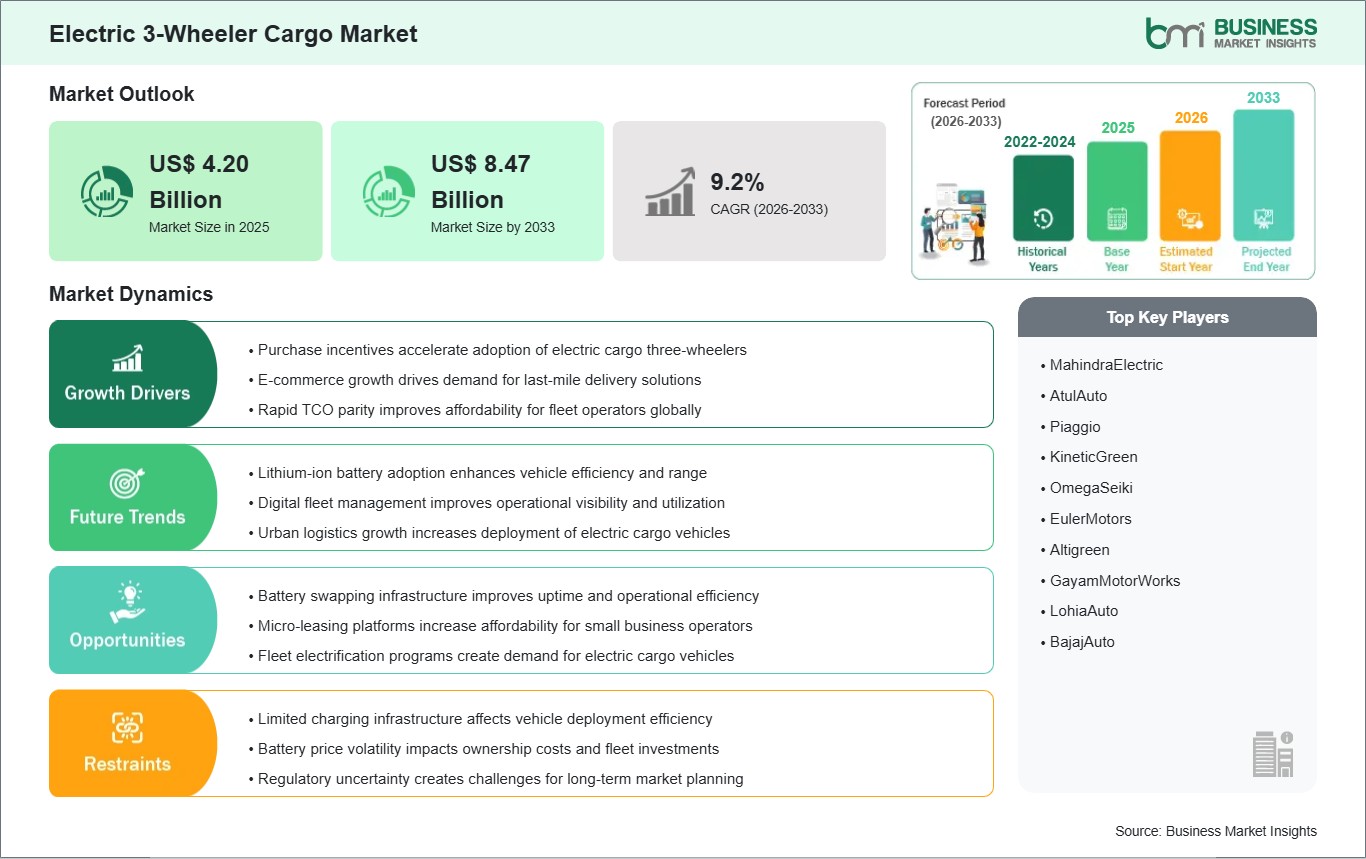
The market for electric 3-wheeler cargo vehicles involves the use of battery-powered 3-wheeled cargo vehicles, which can be utilized for last-mile cargo transportation and logistics. The purpose of using these vehicles is that they help in moving cargo in an economical manner and are more environmentally friendly than traditional fuel-powered vehicles. Lithium-ion batteries and lead-acid batteries are some of the types of batteries that are used in these vehicles.
There is an increasing concern regarding sustainability in urban mobility, which in turn is driving the use of electric cargo vehicles for logistics and delivery purposes. Companies are using these electric cargo vehicles not only because of the cost savings associated with fuel but also due to the changing environmental regulations. Growing activities in the e-commerce sector have also increased the use of these vehicles for last-mile cargo delivery.
The market is segmented by battery type, power, and application because different types of batteries have varied operating capabilities depending on the applications they are intended for. The rising popularity of lithium-ion batteries is attributed to increased efficiency levels and longevity, whereas the use of lead-acid batteries can be justified for cost-effective operations. In terms of power, batteries operate on varying power ratings of up to 6kW and between 2-4kW.
Emerging technologies in batteries and vehicle construction are contributing to developments in the market. Energy efficiency, payload carrying capacity, and durability are some of the aspects that manufacturers are emphasizing in their production process. Competitiveness in this market involves costs, range, and fleet incorporation capabilities.
Segment Analysis
Electric 3-Wheeler Cargo Market Segmentation
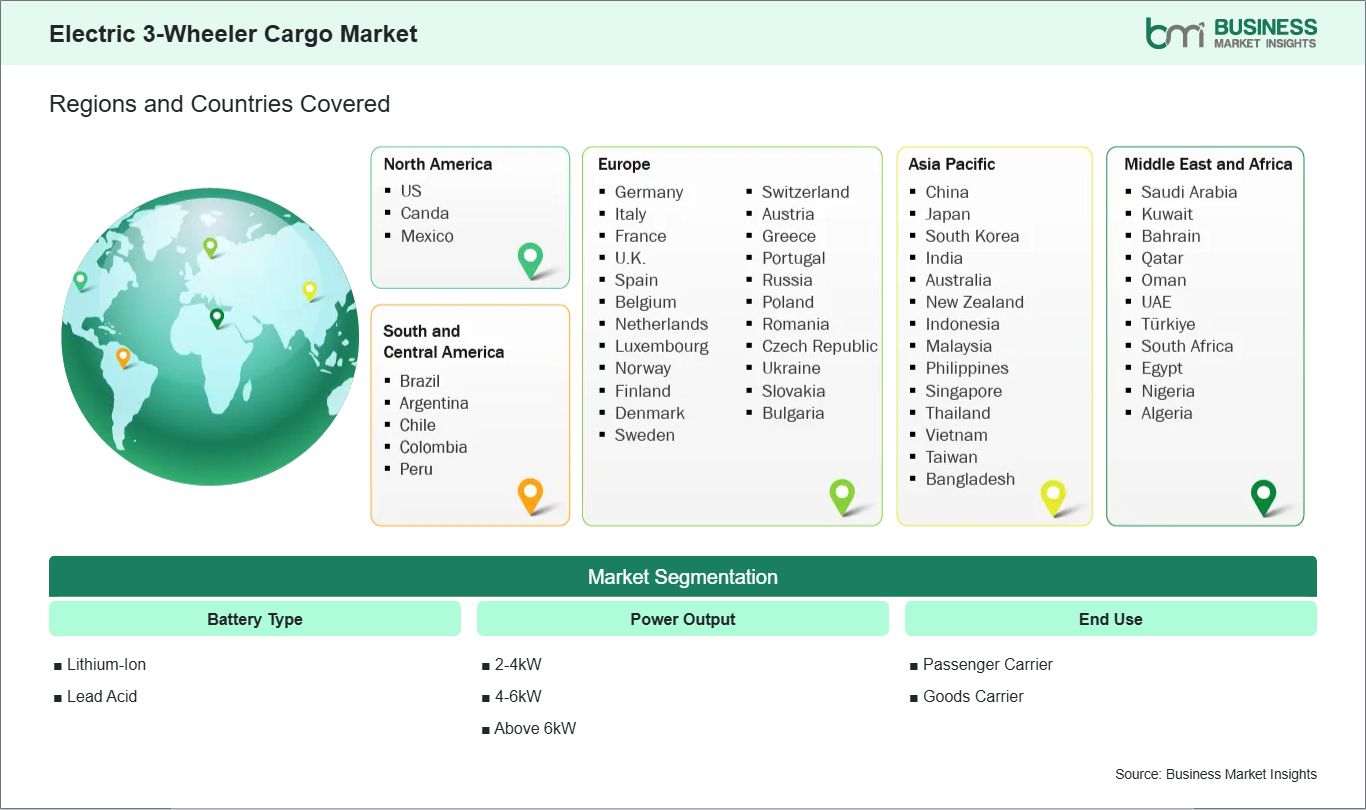
The electric 3-wheeler cargo market is segmented based on battery type, power output, and end use, reflecting operational diversity in urban logistics, energy efficiency requirements, and cargo transportation applications.
By Battery Type
- Lithium-Ion – High energy density batteries support longer range and faster charging performance.
- Lead Acid – Cost-effective battery option widely used in price-sensitive cargo applications.
By Power Output
- 2–4kW – Suitable for light-duty urban deliveries with lower payload requirements.
- 4–6kW – Balanced performance range supporting moderate cargo transportation needs.
- Above 6kW – High-power systems designed for heavy-duty last-mile logistics operations.
By End Use
- Passenger Carrier – Dual-use configurations support mixed passenger and light cargo transport.
- Goods Carrier – Dedicated freight vehicles dominate urban logistics and delivery services.
Market Forces
Electric 3-Wheeler Cargo Market Drivers and Opportunities
Extended purchase incentives
Government-backed purchase incentive schemes are playing a crucial role in driving the adoption of electric cargo three-wheelers. The availability of financial support schemes, tax breaks, and decreased registration costs is helping ease the process of buying such vehicles. Such initiatives have been found to be particularly effective in cases involving urban logistics, where cost factors become extremely important while selecting vehicles. Therefore, demand for electric cargo three-wheelers is rising within the realms of last-mile deliveries and intra-city logistics.
In addition to helping boost demand for such vehicles, the government-sponsored incentive schemes are also aiding in promoting production and making electric cargo three-wheelers more affordable. Through these means, fleet electrification and cost-affordable fleet operation are being accelerated, especially by small logistic firms and delivery aggregators. Further expansions in such incentive schemes can help bolster their penetration further into the market.
Battery swapping infra
The expansion of the battery-swapping system infrastructure is also paving the way for further operational efficiency among electric 3-wheeler cargo vehicles. The battery-swapping infrastructure allows for reducing the time that a fleet spends on battery charging through quick replacement. This approach is especially advantageous when it comes to frequent transportation services since any minute saved makes a considerable difference.
Increasing investments in battery-swapping standardization and station deployment are anticipated to increase the efficiency of adopting electric fleets. More interoperable and expanded infrastructure will allow electric cargo transport fleets to spread across more urban environments. As the adoption of battery swapping grows, it can become less reliant on the shortcomings of the charging infrastructure system.
Size and Share Analysis
Electric 3-Wheeler Cargo Market Size and Share Analysis
The electric 3-wheeler cargo market is projected to grow from US$ 4.20 billion in 2025 to US$ 8.47 billion by 2033, registering a CAGR of 9.2% from 2026 to 2033.
By battery type, lithium-ion batteries dominate the market due to their higher energy density, longer lifecycle, and faster charging capability compared to lead-acid batteries. They are increasingly preferred in electric 3-wheelers as governments push for electrification, while manufacturers focus on improving vehicle range, efficiency, and total cost of ownership over time.
By power output, the 4–6 kW segment accounts for a significant share as it offers an optimal balance between load-carrying capacity and energy efficiency. This range is most suitable for commercial cargo operations in urban and semi-urban logistics, where vehicles require sufficient torque for heavier payloads without compromising battery performance or range.
By end use, goods carriers dominate the market because electric 3-wheelers are primarily deployed for last-mile delivery, e-commerce logistics, FMCG distribution, and intra-city goods transport. Rapid growth in urban logistics demand and cost advantages over fuel-based cargo vehicles continue to drive strong adoption in this segment.
Report Coverage
Electric 3-Wheeler Cargo Market Report Coverage and Deliverables
The "Electric 3-Wheeler Cargo Market Size and Forecast (2022–2033)" report provides a detailed analysis of the market covering below areas:
- Market size and forecast at global, regional, and country levels for all key market segments covered under the scope
- Market trends, along with market dynamics such as drivers, restraints, and key opportunities
- Market analysis covering key trends, global and regional frameworks, major players, regulations, and recent developments
- Industry landscape and competitive analysis covering market concentration, heat map analysis, prominent players, and recent developments
- Detailed company profiles, including SWOT analysis
Geographic Insights
Electric 3-Wheeler Cargo Market Geographic Insights
The electric 3-wheeler cargo market displays varying adoption patterns across regions depending on the level of urbanization, changes in fuel prices, and policies promoting electric vehicles. The growing adoption trend is fueled by the increased need for effective last-mile delivery mechanisms in both developing and developed markets.
In terms of market adoption, the Asia Pacific region emerges as the leading region owing to its presence in countries like India, China, and other Southeast Asian countries. E-commerce penetration, along with urban population growth and favorable government policies, has contributed greatly to the adoption of the vehicles. India emerges as a leading adopter of the vehicles owing to its cost-sensitive logistic industry.
The North American region has seen a steady rise thanks to the implementation of sustainable practices in urban logistics and commercial transportation. In the United States, there have been initial trials in urban logistic and delivery systems. Europe has steadily adopted EV mobility due to its stringent emission policies. Nations such as Germany, France, and the UK have encouraged integration within their territories.
New markets such as Latin America and the Middle East are slowly adopting EV mobility as urban logistics infrastructure develops in the area. Rising consciousness about operational cost savings and environmental impact has prompted businesses to adopt EV mobility in their logistics operations.
Industry Activity
Recent Developments
The electric 3-wheeler cargo market is evaluated by gathering qualitative and quantitative data post primary and secondary research, which includes important corporate publications, association data, and databases. Recent developments and news in the market include:
- In April 2026, Hyundai Motor Company announced that it had formalized a joint development agreement with TVS Motor Company to co-develop electric three-wheelers for cargo and last-mile mobility markets. The partnership focuses on jointly engineering and commercializing E3W platforms tailored for India and other emerging markets.
- In January 2026, Servotech Renewable Power System Ltd. announced that it expanded into the electric three-wheeler ecosystem by launching dedicated lithium-ion battery and charging solutions for E3W cargo vehicles.
Trust & Transparency
Research Methodology
The market analysis combines proprietary research with secondary data from government agencies, company disclosures, regulatory filings, industry databases and expert interviews. Market estimates are validated through data triangulation, cross-market benchmarking and analyst
review.
View Full Research Methodology
Key Sources Referred:
Ministry of Road Transport and Highways (India) Ministry of Heavy Industries (India) European Commission Directorate-General for Mobility and Transport (DG MOVE) S. Department of Transportation (DOT) Society of Indian Automobile Manufacturers (SIAM) International Organization of Motor Vehicle Manufacturers (OICA) Automotive Research Association of India (ARAI) Company Websites Company Annual Reports Company Investor Presentations