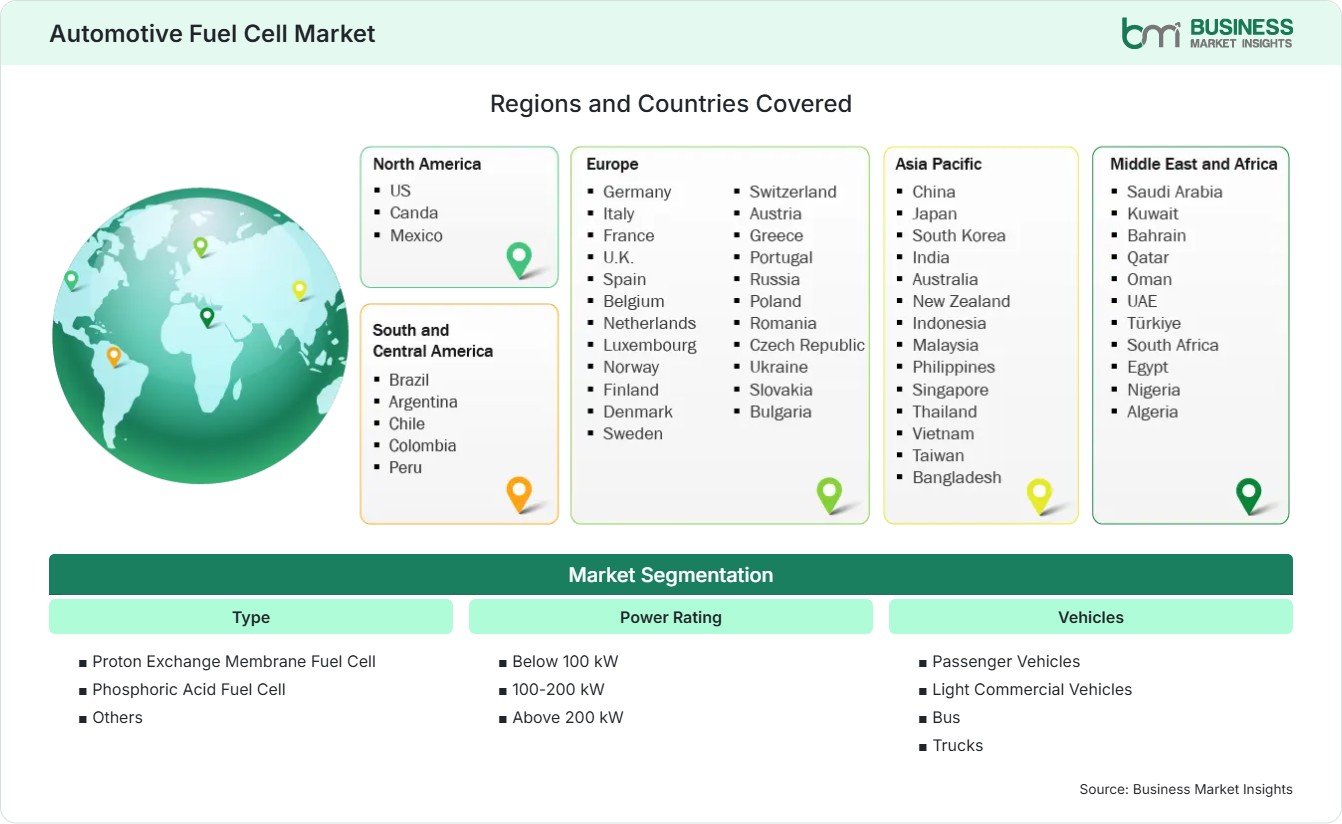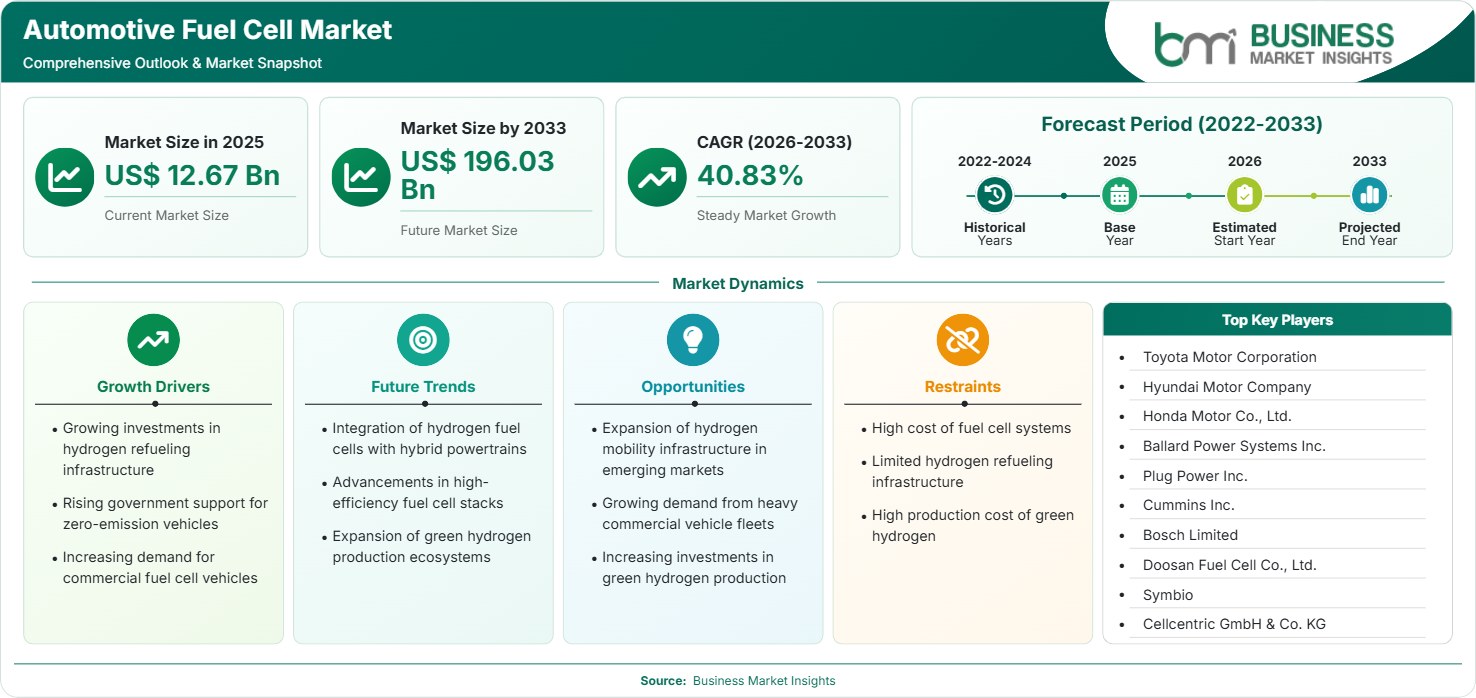
Automotive Fuel Cell Market Regional Highlights
North America Automotive Fuel Cell Market
North America accounted for approximately 24%–28% of global revenue in 2025 and is projected to expand at a 39.5%–41.5% CAGR during 2026–2033. The region benefits from hydrogen infrastructure investments, commercial fleet electrification initiatives, and government-supported clean transportation programs. The Automotive Fuel Cell Market share in North America is supported by the United States and Canada, where manufacturers are developing hydrogen-powered mobility solutions for passenger and heavy-duty vehicle applications.
- The United States leads regional adoption through hydrogen hub investments, commercial vehicle demonstrations, and government programs supporting zero-emission transportation.
- Canada is expanding fuel cell opportunities through clean energy initiatives, hydrogen production projects, and transportation decarbonization strategies.
- Growing hydrogen refueling infrastructure is improving feasibility for fuel cell vehicle deployment across major transportation corridors.
- Commercial fleet operators are exploring fuel cell solutions to reduce emissions from long-distance transportation applications.
US Automotive Fuel Cell Market
The United States represented approximately 80%–84% of North American revenue in 2025 and is expected to grow at a 40.0%–42.0% CAGR during 2026–2033. Growth is supported by hydrogen infrastructure expansion, federal clean energy investments, and increasing adoption of fuel cell commercial vehicles. The country is developing hydrogen networks to support transportation applications while automotive companies continue investing in fuel cell technology development and manufacturing capabilities in Automotive Fuel Cell Market.
- Hydrogen hubs are creating new growth opportunities by improving fuel availability, expanding hydrogen production and distribution networks, and supporting the development of regional fuel cell vehicle ecosystems.
- Fleet operators are increasingly adopting hydrogen-powered trucks, buses, and commercial vehicles to achieve emission reduction targets and improve operational efficiency.
- Automotive manufacturers are increasing investments in fuel cell research, manufacturing capacity, and commercialization strategies to strengthen their position in the growing hydrogen mobility market.
- Government incentives and supportive policies are encouraging the development of hydrogen mobility infrastructure, fuel cell vehicle adoption, and zero-emission transportation solutions.
Europe Automotive Fuel Cell Market
Europe accounted for approximately 22%–26% of global revenue in 2025 and is forecast to register a 38.0%–40.5% CAGR from 2026–2033. The region is supported by hydrogen strategies, emission reduction policies, and investments in alternative transportation technologies. Germany represents the leading market due to automotive manufacturing capabilities and hydrogen initiatives, while France, the United Kingdom, and the Netherlands demonstrate strong growth through commercial mobility programs and infrastructure development in Automotive Fuel Cell Market.
- Germany leads regional demand through strong fuel cell vehicle research, hydrogen infrastructure expansion, and active participation from major automotive manufacturers.
- France is increasing hydrogen mobility investments through government-supported clean transportation programs, industrial decarbonization initiatives, and the development of hydrogen-powered commercial vehicles.
- The United Kingdom is supporting fuel cell vehicle adoption through hydrogen transport projects, low-emission mobility initiatives, and investments in hydrogen production and distribution infrastructure.
- The Netherlands is developing hydrogen corridors to support commercial vehicle applications, logistics transportation, and cross-border hydrogen mobility networks.
- European policies promoting carbon reduction, renewable energy integration, and clean transportation are encouraging investments in hydrogen mobility technologies.
Asia Pacific Automotive Fuel Cell Market
Asia Pacific represented approximately 45%–49% of global revenue in 2025 and is projected to achieve the highest growth rate at a 42.0%–44.0% CAGR during 2026–2033. The region benefits from strong automotive manufacturing capacity, government hydrogen strategies, and increasing deployment of fuel cell buses and trucks. China, Japan, and South Korea are leading markets due to extensive investments in hydrogen mobility infrastructure and vehicle commercialization programs.
- China dominates regional growth through hydrogen vehicle initiatives, commercial fleet deployment, and expanding fuel cell manufacturing capabilities.
- Japan continues supporting fuel cell adoption through established hydrogen strategies and passenger vehicle commercialization efforts.
- South Korea is increasing investments in hydrogen mobility through fuel cell vehicle programs and infrastructure expansion.
- India is emerging as a potential market due to clean transportation initiatives and growing interest in hydrogen technologies.
- Regional manufacturers are improving fuel cell production capabilities to support domestic and export markets.
Rest of World Automotive Fuel Cell Market
The Rest of World region accounted for approximately 4%–7% of global revenue in 2025 and is expected to grow at a 36.5%–39.0% CAGR during 2026–2033. Latin America is exploring hydrogen mobility through renewable energy resources and clean transportation initiatives. Middle East and Africa markets are developing hydrogen strategies supported by renewable energy potential and industrial investment. Countries including Brazil, Chile, Saudi Arabia, and the UAE are creating future opportunities in Automotive Fuel Cell Market.
Hydrogen production investments and transportation decarbonization programs are improving market potential across emerging economies. Infrastructure development remains essential for wider fuel cell vehicle adoption.
- Chile is developing hydrogen projects supported by abundant renewable energy resources and export-oriented clean energy strategies. The country is focusing on green hydrogen production to support transportation, industrial applications, and future international energy exports.
- Brazil is exploring hydrogen applications for transportation and industrial sectors through renewable energy initiatives and investments in clean fuel technologies. Its renewable energy potential creates opportunities for hydrogen development.
- Saudi Arabia is investing in hydrogen production capabilities and future clean mobility applications as part of its energy diversification strategy.
- The UAE is developing hydrogen projects to support energy diversification, sustainable transportation goals, and low-carbon energy solutions.
- Emerging markets are expected to create new growth opportunities as hydrogen infrastructure availability improves, enabling wider adoption of fuel cell vehicles and clean transportation technologies.