
Fuel Cell Vehicle Market Outlook: Size, Share, Trends, Growth Analysis, Competitive Landscape & Forecast, 2026-2033

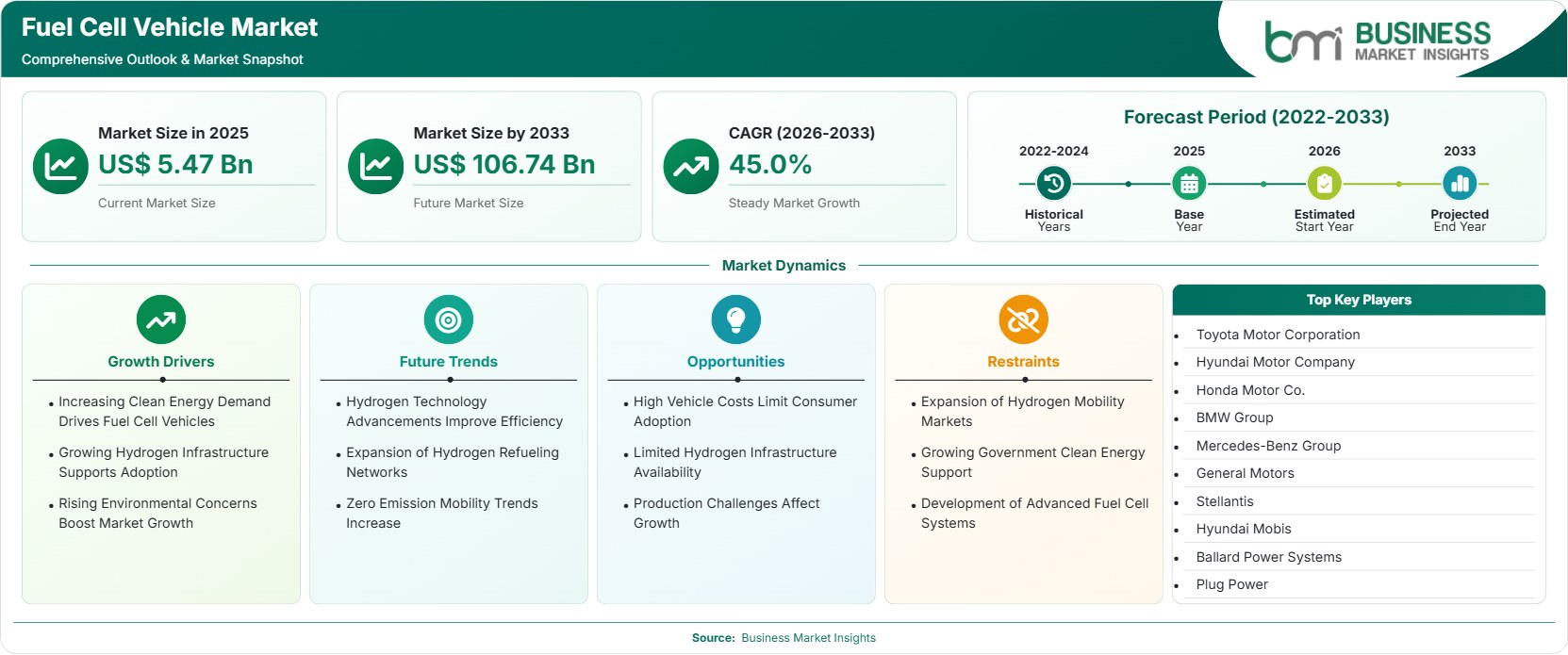
The Fuel Cell Vehicle Market size was valued at US$ 5.47 billion in 2025 and is projected to reach US$ 106.74 billion by 2033, growing at a CAGR of 45.0% during 2026–2033. Rising decarbonization initiatives, expanding hydrogen refueling infrastructure, and increasing investments in zero-emission mobility are accelerating market adoption, while technological advancements in fuel cell systems and supportive government policies create substantial opportunities across passenger and commercial transportation.

Report Coverage
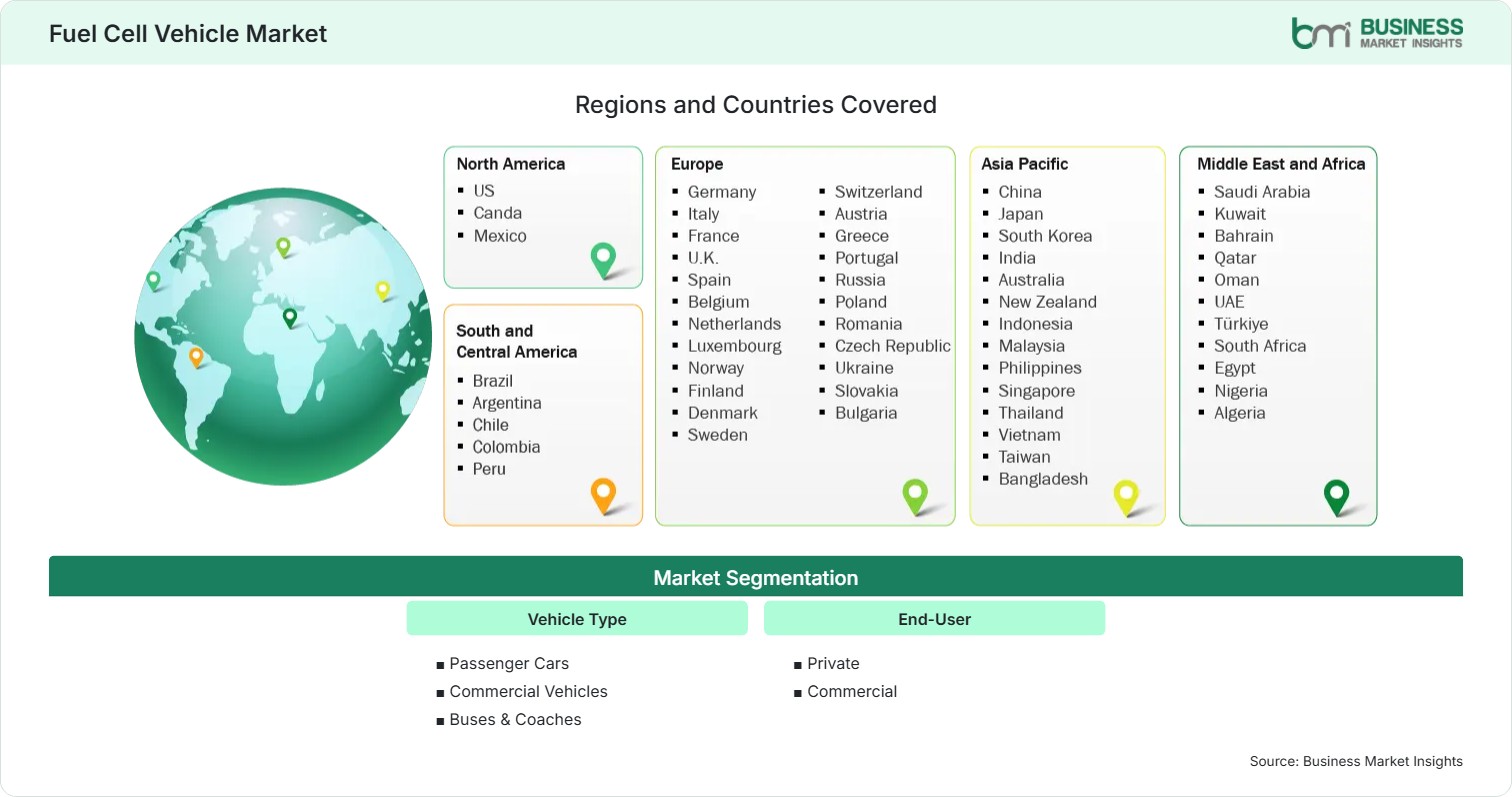
  • Vehicle Type: Passenger Cars, Commercial Vehicles, Buses & Coaches
  • End-User: Private, Commercial
US$ 5.47 Bn Market size in 2025
US$ 106.74 Bn Market Size by 2033
45.0% CAGR, 2026 - 2033
2026-2033 Forecast Period

01 AI Overview

Fuel Cell Vehicle Market Summary

  • North America Region: North America holds 30%–33% market share in 2025 and is expected to register a CAGR of 42.8%–43.6% during 2026–2033, supported by increasing hydrogen infrastructure investments, clean transportation policies, and commercialization of fuel cell-powered commercial vehicles. The United States dominates the regional market with a CAGR of 43.1%–43.9%, driven by federal hydrogen initiatives, fleet electrification programs, and expanding investments in heavy-duty transportation.
  • Fastest Growing Region: Asia Pacific accounts for 38%–41% market share in 2025 while recording a CAGR of 46.8%–47.7% through 2033, driven by government-backed hydrogen roadmaps, expanding fuel cell manufacturing, large-scale infrastructure investments, and strong demand for zero-emission mobility solutions.
  • Leading Segment: Passenger Cars hold 48%–51% market share in 2025 and are projected to expand at a CAGR of 44.2%–45.0%, supported by technological improvements in fuel cell efficiency, extended driving range, and increasing consumer interest in sustainable transportation.
  • High Growth Segment: Commercial Vehicles account for 31%–34% market share in 2025 and are anticipated to grow at a CAGR of 47.8%–48.6%, owing to fleet decarbonization initiatives, increasing hydrogen truck deployment, and growing adoption across logistics and freight transportation.
  • Key Market Opportunity: Increasing investment in green hydrogen production, integrated hydrogen mobility ecosystems, and large-scale refueling infrastructure is creating long-term opportunities for fuel cell vehicle manufacturers, component suppliers, and hydrogen technology developers.
  • Major Market Players: Toyota Motor Corporation, Hyundai Motor Company, Honda Motor Co., Ltd., BMW Group, Mercedes-Benz Group AG, General Motors Company, Stellantis N.V., Hyundai Mobis Co., Ltd., Ballard Power Systems Inc., Plug Power Inc.
02 Strategic Insights

Fuel Cell Vehicle Market: Strategic Insights

fuel-cell-vehicle-market-market-strategic-framework
FREE PDF
Request your free sample
Request free sample
03 Stakeholder View

Key Takeaways

1. The market ecosystem is evolving through close collaboration among automotive manufacturers, fuel cell developers, hydrogen producers, infrastructure operators, and government agencies, creating integrated hydrogen mobility value chains capable of supporting long-term commercialization.

2. Commercial transportation and heavy-duty mobility present the strongest long-term growth opportunities as fleet operators increasingly seek zero-emission alternatives capable of delivering long driving range, rapid refueling, and reliable operational performance.

3. Continuous innovation in fuel cell stacks, hydrogen storage systems, lightweight materials, and thermal management technologies is improving vehicle efficiency, durability, and lifecycle economics while accelerating commercialization across multiple transportation segments.

4. Asia Pacific remains the most attractive investment destination because of strong policy support, expanding hydrogen infrastructure, established automotive manufacturing capabilities, and ambitious national hydrogen economy roadmaps in countries such as Japan, South Korea, and China.

5. Strategic partnerships among automotive OEMs, hydrogen suppliers, and energy companies continue accelerating deployment of hydrogen refueling networks while reducing commercialization barriers through shared infrastructure investments and collaborative technology development.

6. Increasing focus on green hydrogen production, renewable energy integration, and large-scale hydrogen distribution networks is expected to strengthen the long-term competitiveness of fuel cell mobility within the global zero-emission transportation ecosystem.

04 Geographic Outlook

Fuel Cell Vehicle Market Regional Highlights

North America Fuel Cell Vehicle Market

North America accounts for 30%–33% of the Fuel Cell Vehicle Market share in 2025 and is anticipated to register a CAGR of 42.8%–43.6% during 2026–2033. The region benefits from expanding hydrogen production projects, supportive clean transportation policies, and increasing investments in heavy-duty fuel cell mobility. Government funding for hydrogen hubs and growing participation from automotive manufacturers, energy companies, and fleet operators continue strengthening regional commercialization while accelerating deployment of hydrogen-powered transportation solutions.

  • The United States and Canada continue investing in hydrogen production, storage, and refueling infrastructure to support commercialization of fuel cell passenger vehicles, trucks, buses, and industrial transportation applications across multiple sectors.
  • Heavy-duty transportation remains a major adoption area as logistics companies increasingly evaluate hydrogen-powered trucks capable of offering longer driving ranges and significantly shorter refueling times than battery-powered alternatives.
  • Public funding programs supporting hydrogen hubs, clean energy infrastructure, and zero-emission transportation continue encouraging automotive manufacturers and technology providers to accelerate fuel cell vehicle deployment.
  • Strategic collaborations among automakers, hydrogen suppliers, and infrastructure developers are strengthening integrated hydrogen mobility ecosystems while reducing commercialization barriers for fleet operators.
  • Continuous advancements in fuel cell stack durability, hydrogen storage technologies, and vehicle efficiency support wider deployment across commercial transportation, municipal fleets, and industrial logistics operations.

US Fuel Cell Vehicle Market

The United States represents the largest contributor within North America, accounting for 24%–27% of global revenue while expanding at a CAGR of 43.1%–43.9% through 2033. Federal efforts in hydrogen, increased investments in clean energy infrastructure, commercial fleets decarbonization efforts, and increased use of hydrogen fueling stations continue to facilitate growth in the market.

  • Hydrogen hub investments are encouraging development of integrated production, transportation, and refueling networks that improve fuel accessibility and strengthen long-term commercial viability.
  • Commercial fleet operators continue evaluating fuel cell trucks for long-haul freight transportation because of rapid refueling capability, extended driving range, and improved operational efficiency.
  • Automotive manufacturers increasingly collaborate with energy companies to accelerate deployment of hydrogen-powered mobility solutions supported by scalable fueling infrastructure.
  • Continued investment in clean transportation technologies strengthens innovation across hydrogen production, fuel cell system development, and next-generation zero-emission vehicle platforms.

Europe Fuel Cell Vehicle Market

Europe contributes 23%–26% market share in 2025 and is projected to expand at a CAGR of 44.0%–44.8% during the forecast period. Strict climate policies, aggressive carbon neutrality goals, and increasing investments in hydrogen energy infrastructure remain some of the main forces contributing to the continued adoption. Germany has been leading regional demand owing to its highly developed automotive industry manufacturing capacities, whereas the Netherlands has registered the highest CAGR of 46.0% - 46.8%.

  • European hydrogen strategies continue encouraging deployment of fuel cell buses, trucks, passenger vehicles, and industrial transport solutions across public and private transportation networks.
  • Automotive manufacturers increasingly integrate hydrogen technologies into their long-term decarbonization strategies while expanding collaborative research on next-generation fuel cell systems.
  • Investments in renewable hydrogen production strengthen long-term sustainability by supporting low-carbon fuel availability for transportation and industrial mobility applications.
  • Public transportation authorities continue adopting hydrogen-powered buses to reduce emissions while maintaining operational flexibility and rapid refueling capability.
  • Cross-border hydrogen infrastructure development strengthens regional connectivity and supports commercialization of fuel cell mobility across multiple European markets.

Asia Pacific Fuel Cell Vehicle Market

Asia Pacific captures 38%–41% of global revenue in 2025 while registering the highest CAGR of 46.8%–47.7% through 2033. China still holds the record for being the largest regional market, owing to the numerous hydrogen mobility investments made, while South Korea experiences the highest growth rate, with a CAGR of 48.2% - 49.0%, owing to the country’s policies on hydrogen economy and automobile innovations.

  • Government-backed hydrogen economy roadmaps continue accelerating investments in production facilities, refueling infrastructure, and fuel cell manufacturing capabilities throughout the region.
  • Automotive manufacturers are expanding commercial production of hydrogen-powered passenger vehicles, buses, and heavy-duty trucks to address rising zero-emission transportation demand.
  • Rapid development of hydrogen refueling networks improves consumer confidence while supporting broader commercialization of fuel cell mobility across urban and intercity transportation corridors.
  • Growing investment in renewable hydrogen production strengthens long-term sustainability while reducing lifecycle emissions associated with fuel cell transportation.
  • Public-private partnerships continue promoting research, technology commercialization, and infrastructure expansion to establish comprehensive hydrogen mobility ecosystems.

Rest of World Fuel Cell Vehicle Market

The Rest of World region accounts for 8%–11% of global revenue in 2025 and is projected to register a CAGR of 44.5%–45.3% during 2026–2033. South & Central America continue witnessing early-stage hydrogen mobility development, while the Middle East and Africa are expanding investments in green hydrogen production and clean transportation infrastructure to support long-term market growth.

The United Arab Emirates leads regional hydrogen mobility initiatives and records the fastest CAGR of 46.2%–47.0%, driven by national clean energy policies, investment in renewable hydrogen, and infrastructure upgrades. Brazil is the leading South and Central American market due to growing demand for sustainable transport and the hydrogen industry.

  • National hydrogen strategies continue encouraging investment in production facilities, export infrastructure, and transportation applications supporting future hydrogen mobility deployment.
  • Green hydrogen projects backed by renewable energy resources strengthen long-term opportunities for fuel cell transportation while supporting national decarbonization objectives.
  • Governments increasingly collaborate with international automotive manufacturers and technology providers to accelerate commercialization of hydrogen-powered vehicles and supporting infrastructure.
  • Expansion of commercial logistics, public transportation modernization, and industrial development creates favorable conditions for future adoption of hydrogen-powered mobility solutions.
  • Growing foreign investment in hydrogen production, storage, and distribution networks supports development of integrated hydrogen value chains capable of sustaining long-term market expansion.
global-market-geography
FREE PDF
Request your free sample
Request free sample
05 Segment Analysis

Fuel Cell Vehicle Market Segmentation

Vehicle Type

The Vehicle Type segment represents the primary demand driver for fuel cell mobility, with adoption varying according to transportation requirements, driving range, payload capacity, and operational efficiency. The segment is expected to expand at a CAGR of 45.3%–46.1% during the forecast period, supported by technological advancements and growing commercialization of hydrogen-powered transportation. The Fuel Cell Vehicle Market scope continues to broaden as governments and manufacturers accelerate investments in zero-emission mobility solutions across passenger and commercial transportation.

  • Passenger Cars: Passenger cars remain the largest segment due to increasing consumer awareness of zero-emission transportation, improvements in fuel cell efficiency, longer driving ranges, and expanding availability of hydrogen-powered vehicle models from global automotive manufacturers.
  • Commercial Vehicles: Commercial vehicles continue gaining strong momentum as logistics companies, freight operators, and fleet owners increasingly adopt hydrogen-powered trucks to reduce emissions while maintaining long operating range and fast refueling capability.
  • Buses & Coaches: Hydrogen-powered buses and coaches are witnessing growing deployment across urban transit systems as municipalities prioritize low-emission public transportation supported by government funding and expanding hydrogen refueling infrastructure.

End-User

End-user demand continues evolving as hydrogen mobility expands beyond pilot deployments toward commercial-scale adoption. This segment is anticipated to register a CAGR of 45.8%–46.6% during 2026–2033, supported by increasing investments in hydrogen infrastructure and favorable clean mobility policies. Growing fleet electrification initiatives continue supporting Fuel Cell Vehicle Market trends across both private ownership and commercial transportation sectors.

  • Private: Private adoption is gradually increasing as consumers seek long-range zero-emission vehicles offering rapid refueling, improved driving performance, and reduced environmental impact compared with conventional internal combustion engine vehicles.
  • Commercial: Commercial operators remain the fastest-growing end-user group owing to increasing fleet decarbonization strategies, expanding hydrogen refueling infrastructure, and operational advantages in logistics, public transportation, municipal services, and heavy-duty freight applications.
06 Market Forces

Fuel Cell Vehicle Market Dynamics

Key Market Drivers

Increasing Clean Energy Demand Drives Fuel Cell Vehicles

The global transition toward clean energy continues accelerating demand for hydrogen-powered transportation as governments and industries pursue ambitious decarbonization targets. According to the International Energy Agency (IEA), hydrogen is expected to play an increasingly important role in achieving net-zero emissions across hard-to-abate sectors, including transportation. This shift directly supports Fuel Cell Vehicle Market growth as fuel cell vehicles offer zero tailpipe emissions, long driving ranges, and rapid refueling compared with conventional vehicles. Increasing renewable energy deployment also strengthens green hydrogen production, creating favorable conditions for wider commercialization of hydrogen mobility across passenger and commercial transportation.

Growing Hydrogen Infrastructure Supports Adoption

Expansion of hydrogen production facilities, storage systems, and refueling stations continues improving the commercial viability of fuel cell transportation. Governments, energy companies, and automotive manufacturers are investing in comprehensive hydrogen ecosystems to ensure reliable fuel availability for consumers and commercial fleet operators. New hydrogen corridors supporting long-distance freight transportation further strengthen Fuel Cell Vehicle Market confidence by addressing refueling accessibility concerns. Continuous infrastructure development enables broader deployment of fuel cell passenger vehicles, buses, and heavy-duty trucks while supporting long-term expansion of the global hydrogen mobility ecosystem.

Rising Environmental Concerns Boost Market Growth

Awareness of greenhouse gas emissions, urban air pollution, and global warming is making more governments, companies, and individuals turn to sustainable transport options. Fuel cell cars play their part in emissions-reduction efforts by emitting only water vapor and enabling the use of renewable hydrogen. Car makers keep investing in hydrogen-based solutions for transport to supplement their battery electric car lineup. Strong environmental commitments across developed and emerging economies continue reinforcing long-term Fuel Cell Vehicle Market growth prospects.

Key Market Opportunities

Expansion of Hydrogen Mobility Markets

Hydrogen mobility ecosystems continue expanding across Asia Pacific, Europe, and North America through coordinated investments in vehicles, refueling stations, hydrogen production, and distribution infrastructure. Growing deployment of hydrogen-powered buses, trucks, trains, and passenger vehicles creates strong Fuel Cell Vehicle Market Forecasts as public and private stakeholders accelerate commercialization efforts. Emerging economies are also introducing hydrogen mobility roadmaps, creating additional opportunities for automotive manufacturers, fuel cell technology developers, and infrastructure providers seeking long-term market expansion.

Growing Government Clean Energy Support

Governments worldwide continue introducing financial incentives, tax benefits, purchase subsidies, and infrastructure funding programs to accelerate hydrogen adoption. National hydrogen strategies increasingly prioritize fuel cell transportation as part of broader energy transition objectives. Public funding for research, manufacturing, and hydrogen production facilities encourages technological innovation while reducing commercialization barriers. Continued policy support is expected to strengthen investor confidence and create sustainable long-term growth opportunities throughout the hydrogen mobility value chain.

Development of Advanced Fuel Cell Systems

Continuous advancements in fuel cell stack design, catalyst materials, membrane durability, hydrogen storage technologies, and thermal management systems are significantly improving vehicle performance and operating efficiency. These innovations reduce system weight, increase energy conversion efficiency, and extend component lifespan while lowering total ownership costs over time. Manufacturers investing in next-generation fuel cell technologies are expected to gain competitive advantages as commercialization expands across passenger transportation, heavy-duty vehicles, and public transit applications.

Market Restraints and Challenges

High Vehicle Costs Limit Consumer Adoption

Factor: Fuel cell vehicles require advanced fuel cell stacks, hydrogen storage tanks, specialized power electronics, and lightweight materials, resulting in substantially higher manufacturing costs than conventional vehicles and many battery electric alternatives. Impact: High vehicle prices remain a significant barrier for widespread consumer adoption, particularly in price-sensitive markets. Although technological advancements and manufacturing scale are expected to reduce production costs over time, current acquisition expenses limit Fuel Cell Vehicle Market penetration among individual buyers and smaller commercial fleet operators. Continued government incentives and technological innovation remain essential to improving long-term affordability.

Limited Hydrogen Infrastructure Availability

Factor: Hydrogen refueling infrastructure remains limited across many countries, with insufficient station coverage restricting convenient access for both private consumers and commercial fleet operators. Impact: Limited refueling availability reduces consumer confidence and slows commercial deployment despite technological advancements in fuel cell vehicles. Expanding hydrogen production, transportation, storage, and refueling infrastructure requires substantial long-term investment and coordinated collaboration among governments, energy companies, infrastructure developers, and automotive manufacturers. Until comprehensive hydrogen networks are established, infrastructure constraints are expected to remain a key challenge affecting broader Fuel Cell Vehicle Market adoption.

07 Company Analysis

Competitive Landscape

The competitive landscape is evolving rapidly as automotive manufacturers, hydrogen technology developers, and fuel cell system suppliers accelerate investments in zero-emission mobility solutions. The Fuel Cell Vehicle Market analysis indicates that leading companies are strengthening their competitive position through strategic partnerships, fuel cell technology advancements, hydrogen infrastructure collaborations, and commercialization of next-generation passenger and commercial fuel cell vehicles.

Company Name

Overview

Products and Services Relevant to this Market

Toyota Motor Corporation

Global automotive manufacturer pioneering hydrogen fuel cell technology and sustainable mobility solutions across passenger and commercial transportation.

Fuel cell passenger vehicles, hydrogen fuel cell systems, hydrogen powertrains, mobility solutions, and hydrogen technology development.

Hyundai Motor Company

Leading automotive company investing extensively in hydrogen mobility, advanced fuel cell systems, and commercial zero-emission transportation.

Fuel cell passenger vehicles, hydrogen trucks, fuel cell systems, hydrogen mobility solutions, and commercial vehicle technologies.

Honda Motor Co., Ltd.

Japanese automotive manufacturer focused on fuel cell innovation and next-generation sustainable transportation technologies.

Fuel cell electric vehicles, hydrogen powertrains, advanced propulsion technologies, and clean mobility solutions.

BMW Group

Premium automotive manufacturer developing hydrogen-powered vehicles alongside battery electric mobility technologies.

Hydrogen prototype vehicles, fuel cell integration technologies, premium mobility solutions, and sustainable vehicle platforms.

Mercedes-Benz Group AG

Global automotive manufacturer expanding hydrogen technologies for commercial transportation and sustainable mobility applications.

Fuel cell commercial vehicle technologies, hydrogen mobility systems, advanced automotive engineering, and zero-emission transportation solutions.

General Motors Company

Automotive technology company investing in hydrogen fuel cell platforms through strategic partnerships and commercial mobility initiatives.

Fuel cell systems, hydrogen propulsion technologies, commercial mobility platforms, and advanced vehicle engineering solutions.

Stellantis N.V.

Global mobility company advancing hydrogen-powered light commercial vehicles and sustainable transportation technologies.

Hydrogen commercial vans, fuel cell propulsion systems, zero-emission mobility technologies, and fleet transportation solutions.

Hyundai Mobis Co., Ltd.

Automotive component manufacturer specializing in hydrogen fuel cell modules and advanced mobility technologies.

Fuel cell power modules, hydrogen components, vehicle electrification systems, and automotive technology solutions.

Ballard Power Systems Inc.

Global fuel cell technology company supplying proton exchange membrane fuel cell solutions for transportation applications.

Fuel cell stacks, fuel cell engines, hydrogen propulsion systems, heavy-duty mobility solutions, and engineering services.

Plug Power Inc.

Hydrogen technology company providing integrated hydrogen ecosystem solutions supporting transportation and industrial applications.

Hydrogen production, fuel cell systems, hydrogen refueling technologies, electrolyzers, and integrated hydrogen infrastructure solutions.

08 Industry Activity

Recent Developments

July 2026

Hyundai Motor Company secured three honors at the Red Dot Award: Design Concept 2026, with its MobED Urban Hopper and MobED Golf concepts receiving the Best of the Best award (and a Luminary nomination).

February 2025

Toyota Motor Corporation developed its third-generation fuel cell (3rd Gen FC) system, offering improved durability, higher fuel efficiency, and lower costs for passenger vehicles, commercial vehicles, rail, marine, and stationary power applications.

May 2024

Plug Power unveiled the integration of a Class 6 medium-duty fuel cell electric truck powered by its ProGen fuel cell technology. The truck is designed to deliver up to 500 miles of range with rapid refueling, supporting zero-emission commercial transportation and accelerating hydrogen-powered fleet adoption.

April 2024

Ballard Power Systems signed a Long-Term Supply Agreement (LTSA) with Solaris Bus & Coach to supply 1,000 hydrogen fuel cell engines through 2027 for the European transit bus market.

10 Trust & Transparency

Research Methodology

The market analysis combines proprietary research with secondary data from government agencies, company disclosures, regulatory filings, industry databases and expert interviews. Market estimates are validated through data triangulation, cross-market benchmarking and analyst review.

View Full Research Methodology

11 Questions Answered

Frequently Asked Questions

How does the Fuel Cell Vehicle Market Report support strategic planning?

The Fuel Cell Vehicle Report provides comprehensive insights into market dynamics, technology trends, regional opportunities, competitive benchmarking, industry segmentation, and future growth prospects, enabling stakeholders to make informed investment and business decisions.

Which region is expected to witness the fastest market expansion?

Asia Pacific is projected to record the fastest growth owing to strong government hydrogen strategies, expanding refueling infrastructure, advanced automotive manufacturing capabilities, and increasing investments in clean mobility technologies.

Why are commercial fuel cell vehicles growing rapidly?

Commercial vehicles benefit from rapid hydrogen refueling, long operating range, high payload capability, and lower downtime, making them well suited for logistics, freight transportation, municipal services, and public transit applications.

Which vehicle type dominates the market?

Passenger Cars represent the leading vehicle segment due to increasing commercialization by major automotive manufacturers, improving fuel cell efficiency, longer driving range, and expanding consumer awareness of hydrogen-powered mobility.

What factors are driving the Fuel Cell Vehicle Market?

Growing investments in hydrogen infrastructure, stringent emission regulations, rising demand for zero-emission transportation, government incentives, and continuous improvements in fuel cell technology are the primary factors accelerating market growth.

Access the Full Fuel Cell Vehicle Market Report

Get segment-level forecasts, regional estimates, competitive benchmarking, company profiles and downloadable Excel datasets.

Access the full Fuel Cell Vehicle Market Report
350 pages PDF & Excel | 2026-07-28