
Flex Fuel Vehicle Market Outlook: Size, Share, Trends, Growth Analysis, Competitive Landscape & Forecast, 2026-2033

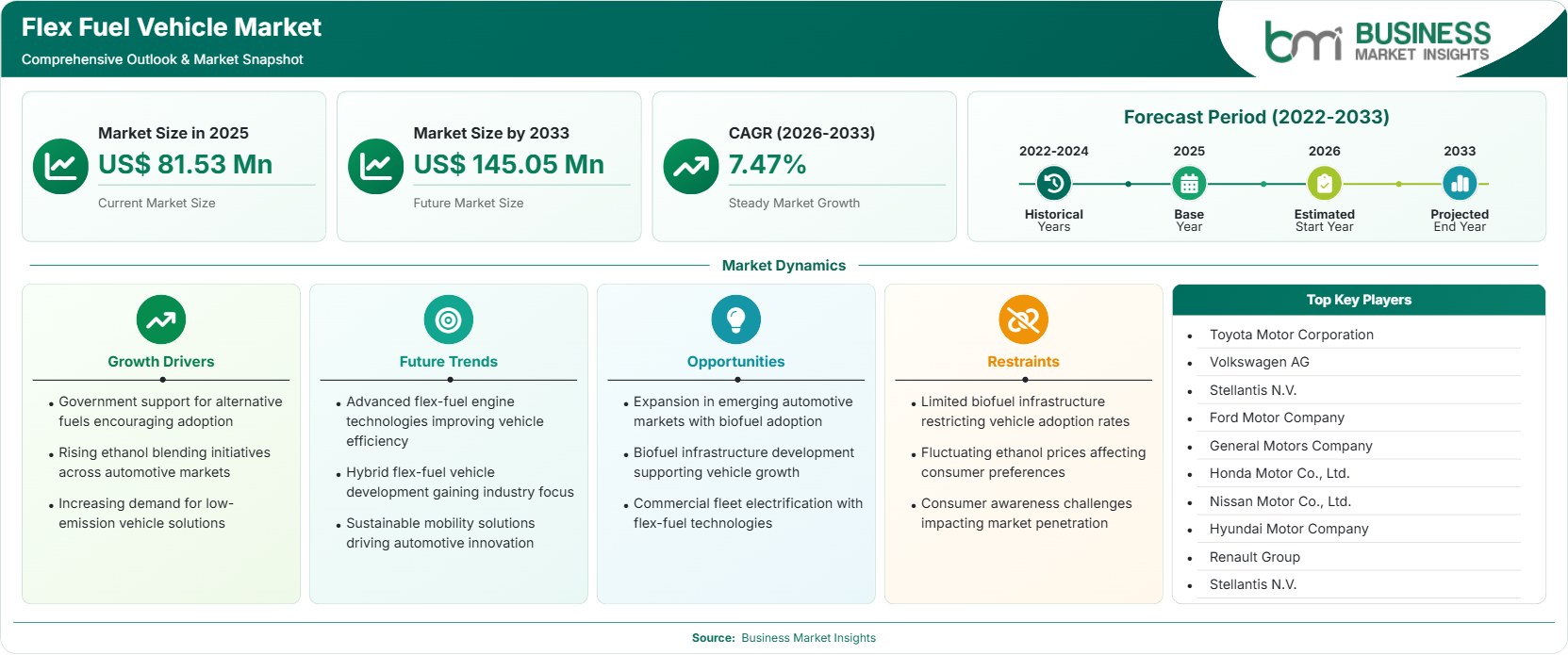
The Flex Fuel Vehicle Market size was valued at US$ 81.53 billion in 2025 and is projected to reach US$ 145.05 billion by 2033, registering a CAGR of 7.47% during 2026–2033. The market is experiencing steady expansion driven by government support for alternative fuels encouraging adoption, rising ethanol blending initiatives across automotive markets, and increasing demand for low-emission vehicle solutions. Flex fuel vehicles (FFVs) are gaining wider acceptance as governments and automotive manufacturers seek practical pathways to reduce greenhouse gas emissions, diversify transportation fuel sources, and improve energy security while utilizing existing internal combustion engine platforms.

Report Coverage
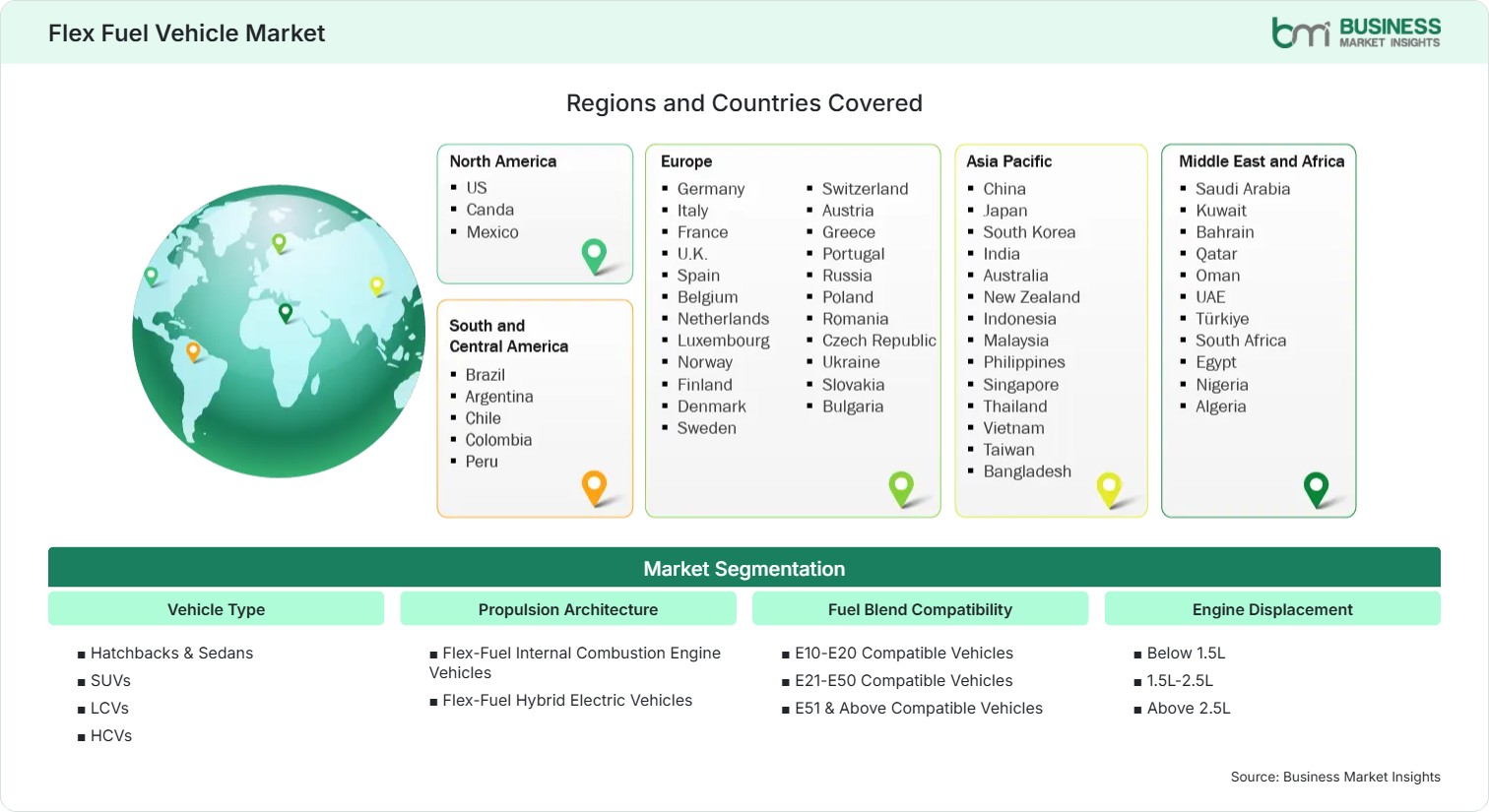
  • Vehicle Type: Hatchbacks & Sedans, SUVs, LCVs, HCVs
  • Propulsion Architecture: Flex-Fuel Internal Combustion Engine Vehicles, Flex-Fuel Hybrid Electric Vehicles
  • Fuel Blend Compatibility: E10-E20 Compatible Vehicles, E21-E50 Compatible Vehicles, E51 & Above Compatible Vehicles
  • Engine Displacement: Below 1.5L, 1.5L-2.5L, Above 2.5L
US$ 81.53 Mn Market size in 2025
US$ 145.05 Mn Market Size by 2033
7.47% CAGR, 2026 - 2033
2026-2033 Forecast Period

AI Overview

Flex Fuel Vehicle Market Summary

  • North America Region: North America accounted for 31%–34% of global revenue in 2025 and is projected to register a CAGR of 7.1%–7.6% during 2026–2033. The region maintains a strong market position due to established ethanol infrastructure, supportive renewable fuel regulations, widespread FFV deployment, and increasing consumer awareness regarding alternative fuels. The United States contributes approximately 86%–89% of regional revenue and is expected to register a CAGR of 7.2%–7.7% owing to expanding ethanol blending programs, strong automotive production, and growing adoption of renewable transportation fuels.
  • Fastest Growing Region: Asia Pacific represented 25%–28% of global revenue in 2025 and is projected to register the highest CAGR of 8.1%–8.6% during the forecast period. Expanding government biofuel initiatives, increasing vehicle production, growing ethanol blending mandates, and rising environmental awareness continue driving regional market growth.
  • Leading Segment: Flex-Fuel Internal Combustion Engine (ICE) Vehicles accounted for 73%–76% of market revenue in 2025 and are projected to register a CAGR of 7.3%–7.8% during the assessment period owing to their established commercial availability, lower acquisition costs, and compatibility with expanding ethanol fuel infrastructure.
  • High Growth Segment: Flex-Fuel Hybrid Electric Vehicles (HEVs/PHEVs) are projected to witness significant growth, expanding at a CAGR of 9.0%–9.6% during 2026–2033 due to increasing demand for low-emission mobility solutions, improved fuel efficiency, and growing investments in hybrid vehicle technologies.
  • Key Market Opportunity: Expansion in emerging automotive markets with biofuel adoption, biofuel infrastructure development supporting vehicle growth, and commercial fleet electrification with flex-fuel technologies continue creating substantial market opportunities.
  • Major Market Players: Toyota Motor Corporation, Volkswagen AG, Stellantis N.V., Ford Motor Company, General Motors Company, Honda Motor Co., Ltd., Nissan Motor Co., Ltd., Hyundai Motor Company, Renault Group, Fiat Automóveis S.A.
Strategic Insights

Flex Fuel Vehicle Market: Strategic Insights

Flex Fuel Vehicle Market Strategic Framework
FREE PDF
Request your free sample
Request free sample
Stakeholder View

Key Takeaways

  • The market continues benefiting from government support for alternative fuels encouraging adoption, rising ethanol blending initiatives across automotive markets, and increasing demand for low-emission vehicle solutions.
  • The strongest Flex Fuel Vehicle Market Growth opportunities continue emerging from expansion in emerging automotive markets with biofuel adoption, biofuel infrastructure development, and commercial fleet electrification with flex-fuel technologies.
  • Flex-Fuel Internal Combustion Engine (ICE) Vehicles remain the dominant propulsion architecture owing to established manufacturing capabilities, widespread market availability, and compatibility with existing ethanol fuel infrastructure.
  • Asia Pacific is projected to witness the fastest growth owing to expanding ethanol blending policies, increasing automotive production, supportive government initiatives, and growing consumer demand for cleaner transportation solutions.
  • Automotive manufacturers are increasingly investing in advanced flex fuel engine technologies, hybrid propulsion systems, intelligent fuel management, and low-emission vehicle platforms to strengthen market competitiveness.
  • Companies focusing on renewable fuel compatibility, hybrid vehicle innovation, sustainable mobility strategies, and expanding biofuel ecosystems are expected to strengthen their competitive positioning.
Geographic Outlook

Flex Fuel Vehicle Market Regional Highlights

North America Flex Fuel Vehicle Market

North America accounted for 31%–34% of global revenue in 2025 and is projected to register a CAGR of 7.1%–7.6% during 2026–2033. The region continues maintaining a strong market position due to well-established ethanol production, supportive renewable fuel regulations, widespread adoption of flex fuel vehicles, and expanding biofuel distribution infrastructure. The Flex Fuel Vehicle Market Share remains significant as governments and automotive manufacturers continue promoting alternative fuels to reduce transportation emissions and improve energy security.

  • The United States remains the largest regional market owing to strong ethanol production capacity, renewable fuel standards, expanding FFV deployment, and increasing consumer awareness regarding alternative fuels.
  • Canada continues supporting regional growth through renewable fuel regulations, increasing ethanol blending initiatives, and growing adoption of sustainable transportation technologies.
  • Rising investments in ethanol production facilities and biofuel infrastructure continue strengthening long-term vehicle adoption.
  • Increasing collaboration between automotive manufacturers and fuel suppliers continues supporting wider market expansion.

US Flex Fuel Vehicle Market

The United States accounted for approximately 86%–89% of North American revenue in 2025 and is projected to register a CAGR of 7.2%–7.7% during the forecast period. Strong renewable fuel policies, advanced automotive manufacturing capabilities, expanding ethanol infrastructure, and increasing government support for alternative fuels continue driving domestic market growth.

  • Expanding ethanol blending mandates continue encouraging broader adoption of flex fuel vehicle technologies.
  • Growing availability of higher ethanol fuel blends is improving operational flexibility for vehicle owners.
  • Increasing investments in sustainable mobility and renewable transportation fuels continue supporting long-term flex fuel vehicle market growth.
  • Automotive manufacturers continue introducing new FFV models equipped with advanced engine management technologies and improved fuel compatibility.

Europe Flex Fuel Vehicle Market

Europe represented 27%–30% of global revenue in 2025 and is expected to expand at a CAGR of 6.9%–7.4% during 2026–2033. The region continues benefiting from ambitious carbon reduction policies, renewable energy directives, increasing biofuel utilization, and growing investments in sustainable transportation solutions. France remains the largest regional market, while Sweden is projected to register the fastest growth with a CAGR of 7.8%–8.3% owing to supportive renewable fuel policies, strong environmental initiatives, and expanding biofuel infrastructure.

  • France continues leading regional demand through established biofuel programs, strong automotive manufacturing, and increasing ethanol fuel utilization.
  • Sweden continues witnessing rapid growth through progressive renewable fuel regulations, expanding ethanol infrastructure, and growing adoption of sustainable transportation technologies.
  • Germany continues supporting flex fuel vehicle market expansion through automotive innovation, emission reduction initiatives, and investments in alternative fuel technologies.
  • European automakers continue investing in advanced flex fuel technologies alongside hybrid and electrified vehicle development.
  • Increasing decarbonization initiatives continue encouraging wider adoption of renewable transportation fuels across the region.

Asia Pacific Flex Fuel Vehicle Market

Asia Pacific accounted for 25%–28% of global revenue in 2025 and is projected to register the highest CAGR of 8.1%–8.6% during the forecast period. Expanding government biofuel programs, increasing vehicle production, growing ethanol blending mandates, and rising environmental awareness continue driving regional market growth. China remains the leading regional market, while India is projected to register the fastest growth with a CAGR of 8.7%–9.2% owing to aggressive ethanol blending targets, expanding automotive manufacturing, and increasing renewable fuel investments.

  • China continues dominating regional demand through strong automotive production, renewable energy investments, and increasing adoption of alternative fuel technologies.
  • India continues witnessing rapid growth due to government ethanol blending initiatives, expanding vehicle production, rising consumer awareness, and supportive automotive policies.
  • Japan continues supporting advanced vehicle technology development through investments in hybrid propulsion systems and sustainable mobility solutions.
  • South Korea continues contributing through automotive innovation, biofuel research, and expanding low-emission vehicle production.
  • Southeast Asian countries continue creating new opportunities through increasing automotive demand, renewable fuel adoption, and expanding biofuel infrastructure.

Rest of World Flex Fuel Vehicle Market

The Rest of World accounted for 9%–11% of global revenue in 2025 and is projected to register a CAGR of 7.2%–7.7% during 2026–2033. Latin America, the Middle East, and Africa continue experiencing increasing adoption of flex fuel vehicles due to expanding ethanol production, supportive government policies, and growing demand for sustainable transportation solutions.

Increasing investments in renewable fuel production, vehicle manufacturing, and biofuel distribution infrastructure are creating substantial opportunities for flex fuel vehicle manufacturers across emerging economies.

  • Brazil continues supporting regional demand through its globally recognized ethanol industry, extensive flex fuel vehicle adoption, and mature biofuel infrastructure.
  • Argentina continues strengthening market growth through expanding biofuel production, supportive renewable fuel regulations, and increasing automotive investments.
  • Middle Eastern countries continue exploring renewable transportation fuel strategies to diversify energy resources and reduce emissions.
  • South Africa continues contributing through growing renewable fuel initiatives, expanding automotive markets, and increasing government sustainability programs.
  • Emerging economies across Latin America, the Middle East, and Africa continue creating long-term opportunities through expanding ethanol production, supportive regulatory frameworks, and increasing vehicle ownership.
Global Market Geography
FREE PDF
Request your free sample
Request free sample
Segment Analysis

Flex Fuel Vehicle Market Segmentation

Vehicle Type

The Vehicle Type segment continues witnessing steady expansion as automotive manufacturers introduce flex fuel models across multiple passenger and commercial vehicle categories. Rising ethanol blending mandates, increasing consumer awareness regarding alternative fuels, and expanding automotive production continue supporting market growth. The Flex Fuel Vehicle Market Trends indicate increasing integration of advanced engine management systems, improved fuel efficiency technologies, and broader model availability across global automotive markets.

  • Hatchbacks & Sedans: Hatchbacks & Sedans remain the dominant vehicle type, accounting for 43%–46% of market revenue in 2025, and are projected to register a CAGR of 7.4%–7.9% during the forecast period. Strong consumer demand, affordability, fuel efficiency, and extensive availability across both developed and emerging markets continue supporting segment leadership.
  • SUVs: SUVs continue witnessing strong growth owing to increasing consumer preference for larger passenger vehicles, higher vehicle versatility, and expanding availability of flex fuel SUV models across global automotive markets.
  • LCVs: LCVs continue supporting market expansion as commercial operators increasingly adopt flex fuel technologies to improve fuel flexibility, reduce operating emissions, and comply with evolving environmental regulations.
  • HCVs: HCVs continue gaining traction through growing utilization in logistics, freight transportation, public transportation, and commercial fleet operations requiring alternative fuel solutions.

Propulsion Architecture

The Propulsion Architecture segment continues evolving as manufacturers combine renewable fuel compatibility with advanced powertrain technologies. The Flex Fuel Vehicle Market Scope continues expanding through increasing investments in hybrid technologies, emission reduction solutions, and intelligent engine management systems.

  • Flex-Fuel Internal Combustion Engine (ICE) Vehicles: Flex-Fuel Internal Combustion Engine (ICE) Vehicles remain the leading propulsion architecture owing to established manufacturing capabilities, lower acquisition costs, extensive commercial availability, and compatibility with existing ethanol fueling infrastructure.
  • Flex-Fuel Hybrid Electric Vehicles (HEVs/PHEVs): Flex-Fuel Hybrid Electric Vehicles (HEVs/PHEVs) are projected to witness the fastest growth due to increasing demand for low-emission mobility, improved fuel economy, government incentives supporting hybrid adoption, and growing investments in sustainable transportation technologies.

Fuel Blend Compatibility

The Fuel Blend Compatibility segment continues expanding as governments implement higher ethanol blending mandates and fuel suppliers improve biofuel availability across transportation networks.

  • E10-E20 Compatible Vehicles: E10-E20 Compatible Vehicles remain the dominant segment owing to widespread implementation of low-to-medium ethanol blending mandates across numerous global automotive markets.
  • E21-E50 Compatible Vehicles: E21-E50 Compatible Vehicles continue witnessing steady growth due to increasing adoption of higher ethanol blends in countries expanding renewable fuel programs and alternative fuel infrastructure.
  • E51 & Above Compatible Vehicles: E51 & Above Compatible Vehicles are gaining increasing attention in regions with mature ethanol industries, allowing consumers to utilize high-concentration ethanol fuels while reducing dependence on conventional gasoline.

Engine Displacement

The Engine Displacement segment continues diversifying as manufacturers develop flex fuel technologies across compact, mid-size, and high-performance vehicle platforms to address varying consumer and commercial requirements.

  • Below 1.5L: Below 1.5L engines continue witnessing steady demand due to fuel efficiency, affordability, and increasing deployment in compact passenger vehicles across emerging markets.
  • 1.5L-2.5L: 1.5L-2.5L remains the dominant engine displacement segment owing to its balanced performance, fuel economy, and extensive adoption across passenger vehicles and SUVs.
  • Above 2.5L: Above 2.5L engines continue supporting commercial applications, premium passenger vehicles, heavy-duty transportation, and specialized vehicle segments requiring higher engine performance.
Market Forces

Flex Fuel Vehicle Market Dynamics

Key Market Drivers

Government support for alternative fuels encouraging adoption

Support from the government for alternative fuels that promote their usage is significantly helping in the expansion of the flex fuel vehicle market through renewable fuel obligations, tax rebates, regulations, and policies geared towards cleaner transportation. Governments still continue to encourage automobile manufacturers and the public in the move to renewable fuels, which offer better energy security and less pollution from transportation.

Rising ethanol blending initiatives across automotive markets

Increased ethanol blending programs within the automobile industry have helped drive up the usage of flex fuel vehicles, with more countries increasing their ethanol blending requirements so as to cut back on the usage of fossil fuels and greenhouse gases emissions. Manufacturers of automobiles are ramping up flex fuel vehicle production as per changing fuel regulations.

Increasing demand for low-emission vehicle solutions

The rising need for low emission vehicle technologies is boosting market growth as customers, companies, and fleet managers look for ways to transport themselves sustainably while still having the convenience of their operations. The flex fuel vehicle offers an efficient route towards this goal by using renewable ethanol mixes.

Key Market Opportunities

Expansion in emerging automotive markets with biofuel adoption

Market opportunities are emerging due to expansion in new automotive markets with the use of biofuels, as many developing nations are adopting their ethanol blending programs, growing automotive manufacturing capacities, and encouraging the use of renewable energy transportation fuels. Increased number of vehicles and favourable government policies will help sustain market demand.

Biofuel infrastructure development supporting vehicle growth

Construction of biofuel infrastructure that meets the growing demands of vehicles is providing growth opportunities due to the continued investment by governments and fuel suppliers in ethanol production plants, fuel storage, distribution systems, and biofuel filling stations. Increased availability of fuel will help boost consumer confidence for flex fuel vehicles.

Commercial fleet electrification with flex-fuel technologies

The growth opportunities in commercial fleet electrification with flex-fuel vehicles are gaining traction with increased usage of hybrid powertrains in logistics operations, public transport services, and commercial fleets. Flex fuel vehicles have better flexibility in fuel and emissions performance along with increased efficiency.

Market Restraints and Challenges

Limited biofuel infrastructure restricting vehicle adoption rates

Factor: The increased use of flex fuel vehicles is dependent upon the availability of ethanol blend fuels via a vast network of production plants, storage facilities, transportation, and fuel stations. There are still many places that lack proper infrastructure of biofuels, especially those with high concentrations of ethanol.

Impact: Inability of proper biofuel infrastructure may prevent the consumers from adopting them, decrease fuel availability, and slow down the market growth despite the increase in the number of vehicles. Governments, fuel providers, and auto producers are making efforts to increase their capacity.

Fluctuating ethanol prices affecting consumer preferences

Factor: The cost of ethanol is affected by feedstock supply, agriculture production, volatility of commodity markets, weather conditions, government regulations, and global energy prices. Changes in ethanol prices will affect the competitiveness of the price of the ethanol-blended fuels compared with regular gasoline.

Impact: The fluctuating ethanol prices could impact customer’s choice in fuel, cost savings, and also undermine confidence in alternative fuel. The industry is constantly working on improving production efficiency, diversifying feedstocks, and ensuring steady supplies.

Company Analysis

Competitive Landscape

Competition within the flex fuel vehicle industry is driven by powertrain innovation, renewable fuel compatibility, emission reduction technologies, fuel efficiency, hybrid integration, and global manufacturing capabilities. The Flex Fuel Vehicle Market Analysis indicates that leading automotive manufacturers are investing in advanced flex fuel engines, hybrid propulsion systems, intelligent fuel management technologies, and sustainable mobility solutions to strengthen their competitive positions.

Company Name

Overview

Products and Services relevant to this market

Toyota Motor Corporation

Global automotive manufacturer recognized for advanced hybrid and sustainable mobility technologies.

Flex-fuel passenger vehicles, hybrid vehicles, alternative fuel technologies, and automotive mobility solutions.

Volkswagen AG

Global automotive manufacturer with a diversified portfolio of passenger and commercial vehicles.

Flex-fuel vehicles, passenger cars, SUVs, commercial vehicles, and advanced powertrain technologies.

Stellantis N.V.

Multinational automotive company manufacturing a broad range of passenger and commercial vehicles.

Flex-fuel vehicles, hybrid vehicles, SUVs, light commercial vehicles, and mobility solutions.

Ford Motor Company

Global automobile manufacturer with extensive experience in flex fuel vehicle development.

Flex-fuel passenger vehicles, pickup trucks, SUVs, commercial vehicles, and hybrid mobility solutions.

General Motors Company

Automotive manufacturer offering diversified vehicle platforms and alternative fuel technologies.

Flex-fuel vehicles, passenger cars, SUVs, pickup trucks, commercial vehicles, and advanced propulsion systems.

Honda Motor Co., Ltd.

Global mobility company focused on efficient engine technologies and sustainable transportation.

Flex-fuel passenger vehicles, hybrid vehicles, automotive engines, and mobility technologies.

Nissan Motor Co., Ltd.

Automotive manufacturer specializing in advanced vehicle technologies and alternative mobility solutions.

Flex-fuel vehicles, passenger cars, SUVs, hybrid technologies, and intelligent mobility systems.

Hyundai Motor Company

Global automotive company investing in sustainable vehicle technologies and alternative fuels.

Flex-fuel vehicles, hybrid vehicles, passenger cars, SUVs, and advanced automotive technologies.

Renault Group

European automotive manufacturer with expertise in sustainable mobility solutions.

Flex-fuel passenger vehicles, hybrid vehicles, commercial vehicles, and automotive powertrain technologies.

Fiat Automóveis S.A.

Automotive manufacturer widely recognized for flex fuel vehicle production in Latin America.

Flex-fuel passenger vehicles, compact cars, SUVs, and ethanol-compatible vehicle technologies.

Trust & Transparency

Research Methodology

The market analysis combines proprietary research with secondary data from government agencies, company disclosures, regulatory filings, industry databases and expert interviews. Market estimates are validated through data triangulation, cross-market benchmarking and analyst review.

View Full Research Methodology

Questions Answered

Frequently Asked Questions

How do market forecasts support strategic planning?

Flex Fuel Vehicle Market Forecasts help automotive manufacturers, biofuel producers, fleet operators, fuel suppliers, investors, and policymakers evaluate future demand, identify emerging opportunities, optimize product strategies, and support long-term business planning.

What does the market report include?

The Flex Fuel Vehicle Market Report provides comprehensive insights covering market size, competitive landscape, segmentation analysis, regional outlook, industry trends, investment opportunities, competitive benchmarking, and future growth prospects.

What factors are driving market expansion?

Government support for alternative fuels encouraging adoption, rising ethanol blending initiatives across automotive markets, increasing demand for low-emission vehicle solutions, and expanding renewable fuel infrastructure continue driving market growth.

Which propulsion architecture segment is expected to witness significant growth?

Flex-Fuel Hybrid Electric Vehicles (HEVs/PHEVs) are expected to witness the fastest growth due to increasing demand for low-emission transportation, improved fuel efficiency, and growing investments in hybrid vehicle technologies.

Which propulsion architecture dominates the market?

Flex-Fuel Internal Combustion Engine (ICE) Vehicles represent the leading propulsion architecture owing to their established manufacturing base, broad commercial availability, lower ownership costs, and compatibility with existing ethanol fueling infrastructure.

Access the Full Flex Fuel Vehicle Market Report

Get segment-level forecasts, regional estimates, competitive benchmarking, company profiles and downloadable Excel datasets.

Access the full Flex Fuel Vehicle Market Report
350 pages PDF & Excel | 2026-08-06
Similar Research

Related Market Reports