
Fuel Cell Powertrain Market Outlook: Size, Share, Trends, Growth Analysis, Competitive Landscape & Forecast, 2026-2033

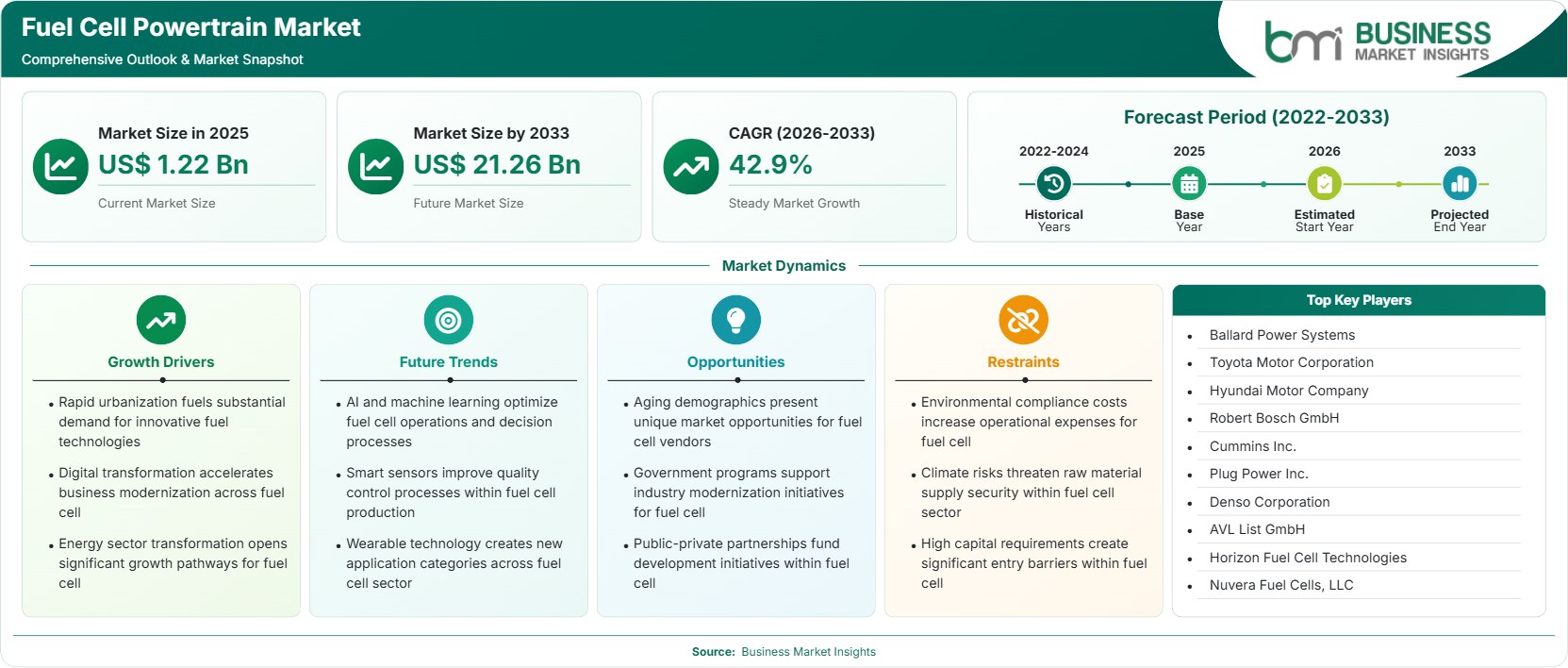
The Fuel Cell Powertrain Market size was valued at US$ 1.22 Billion in 2025 and is projected to reach US$ 21.26 Billion by 2033, growing at a CAGR of 42.9% during 2026-2033, driven by hydrogen mobility expansion, zero-emission transportation mandates, commercialization of heavy-duty fuel cell vehicles, supportive government incentives, and increasing investments in hydrogen production, refueling infrastructure, and advanced fuel cell technologies.

Report Coverage
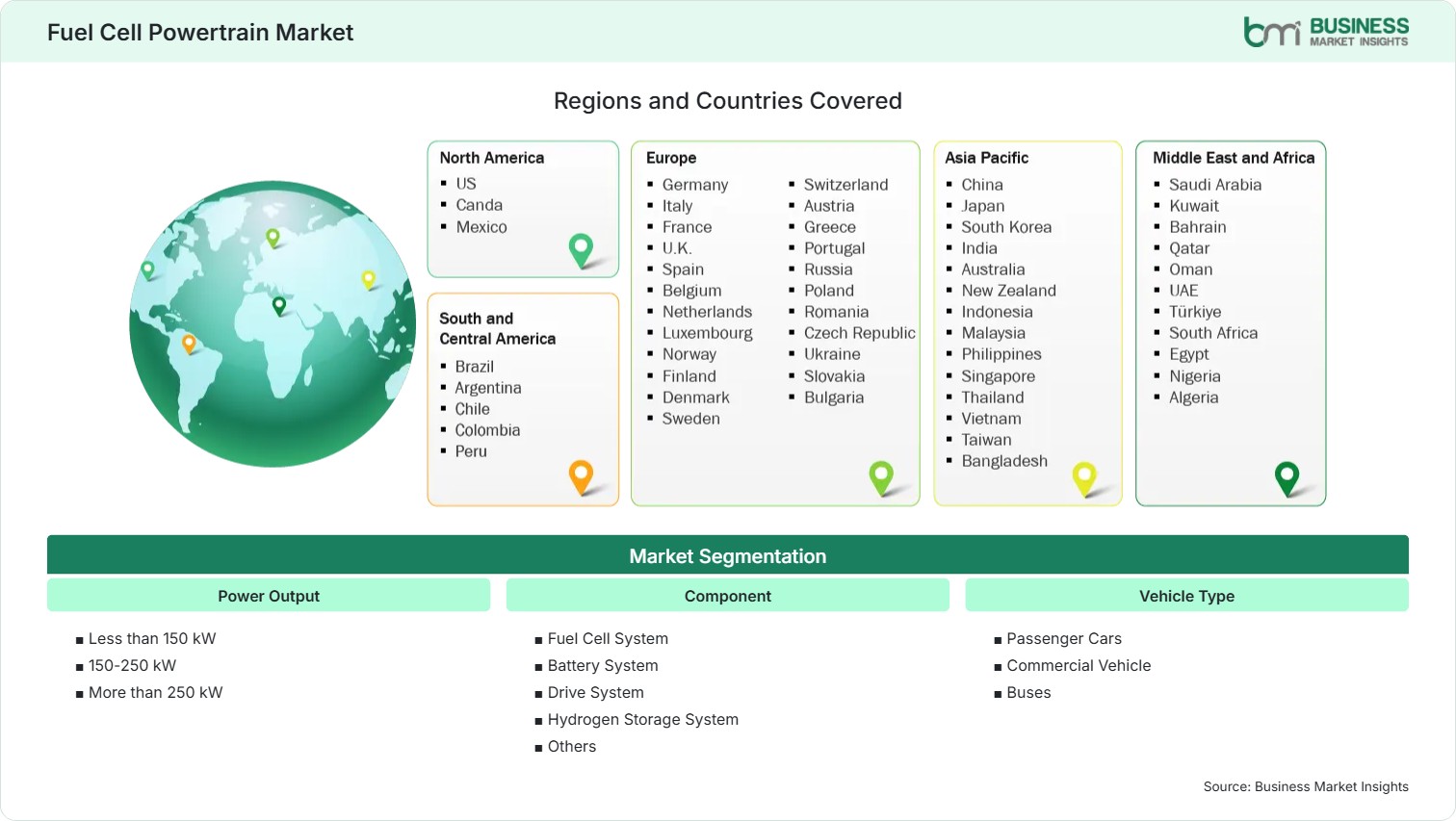
  • Power Output: Less than 150 kW, 150-250 kW, More than 250 kW
  • Component: Fuel Cell System, Battery System, Drive System, Hydrogen Storage System, Others
  • Vehicle Type: Passenger Cars, Commercial Vehicle, Buses
US$ 1.22 Bn Market size in 2025
US$ 21.26 Bn Market Size by 2033
42.9% CAGR, 2026 - 2033
2026-2033 Forecast Period

01 AI Overview

Fuel Cell Powertrain Market Summary

  • North America Region: Holds an estimated 34%–37% market share in 2025 and is projected to expand at a CAGR of 87%–90% during 2026–2033. Growth is supported by hydrogen infrastructure investments, commercial fleet electrification, federal clean transportation incentives, and increasing collaborations between automotive manufacturers and fuel cell technology developers. The U.S. remains the regional leader, supported by extensive hydrogen mobility projects, public funding, expanding commercial fleet deployment, and an anticipated CAGR of 88%–91%.
  • Fastest Growing Region: Asia Pacific accounts for approximately 28%–31% of global demand in 2025 and is anticipated to register a CAGR of 90%–93% during 2026–2033. National hydrogen strategies, industrial decarbonization programs, large-scale vehicle deployments, and expanding refueling infrastructure continue strengthening regional manufacturing capabilities and technology commercialization.
  • Leading Segment: Fuel Cell System represents nearly 39%–42% market share in 2025 and is forecast to grow at 89%–92% CAGR during 2026–2033. Continuous stack efficiency improvements, durability enhancements, platinum loading reduction, and increased commercial vehicle integration continue accelerating technology adoption across transportation applications worldwide.
  • High Growth Segment: Commercial Vehicle contributes approximately 40%–43% market share in 2025 while expanding at 90%–93% CAGR through 2033. Fleet operators increasingly prioritize extended driving range, faster refueling, reduced lifecycle emissions, and improved operational efficiency for long-haul logistics and freight transportation.
  • Key Market Opportunity: Large-scale hydrogen production, renewable energy integration, public-private infrastructure investments, and increasing cross-border clean mobility initiatives create favorable conditions for accelerated commercialization of fuel cell powertrains across passenger, commercial, and public transportation sectors worldwide.
  • Major Market Players: Ballard Power Systems Inc., Toyota Motor Corporation, Hyundai Motor Company, Robert Bosch GmbH, Cummins Inc., Plug Power Inc., Denso Corporation, AVL List GmbH, Horizon Fuel Cell Technologies Pte. Ltd., Nuvera Fuel Cells, LLC, PowerCell Sweden AB, Intelligent Energy Limited, FEV Group GmbH, Symbio SAS, and Doosan Fuel Cell Co., Ltd.
02 Strategic Insights

Fuel Cell Powertrain Market: Strategic Insights

Fuel Cell Powertrain Market Strategic Framework
FREE PDF
Request your free sample
Request free sample
03 Stakeholder View

Key Takeaways

  • The industry ecosystem is increasingly characterized by strategic partnerships among fuel cell developers, automotive OEMs, hydrogen producers, component suppliers, and infrastructure providers, creating vertically integrated value chains that accelerate commercialization while reducing deployment risks.
  • Heavy-duty commercial transportation presents the strongest long-term revenue opportunity as logistics companies prioritize longer driving ranges, reduced refueling times, and higher operational utilization compared with conventional battery-electric alternatives for freight movement.
  • Continuous innovation in proton exchange membrane fuel cell stacks, bipolar plate materials, thermal management systems, hydrogen storage technologies, and intelligent power management software is improving durability, efficiency, and overall vehicle performance while lowering lifecycle costs.
  • Asia Pacific offers an attractive investment landscape owing to coordinated hydrogen policies, large-scale manufacturing capacity, supportive public funding, and growing deployment of fuel cell buses, trucks, and passenger vehicles across multiple national programs.
  • Strategic acquisitions, technology licensing agreements, joint ventures, and long-term supply contracts are becoming increasingly common as manufacturers strengthen hydrogen value chains and secure access to advanced fuel cell technologies, critical materials, and production capabilities.
  • Future competitiveness will increasingly depend on localized hydrogen production, standardized refueling infrastructure, digital fleet management integration, and continued cost reductions across stacks, balance-of-plant components, and hydrogen storage systems, enabling broader commercial adoption across diverse vehicle platforms.
04 Geographic Outlook

Fuel Cell Powertrain Market Regional Highlights

North America Fuel Cell Powertrain Market

North America accounted for an estimated 34%–37% Fuel Cell Powertrain Market share in 2025 and is projected to expand at a CAGR of 87%–90% during 2026–2033. Regional demand is supported by accelerating hydrogen mobility programs, public investment in clean transportation corridors, and commercial fleet decarbonization initiatives. Government incentives, expanding hydrogen refueling infrastructure, and collaboration between automotive manufacturers and energy companies continue strengthening supply chains. Increasing deployment of fuel cell trucks and transit buses further reinforces regional competitiveness and long-term industrial investment.

  • Federal hydrogen hubs established under clean energy initiatives are accelerating infrastructure development, encouraging domestic manufacturing, supporting fuel production capacity, and creating long-term commercial opportunities for heavy-duty transportation operators across North America.
  • Commercial logistics companies are increasing procurement of hydrogen-powered trucks to reduce operational emissions while maintaining extended driving range and rapid refueling capability, particularly for freight transportation requiring continuous vehicle utilization.
  • Automotive manufacturers continue expanding partnerships with hydrogen suppliers, component manufacturers, and technology developers, enabling integrated fuel cell ecosystems that improve production efficiency, supply reliability, and technology commercialization across transportation applications.
  • Continuous investment in advanced fuel cell stack manufacturing, hydrogen storage innovation, and digital fleet management solutions enhances vehicle performance while improving lifecycle economics for logistics providers, municipal transit agencies, and industrial transportation operators.
  • Cross-border cooperation between the United States and Canada supports hydrogen production, infrastructure expansion, component manufacturing, and technology standardization, strengthening regional competitiveness throughout the evolving hydrogen mobility value chain.

US Fuel Cell Powertrain Market

The United States represented nearly 73%–76% of the North American Fuel Cell Powertrain Market during 2025 while advancing at a projected CAGR of 88%–91% through 2033. Strong federal funding, extensive research programs, commercial fleet demonstrations, and growing private investment continue accelerating domestic hydrogen mobility deployment. Automotive manufacturers, industrial gas companies, and infrastructure developers are jointly expanding hydrogen production and distribution capabilities while supporting large-scale commercialization of zero-emission transportation technologies.

  • National hydrogen strategy initiatives continue strengthening domestic manufacturing capabilities while encouraging investments across hydrogen production, storage systems, transportation infrastructure, and integrated mobility solutions supporting commercial fleet adoption.
  • Major truck manufacturers increasingly collaborate with technology developers to commercialize hydrogen-powered heavy-duty vehicles, improving operational efficiency for freight transportation while reducing dependence on fossil fuel-powered fleets.
  • Public transit authorities are accelerating procurement of fuel cell buses supported by federal grants, improving urban air quality while demonstrating long-term operational viability across metropolitan transportation systems.
  • Expanding private investment in electrolyzer facilities and renewable hydrogen production enhances domestic supply security while supporting long-term deployment of commercial fuel cell transportation across multiple industrial sectors.

Europe Fuel Cell Powertrain Market

Europe held approximately 26%–29% market share in 2025 and is forecast to grow at a CAGR of 86%–89% during 2026–2033. Decarbonization regulations, hydrogen corridor initiatives, and strong industrial partnerships continue supporting Fuel Cell Powertrain Market expansion. Germany leads regional deployment through advanced automotive manufacturing and hydrogen infrastructure investments, while France demonstrates one of the fastest growth trajectories through collaborative fuel cell mobility projects, government funding, and expanding commercial transportation applications.

  • Germany remains the regional leader owing to established automotive engineering capabilities, integrated hydrogen projects, and significant investments supporting industrial-scale fuel cell manufacturing with an estimated CAGR of 86%–89%.
  • France records one of Europe's strongest expansion rates, benefiting from national hydrogen investment programs, public transportation modernization, and collaborative vehicle development initiatives with an estimated CAGR of 88%–91%.
  • European Union emission reduction regulations encourage vehicle manufacturers to diversify zero-emission technologies beyond battery-electric solutions, supporting commercial adoption of hydrogen-powered mobility across freight and passenger transportation.
  • Cross-border hydrogen transport corridors facilitate infrastructure standardization while strengthening commercial logistics operations requiring rapid refueling and extended operational range across multiple European countries.
  • Continued investment in renewable hydrogen production and electrolyzer manufacturing enhances regional competitiveness while improving long-term sustainability of hydrogen-powered transportation ecosystems.

Asia Pacific Fuel Cell Powertrain Market

Asia Pacific represented approximately 28%–31% market share in 2025 and is expected to register the fastest CAGR of 90%–93% during 2026–2033. Strong government hydrogen roadmaps, manufacturing leadership, expanding commercial vehicle deployment, and coordinated infrastructure investments continue driving regional momentum. Japan maintains technological leadership through advanced fuel cell innovation, while China demonstrates the fastest expansion supported by large-scale hydrogen infrastructure development and industrial policy initiatives promoting clean transportation.

  • Japan continues leading technological innovation through continuous investment in fuel cell vehicle development, stack efficiency improvements, hydrogen refueling expansion, and integrated mobility ecosystems with an estimated CAGR of 89%–92%.
  • China represents the region's fastest-growing national Fuel Cell Powertrain Market with an estimated CAGR of 91%–94%, supported by industrial policy, commercial fleet deployment, hydrogen production expansion, and rapid infrastructure construction.
  • South Korea strengthens regional competitiveness through strategic investment in hydrogen-powered commercial transportation, advanced component manufacturing, and export-oriented fuel cell technology development supporting global automotive supply chains.
  • Increasing localization of stack production, hydrogen storage systems, and electric drive components reduces manufacturing costs while improving regional supply resilience for growing domestic and export demand.
  • Public investment in hydrogen cities, industrial clusters, and renewable energy integration accelerates commercialization opportunities while strengthening collaboration among vehicle manufacturers, energy providers, and technology developers.

Rest of World Fuel Cell Powertrain Market

The Rest of World region accounted for nearly 8%–11% Fuel Cell Powertrain Market share in 2025 and is projected to grow at a CAGR of 84%–87% during 2026–2033. South and Central America are gradually adopting hydrogen mobility through pilot transportation programs and renewable energy integration, while the Middle East and Africa benefit from expanding green hydrogen investments, industrial diversification, and export-focused hydrogen production strategies supporting future transportation deployment.

Growing collaboration between governments, international investors, and technology providers continues strengthening regional hydrogen ecosystems. Infrastructure expansion, demonstration projects, and favorable renewable energy resources create long-term opportunities for fuel cell commercialization across commercial transportation and public mobility applications.

  • Brazil leads South and Central America with an estimated CAGR of 84%–87%, supported by renewable energy resources, emerging hydrogen strategies, and pilot commercial transportation projects encouraging industrial participation.
  • Saudi Arabia demonstrates one of the fastest growth trajectories within the Middle East, recording an estimated CAGR of 87%–90% through significant investments in green hydrogen production and future mobility infrastructure.
  • South Africa continues expanding hydrogen innovation through mining-supported platinum supply, research collaboration, and demonstration projects supporting commercialization of fuel cell transportation technologies.
  • Increasing international partnerships facilitate technology transfer, infrastructure financing, and hydrogen export development while strengthening long-term regional competitiveness across emerging clean mobility markets.
  • Renewable energy abundance across several regional economies enables cost-effective green hydrogen production, improving future investment prospects for hydrogen-powered transportation and industrial decarbonization initiatives.
Global Market Geography
FREE PDF
Request your free sample
Request free sample
05 Segment Analysis

Fuel Cell Powertrain Market Segmentation

Power Output

The Power Output segment accounted for approximately 31%–34% market share in 2025 and is projected to register a CAGR of 88%–91% during 2026–2033. Demand continues expanding as manufacturers optimize fuel cell systems for passenger vehicles, transit fleets, and heavy-duty transportation. The Fuel Cell Powertrain Market scope continues widening because diverse vehicle platforms require customized power ratings balancing efficiency, durability, payload capability, and operating range.

  • Less than 150 kW: Widely adopted in passenger cars and compact commercial vehicles where energy efficiency, lightweight architecture, and lower operating costs support growing deployment across urban transportation and shared mobility applications.
  • 150-250 kW: Increasingly preferred for medium-duty trucks and city buses requiring balanced power delivery, operational flexibility, improved acceleration, and dependable performance across municipal transportation and regional logistics operations.
  • More than 250 kW: Designed primarily for heavy-duty freight vehicles, mining equipment, and long-distance transportation requiring high continuous output, extended driving range, rapid hydrogen refueling, and demanding operational capability.

Component

The Component segment represented approximately 39%–42% market share in 2025 while advancing at a CAGR of 89%–92% during 2026–2033. Continuous technological innovation across stack design, hydrogen storage, battery integration, and electric drive systems improves overall vehicle efficiency. The Fuel Cell Powertrain Market trends increasingly emphasize integrated powertrain architectures that reduce energy losses while enhancing operational reliability.

  • Fuel Cell System: Represents the technological core of hydrogen-powered vehicles, delivering electrical energy through electrochemical reactions while continuous material innovation enhances efficiency, durability, and commercial operating performance.
  • Battery System: Supports regenerative braking, peak power assistance, and optimized energy management, improving vehicle responsiveness while reducing load fluctuations experienced by the primary fuel cell system.
  • Drive System: Converts electrical energy into mechanical propulsion using advanced electric motors, inverters, and control software that maximize efficiency across varying driving conditions and commercial transportation requirements.
  • Hydrogen Storage System: High-pressure composite storage technologies improve safety, energy density, and driving range while enabling rapid refueling and reliable hydrogen containment under demanding transportation environments.

Vehicle Type

The Vehicle Type segment accounted for nearly 35%–38% Fuel Cell Powertrain Market share in 2025 and is expected to grow at a CAGR of 89%–92% during 2026–2033. Growing investments in commercial transportation, public transit modernization, and zero-emission mobility continue accelerating adoption across multiple vehicle categories. Fleet operators increasingly evaluate total ownership costs, operational uptime, and infrastructure availability when selecting hydrogen-powered transportation solutions.

  • Passenger Cars: Premium and long-range mobility applications continue driving adoption where rapid refueling, extended travel capability, and zero tailpipe emissions provide competitive advantages over conventional propulsion technologies.
  • Commercial Vehicle: Strong logistics demand, fleet decarbonization targets, and increasing investment in hydrogen corridors encourage widespread deployment across freight transportation, distribution networks, and industrial vehicle operations.
  • Buses: Municipal transit authorities increasingly deploy hydrogen-powered buses to improve urban air quality while maintaining operational flexibility through rapid refueling and consistent service across high-frequency transportation routes.
06 Market Forces

Fuel Cell Powertrain Market Dynamics

Key Market Drivers

Expansion of National Hydrogen Mobility Strategies

Governments worldwide continue introducing hydrogen roadmaps that support production facilities, refueling infrastructure, research funding, and commercial fleet deployment. According to the International Energy Agency, there are currently over forty hydrogen strategies that are backing the transition towards clean energy. The implementation of such strategies mitigates the commercial risks associated with hydrogen energy while simultaneously urging auto manufacturers to build up their hydrogen fuel cells production capabilities. This public financing drives partnerships between tech companies, industrial gas producers, and transportation operators. Stable policy frameworks improve investor confidence and strengthen long-term Fuel Cell Powertrain Market competitiveness across commercial transportation and public mobility applications.

Growing Commercial Fleet Decarbonization Requirements

Freight transportation companies increasingly prioritize zero-emission technologies to comply with tightening environmental regulations and corporate sustainability objectives. Hydrogen fuel cells bring advantages to heavy-duty vehicles running over long hauls in terms of faster refueling and longer range than many battery-operated counterparts. Better utilization of these vehicles is another reason why hydrogen fuel cells are more desirable for logistics, construction, mining, and public transport applications. Additional development of hydrogen fuel infrastructure is another factor that contributes to better usage of hydrogen technologies due to commercial demands for zero-emissions vehicles.

Continuous Technological Improvements in Fuel Cell Systems

Rapid advances in membrane materials, catalyst optimization, bipolar plates, and intelligent thermal management continue improving fuel cell efficiency and durability. Manufacturers are now using less platinum and increasing the life cycle of their stacks to decrease ownership costs for their commercial customers. The inclusion of diagnostic tools and predictive maintenance software has increased system reliability. These technological advancements make it possible for fuel cells to be commercialized in passenger cars, buses, and heavy trucks and increase competitiveness against internal combustion engines.

Key Market Opportunities

Expansion of Green Hydrogen Production Capacity

Growing investment in renewable hydrogen production creates significant opportunities for the large-scale commercialization of fuel cell transportation. A decrease in the cost of electrolyzers, an increase in the production of renewable electricity, and government incentives increase the availability of hydrogen while cutting down lifecycle carbon emissions. Nations that are utilizing wind, solar, and hydroelectric power sources are incorporating the use of green hydrogen into their energy policies. This helps in ensuring the future application of hydrogen fuel in commercial vehicles.

Development of Hydrogen Freight Corridors

Hydrogen transportation corridors dedicated for moving hydrogen from ports and logistics hubs to industries create promising areas for investments during the forecast period. Increased infrastructure allows efficient operation of long-distance trucks on regional and international freight corridors. Public-private collaboration keeps on funding fueling stations, hydrogen storage systems, and the digital infrastructure for fleet operations. Fuel Cell Powertrain Market Forecasts increasingly recognize freight corridor development as a major catalyst for expanding commercial adoption while improving supply chain efficiency and reducing transportation emissions.

Localization of Advanced Component Manufacturing

Regional manufacturing expansion for stacks, hydrogen tanks, electric drive components, and control systems creates opportunities for supply chain resilience and cost reduction. Production on the local level reduces reliance on foreign technologies, along with enhancing the logistics of delivering vehicles for manufacturers of automobiles. Governments nowadays promote local manufacturing with the help of industrial incentives, technology transfer, and research collaboration. Such measures enhance the competitiveness of regions, provide skilled employment, and speed up the commercialization of the hydrogen vehicle market.

Market Restraints and Challenges

Limited Hydrogen Refueling Infrastructure

Factor: Hydrogen refueling stations remain concentrated within selected metropolitan areas and pilot transportation corridors.

Impact: Limited infrastructure restricts commercial fleet expansion and reduces confidence among vehicle operators considering hydrogen adoption. Higher levels of capital expenditures, complications arising from obtaining permits, and fluctuations in hydrogen availability hinder infrastructure installation in a number of emerging markets. Fleet owners often put off purchasing their fleets until adequate refueling stations become available. Increasing availability of such stations is crucial in enabling broad-scale use in passenger cars, buses, and commercial transport.

High Initial System and Vehicle Costs

Factor: Fuel cell stacks, hydrogen storage systems, and specialized manufacturing processes continue requiring substantial upfront investment.

Impact: Elevated acquisition costs remain a significant barrier for fleet operators despite improving lifecycle economics. Low production volume, costly catalysts, and dynamic logistics are some of the factors leading to increased costs in the vehicles compared to their counterparts. While the technology continues to advance, decreasing the cost of production, affordability requires mass production, efficient use of materials, and widespread infrastructural facilities. The role of government and industries in providing incentives cannot be overlooked.

07 Company Analysis

Competitive Landscape

The competitive environment is characterized by strategic alliances, technology licensing, hydrogen ecosystem partnerships, and manufacturing expansion. The Fuel Cell Powertrain Market analysis indicates that companies are prioritizing stack efficiency, integrated powertrain development, localized production, and commercial fleet collaborations to strengthen global competitiveness.

Company Name

Overview

Products and Services Relevant to this Market

Ballard Power Systems Inc.

Canadian fuel cell developer specializing in proton exchange membrane technologies for commercial mobility, marine, rail, and stationary power applications.

PEM fuel cell stacks, power modules, heavy-duty vehicle propulsion systems, engineering support, and fuel cell integration solutions.

Toyota Motor Corporation

Global automotive manufacturer leading hydrogen mobility commercialization through extensive fuel cell vehicle development and international partnerships.

Fuel cell passenger vehicles, fuel cell modules, hydrogen powertrain technologies, mobility platforms, and integrated propulsion systems.

Hyundai Motor Company

South Korean mobility leader investing heavily in hydrogen transportation, commercial vehicles, and next-generation clean mobility solutions.

Hydrogen trucks, passenger fuel cell vehicles, integrated fuel cell systems, electric drivetrains, and hydrogen mobility technologies.

Robert Bosch GmbH

Diversified engineering company expanding fuel cell component manufacturing through strategic technology collaborations and industrial investments.

Fuel cell power modules, electric drive components, control electronics, hydrogen system integration, and automotive engineering solutions.

Cummins Inc.

U.S.-based power technology company developing hydrogen propulsion technologies for commercial transportation and industrial applications.

Fuel cell engines, hydrogen powertrains, electrolyzers, commercial vehicle propulsion systems, and integrated energy technologies.

Plug Power Inc.

Hydrogen solutions provider building integrated hydrogen production, distribution, and fuel cell technology ecosystems worldwide.

Fuel cell engines, hydrogen infrastructure, electrolyzers, fueling systems, and commercial mobility energy solutions.

Denso Corporation

Automotive component manufacturer supporting electrification through advanced thermal management and powertrain technologies.

Fuel cell control systems, thermal management components, electronic modules, sensors, and automotive power electronics.

AVL List GmbH

Austrian engineering company providing advanced mobility research, testing, simulation, and powertrain development services.

Fuel cell engineering, testing platforms, simulation software, validation services, and integrated propulsion development.

Horizon Fuel Cell Technologies Pte. Ltd.

Singapore-based fuel cell technology company serving mobility, distributed energy, and educational markets globally.

Fuel cell stacks, hydrogen power systems, engineering platforms, mobility modules, and customized hydrogen technologies.

Nuvera Fuel Cells, LLC

Developer of fuel cell propulsion systems focused on commercial transportation and industrial vehicle applications.

Fuel cell engines, stack technologies, hydrogen propulsion solutions, and commercial vehicle integration services.

PowerCell Sweden AB

Swedish manufacturer recognized for high-performance fuel cell platforms serving automotive, marine, aviation, and stationary applications.

Fuel cell stacks, power systems, hydrogen propulsion technologies, engineering support, and industrial fuel cell solutions.

Intelligent Energy Limited

U.K.-based fuel cell innovator specializing in compact, lightweight, high-efficiency hydrogen power technologies.

Fuel cell stacks, lightweight propulsion systems, aviation fuel cells, automotive technologies, and engineering services.

FEV Group GmbH

Global engineering company supporting sustainable mobility through advanced vehicle development and powertrain innovation.

Fuel cell engineering, vehicle integration, testing services, software development, and propulsion optimization solutions.

Symbio SAS

French hydrogen mobility specialist jointly advancing commercial fuel cell systems for transportation markets.

Fuel cell systems, hydrogen mobility platforms, commercial vehicle integration, stack development, and engineering services.

Doosan Fuel Cell Co., Ltd.

South Korean energy technology company expanding hydrogen fuel cell capabilities across transportation and stationary markets.

Fuel cell technologies, hydrogen energy systems, power generation solutions, engineering services, and integrated hydrogen applications.

10 Trust & Transparency

Research Methodology

The market analysis combines proprietary research with secondary data from government agencies, company disclosures, regulatory filings, industry databases and expert interviews. Market estimates are validated through data triangulation, cross-market benchmarking and analyst review.

View Full Research Methodology

11 Questions Answered

Frequently Asked Questions

Why should organizations invest in a Fuel Cell Powertrain Market Report?

A comprehensive report helps manufacturers, investors, technology developers, and policymakers evaluate competitive positioning, emerging regional opportunities, technology developments, regulatory trends, and long-term investment potential for hydrogen mobility across global transportation markets.

How does hydrogen infrastructure influence market competitiveness?

Hydrogen refueling availability directly affects fleet deployment decisions, investment confidence, and vehicle utilization. Expanding infrastructure lowers operational uncertainty while supporting wider commercialization across passenger, commercial, and public transportation sectors.

Which vehicle category offers the greatest commercial opportunity?

Commercial vehicles provide the strongest opportunity because long-haul logistics, freight transportation, and municipal fleets benefit from hydrogen's operational efficiency, reduced downtime, and extended driving capability compared with several alternative propulsion technologies.

Which region is expected to deliver the fastest future Fuel Cell Powertrain Market expansion?

Asia Pacific is projected to record the strongest growth due to coordinated hydrogen strategies, manufacturing leadership, expanding refueling infrastructure, and significant investments by governments and automotive manufacturers supporting hydrogen mobility deployment.

What factors are accelerating adoption of fuel cell powertrains in commercial transportation?

Commercial fleet operators increasingly value rapid refueling, extended driving range, reduced emissions, and improved operational utilization. Supportive hydrogen infrastructure investments and decarbonization regulations further strengthen long-term commercial adoption across freight and public transportation.

Access the Full Fuel Cell Powertrain Market Report

Get segment-level forecasts, regional estimates, competitive benchmarking, company profiles and downloadable Excel datasets.

Access the full Fuel Cell Powertrain Market Report
350 pages PDF & Excel | 2026-08-17