
Hybrid Powertrain Systems Market Outlook: Size, Share, Trends, Growth Analysis, Competitive Landscape & Forecast, 2022-2033

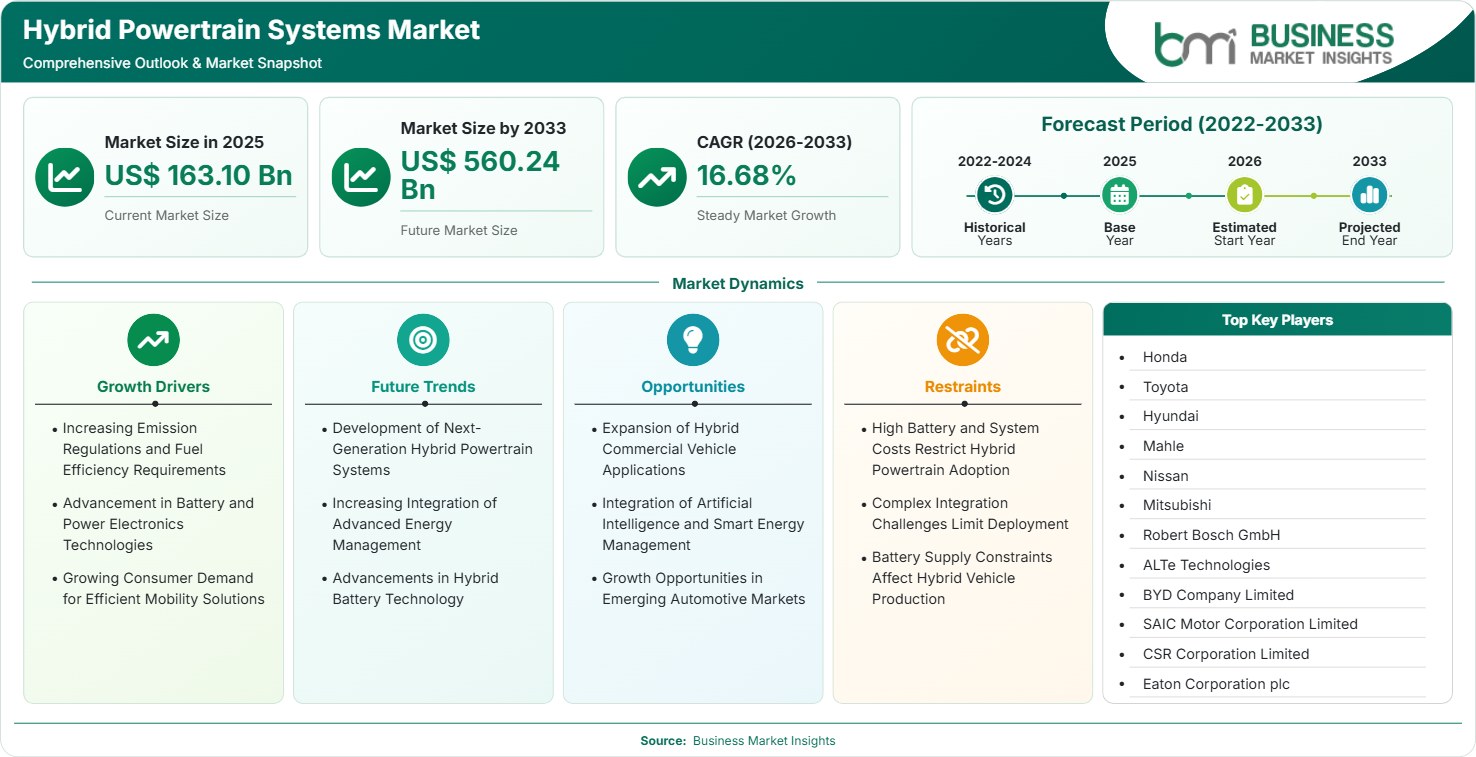
The Hybrid Powertrain Systems Market size was valued at US$ 163.10 Billion in 2025 and is projected to reach US$ 560.24 Billion by 2033, growing at a CAGR of 16.68% during 2026–2033, driven by electrification mandates, fuel efficiency regulations, advanced battery integration, and increasing demand for low-emission mobility solutions.

Report Coverage
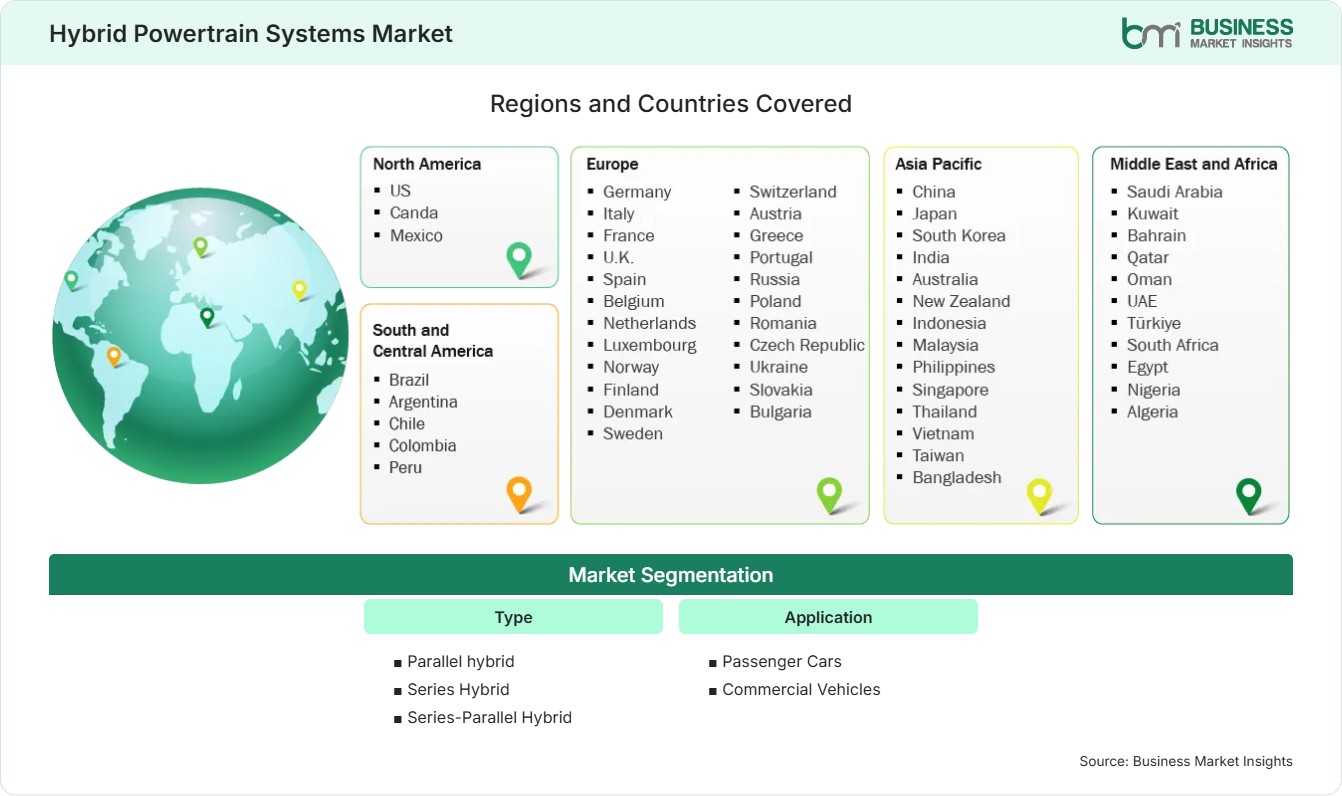
  • Type: Parallel hybrid, Series Hybrid, Series-Parallel Hybrid
  • Application: Passenger Cars, Commercial Vehicles
US$ 163.10 Bn Market size in 2025
US$ 560.24 Bn Market Size by 2033
16.68% CAGR, 2026 - 2033
2026-2033 Forecast Period

AI Overview

Hybrid Powertrain Systems Market Summary

  • North America Region: North America holds a 28%–31% share in 2025, expanding at a CAGR of 15.2%–16.8% through 2026–2033, supported by emission regulations, consumer preference for efficient vehicles, fleet electrification, and OEM investments. The US market demonstrates strong adoption through hybrid passenger vehicles, with a CAGR of 15.5%–17.0% between 2026 and 2033, supported by federal efficiency targets and automotive innovation.
  • Fastest Growing Region: Asia Pacific represents the fastest-growing region with a 38%–41% share in 2025 and a CAGR of 17.5%–19.0% from 2026–2033, driven by rising vehicle production, government incentives, urban pollution reduction programs, and expanding hybrid vehicle adoption across China, Japan, South Korea, and India.
  • Leading Segment: Parallel hybrid systems account for a 42%–45% share in 2025, growing at a CAGR of 15.8%–17.2% during 2026–2033, supported by balanced performance, fuel savings, established manufacturing ecosystems, and broad deployment across passenger vehicles and commercial mobility applications.
  • High Growth Segment: Series-parallel hybrid systems capture a 30%–33% share in 2025 and register a CAGR of 18.0%–19.5% during 2026–2033, driven by improved power management, advanced energy recovery systems, flexible drivetrain configurations, and premium vehicle electrification strategies.
  • Key Market Opportunity: Hybrid Powertrain Systems Market offer opportunities through next-generation battery technologies, commercial vehicle electrification, regional manufacturing expansion, intelligent energy management software, and partnerships between automotive manufacturers, component suppliers, and technology providers.
  • Major Market Players: Honda, Toyota, Hyundai, Mahle, Nissan, Mitsubishi, Robert Bosch GmbH, ALTe Technologies, BYD Company Limited, SAIC Motor Corporation Limited, CSR Corporation Limited, Eaton Corporation plc, Tianjin Santroll Electric Auto Technology Co., Ltd., Allison Transmission, Inc., and Voith GmbH & Co. KGaA.
Strategic Insights

Hybrid Powertrain Systems Market: Strategic Insights

Hybrid Powertrain Systems Market Strategic Framework
FREE PDF
Request your free sample
Request free sample
Stakeholder View

Key Takeaways

  • The market ecosystem is evolving through collaboration among vehicle manufacturers, battery suppliers, semiconductor companies, and power electronics providers, creating integrated supply chains focused on improving hybrid drivetrain efficiency and reducing production complexity.
  • Passenger vehicles remain a major opportunity area due to consumer acceptance, fuel cost considerations, and regulatory pressure, while commercial vehicle applications are gaining momentum through fleet modernization and sustainability programs.
  • Innovation priorities are shifting toward higher-density batteries, intelligent power distribution, advanced transmission integration, and software-controlled energy optimization systems that enhance vehicle performance and operational efficiency.
  • Asia Pacific presents a strong investment opportunity due to high automotive production volumes, government-supported electrification initiatives, and expanding hybrid adoption in China, Japan, South Korea, and India.
  • Automotive technology partnerships and strategic investments are increasing as companies pursue battery expertise, electric drivetrain capabilities, and hybrid system integration to strengthen competitive positioning.
Geographic Outlook

Hybrid Powertrain Systems Market Regional Highlights

North America Hybrid Powertrain Systems Market

North America accounted for a 28%–31% share in 2025 and is projected to expand at a CAGR of 15.2%–16.8% between 2026 and 2033. The region benefits from strong automotive manufacturing capabilities, consumer demand for fuel-efficient vehicles, and regulatory initiatives supporting reduced emissions. Hybrid Powertrain Systems Market share in North America continues to strengthen as automakers introduce diversified hybrid models across passenger and commercial vehicle categories.

  • The US automotive sector maintains a leading position with strong OEM investments, advanced engineering capabilities, and increasing hybrid vehicle availability across multiple segments.
  • Canada supports adoption through environmental policies, automotive manufacturing expertise, and growing interest in efficient transportation solutions for urban and commercial mobility.
  • Mexico is emerging as a production hub due to vehicle manufacturing expansion, supplier networks, and increasing integration of hybrid technologies.
  • Regional manufacturers are investing in battery systems, electric motors, and power electronics to improve hybrid drivetrain competitiveness.

US Hybrid Powertrain Systems Market

The US represented a 22%–25% share of the North American market in 2025 and is estimated to grow at a CAGR of 15.5%–17.0% during 2026–2033. Strong consumer acceptance, advanced automotive research capabilities, and increasing corporate sustainability objectives support market expansion. Hybrid Powertrain Systems Market analysis indicates that US manufacturers are focusing on scalable architectures, efficient components, and integration of digital vehicle technologies.

  • Passenger vehicle demand remains a primary growth contributor as consumers seek improved mileage without complete transition to battery-electric vehicles.
  • Government efficiency programs encourage manufacturers to develop hybrid platforms alongside electric vehicle portfolios.
  • Commercial fleet operators are evaluating hybrid solutions to reduce fuel consumption and operational expenses.
  • Automotive suppliers are expanding domestic production capabilities for motors, controllers, and drivetrain components.

Europe Hybrid Powertrain Systems Market

Europe held a 25%–28% share in 2025 and is expected to grow at a CAGR of 14.8%–16.2% from 2026–2033. The region benefits from strict emission regulations, advanced automotive engineering, and increasing demand for sustainable mobility. Germany, France, the UK, and Italy remain important markets, while Germany demonstrates higher adoption through premium vehicle hybridization and technology development initiatives.

  • Germany leads regional innovation with strong automotive manufacturers, engineering expertise, and investment in efficient propulsion technologies.
  • France supports hybrid adoption through government incentives, emission reduction programs, and domestic vehicle production capabilities.
  • The UK market benefits from sustainability commitments, fleet electrification strategies, and hybrid technology integration.
  • European suppliers are developing advanced power management systems to improve vehicle efficiency and compliance.

Asia Pacific Hybrid Powertrain Systems Market

Asia Pacific accounted for a 38%–41% share in 2025 and is forecast to register a CAGR of 17.5%–19.0% between 2026 and 2033. The region remains the largest manufacturing center for automotive production, supported by government electrification programs, rising vehicle ownership, and expanding hybrid technology deployment. Hybrid Powertrain Systems Market growth in Asia Pacific is strengthened by China, Japan, South Korea, and India, where manufacturers are increasing investments in efficient propulsion platforms.

  • China represents a major regional contributor due to large-scale vehicle manufacturing, domestic technology development, and increasing adoption of hybrid passenger vehicles.
  • Japan maintains technological leadership through advanced hybrid engineering, extensive OEM experience, and strong consumer acceptance of fuel-efficient vehicles.
  • South Korea is expanding hybrid production through automotive innovation, battery capabilities, and strategic investments from leading vehicle manufacturers.
  • India demonstrates rising potential due to fuel efficiency requirements, increasing urban mobility demand, and growing automotive manufacturing activities.
  • Regional suppliers are strengthening production capacity for motors, battery modules, electronic controls, and hybrid drivetrain components.

Rest of World Hybrid Powertrain Systems Market

Rest of World accounted for a 6%–9% share in 2025 and is projected to grow at a CAGR of 12.5%–14.5% during 2026–2033. South and Central America are gradually adopting hybrid technologies through urban mobility initiatives and vehicle efficiency requirements. The Middle East and Africa are exploring hybrid applications due to sustainability strategies, transportation modernization, and reduced fuel consumption objectives.

  • Brazil is emerging as a regional opportunity due to flexible vehicle technologies, automotive manufacturing capabilities, and demand for efficient mobility solutions.
  • South American markets are supporting hybrid adoption through lower operating cost considerations and environmental improvement programs.
  • Middle Eastern countries are investing in cleaner transportation technologies as part of broader economic diversification strategies.
  • African markets present long-term potential through commercial mobility solutions and sustainable transportation development.
  • Regional growth depends on infrastructure development, vehicle affordability, technology availability, and supportive regulatory frameworks.
Global Market Geography
FREE PDF
Request your free sample
Request free sample
Segment Analysis

Hybrid Powertrain Systems Market Segmentation

Type

The Type segment represents the technological foundation of the market, including Parallel hybrid, Series Hybrid, and Series-Parallel Hybrid configurations. The segment accounted for a 100% application base in 2025 and is expected to expand at a CAGR of 16.68% from 2026–2033. Hybrid Powertrain Systems Market scope continues expanding as manufacturers optimize drivetrain architectures for efficiency, performance, and regulatory compliance.

  • Parallel hybrid: Parallel hybrid systems maintain widespread adoption due to direct engine and electric motor power delivery, offering improved efficiency, lower complexity, and suitability for passenger vehicles requiring balanced performance.
  • Series Hybrid: Series hybrid configurations enable electric motor-driven propulsion with engine-based power generation, supporting applications requiring optimized energy management and enhanced operational efficiency.
  • Series-Parallel Hybrid: Series-parallel hybrid technology combines benefits of parallel and series architectures, enabling flexible power distribution, improved fuel economy, and advanced drivetrain control for modern vehicles.

Application

The application segment demonstrates increasing adoption across passenger cars and commercial vehicles as manufacturers target emission reduction and operational efficiency. Passenger Cars represented a 68%–72% share in 2025, while Commercial Vehicles represented a 28%–32% share. Both applications are supported by evolving regulations, fuel efficiency requirements, and automotive electrification strategies.

  • Passenger Cars: Passenger cars remain the dominant application due to consumer demand for efficient vehicles, established hybrid models, improved driving range, and growing availability across global automotive markets.
  • Commercial Vehicles: Commercial vehicles are gaining attention through fleet efficiency programs, reduced operating costs, and hybrid solutions designed for buses, delivery vehicles, and specialized transportation applications.
Market Forces

Hybrid Powertrain Systems Market Dynamics

Key Market Drivers

Increasing Emission Regulations and Fuel Efficiency Requirements

Emissions regulations for vehicles are being increased in governments across the globe, thereby making it imperative for manufacturers to incorporate hybrid technology into upcoming mobility systems. The International Energy Agency mentions an ongoing increase in the adoption of electric and hybrid cars worldwide in order to achieve their goals of transportation decarbonization. Market growth is being driven by regulations that mandate better fuel efficiency, lower carbon emissions, and greener transport alternatives. The Hybrid Powertrain Systems Market trends environment indicates a careful integration of internal combustion technologies with electric technologies in order to comply with regulations, and at the same time, provide convenience to consumers.

Advancement in Battery and Power Electronics Technologies

The development of better battery systems, smaller electric motors, and high-level power electronics is making hybrid vehicles more efficient. The improvements being made to lithium-ion batteries, battery management systems, and energy regeneration systems have helped make this possible at reduced cost. Car manufacturers are focusing on developing lightweight components and electronic systems to improve the efficiency of hybrid systems. Such innovations are making it possible to overcome certain technological barriers associated with older hybrid systems. Better semiconductors and computerized energy management systems have made it possible to develop hybrid systems that are flexible to other vehicle types.

Growing Consumer Demand for Efficient Mobility Solutions

With the rise of fuel costs, environmental consciousness, and the need for alternative means of electrification, more people are being drawn into hybrid cars. One reason why customers opt for hybrid cars is the fact that they offer better fuel efficiency without the need for significant charging facilities. Automakers are diversifying their hybrid fleets to cater to the various needs of different customer segments, be it luxury, middle, or commercial markets. Hybrid car technologies offer several advantages, including cost efficiency and better car performance. Moreover, hybrid technology gives automobile companies an intermediate route to full electrification while ensuring flexibility in production and compatibility with the customer.

Key Market Opportunities

Expansion of Hybrid Commercial Vehicle Applications

The commercial transportation sector offers a key business opportunity since there is a need to find solutions to cut down fuel costs and perform more environmentally. Hybrid buses, delivery trucks, and commercial vehicles are capable of offering some advantages while driving in urban conditions, which involve stop-and-go traffic. Designing hybrid architectures that suit logistic, public transport, and industrial mobility needs is currently ongoing. The investments in fleet modernization programs in the leading economies are driving the need for energy-efficient propulsion systems. The potential is made even more promising because of collaborations that exist among vehicle makers, tech companies, and fleet operators to achieve better results.

Integration of Artificial Intelligence and Smart Energy Management

The development of vehicle control using artificial intelligence is providing more chances for bettering hybrid drivetrain performance. Through algorithms, the system will be able to maximize the efficiency of the engine, battery performance, regenerative braking, and even power distribution in accordance with the type of driving conditions. Automakers are developing connected mobility solutions that integrate both software intelligence and hybrid hardware solutions. Smart energy management not only increases efficiency and prolongs the lifetime of the components but also enables automakers to achieve a competitive advantage.

Growth Opportunities in Emerging Automotive Markets

Developing countries hold high promise because of rising car ownership, urbanization trends, and the need for cost-effective transport options. Countries from the Asia Pacific, Latin America, and chosen African markets are looking at hybrid technology as a means to achieve reduced emissions. Automakers are setting up production facilities and logistics within these regions to increase access to and affordability of their vehicles. Incentives, localization practices, and infrastructure for automotive production make a conducive environment for hybrid adoption in such markets, which can help companies scale and grow within these markets.

Key Market Restraints

High Battery and System Costs Restrict Hybrid Powertrain Adoption

Factor: Hybrid powertrains require costly batteries, electric motors, power electronics, and control systems, increasing vehicle production expenses. Impact: Higher upfront costs can discourage consumers and fleet operators from adopting hybrid vehicles, particularly in price-sensitive markets. Manufacturers must optimize component costs, improve production efficiency, and develop affordable battery technologies to maintain competitiveness while delivering fuel savings and emissions benefits over the vehicle lifecycle.

Complex Integration Challenges Limit Deployment

Factor: Integrating internal combustion engines, electric motors, batteries, power electronics, and control software requires sophisticated engineering and calibration. Impact: System complexity can increase development timelines, maintenance requirements, and servicing costs while requiring specialized technical expertise. Manufacturers must invest in advanced engineering capabilities, standardized architectures, and technician training to improve reliability, simplify maintenance, and support broader deployment of hybrid powertrain systems across diverse vehicle applications.

Company Analysis

Competitive Landscape

The Hybrid Powertrain Systems Market analysis indicates a competitive environment shaped by automotive manufacturers, drivetrain technology developers, component suppliers, and mobility solution providers. Companies are focusing on improving hybrid efficiency, reducing component costs, enhancing battery integration, and developing scalable architectures for passenger and commercial vehicle applications.

Company Name

Overview

Products and Services relevant to this market

Honda

Honda develops advanced electrified mobility solutions with extensive experience in hybrid vehicle engineering and global automotive manufacturing operations.

Hybrid vehicle platforms, electric motors, intelligent power control systems, battery management technologies, and integrated hybrid drivetrain solutions.

Toyota

Toyota is a leading automotive company recognized for large-scale hybrid vehicle deployment and continuous innovation in electrified propulsion technologies.

Hybrid systems, hybrid vehicles, power control units, electric motors, battery technologies, and advanced energy management solutions.

Hyundai Motor Company

Hyundai develops diverse electrified vehicle technologies supported by global manufacturing capabilities and automotive research expertise.

Hybrid electric vehicles, hybrid drivetrain components, battery systems, electric motors, and vehicle energy optimization technologies.

MAHLE GmbH

MAHLE specializes in automotive components and develops technologies supporting efficient combustion and electrified mobility systems.

Hybrid powertrain components, thermal management systems, electric motor technologies, power electronics solutions, and efficiency-enhancing components.

Nissan Motor Co., Ltd.

Nissan develops electrified mobility solutions with expertise in hybrid technologies and energy-efficient vehicle platforms.

Hybrid vehicles, e-POWER systems, electric motors, battery integration solutions, and advanced vehicle control technologies.

Mitsubishi Motors Corporation

Mitsubishi focuses on electrified vehicle development with expertise in hybrid and plug-in hybrid technologies.

Hybrid powertrain systems, electric drive technologies, battery solutions, vehicle control systems, and electrified SUV platforms.

Robert Bosch GmbH

Bosch provides automotive technology solutions supporting global vehicle manufacturers with advanced hybrid and electrification components.

Electric motors, power electronics, hybrid control units, energy management systems, sensors, and drivetrain technologies.

ALTe Technologies

ALTe Technologies develops electrification solutions focused on converting conventional vehicles into hybrid and electric platforms.

Hybrid conversion systems, electric drivetrain solutions, battery integration technologies, and commercial vehicle electrification platforms.

BYD Company Limited

BYD specializes in new energy vehicles and integrated electric mobility technologies across global automotive markets.

Hybrid vehicles, battery systems, electric motors, power electronics, and integrated vehicle electrification technologies.

SAIC Motor Corporation Limited

SAIC Motor develops automotive technologies with a strong presence in new energy and hybrid vehicle segments.

Hybrid vehicles, electric drive systems, intelligent vehicle technologies, battery solutions, and connected mobility platforms.

CSR Corporation Limited

CSR Corporation provides transportation technology solutions and has capabilities linked with electric mobility systems.

Electric propulsion technologies, rail and mobility electrification solutions, drivetrain components, and energy management systems.

Eaton Corporation plc

Eaton develops power management technologies supporting efficient energy systems across automotive applications.

Hybrid vehicle power electronics, electrical distribution systems, converters, controllers, and energy management components.

Tianjin Santroll Electric Auto Technology Co., Ltd.

Tianjin Santroll specializes in automotive electric components and drivetrain technologies supporting electrified mobility applications.

Electric motors, controllers, hybrid vehicle components, automotive electronic systems, and power management solutions.

Allison Transmission, Inc.

Allison Transmission develops propulsion technologies for commercial vehicles with expertise in efficient transmission systems.

Hybrid propulsion systems, electric hybrid transmissions, commercial vehicle drivetrain solutions, and energy optimization technologies.

Voith GmbH & Co. KGaA

Voith provides mobility technologies with expertise in sustainable transportation solutions and efficient drivetrain systems.

Hybrid drive systems, electric mobility solutions, commercial vehicle technologies, and integrated propulsion systems.

Trust & Transparency

Research Methodology

The market analysis combines proprietary research with secondary data from government agencies, company disclosures, regulatory filings, industry databases and expert interviews. Market estimates are validated through data triangulation, cross-market benchmarking and analyst review.

View Full Research Methodology

Questions Answered

Frequently Asked Questions

How can companies benefit from the Hybrid Powertrain Systems Market Report?

The report provides strategic insights into market dynamics, competitive positioning, technology trends, regional opportunities, and investment areas supporting informed business planning and expansion decisions.

Why are Asia Pacific countries important for hybrid technology expansion?

According to Hybrid Powertrain Systems Market forecasts, Asia Pacific benefits from high vehicle production volumes, strong automotive supply chains, government support for cleaner transportation, and increasing consumer adoption of fuel-efficient mobility solutions.

How are battery improvements influencing hybrid vehicle performance?

Advances in battery chemistry, energy density, thermal management, and control software are improving hybrid vehicle efficiency, reliability, and overall driving performance while reducing system limitations.

What role do hybrid systems play in commercial vehicle electrification?

Hybrid systems help commercial fleets reduce fuel consumption, improve operational efficiency, and lower emissions in applications such as buses, delivery vehicles, and specialized transportation platforms.

What factors are driving the adoption of hybrid powertrain technologies globally?

Hybrid adoption is influenced by emission regulations, fuel efficiency requirements, consumer demand for lower operating costs, and automaker strategies to provide electrified mobility solutions without full dependence on charging infrastructure.

Access the Full Hybrid Powertrain Systems Market Report

Get segment-level forecasts, regional estimates, competitive benchmarking, company profiles and downloadable Excel datasets.

Access the full Hybrid Powertrain Systems Market Report
350 pages PDF & Excel | 2026-08-17
Similar Research

Related Market Reports