
Automotive Powertrain Sensors Market Outlook: Size, Share, Trends, Growth Analysis, Competitive Landscape & Forecast, 2026-2033

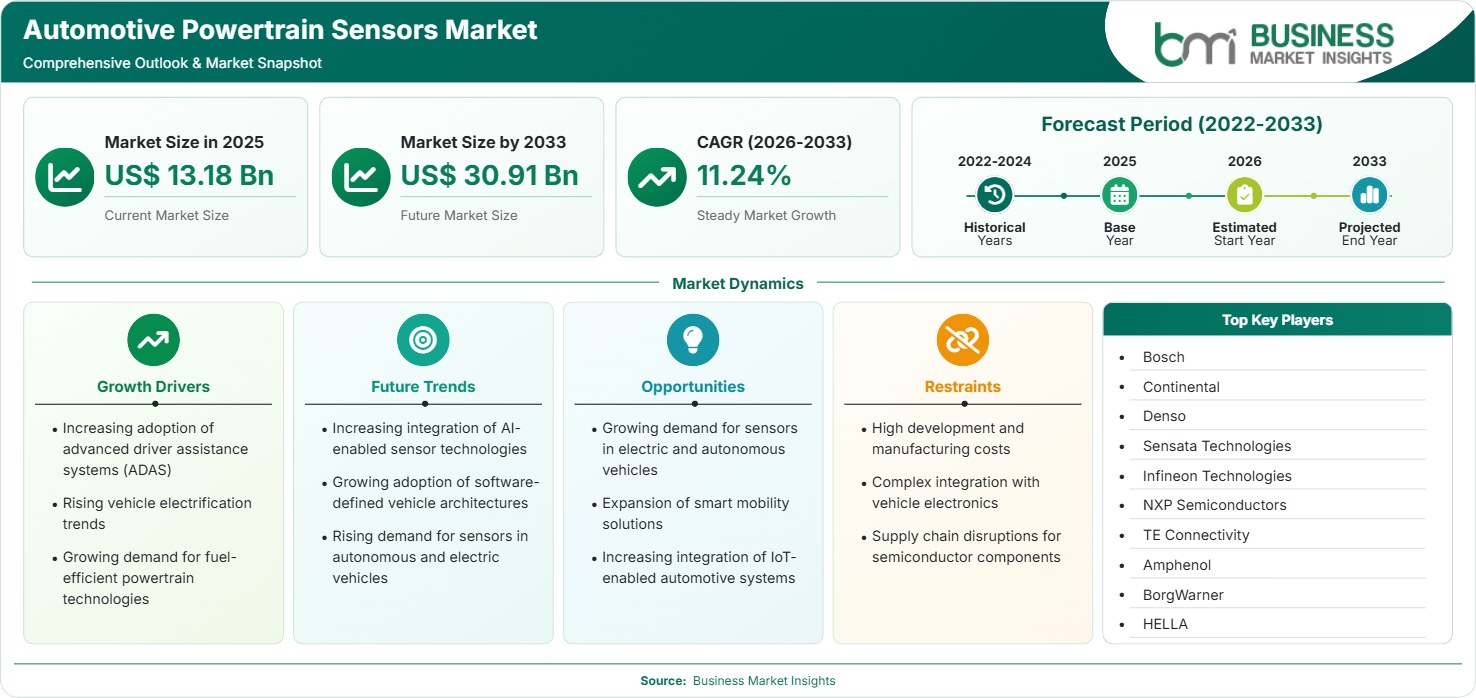
The Automotive Powertrain Sensors Market size was valued at US$ 13.18 Billion in 2025 and is projected to reach US$ 30.91 Billion by 2033, growing at a CAGR of 11.24% from 2026 to 2033, driven by ADAS adoption, vehicle electrification, fuel-efficient powertrain technologies, smart mobility expansion, and connected vehicle innovation.

Report Coverage
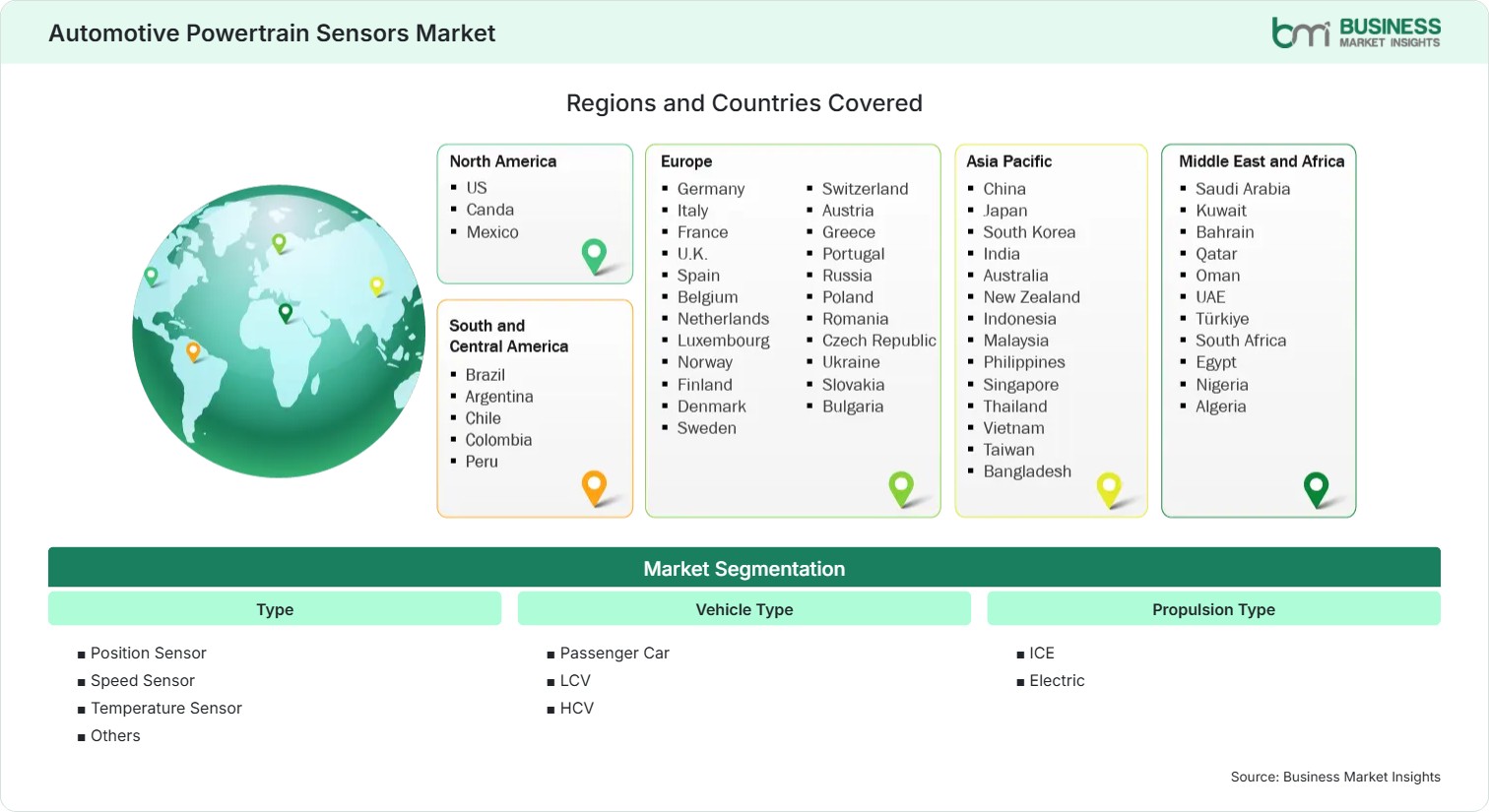
  • Type: Position Sensor, Speed Sensor, Temperature Sensor, Others
  • Vehicle Type: Passenger Car, LCV, HCV
  • Propulsion Type: ICE, Electric
US$ 13.18 Bn Market size in 2025
US$ 30.91 Bn Market Size by 2033
11.24% CAGR, 2026 - 2033
2026-2033 Forecast Period

01 AI Overview

Automotive Powertrain Sensors Market Summary

  • North America Region: North America holds a market share of 27%–30% in 2025, growing with a CAGR of 10%–12% influenced by electric vehicle adoption, advanced vehicle technologies, stringent emission standards, and increasing integration of intelligent automotive systems. The US market demonstrates strong adoption with a CAGR of 10%–12% during 2026–2033, supported by EV investments, autonomous driving development, and advanced sensor deployment.
  • Fastest Growing Region: Asia Pacific holds a market share of 40%–43% in 2025, expanding with a CAGR of 12%–14% due to automotive production growth, electric vehicle expansion, semiconductor investments, and increasing adoption of advanced powertrain technologies across major vehicle manufacturing hubs.
  • Leading Segment: Temperature Sensor holds a market share of 32%–35% in 2025, growing with a CAGR of 11%–13% due to thermal management requirements, emission compliance, engine optimization, and increasing electrification of vehicle systems.
  • High Growth Segment: Electric Propulsion holds a market share of 22%–25% in 2025, advancing with a CAGR of 14%–16% due to battery electric vehicle growth, power electronics integration, thermal monitoring requirements, and intelligent vehicle architectures.
  • Key Market Opportunity: Increasing sensor demand in electric and autonomous vehicles, smart mobility expansion, and IoT-enabled automotive systems are creating opportunities for advanced sensing technologies and connected powertrain solutions.
  • Major Market Players: Bosch, Continental, Denso, Sensata Technologies, Infineon Technologies, NXP Semiconductors, TE Connectivity, Amphenol, BorgWarner, and HELLA.
02 Strategic Insights

Automotive Powertrain Sensors Market: Strategic Insights

Automotive Powertrain Sensors Market Strategic Framework
FREE PDF
Request your free sample
Request free sample
03 Stakeholder View

Key Takeaways

  • Automotive sensor ecosystems are shifting toward higher electronic content, with powertrain systems requiring greater accuracy, reliability, and integration capabilities.
  • Electric vehicle platforms represent a major growth opportunity as battery management, thermal control, and electric drivetrain monitoring increase sensor requirements.
  • Innovation priorities include advanced semiconductor sensors, miniaturized components, intelligent processing capabilities, and connected vehicle integration.
  • Asia Pacific provides strong investment opportunities due to automotive manufacturing leadership, EV expansion, and growing semiconductor production capabilities.
  • Strategic partnerships between automotive suppliers and technology companies are increasing to accelerate sensor innovation and vehicle electrification solutions.
  • IoT-enabled automotive systems are creating new opportunities for real-time monitoring, predictive maintenance, and connected mobility services.
04 Geographic Outlook

Automotive Powertrain Sensors Market Regional Highlights

North America Automotive Powertrain Sensors Market

North America accounted for a 27%–30% share in 2025 and is projected to register a CAGR of 10%–12% from 2026–2033. The region maintains a strong position due to advanced automotive technologies, electric vehicle investments, and increasing adoption of intelligent vehicle systems. The Automotive Powertrain Sensors Market share reflects growing demand from passenger vehicles, commercial fleets, and autonomous mobility developers. The United States remains the largest contributor due to strong automotive innovation.

  • The United States is promoting the use of sensors in the automotive industry via fast electric vehicle development, ADAS incorporation, and growing need for high-end automotive electronics. The automobile industry is concentrating on intelligent mobility and advanced safety features of vehicles.
  • Canada is supporting automotive technology growth through electrification initiatives, clean mobility investments, and increasing adoption of advanced vehicle systems. The market is encouraging innovation in sustainable transportation solutions.
  • Automotive suppliers are developing high-performance sensors for next-generation vehicle architectures, including electric, connected, and autonomous vehicles.
  • Manufacturers are focusing on improving vehicle efficiency through advanced powertrain monitoring technologies, enabling better performance, reliability, and energy management.

US Automotive Powertrain Sensors Market

The United States represented a 23%–26% share in 2025 and is expected to achieve a CAGR of 10%–12% between 2026–2033. The country benefits from strong automotive research capabilities, EV investments, semiconductor innovation, and increasing adoption of advanced driver assistance technologies. The Automotive Powertrain Sensors Market growth is supported by vehicle electrification, autonomous mobility development, and demand for efficient transportation systems.

  • Auto manufacturers are incorporating more sensors in order to increase vehicle efficiency, improve safety features, and improve intelligent vehicle system performance. Advanced sensors are becoming necessary for connected, electric, and autonomous vehicles.
  • EV manufacturers are adopting advanced thermal management and battery monitoring sensors to optimize energy efficiency, improve battery performance, and enhance overall vehicle reliability.
  • Technology providers are investing in automotive semiconductor development and innovative sensing solutions to meet the growing demand for next-generation mobility technologies and advanced vehicle platforms.

Europe Automotive Powertrain Sensors Market

Europe accounted for a 25%–28% share in 2025 and is forecast to grow at a CAGR of 10%–12% during 2026–2033. The region benefits from strict emission regulations, strong automotive manufacturing capabilities, and increasing electric vehicle adoption. Germany, France, and the United Kingdom represent leading markets, while Italy and Sweden demonstrate growth through automotive innovation and sustainable mobility initiatives.

  • Germany is fueling the demand for sensors in the country through its well-developed automobile engineering know-how, sophisticated manufacturing processes, and increased investment in the production of electric vehicles. Germany aims to incorporate advanced sensors into future mobility solutions and smart vehicles.
  • France is adopting advanced vehicle technologies through electrification initiatives, emission reduction programs, and increasing demand for efficient automotive sensor systems.
  • The United Kingdom is supporting intelligent mobility solutions through autonomous vehicle development, smart transportation initiatives, and investments in advanced automotive technologies.
  • European suppliers are investing in efficient sensor technologies to support future vehicle platforms, improve safety features, and enhance electric and connected vehicle performance.

Asia Pacific Automotive Powertrain Sensors Market

Asia Pacific represented a 40%–43% share in 2025 and is projected to grow at a CAGR of 12%–14% between 2026–2033. The region is growing because of high levels of vehicle production, increased use of electric vehicles, semiconductors, and advanced automotive electronics. Major markets in the region include China, Japan, South Korea, and India support the demand for sensors through the development of automobiles.

  • In China, the use of sensors is being increased via good leadership in electric vehicles, high production of automobiles, and investment in smart cars. The increasing need for electric and autonomous cars is leading to the adoption of automotive sensors.
  • Japan continues advancing sensor technologies through automotive innovation, precision engineering, and research-driven development of high-performance sensing solutions for modern vehicles.
  • South Korea is increasing sensor demand through semiconductor advancements, electric vehicle growth, and automotive electronics innovation.
  • India is witnessing market expansion through vehicle electrification, increasing automotive technology investments, and growing adoption of intelligent mobility solutions.

Rest of World Automotive Powertrain Sensors Market

South and Central America accounted for a 5%–7% share in 2025, while the Middle East and Africa contributed a combined 4%–6% share. These regions are projected to grow at CAGRs of 9%–11% and 10%–12%, respectively, supported by vehicle modernization, increasing automotive imports, infrastructure development, and gradual electrification. Brazil, Mexico, UAE, and South Africa represent emerging markets with increasing demand for efficient and connected vehicle technologies.

  • Brazil is expanding automotive sensor adoption through vehicle production growth and technology modernization initiatives.
  • Mexico is increasing demand through automotive manufacturing expansion and global supplier investments.
  • UAE is supporting intelligent mobility solutions through smart transportation and premium vehicle adoption.
  • South Africa is improving automotive technology integration through modernization of vehicle systems.
Global Market Geography
FREE PDF
Request your free sample
Request free sample
05 Segment Analysis

Automotive Powertrain Sensors Market Segmentation

Type

Type segmentation is influenced by increasing requirements for accurate vehicle monitoring, emission control, and powertrain optimization. Temperature Sensor dominated the segment with a 32%–35% share in 2025 and is projected to grow at a CAGR of 11%–13% between 2026–2033. The Automotive Powertrain Sensors Market scope continues expanding as manufacturers integrate advanced sensing technologies for thermal management, efficiency improvement, and electrified powertrain performance.

  • Position Sensor: Enables accurate monitoring of engine components, transmission systems, and electric motor operations. Adoption is increasing due to automation and precision control requirements.
  • Speed Sensor: Supports vehicle control systems by monitoring rotational speed and movement parameters. Demand is increasing through advanced transmission systems and electric drivetrain applications.
  • Temperature Sensor: Provides thermal monitoring for engines, batteries, and power electronics. Growth is supported by emission control requirements and electric vehicle thermal management.

Vehicle Type

Vehicle Type segmentation reflects increasing sensor requirements across passenger and commercial vehicle platforms. Passenger Car represented a 62%–65% share in 2025 and is expected to grow at a CAGR of 11%–13% between 2026–2033. High passenger vehicle production, increasing ADAS adoption, and electrification trends are driving demand for advanced powertrain sensors across global automotive markets.

  • Passenger Car: Represents the largest application area due to rising vehicle electronics integration, consumer demand for efficiency, and increasing EV adoption.
  • LCV: Utilizes sensors for fleet efficiency, emission management, and operational reliability. Growth is supported by expanding logistics and urban delivery services.
  • HCV: Requires advanced sensing solutions for heavy-duty performance, fuel optimization, and commercial transportation efficiency improvements.

Propulsion Type

Propulsion Type segmentation is undergoing transformation due to rising electrification and continued demand for efficient internal combustion systems. ICE accounted for a 75%–78% share in 2025 and is projected to grow at a CAGR of 9%–11% between 2026–2033. Electric propulsion demonstrates faster expansion due to increasing EV production, battery technologies, and intelligent vehicle system integration.

  • ICE: Remains widely used globally with sensors supporting fuel efficiency, emission control, engine monitoring, and performance optimization.
  • Electric: Gains adoption through battery monitoring, thermal management, motor control, and advanced power electronics requirements in electric vehicles.
06 Market Forces

Automotive Powertrain Sensors Market Dynamics

Key Market Drivers

Increasing Adoption of Advanced Driver Assistance Systems

The increasing adoption of advanced driver assistance systems is accelerating demand for automotive sensors by improving vehicle intelligence, safety, and operational control. ADAS technologies require accurate sensor inputs to support functions such as adaptive cruise control, automated braking, and vehicle monitoring. Although ADAS primarily relies on multiple sensor categories, powertrain sensors contribute essential operational data for optimized vehicle performance. The Automotive Powertrain Sensors Market trends indicate growing integration of electronic systems as automakers develop connected and intelligent vehicles. Regulatory emphasis on vehicle safety and consumer demand for advanced features are encouraging manufacturers to increase sensor content across new vehicle platforms.

Rising Vehicle Electrification Trends

Electric vehicle trends are having a major impact on the sensor market because the electric vehicles have sophisticated sensing systems that are needed to monitor batteries, engines, and heating/cooling components. Electric powertrains rely on sensing technologies to help optimize their energy efficiency, reliability, and safety during operation. There has been an increase in the production of electric vehicles in Asia, Europe, and North America, which is driving up the requirement for temperature, position, and speed sensors. Auto makers are adopting electronic platforms for hybrid and battery-powered vehicles.

Growing Demand for Fuel-Efficient Powertrain Technologies

The increasing demand for energy-saving powertrain systems has prompted automotive manufacturers to install more sophisticated sensors that help enhance engine efficiency, reduce emissions, and conserve energy. Powertrain sensors offer important data to the engine control unit that helps in controlling the operational conditions. Regulatory pressures regarding emissions and fuel efficiency are leading to an increased use of advanced sensors. Companies are focusing on improving combustion processes and minimizing energy losses through electronic control systems. The requirement for efficient vehicles in both passenger and commercial segments will continue to drive the adoption of sensors in automobiles.

Key Market Opportunities

Growing Demand for Sensors in Electric and Autonomous Vehicles

The growing demand for sensors in electric and autonomous vehicles is creating substantial opportunities for automotive technology suppliers. Electric vehicles require advanced sensing solutions for battery monitoring, thermal management, motor control, and power electronics optimization. Autonomous vehicles further increase sensor requirements through complex electronic architectures and intelligent control systems. The Automotive Powertrain Sensors Market Forecasts indicate strong opportunities for manufacturers developing high-precision, compact, and energy-efficient sensors designed for next-generation mobility platforms. Automotive companies are increasing investments in electrification and autonomous driving technologies, creating long-term growth potential for sensor developers focused on advanced vehicle applications.

Expansion of Smart Mobility Solutions

The expansion of smart mobility solutions is creating opportunities as connected vehicles and intelligent transportation systems require improved sensing capabilities. Smart mobility ecosystems depend on real-time vehicle data collection, predictive maintenance, and efficient transportation management. Automobile sensors can continuously monitor automobile performance and help enhance operational efficiency. Urbanization, fleet management and infrastructure that uses sensors are making automobile manufacturers design sophisticated sensors. Suppliers of integrated sensors for connected mobility systems will benefit from the growing demand for intelligent transportation systems and digitized automotive services.

Increasing Integration of IoT-Enabled Automotive Systems

Increasing integration of IoT-enabled automotive systems is opening opportunities for sensor manufacturers by enabling connected vehicle monitoring and data-driven services. IoT technologies allow vehicles to collect, process, and transmit operational information, improving predictive maintenance and vehicle performance analysis. The powertrain sensors are highly important in ensuring that there is a generation of real-time data which is needed in connected automotive eco-systems. The automobile companies are making investments in intelligent car platforms which have sensors, connectivity and analytics. The use of Internet of Things-based automotive solutions is bound to drive innovation in sensor technologies.

Market Restraints and Challenges

High Development and Manufacturing Costs

Factor: Advanced automotive powertrain sensors require significant research investment, specialized semiconductor components, precision manufacturing processes, and extensive validation testing. Impact: High development and production costs can increase component pricing and create challenges for suppliers competing in cost-sensitive automotive markets. Sensor manufacturers must invest heavily in material innovation, quality control systems, and advanced manufacturing capabilities to meet automotive reliability standards. Smaller suppliers may face difficulty competing with established technology providers due to high capital requirements. Companies are addressing this challenge through manufacturing optimization, automation, and strategic partnerships to reduce production expenses while maintaining performance standards.

Complex Integration with Vehicle Electronics

Factor: Modern vehicles contain increasingly complex electronic architectures requiring seamless integration between sensors, control units, communication networks, and software platforms. Impact: Integration complexity can increase development timelines, compatibility challenges, and testing requirements for automotive manufacturers. Powertrain sensors must operate reliably under varying environmental conditions while communicating accurately with vehicle systems. As vehicles become more software-defined, suppliers must develop solutions compatible with evolving electronic platforms. Automakers are collaborating with technology providers to improve integration processes, but complexity remains a key challenge affecting deployment speed and system development costs.

07 Company Analysis

Competitive Landscape

The competitive environment is shaped by automotive technology innovation, semiconductor advancements, electrification strategies, and increasing demand for intelligent sensing systems. Automotive Powertrain Sensors Market analysis indicates that leading companies are focusing on advanced sensor development, automotive electronics integration, EV applications, and connected vehicle technologies. Market participants are strengthening their positions through research investments, strategic collaborations, product development, and expansion of automotive sensor portfolios.

Company Name

Overview

Products and Services relevant to this market

Bosch

Global automotive technology supplier providing mobility solutions.

Engine sensors, position sensors, temperature sensors, automotive electronics.

Continental

Automotive technology company specializing in vehicle systems.

Powertrain sensors, electronic control systems, vehicle sensor technologies.

Denso

Automotive component manufacturer focused on mobility technologies.

Engine sensors, thermal sensors, vehicle control solutions.

Sensata Technologies

Sensor technology company serving automotive and industrial markets.

Pressure sensors, temperature sensors, powertrain monitoring solutions.

Infineon Technologies

Semiconductor company developing automotive electronic components.

Automotive sensors, microcontrollers, powertrain semiconductor solutions.

NXP Semiconductors

Semiconductor provider supporting connected automotive systems.

Automotive processors, sensor interfaces, vehicle electronics solutions.

TE Connectivity

Technology company providing connectivity and sensor solutions.

Automotive sensors, connectors, electronic components.

Amphenol

Electronics manufacturer supplying sensing and connectivity technologies.

Automotive sensors, interconnect solutions, electronic systems.

BorgWarner

Automotive supplier focused on propulsion and mobility technologies.

EV systems, powertrain components, sensor-integrated technologies.

HELLA

Automotive supplier specializing in lighting and electronics systems.

Vehicle sensors, electronic modules, automotive control solutions.

10 Trust & Transparency

Research Methodology

The market analysis combines proprietary research with secondary data from government agencies, company disclosures, regulatory filings, industry databases and expert interviews. Market estimates are validated through data triangulation, cross-market benchmarking and analyst review.

View Full Research Methodology

11 Questions Answered

Frequently Asked Questions

Why are IoT-enabled automotive systems important?

IoT-enabled automotive systems support real-time vehicle monitoring, predictive maintenance, connected services, and improved operational efficiency through continuous data collection.

What does the Automotive Powertrain Sensors Market Report cover?

The report covers market size, segmentation, regional analysis, competitive landscape, trends, opportunities, challenges, and future technology developments.

How are electric vehicles impacting sensor demand?

Electric vehicles are increasing demand for advanced sensors used in battery monitoring, thermal management, motor control, and power electronics systems.

Which sensor type dominates automotive powertrain applications?

Temperature sensors represent a leading segment due to increasing requirements for thermal management, emission control, and electric vehicle powertrain optimization.

What factors are driving the Automotive Powertrain Sensors Market growth?

The market is driven by vehicle electrification, ADAS adoption, fuel efficiency requirements, connected mobility development, and increasing integration of advanced automotive electronics.

Access the Full Automotive Powertrain Sensors Market Report

Get segment-level forecasts, regional estimates, competitive benchmarking, company profiles and downloadable Excel datasets.

Access the full Automotive Powertrain Sensors Market Report
350 pages PDF & Excel | 2026-08-05