
Automotive Active Safety Sensors Market Outlook: Size, Share, Trends, Growth Analysis, Competitive Landscape & Forecast, 2022-2033

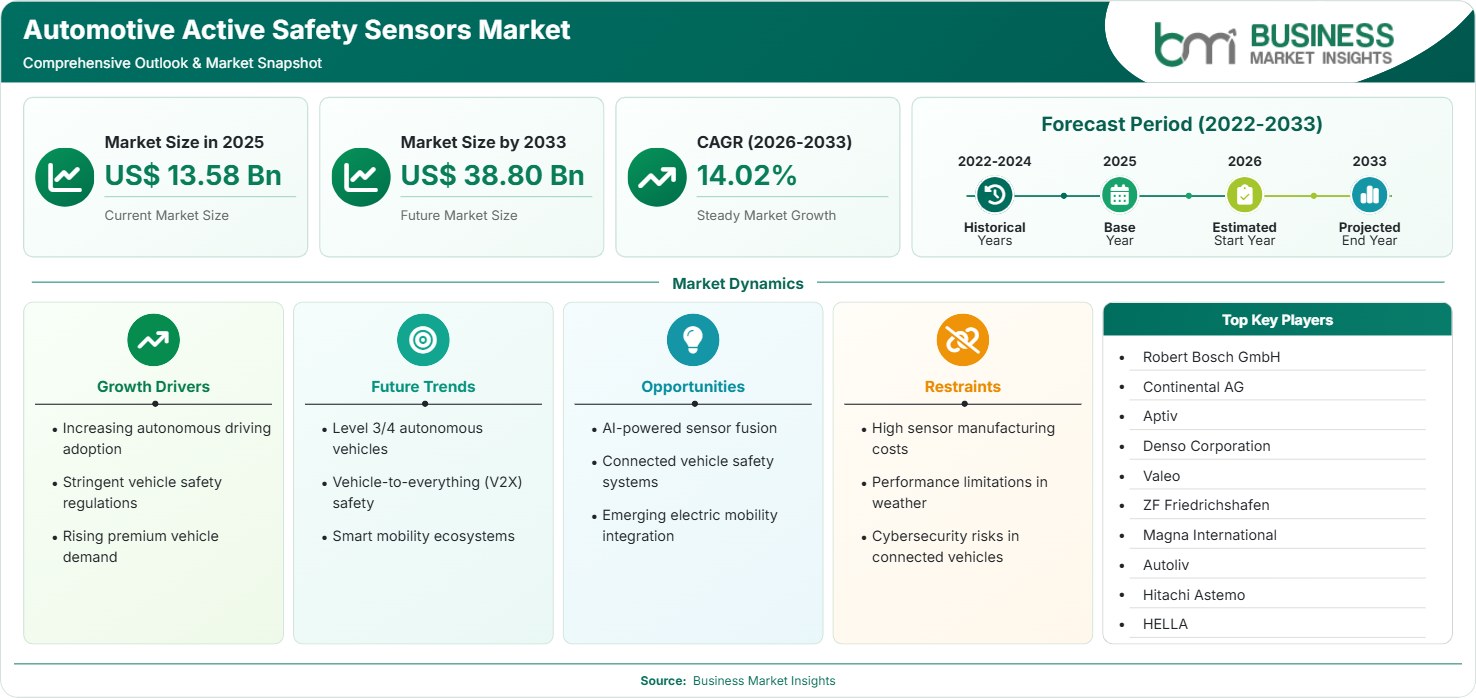
The Automotive Active Safety Sensors Market size was valued at USD 13.58 billion in 2025 and is projected to reach USD 38.8 billion by 2033, growing at a CAGR of 14.02% during 2026–2033. Rising adoption of advanced driver assistance systems, expanding vehicle safety regulations, rapid sensor innovation, and increasing investments in autonomous mobility technologies continue to strengthen long-term market expansion opportunities across passenger and commercial vehicle segments.

Report Coverage
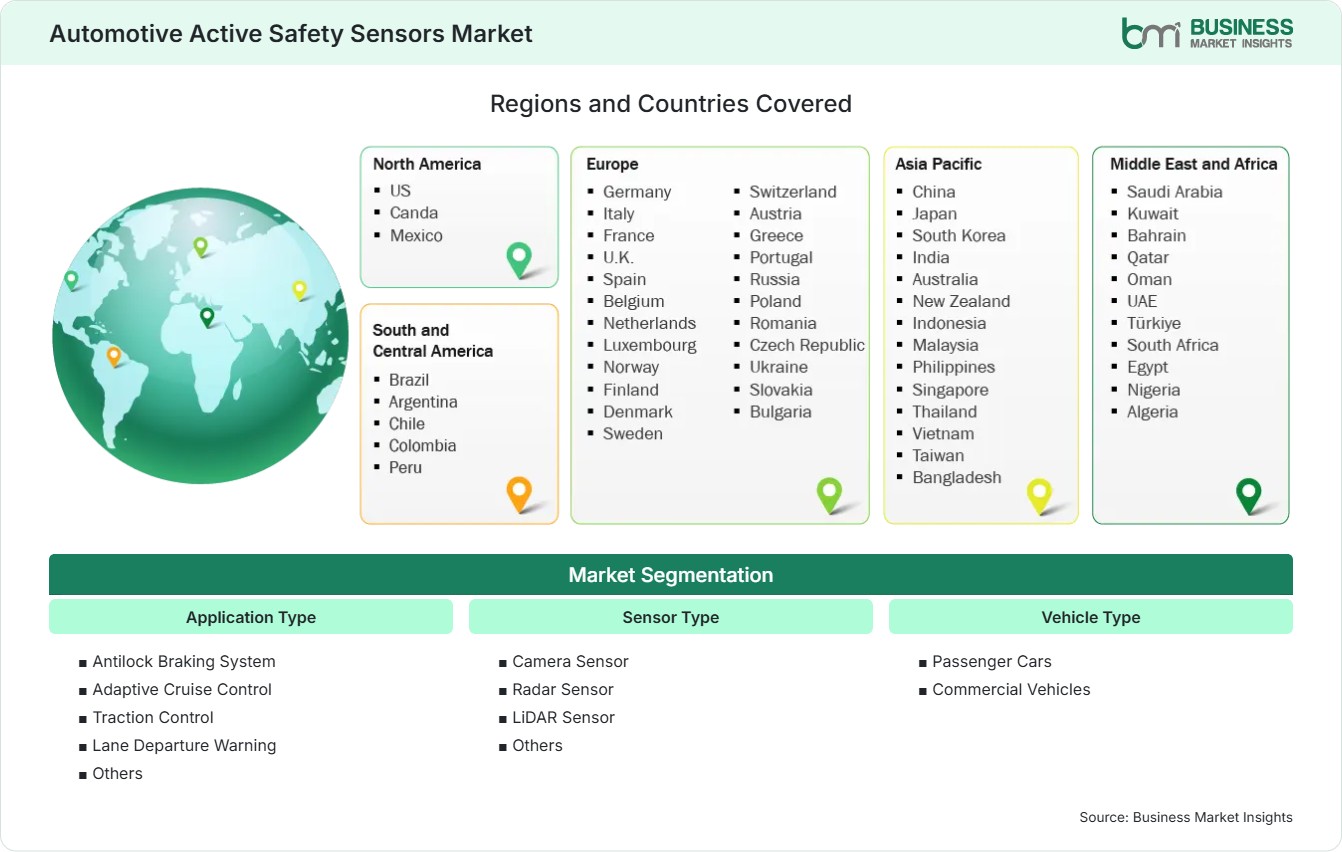
  • Application Type: Antilock Braking System, Adaptive Cruise Control, Traction Control, Lane Departure Warning, Others
  • Sensor Type: Camera Sensor, Radar Sensor, LiDAR Sensor, Others
  • Vehicle Type: Passenger Cars, Commercial Vehicles
US$ 13.58 Bn Market size in 2025
US$ 38.80 Bn Market Size by 2033
14.02% CAGR, 2026 - 2033
2026-2033 Forecast Period

AI Overview

Automotive Active Safety Sensors Market Summary

  • North America Region: North America holds a market share of 34%–37% in 2025 and is projected to register a CAGR of 13.2%–13.8% during 2026–2033. Growth is supported by stringent vehicle safety mandates, premium vehicle penetration, increasing ADAS integration, semiconductor investments, and strong OEM collaboration for autonomous mobility technologies. The United States remains the regional growth engine with expanding ADAS deployment across passenger vehicles and an estimated CAGR of 13.4%–14.0% during the forecast period.
  • Fastest Growing Region: Asia Pacific accounts for 28%–31% of the global market in 2025 and is anticipated to expand at a CAGR of 15.2%–15.8% through 2033. Accelerating vehicle production, growing consumer awareness of safety technologies, supportive government policies, expanding EV manufacturing, and investments in intelligent transportation systems continue driving regional demand.
  • Leading Segment: Camera Sensor represents the largest segment with a market share of 37%–40% in 2025 and is expected to grow at a CAGR of 13.8%–14.4% during 2026–2033. Broad application across lane departure warning, traffic sign recognition, collision avoidance, and driver monitoring systems supports sustained deployment by global automakers.
  • High Growth Segment: LiDAR Sensor contributes 12%–15% of the market in 2025 and is forecast to grow at a CAGR of 18.0%–19.2% through 2033. Falling component costs, higher autonomous driving investments, improved long-range detection capabilities, and increasing commercial deployment accelerate adoption across advanced vehicle platforms.
  • Key Market Opportunity: Expanding deployment of AI-enabled sensor fusion platforms integrating radar, cameras, and LiDAR with centralized vehicle computing creates substantial opportunities for safer autonomous driving, predictive hazard detection, and software-defined vehicle architectures.
  • Major Market Players: Robert Bosch GmbH, Continental AG, Aptiv PLC, DENSO Corporation, Valeo SE, ZF Friedrichshafen AG, Magna International Inc., Autoliv Inc., Hitachi Astemo, Ltd., HELLA GmbH & Co. KGaA.
Strategic Insights

Automotive Active Safety Sensors Market: Strategic Insights

Automotive Active Safety Sensors Market Strategic Framework
FREE PDF
Request your free sample
Request free sample
Stakeholder View

Key Takeaways

  • The market ecosystem continues shifting toward vertically integrated supply chains where semiconductor suppliers, software developers, Tier-1 suppliers, and vehicle manufacturers collaborate to optimize sensor performance, reduce integration complexity, and improve production scalability.
  • Passenger vehicles equipped with advanced driver assistance systems present the strongest near-term commercial opportunity, while commercial fleet modernization creates additional long-term demand for collision avoidance and predictive safety technologies.
  • Innovation increasingly centers on AI-powered perception software, sensor fusion algorithms, edge computing processors, and over-the-air software updates that improve vehicle safety without requiring major hardware redesigns.
  • Asia Pacific offers one of the strongest long-term investment environments owing to expanding automotive manufacturing capacity, rising EV production, supportive government incentives, and increasing consumer demand for advanced safety technologies.
  • Strategic acquisitions, semiconductor partnerships, and software collaborations are becoming central competitive strategies as suppliers seek broader technology portfolios supporting autonomous driving and software-defined vehicle platforms.
  • Manufacturers emphasizing modular sensor architectures and scalable software platforms are expected to improve profitability while addressing diverse regulatory requirements across developed and emerging automotive markets.
Geographic Outlook

Automotive Active Safety Sensors Market Regional Highlights

North America Automotive Active Safety Sensors Market

North America accounts for 34%–37% of global revenue in 2025 and is projected to expand at a CAGR of 13.2%–13.8% through 2033. The Automotive Active Safety Sensors market share remains the largest globally owing to strong ADAS penetration, favorable regulatory initiatives, high premium vehicle production, and rapid commercialization of autonomous driving technologies. Significant investments in automotive semiconductor manufacturing further strengthen regional competitiveness.

  • Advanced emergency braking regulations and consumer demand for intelligent safety systems encourage higher installation rates of radar, camera, and LiDAR technologies across passenger and commercial vehicle production throughout North America.
  • Strategic investments from global semiconductor manufacturers improve supply resilience, reduce procurement risks, and support increasing production volumes for advanced sensing platforms integrated into software-defined vehicle architectures.
  • Fleet modernization programs accelerate adoption of adaptive cruise control, collision avoidance systems, and driver monitoring technologies, particularly among logistics operators seeking improved operational safety and insurance cost reductions.

US Automotive Active Safety Sensors Market

The United States is the dominant national market in North America, with a regional share of 79%–82% and an estimated CAGR of 13.4%–14.0% in Automotive Active Safety Sensors Market forecasts. Strong consumer purchasing power, technological leadership, expanding EV manufacturing, and continued investments in autonomous mobility strengthen long-term demand for integrated safety sensor platforms.

  • Federal vehicle safety initiatives continue encouraging wider deployment of automatic emergency braking, lane assistance, and adaptive cruise technologies across multiple passenger vehicle categories.
  • Domestic technology companies increasingly collaborate with global automotive manufacturers to accelerate commercialization of AI-enabled perception software supporting advanced driver assistance capabilities.
  • Expanding electric vehicle production increases integration opportunities for centralized electronic architectures capable of supporting multiple sensor technologies through unified computing platforms.

Europe Automotive Active Safety Sensors Market

Europe contributes 26%–29% of global revenue in 2025 while advancing at a CAGR of 13.6%–14.2% through 2033. Mandatory vehicle safety regulations, premium automotive manufacturing, and strong engineering capabilities continue supporting regional competitiveness. Germany leads regional demand, while Eastern European manufacturing expansion contributes additional production capacity and supply chain resilience.

  • Germany remains the largest contributor because of premium vehicle manufacturing, advanced engineering expertise, and continued investments in intelligent mobility technologies supporting sensor innovation.
  • France demonstrates one of the strongest regional expansion rates with an estimated CAGR of 14.0%–14.6%, supported by electrification initiatives and increased deployment of ADAS-equipped passenger vehicles.
  • Euro NCAP assessment standards continue encouraging manufacturers to integrate increasingly sophisticated active safety technologies across multiple vehicle categories.

Asia Pacific Automotive Active Safety Sensors Market

Asia Pacific represents 28%–31% of global revenue during 2025 and is forecast to register the highest CAGR of 15.2%–15.8% through 2033. Rapid vehicle production growth, expanding electric mobility investments, supportive industrial policies, and increasing consumer awareness of safety technologies continue accelerating adoption throughout major automotive manufacturing economies.

  • China remains the largest regional market through extensive EV production, large-scale ADAS deployment, and significant government investment supporting intelligent connected vehicle development.
  • India records one of the fastest expansion rates with a projected CAGR of 16.0%–16.8%, supported by rising vehicle ownership, stronger road safety regulations, and increasing domestic automotive manufacturing.
  • Japan continues strengthening technology leadership through continuous innovation in imaging sensors, radar systems, and autonomous driving software platforms.

Rest of World Automotive Active Safety Sensors Market

The Rest of World accounts for 9%–11% of global revenue in 2025 and is projected to expand at a CAGR of 12.6%–13.2% during 2026–2033. South & Central America continue witnessing gradual adoption as vehicle safety awareness improves and premium vehicle imports increase.

The Middle East & Africa benefit from infrastructure modernization, premium automotive demand, and growing investments in connected transportation systems supporting future adoption of intelligent safety technologies across both passenger and commercial vehicle fleets.

  • Brazil remains the leading South American market owing to expanding vehicle manufacturing activities and increasing adoption of advanced safety technologies among domestic automotive producers.
  • Saudi Arabia demonstrates one of the strongest Middle East growth trajectories with an estimated CAGR of 13.8%–14.4%, supported by smart mobility initiatives and transportation modernization investments.
  • Growing logistics activities increase commercial fleet demand for predictive safety systems capable of reducing accident rates and improving operational efficiency.
Global Market Geography
FREE PDF
Request your free sample
Request free sample
Segment Analysis

Automotive Active Safety Sensors Market Segmentation

Application Type

The application segment accounted for the broadest adoption across vehicle safety systems, supported by increasing regulatory compliance and widespread integration of advanced driver assistance technologies. This segment represented approximately 42%–45% of the market in 2025 and is projected to register a CAGR of 13.9%–14.5% during 2026–2033. The Automotive Active Safety Sensors Market scope continues expanding as automakers integrate multiple active safety functions into standardized vehicle platforms to improve road safety, automation capability, and consumer confidence.

  • Antilock Braking System: Continues representing a foundational safety application because of mandatory adoption across numerous countries, ensuring stable sensor demand while supporting braking stability and vehicle control under challenging road conditions.
  • Adaptive Cruise Control: Rapid adoption across passenger and premium vehicles is increasing demand for radar and camera sensors capable of maintaining safe vehicle spacing while improving driving comfort during highway operation.
  • Traction Control: Growing installation across electric vehicles and commercial fleets supports stable demand for wheel speed sensors, enhancing traction management, vehicle stability, and overall driving safety under varying road conditions.
  • Lane Departure Warning: Rising implementation of intelligent lane assistance technologies increases camera sensor deployment, helping reduce unintended lane departures while improving compliance with evolving global vehicle safety regulations.

Sensor Type

Sensor technologies represent the technological backbone of active safety systems, enabling real-time environmental perception and intelligent driving decisions. This segment accounted for approximately 38%–41% of global revenue in 2025 and is anticipated to expand at a CAGR of 14.3%–14.9% through 2033. The Automotive Active Safety Sensors Market trends increasingly emphasize multi-sensor fusion architectures combining cameras, radar, and LiDAR to improve detection accuracy, operational redundancy, and autonomous driving capability.

  • Camera Sensor: Maintains leadership because of broad deployment across lane departure warning, traffic sign recognition, driver monitoring, and pedestrian detection applications, supported by improving image processing and declining component costs.
  • Radar Sensor: Experiences strong adoption through adaptive cruise control and automatic emergency braking systems, offering reliable object detection under poor visibility while supporting long-range environmental monitoring across multiple vehicle categories.
  • LiDAR Sensor: Benefits from growing autonomous driving investments, improving three-dimensional environmental mapping, higher detection precision, and gradually declining production costs that encourage wider commercial deployment across advanced vehicle platforms.

Vehicle Type

Vehicle type remains a primary determinant of active safety sensor deployment because safety requirements, regulatory mandates, and technology adoption vary considerably between passenger and commercial transportation. This segment generated approximately 47%–50% of overall revenue in 2025 and is forecast to grow at a CAGR of 13.8%–14.4% during the forecast period. Expanding electrification, autonomous driving development, and connected mobility continue strengthening long-term adoption across diverse vehicle categories.

  • Passenger Cars: Continue dominating demand as manufacturers increasingly standardize advanced driver assistance technologies across mid-range and premium models, supported by rising consumer safety awareness and regulatory requirements.
  • Commercial Vehicles: Fleet operators increasingly adopt advanced sensing technologies to improve operational safety, reduce accident frequency, optimize insurance costs, and comply with evolving transportation safety regulations across logistics and public transport sectors.
Market Forces

Automotive Active Safety Sensors Market Dynamics

Key Market Drivers

Increasing autonomous driving adoption

Increasing adoption of autonomous driving technologies is driving demand for automotive active safety sensors as vehicles require continuous environmental monitoring and real-time decision-making. Radar, LiDAR, cameras, and ultrasonic sensors enable obstacle detection, lane monitoring, and collision avoidance. Automakers are expanding ADAS integration to support higher automation levels and improve road safety. Growing investments in autonomous mobility and intelligent sensing technologies continue to strengthen the Automotive Active Safety Sensors Market growth.

Stringent vehicle safety regulations

Stringent vehicle safety regulations are accelerating adoption of automotive active safety sensors as governments mandate technologies such as automatic emergency braking, lane departure warning, adaptive cruise control, and blind spot detection. Automakers are integrating advanced sensing systems to meet safety standards and improve vehicle safety ratings. Regulatory efforts to reduce accidents and enhance occupant protection remain a major Automotive Active Safety Sensors Market trends.

Rising premium vehicle demand

Rising demand for premium vehicles is increasing deployment of advanced active safety sensors as luxury manufacturers offer intelligent safety features as standard. Consumers increasingly prefer vehicles equipped with ADAS, collision avoidance, and driver assistance technologies. Growing disposable incomes and wider availability of premium safety features across mid-range vehicles are supporting market expansion.

Key Market Opportunities

AI-powered sensor fusion

AI-powered sensor fusion is creating significant opportunities by combining data from radar, cameras, LiDAR, and ultrasonic sensors to improve object detection and driving decisions. Artificial intelligence increases accuracy and reduces erroneous alerts; artificial intelligence also improves ADAS. Growing investment in intelligent vehicles is promoting the adoption of smart sensor fusion technology.

Connected vehicle safety systems

Connected vehicle safety systems are expanding opportunities through V2V and V2X communication technologies that enable real-time exchange of traffic and hazard information. The integration of active safety sensors in connected mobility platforms helps to enhance driving safety and prevent collisions. Continued development of smart transportation infrastructure still supports demand.

Emerging electric mobility integration

Growing electric vehicle production is creating opportunities for advanced active safety sensors designed for EV platforms. These sensors provide collision warning, battery protection, driver assist, and self-driving features. More governmental interest in vehicle electrification will fuel the growth of the market of sensors.

Market Restraints and Challenges

High system development costs

Factor: High system development costs remain a major challenge due to investments required for sensor design, software development, testing, and regulatory compliance.

Impact: Advanced semiconductor technologies and validation processes increase production costs, limiting adoption in price-sensitive vehicle segments despite ongoing cost optimization efforts.

Complex sensor integration

Factor: Complex sensor integration challenges arise from coordinating multiple sensors, electronic control units, and software platforms within modern vehicles.

Impact: Ensuring accurate data processing, low latency, and reliable system performance increases engineering complexity and development time. Maintaining seamless integration across diverse vehicle platforms remains a key industry challenge.

Company Analysis

Competitive Landscape

The competitive environment is characterized by continuous investment in sensor miniaturization, AI-enabled perception software, radar imaging, and integrated safety platforms. The Automotive Active Safety Sensors Market analysis indicates that Tier-1 automotive suppliers are strengthening partnerships with semiconductor manufacturers, software developers, and vehicle OEMs to accelerate commercialization of next-generation ADAS solutions. Companies are also expanding regional manufacturing footprints, increasing R&D spending, and introducing scalable sensor architectures to support software-defined vehicles and higher levels of driving automation.

Company Name

Overview

Products and Services Relevant to this Market

Robert Bosch GmbH

Global automotive technology leader specializing in intelligent mobility, ADAS, electrification, and connected vehicle solutions across major automotive markets.

Automotive radar sensors, camera modules, ultrasonic sensors, braking systems, ADAS software, autonomous driving technologies, and integrated safety platforms.

Continental AG

Leading Tier-1 supplier delivering advanced automotive electronics, sensing technologies, and intelligent mobility systems for global vehicle manufacturers.

Radar sensors, surround-view cameras, LiDAR solutions, electronic braking systems, driver monitoring technologies, and integrated ADAS platforms.

Aptiv PLC

Develops advanced vehicle architecture, intelligent software platforms, and high-performance sensing technologies supporting autonomous driving applications.

Sensor fusion software, camera systems, radar platforms, autonomous driving solutions, intelligent vehicle architecture, and connectivity technologies.

DENSO Corporation

Major automotive supplier focused on advanced electronics, sensing technologies, and intelligent mobility innovations supporting safer transportation.

Millimeter-wave radar, vision sensors, driver assistance technologies, electronic control units, vehicle safety systems, and AI-enabled sensing solutions.

Valeo SE

International automotive technology company emphasizing electrification, autonomous mobility, and innovative safety systems for passenger vehicles.

Smart cameras, LiDAR sensors, ultrasonic sensors, parking assistance systems, driver assistance platforms, and automated driving technologies.

ZF Friedrichshafen AG

Global supplier of mobility technologies integrating electronics, safety systems, software, and intelligent sensing solutions.

Radar systems, cameras, steering technologies, braking systems, autonomous driving software, and integrated active safety solutions.

Magna International Inc.

Automotive supplier delivering complete vehicle systems, electronics, ADAS technologies, and mobility engineering services worldwide.

Front-facing cameras, radar modules, electronic vision systems, sensor integration platforms, and advanced vehicle safety technologies.

Autoliv Inc.

Global leader in automotive safety systems with strong expertise in passive and active vehicle safety technologies.

Driver monitoring systems, radar integration, active safety electronics, collision avoidance technologies, and vehicle safety software.

Hitachi Astemo, Ltd.

Develops intelligent mobility technologies combining advanced sensing, powertrain, and chassis systems for global OEMs.

Stereo cameras, radar sensors, electronic control systems, integrated ADAS platforms, and autonomous driving technologies.

HELLA GmbH & Co. KGaA

Automotive electronics and lighting specialist expanding intelligent sensing technologies for connected and autonomous vehicles.

Radar sensors, camera electronics, ultrasonic sensing, electronic control modules, lighting intelligence, and ADAS components.

Industry Activity

Recent Developments

January 2026

Hyundai Mobis Co., Ltd. and Qualcomm Technologies, Inc. entered a strategic collaboration to develop software-defined vehicle (SDV) architecture integrating advanced ADAS sensors and centralized computing for next-generation active safety systems.

January 2026

Mobileye Global Inc. announced that a top-10 U.S. automaker selected its EyeQ6 High platform to power next-generation surround ADAS with hands-free highway driving, expanding deployment of camera- and sensor-based active safety technologies.

December 2025

ZF Friedrichshafen AG announced the sale of its ADAS business to HARMAN International (a Samsung company), including smart camera, radar sensor, ADAS software, and compute platform technologies, strengthening HARMAN's automotive active safety sensor portfolio.

September 2025

Valeo SE and Qualcomm Technologies, Inc. expanded their strategic collaboration to deliver scalable ADAS and automated driving solutions, combining Qualcomm's Snapdragon Ride platforms with Valeo's camera, radar, ECU, and parking technologies to accelerate software-defined vehicle development.

Trust & Transparency

Research Methodology

The market analysis combines proprietary research with secondary data from government agencies, company disclosures, regulatory filings, industry databases and expert interviews. Market estimates are validated through data triangulation, cross-market benchmarking and analyst review.

View Full Research Methodology

Questions Answered

Frequently Asked Questions

Which vehicle category generates the highest demand for active safety sensors?

Passenger cars account for the largest share of demand because automotive manufacturers are increasingly standardizing active safety technologies across both premium and mid-range models. Rising consumer awareness regarding vehicle safety, expanding regulatory requirements, and growing adoption of electric vehicles continue supporting sensor integration. Furthermore, increasing availability of ADAS features in mass-market vehicles is expected to sustain long-term demand within this segment.

Who are the leading companies covered in the Automotive Active Safety Sensors Market Report?

The report profiles leading global companies including Robert Bosch GmbH, Continental AG, Aptiv PLC, DENSO Corporation, Valeo SE, ZF Friedrichshafen AG, Magna International Inc., Autoliv Inc., Hitachi Astemo, Ltd., and HELLA GmbH & Co. KGaA. These companies focus on continuous innovation through strategic partnerships, product development, and investments in AI-enabled sensing technologies. Their extensive portfolios support the evolving requirements of advanced driver assistance and autonomous driving applications.

Which sensor technology is expected to witness the fastest growth?

LiDAR sensors are anticipated to register the fastest growth owing to their superior three-dimensional mapping capabilities and high-precision object detection. Declining component costs and improvements in solid-state LiDAR technology are making these solutions increasingly viable for commercial vehicle production. Growing investments in autonomous driving and AI-powered perception systems are expected to further accelerate LiDAR adoption across next-generation vehicles.

Which region is expected to dominate the market during the forecast period?

North America is expected to maintain its leading position throughout the forecast period due to strong regulatory support, high penetration of ADAS-equipped vehicles, and continuous investments in autonomous mobility technologies. The presence of major automotive manufacturers, Tier-1 suppliers, and semiconductor companies further strengthens regional competitiveness. Increasing adoption of premium vehicles and connected transportation infrastructure also contributes to sustained market leadership.

What are the primary factors driving the Automotive Active Safety Sensors Market?

The market is driven by the growing adoption of advanced driver assistance systems (ADAS), increasingly stringent vehicle safety regulations, and rising consumer preference for safer and more intelligent vehicles. Continuous advancements in camera, radar, and LiDAR technologies are improving sensing accuracy and reliability. In addition, expanding investments in autonomous driving technologies, connected vehicles, and software-defined vehicle architectures are accelerating sensor integration across passenger and commercial vehicle platforms.

Access the Full Automotive Active Safety Sensors Market Report

Get segment-level forecasts, regional estimates, competitive benchmarking, company profiles and downloadable Excel datasets.

Access the full Automotive Active Safety Sensors Market Report
350 pages PDF & Excel | 2026-08-03
Similar Research

Related Market Reports