
Automotive Active Health Monitoring System Market Outlook: Size, Share, Trends, Growth Analysis, Competitive Landscape & Forecast, 2026-2033

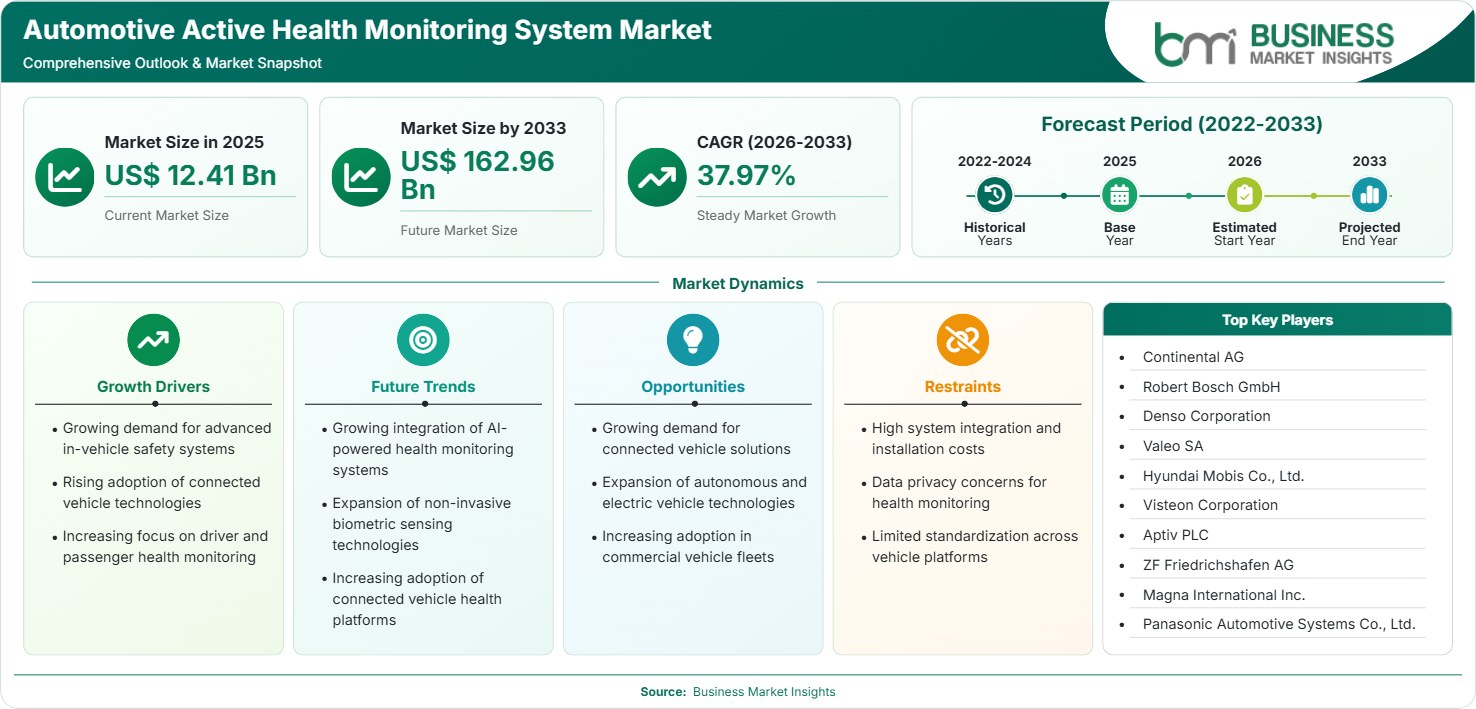
The Automotive Active Health Monitoring System Market size was valued at US$ 12.41 Billion in 2025 and is projected to reach US$ 162.96 Billion by 2033, growing at a CAGR of 37.97% during 2026–2033, driven by connected vehicles, advanced safety technologies, health monitoring integration, autonomous mobility, and commercial fleet opportunities.

Report Coverage
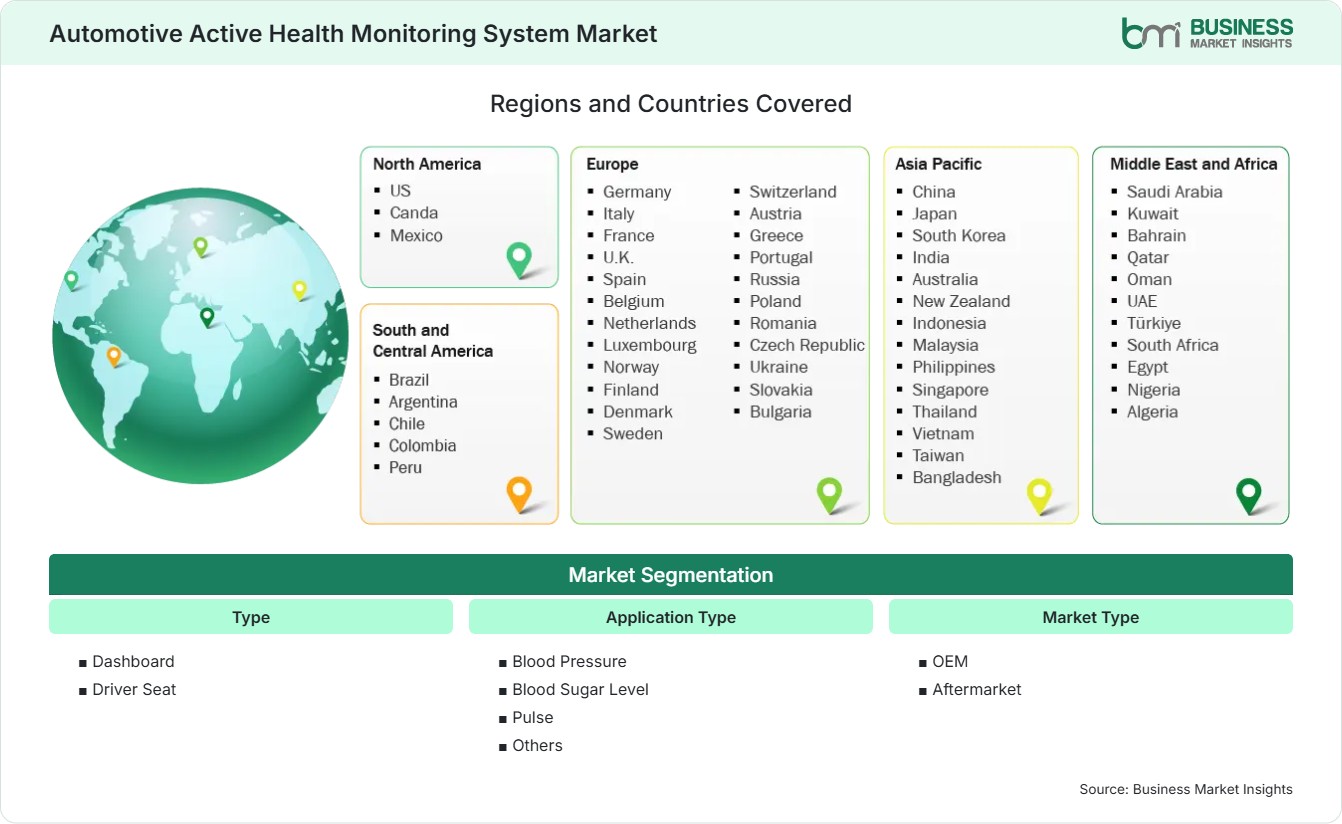
  • Type: Dashboard, Driver Seat
  • Application Type: Blood Pressure, Blood Sugar Level, Pulse, Others
  • Market Type: OEM, Aftermarket
US$ 12.41 Bn Market size in 2025
US$ 162.96 Bn Market Size by 2033
37.97% CAGR, 2026 - 2033
2026-2033 Forecast Period

AI Overview

Automotive Active Health Monitoring System Market Summary

  • North America Region: North America holds a 34%–38% share in 2025, growing with a CAGR of 36.5%–38.5% during 2026–2033, influenced by connected vehicle adoption, premium vehicle penetration, safety regulations, and automotive technology investments. The US market demonstrates strong adoption of in-cabin monitoring solutions, supported by advanced vehicle electronics, healthcare integration, and a CAGR of 37.0%–39.0% between 2026 and 2033.
  • Fastest Growing Region: Asia Pacific holds a 28%–32% share in 2025, expanding at a CAGR of 39.0%–41.0% during 2026–2033, supported by electric vehicle growth, automotive manufacturing expansion, smart mobility initiatives, and increasing demand for intelligent vehicle technologies.
  • Leading Segment: Driver Seat systems hold a 55%–60% share in 2025, progressing with a CAGR of 38.0%–40.0% during 2026–2033, driven by driver safety requirements, fatigue monitoring integration, biometric sensing technologies, and advanced cockpit development.
  • High Growth Segment: OEM market type holds a 65%–70% share in 2025, advancing at a CAGR of 39.0%–41.0% during 2026–2033, supported by factory-installed health monitoring features, connected vehicle platforms, and increasing integration of smart automotive systems.
  • Key Market Opportunity: Opportunities are emerging through autonomous vehicles, electric mobility, connected transportation, commercial fleet adoption, AI-based health analytics, and integration of healthcare technologies within vehicle ecosystems.
  • Major Market Players: Continental AG, Robert Bosch GmbH, Denso Corporation, Valeo SA, Hyundai Mobis Co., Ltd., Visteon Corporation, Aptiv PLC, ZF Friedrichshafen AG, Magna International Inc., Panasonic Automotive Systems Co., Ltd.
Strategic Insights

Automotive Active Health Monitoring System Market: Strategic Insights

Automotive Active Health Monitoring System Market Strategic Framework
FREE PDF
Request your free sample
Request free sample
Stakeholder View

Key Takeaways

  • The market ecosystem is evolving through collaboration among automotive manufacturers, sensor technology providers, software developers, connectivity companies, and healthcare technology organizations focused on intelligent mobility solutions.
  • Driver monitoring applications represent a major growth opportunity as manufacturers prioritize fatigue detection, biometric analysis, and real-time health assessment to improve road safety and user experience.
  • Innovation is shifting toward AI-enabled sensing technologies, contactless monitoring systems, advanced analytics platforms, and integrated vehicle health solutions supporting future autonomous mobility.
  • Asia Pacific presents a strong investment opportunity due to electric vehicle expansion, automotive production leadership, smart city initiatives, and increasing adoption of connected transportation technologies.
  • Strategic partnerships and acquisitions are increasing as automotive suppliers seek expertise in artificial intelligence, sensors, digital health platforms, and vehicle connectivity solutions.
  • Commercial fleet operators are becoming important adopters by using health monitoring systems to improve driver safety, reduce operational risks, and enhance fleet management capabilities.
Geographic Outlook

Automotive Active Health Monitoring System Market Regional Highlights

North America Automotive Active Health Monitoring System Market

North America accounted for a 34%–38% share in 2025 and is projected to grow at a CAGR of 36.5%–38.5% during 2026–2033. The region remains a leading market due to advanced automotive infrastructure, strong technology adoption, and increasing demand for intelligent safety systems. The Automotive Active Health Monitoring System Market share is driven by AI integration, regulatory safety focus, and increasing consumer expectations for advanced vehicle features.

  • The United States dominates regional demand due to strong automotive technology investments, connected vehicle adoption, and increasing integration of health monitoring features in premium vehicles.
  • Canada is witnessing adoption through smart transportation initiatives, automotive innovation programs, and growing interest in advanced driver assistance and passenger safety technologies.
  • Automotive manufacturers are investing in sensor-based monitoring systems to enhance safety, improve user experience, and support future autonomous vehicle development.
  • Healthcare and automotive technology companies are forming partnerships to develop vehicle-based wellness monitoring solutions and connected health applications.

US Automotive Active Health Monitoring System Market

The US accounted for a 28%–32% share within North America in 2025 and is expected to register a CAGR of 37.0%–39.0% during 2026–2033. The country represents a major innovation hub due to strong automotive research capabilities, connected vehicle penetration, and advanced technology adoption. The Automotive Active Health Monitoring System Market share in the US is supported by increasing demand for safety-focused vehicle technologies and intelligent cockpit solutions.

  • Automakers are integrating biometric sensors and AI-based monitoring systems to improve driver awareness, safety performance, and personalized mobility experiences.
  • Consumer demand for connected vehicles is encouraging manufacturers to introduce advanced health monitoring features across premium and mid-range vehicle segments.
  • Technology companies are developing non-invasive sensing solutions that enable continuous health assessment without affecting driving comfort or convenience.
  • Fleet operators are adopting vehicle health monitoring systems to improve driver safety, reduce accidents, and enhance operational efficiency.

Europe Automotive Active Health Monitoring System Market

Europe represented a 22%–26% share in 2025 and is expected to expand at a CAGR of 36.0%–38.0% during 2026–2033. The region is supported by strict vehicle safety standards, advanced automotive manufacturing capabilities, and increasing adoption of connected mobility solutions. Germany, France, and the United Kingdom are leading contributors due to strong automotive ecosystems and investments in intelligent vehicle technologies. The Automotive Active Health Monitoring System Market share in Europe is influenced by growing demand for driver assistance, passenger wellness features, and advanced cockpit systems.

  • Germany remains a key market due to its strong automotive manufacturing base, premium vehicle production, and continuous investment in advanced vehicle electronics and safety technologies.
  • France is expanding through connected mobility initiatives, electric vehicle adoption, and increasing collaboration between automotive manufacturers and technology solution providers.
  • The United Kingdom demonstrates growth potential through innovation in autonomous driving technologies, smart transportation programs, and increasing demand for vehicle safety solutions.
  • European automakers are integrating health monitoring technologies into next-generation vehicles to support safer driving environments and personalized mobility experiences.
  • Regulatory emphasis on road safety and driver assistance systems is encouraging manufacturers to invest in intelligent monitoring capabilities.

Asia Pacific Automotive Active Health Monitoring System Market

Asia Pacific accounted for a 28%–32% share in 2025 and is projected to grow at a CAGR of 39.0%–41.0% during 2026–2033. The region represents the fastest-growing market due to expanding automotive production, electric vehicle adoption, connected transportation development, and increasing technology investments. China, Japan, South Korea, and India are major contributors supported by strong automotive manufacturing capabilities. The Automotive Active Health Monitoring System Market growth in Asia Pacific is driven by smart mobility initiatives and rising consumer demand for advanced vehicle features.

  • China leads regional adoption due to its electric vehicle ecosystem, automotive technology investments, and strong focus on connected and intelligent transportation solutions.
  • Japan is advancing through automotive innovation, robotics expertise, and integration of advanced sensing technologies into next-generation vehicle platforms.
  • South Korea is strengthening its position through electric vehicle development, automotive electronics capabilities, and investments in smart cockpit technologies.
  • India represents an emerging opportunity due to increasing vehicle modernization, growing technology adoption, and expansion of connected vehicle solutions.
  • Regional automotive manufacturers are collaborating with technology providers to develop affordable health monitoring solutions for broader consumer adoption.

Rest of World Automotive Active Health Monitoring System Market

Latin America and Middle East & Africa accounted for a 6%–10% share in 2025 and are projected to grow at a CAGR of 34.0%–36.5% during 2026–2033. These regions are gradually adopting connected vehicle technologies through automotive modernization, infrastructure development, and increasing interest in advanced safety systems. Brazil, Mexico, UAE, and Saudi Arabia are emerging markets due to rising vehicle technology investments and smart transportation initiatives. The Automotive Active Health Monitoring System Market share remains lower compared with developed regions but provides long-term expansion opportunities.

  • Brazil is developing opportunities through automotive manufacturing capabilities, increasing technology adoption, and demand for improved vehicle safety solutions.
  • Mexico benefits from its automotive production ecosystem and increasing integration of advanced electronics within passenger and commercial vehicles.
  • UAE is investing in smart mobility infrastructure, luxury vehicle technologies, and intelligent transportation systems supporting advanced monitoring adoption.
  • Saudi Arabia is expanding automotive technology investments through transportation modernization programs and connected mobility initiatives.
  • Regional markets require improved awareness, infrastructure development, and cost-effective solutions to accelerate adoption of vehicle health monitoring systems.
Global Market Geography
FREE PDF
Request your free sample
Request free sample
Segment Analysis

Automotive Active Health Monitoring System Market Segmentation

Type

The Type segment is led by Driver Seat systems, which accounted for a 55%–60% share in 2025 and is expected to grow at a CAGR of 37.5%–39.5% between 2026–2033. Vehicle manufacturers are increasingly integrating health monitoring features into driver-focused and passenger-oriented systems. The Automotive Active Health Monitoring System Market scope is expanding through advancements in biometric sensors, artificial intelligence, and connected vehicle platforms. Driver Seat systems represent the leading category due to safety-focused applications.

  • Dashboard: Dashboard-based systems enable integrated health monitoring through vehicle displays, sensors, and digital interfaces supporting real-time driver information and alerts.
  • Driver Seat: Driver Seat systems dominate due to direct biometric measurement capabilities, improved safety monitoring, and integration with advanced driver assistance technologies.

Application Type

The Application Type segment is led by Pulse monitoring systems, which accounted for a30%–35% share in 2025 and is projected to expand at a CAGR of 37.5%–39.5% between 2026–2033. Increasing demand for preventive safety solutions is encouraging integration of multiple health monitoring functions. The Automotive Active Health Monitoring System Market trends reflect growing adoption of biometric technologies capable of monitoring vital signs and improving driver response capabilities.

  • Blood Pressure: Blood pressure monitoring applications support driver wellness assessment by identifying potential health risks and enabling timely safety interventions.
  • Blood Sugar Level: Blood sugar monitoring technologies provide opportunities for supporting diabetic drivers through advanced sensing and personalized vehicle safety systems.
  • Pulse: Pulse monitoring systems enable continuous physiological assessment, helping identify stress, fatigue, or abnormal conditions during vehicle operation.

Market Type

The market type is dominated by OEM solutions, which accounted for a 65%–70% share in 2025 and is expected to grow at a CAGR of 37.5%–39.5% between 2026–2033. OEM integration remains dominant as vehicle manufacturers increasingly introduce factory-installed health monitoring technologies. Aftermarket solutions are also developing through retrofit technologies and connected devices. The segment expansion is supported by rising vehicle intelligence and consumer demand for personalized safety features.

  • OEM: OEM systems gain adoption through integrated vehicle architectures, manufacturer support, and seamless connection with advanced safety platforms.
  • Aftermarket: Aftermarket solutions provide flexible installation options, enabling existing vehicle owners to access advanced health monitoring capabilities.
Market Forces

Automotive Active Health Monitoring System Market Dynamics

Key Market Drivers

Growing demand for advanced in-vehicle safety systems

Increasing focus on vehicle safety is driving adoption of active health monitoring systems that can identify driver conditions and support preventive safety measures. Automotive manufacturers are integrating biometric sensors, artificial intelligence algorithms, and real-time monitoring technologies to reduce risks associated with fatigue, stress, and sudden health events. Rising adoption of advanced driver assistance systems is encouraging integration of health-related features into connected vehicle platforms. The Automotive Active Health Monitoring System Market growth is supported by consumer expectations for safer mobility experiences and regulatory attention toward accident prevention technologies. Vehicle manufacturers are increasingly viewing health monitoring as an important component of future intelligent transportation systems, particularly in premium and autonomous vehicle segments.

Rising adoption of connected vehicle technologies

The growth in connected vehicle technologies is driving increased demand for digital platforms that can collect, analyze, and transmit data on driver health. Connected cars which have sensors, cloud computing, and artificial intelligence can monitor and respond to driver health issues. Automakers are developing software-defined vehicles and intelligent cockpits that incorporate driver health monitoring features into their vehicle systems. The availability of high-speed network connections is facilitating the processing and transmission of data from vehicles to external platforms. This trend is boosting adoption by consumer vehicles, commercial fleet operations, and autonomous mobility platforms.

Increasing focus on driver and passenger health monitoring

Increased focus on the well-being of drivers and the safety of passengers is prompting automakers to create technologies that measure key health parameters when driving. Health monitoring solutions are becoming more advanced and capable of detecting any anomalies in the body physiology. Growing emphasis on customized experience in the vehicle leads to the incorporation of health monitoring features such as pulse and blood pressure measurement along with wellness analytics in the interior of the vehicle. Automotive companies are partnering with technology companies to create reliable and comfortable sensors that can accurately measure vital health parameters. A consumer approach towards designing cars is fostering the creation of intelligent cabins with a focus on occupant health along with other aspects.

Key Market Opportunities

Growing demand for connected vehicle solutions

The increasing demand for connected vehicle solutions creates opportunities for automotive health monitoring technologies by enabling seamless integration between vehicles, cloud platforms, and digital healthcare systems. Connected vehicle ecosystems provide the infrastructure required for real-time health data analysis, predictive safety alerts, and personalized mobility services. Automakers and technology providers are investing in software platforms capable of supporting advanced monitoring applications. Commercial vehicle operators are also exploring connected health solutions to improve driver safety and operational performance. The Automotive Active Health Monitoring System Market Forecasts indicate that connected mobility expansion will create opportunities for companies developing scalable software, sensor technologies, and integrated vehicle platforms.

Expansion of autonomous and electric vehicle technologies

The expansion of autonomous and electric vehicle technologies is creating opportunities for integrating advanced health monitoring features into next-generation mobility platforms. Autonomous vehicles require sophisticated occupant monitoring systems to understand driver readiness, passenger conditions, and emergency situations. There is an increasing trend among electric vehicle makers to build intelligent cockpits with state-of-the-art technology to provide better user experience. Health monitoring and autonomous driving technology integration in vehicles will help provide a safer driving experience and personalized mobility services. Suppliers are working on sensors and software to meet upcoming vehicle needs. There will be increasing demand for advanced cockpit technology as more electric vehicles are adopted around the world.

Increasing adoption in commercial vehicle fleets

Commercial vehicle fleets present a huge market potential for companies as operators concentrate on making driving safe and effective along with minimizing accidents. Operators are incorporating smart monitoring solutions that will help them assess driver condition and manage incidents due to health problems. Health monitoring solutions will help logistics companies, transportation service providers, and public mobility companies as well through proactive safety management. Rising interest in smart fleet management solutions is pushing companies to integrate health monitoring solutions into telematics solutions. Companies that are able to develop affordable and scalable solutions will have huge benefits due to rising adoption of such solutions by the commercial sector.

Market Restraints and Challenges

High system integration and installation costs

Factor: Advanced sensors, artificial intelligence platforms, connectivity components, and vehicle architecture modifications increase development and deployment expenses. Impact: Higher costs can limit adoption in mid-range vehicles, increase manufacturing complexity, and slow implementation across price-sensitive automotive segments. Automakers must balance technology integration with consumer affordability while maintaining system reliability. Suppliers are focusing on cost-efficient sensors, scalable software platforms, and improved manufacturing processes to reduce implementation barriers. As technology matures, economies of scale and broader adoption are expected to improve affordability and support wider market penetration.

Data privacy concerns for health monitoring

Factor: Collection, storage, and transmission of biometric data require strong cybersecurity measures, regulatory compliance, and transparent user consent mechanisms. Impact: Privacy concerns can reduce consumer acceptance, create regulatory challenges, and increase technology development requirements for manufacturers. Automotive companies must implement secure data management systems, encryption technologies, and clear privacy policies to build consumer trust. Collaboration between automotive and digital security providers is becoming essential for protecting health information. Addressing privacy concerns will be critical for achieving long-term acceptance of connected vehicle health monitoring solutions.

Company Analysis

Competitive Landscape

The Automotive Active Health Monitoring System Market analysis highlights a competitive landscape shaped by automotive electronics innovation, connected vehicle development, sensor technology advancement, and intelligent mobility solutions. Leading companies are focusing on integrating biometric monitoring, artificial intelligence, vehicle connectivity, and advanced safety platforms to strengthen their positions in the evolving automotive technology ecosystem.

Company Name

Overview

Products and Services relevant to this market

Continental AG

Global automotive technology company providing advanced mobility solutions, vehicle electronics, and safety technologies.

Develops vehicle sensor systems, cockpit technologies, and intelligent monitoring solutions supporting driver safety applications.

Robert Bosch GmbH

Leading automotive supplier specializing in mobility technologies, electronics, software, and safety systems.

Provides automotive sensors, connectivity solutions, driver monitoring technologies, and intelligent vehicle systems.

Denso Corporation

Japanese automotive supplier focused on advanced vehicle components and electronic technologies.

Develops automotive sensing systems, electronic control solutions, and technologies supporting connected vehicle applications.

Valeo SA

Global automotive technology company specializing in mobility solutions, electrification, and intelligent vehicle systems.

Provides driver assistance technologies, vehicle sensors, and smart cockpit solutions.

Hyundai Mobis Co., Ltd.

Automotive supplier focused on vehicle modules, electronics, and future mobility technologies.

Develops cockpit systems, vehicle electronics, and safety technologies supporting health monitoring integration.

Visteon Corporation

Automotive technology company specializing in digital cockpit systems and connected vehicle solutions.

Provides smart cockpit platforms, display technologies, and software solutions for intelligent vehicles.

Aptiv PLC

Technology company focused on advanced mobility, vehicle software, and electrical architecture solutions.

Develops connected vehicle platforms, sensing technologies, and intelligent safety solutions.

ZF Friedrichshafen AG

Global automotive supplier providing mobility systems and advanced vehicle technologies.

Offers driver assistance systems, vehicle electronics, and safety technologies supporting smart mobility.

Magna International Inc.

Global automotive supplier providing vehicle systems, components, and technology solutions.

Develops vehicle technologies, electronic systems, and mobility solutions for automotive manufacturers.

Panasonic Automotive Systems Co., Ltd.

Automotive technology provider focused on vehicle electronics, infotainment, and mobility innovation.

Provides cockpit systems, sensors, connectivity solutions, and advanced automotive electronics.

Trust & Transparency

Research Methodology

The market analysis combines proprietary research with secondary data from government agencies, company disclosures, regulatory filings, industry databases and expert interviews. Market estimates are validated through data triangulation, cross-market benchmarking and analyst review.

View Full Research Methodology

Questions Answered

Frequently Asked Questions

How does the Automotive Active Health Monitoring System Market Report support industry stakeholders?

The report provides insights into market trends, competitive strategies, regional opportunities, technology developments, and investment areas supporting business decisions.

Why are commercial fleets adopting active health monitoring systems?

Commercial fleets are adopting these systems to improve driver safety, reduce accident risks, monitor wellness conditions, and enhance operational efficiency through connected fleet management platforms. What role does artificial intelligence play in vehicle health monitoring in Automotive Active Health Monitoring System Market? Artificial intelligence enables analysis of physiological data, identification of abnormal conditions, predictive alerts, and improved accuracy of vehicle-based health monitoring solutions.

How are autonomous vehicles influencing health monitoring system adoption?

Autonomous vehicles require advanced occupant monitoring capabilities to improve safety, understand passenger conditions, and support intelligent decision-making during vehicle operation.

What technologies are enabling automotive health monitoring systems?

Advanced sensors, artificial intelligence, connectivity platforms, biometric measurement technologies, and software analytics are enabling real-time monitoring of driver and passenger health conditions.

Access the Full Automotive Active Health Monitoring System Market Report

Get segment-level forecasts, regional estimates, competitive benchmarking, company profiles and downloadable Excel datasets.

Access the full Automotive Active Health Monitoring System Market Report
350 pages PDF & Excel | 2026-08-31
Similar Research

Related Market Reports