
Automotive Passive Safety System Market Outlook: Size, Share, Trends, Growth Analysis, Competitive Landscape & Forecast, 2026-2033

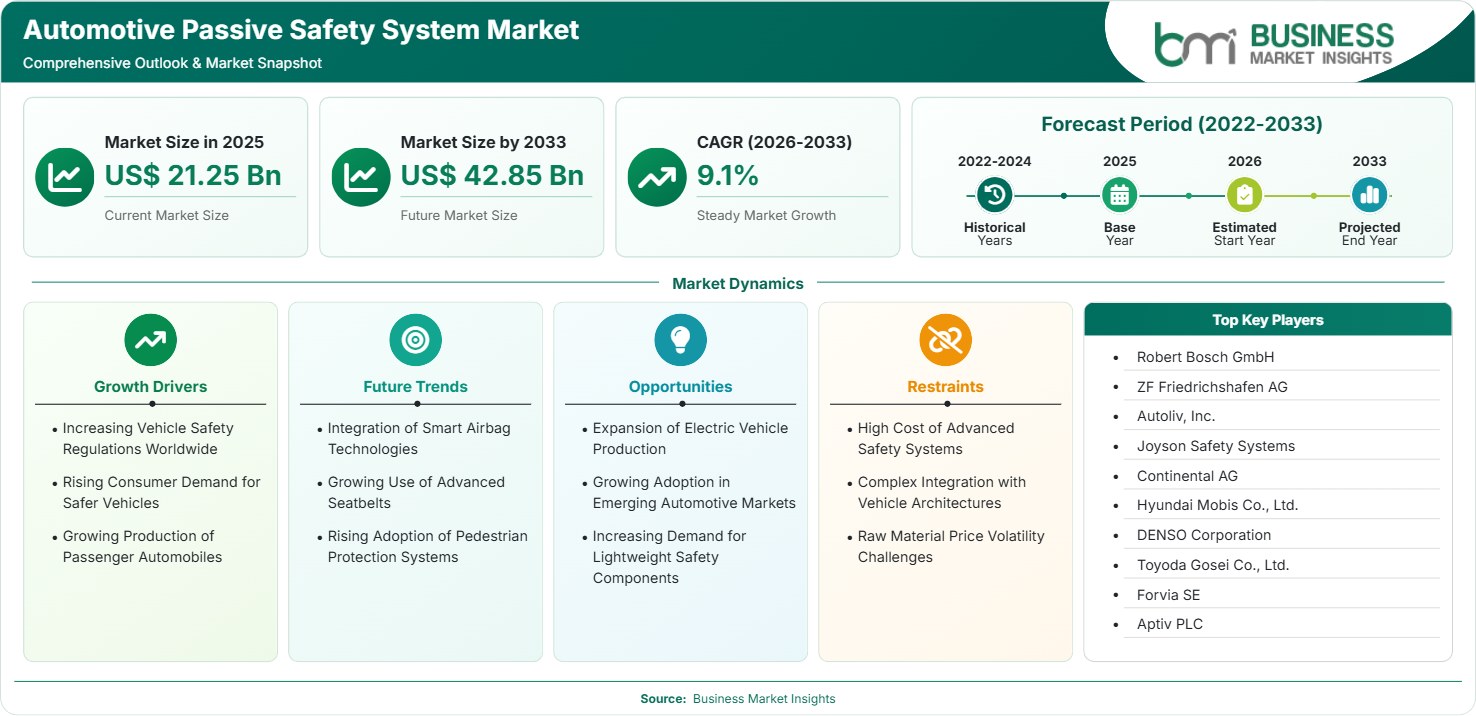
The Automotive Passive Safety System Market size was valued at US$ 21.25 Billion in 2025 and is projected to reach US$ 42.85 Billion by 2033, growing at a CAGR of 9.1% during 2026–2033, driven by increasingly stringent vehicle safety regulations, rising consumer demand for safer automobiles, and continuous growth in global passenger vehicle production.

Report Coverage
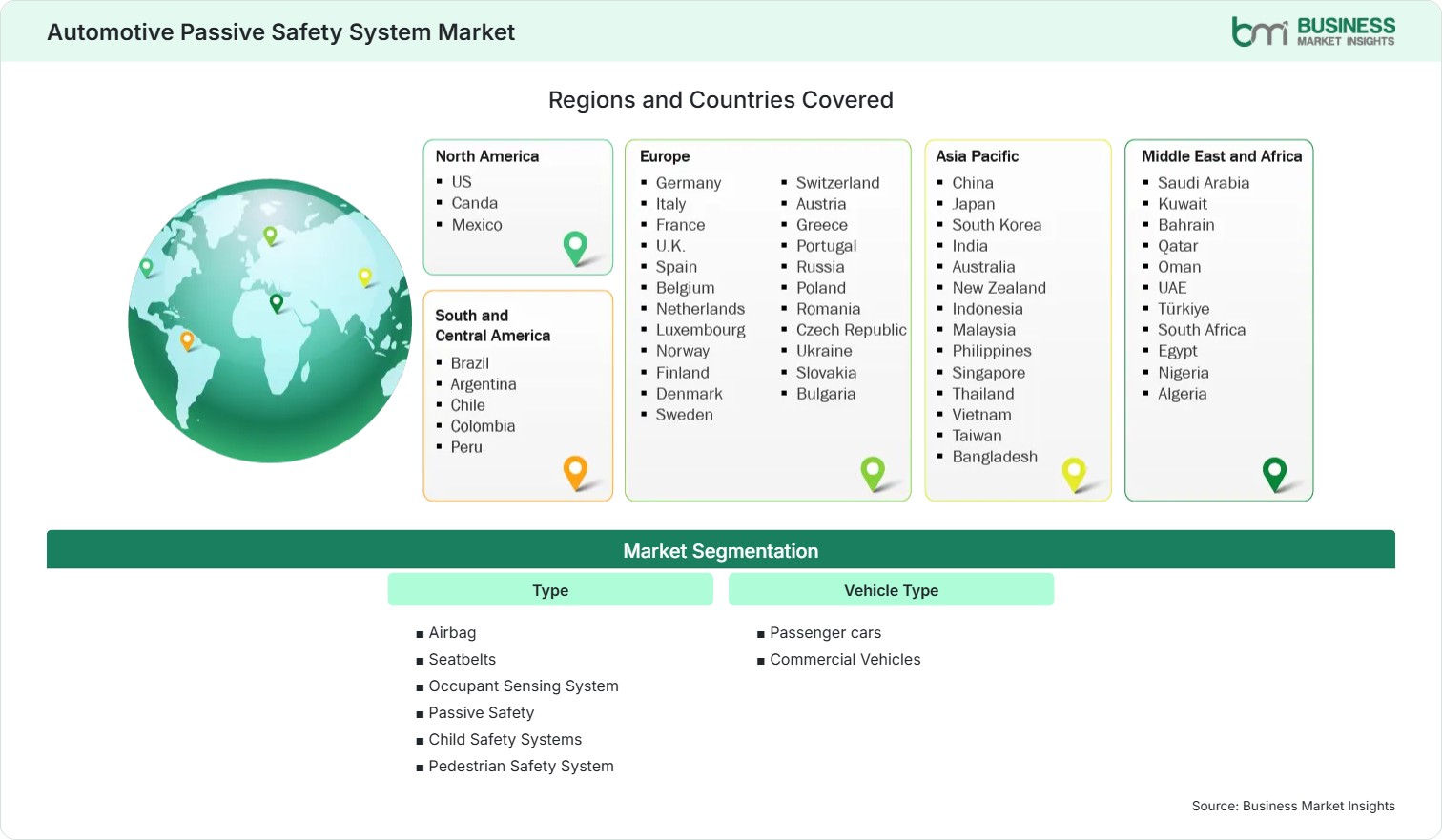
  • Type: Airbag, Seatbelts, Occupant Sensing System, Passive Safety, Child Safety Systems, Pedestrian Safety System
  • Vehicle Type: Passenger cars, Commercial Vehicles
US$ 21.25 Bn Market size in 2025
US$ 42.85 Bn Market Size by 2033
9.1% CAGR, 2026 - 2033
2026-2033 Forecast Period

01 AI Overview

Automotive Passive Safety System Market Summary

  • North America Region: North America holds a 31%–34% share in 2025, growing with a CAGR of 8.6%–9.2% during 2026–2033, supported by stringent crash safety regulations, increasing adoption of advanced restraint technologies, and strong automotive manufacturing capabilities. The US market is projected to expand at a 8.7%–9.3% CAGR through 2033, driven by high vehicle safety awareness, regulatory compliance, and increasing demand for premium passenger vehicles.
  • Fastest Growing Region: Asia Pacific accounts for 35%–38% of the market in 2025 and is expected to register the fastest CAGR of 9.8%–10.5% during 2026–2033, supported by expanding automobile production, rising disposable incomes, growing vehicle ownership, and strengthening automotive safety regulations.
  • Leading Segment: Airbag systems represent a 38%–41% share in 2025 and are forecast to grow at a 9.0%–9.6% CAGR, supported by mandatory safety regulations, technological advancements in multi-stage airbags, and increasing integration across vehicle categories.
  • High Growth Segment: Passenger Cars account for a 74%–77% share in 2025 and are projected to expand at a 9.3%–10.0% CAGR, driven by increasing global passenger automobile production, rising consumer safety awareness, and growing adoption of premium safety features.
  • Key Market Opportunity: Development of lightweight passive safety components integrated with electric vehicle architectures and intelligent occupant protection technologies is creating substantial opportunities for global automotive safety suppliers.
  • Major Market Players: Robert Bosch GmbH, ZF Friedrichshafen AG, Autoliv, Inc., Joyson Safety Systems, Continental AG, Hyundai Mobis Co., Ltd., DENSO Corporation, Toyoda Gosei Co., Ltd., Forvia SE, and Aptiv PLC.
02 Strategic Insights

Automotive Passive Safety System Market: Strategic Insights

Automotive Passive Safety System Market Strategic Framework
FREE PDF
Request your free sample
Request free sample
03 Stakeholder View

Key Takeaways

  • The automotive passive safety ecosystem is evolving toward integrated occupant protection platforms where OEMs, Tier-1 suppliers, semiconductor manufacturers, and material technology providers collaborate to enhance crash safety, regulatory compliance, and vehicle performance.
  • The strongest growth opportunities are concentrated in intelligent airbag systems, occupant sensing technologies, and pedestrian protection solutions as automakers increasingly focus on achieving higher vehicle safety ratings across global markets.
  • Innovation is accelerating through lightweight composite materials, adaptive restraint systems, AI-enabled occupant detection, and advanced sensor integration that improve crash protection while supporting electric and software-defined vehicle architectures.
  • Asia Pacific represents the most attractive long-term investment destination due to its expanding passenger vehicle production, growing electric vehicle manufacturing capacity, strengthening safety regulations, and increasing domestic automotive demand.
  • Strategic collaborations, acquisitions, and long-term supply agreements between vehicle manufacturers and safety system suppliers are reshaping the competitive landscape as companies invest in next-generation passive safety technologies.
  • Sustainability is becoming an important differentiator, encouraging manufacturers to develop lightweight, recyclable, and energy-efficient passive safety components that improve vehicle efficiency while maintaining superior occupant protection.
04 Geographic Outlook

Automotive Passive Safety System Market Regional Highlights

North America Automotive Passive Safety System Market

North America accounts for 31%–34% of global revenue in 2025 and is expected to expand at a CAGR of 8.6%–9.2% during 2026–2033. Strict crashworthiness regulations, strong automotive manufacturing capabilities, and continuous technological advancements continue supporting the Automotive Passive Safety System Market share throughout the region. OEMs are increasingly integrating intelligent restraint systems, advanced airbags, and occupant sensing technologies to improve vehicle safety and comply with evolving regulatory standards.

  • Automotive manufacturers continue investing in multi-stage airbags, adaptive seatbelt systems, and pedestrian protection technologies to achieve higher vehicle safety ratings across passenger and commercial vehicle segments.
  • Growing production of premium vehicles equipped with advanced passive safety technologies is supporting continuous demand for innovative restraint systems and integrated occupant protection solutions.
  • Regulatory agencies continue strengthening crash safety standards, encouraging OEMs to accelerate the deployment of intelligent passive safety technologies across broader vehicle portfolios.
  • Increasing electrification of vehicle platforms is creating additional opportunities for lightweight passive safety components designed to optimize energy efficiency without compromising occupant protection.

US Automotive Passive Safety System Market

The United States contributes 27%–30% of global market revenue in 2025 while growing at a CAGR of 8.7%–9.3% through 2033. Strong consumer awareness regarding vehicle safety, robust automotive production, and continuous investments in advanced occupant protection technologies remain the primary drivers supporting long-term market expansion.

  • Major OEMs continue introducing advanced restraint systems capable of adapting deployment characteristics based on occupant size, seating position, and crash severity.
  • Rising demand for SUVs, pickup trucks, and premium passenger vehicles continues supporting adoption of comprehensive passive safety packages.
  • Automotive suppliers continue expanding research into lightweight safety materials and digitally integrated occupant sensing technologies.
  • Federal safety regulations and independent crash testing programs continue encouraging manufacturers to improve vehicle occupant protection performance.

Europe Automotive Passive Safety System Market

Europe represents 25%–28% of global revenue in 2025 and is projected to register a CAGR of 8.9%–9.6% through 2033. Strict European vehicle safety regulations, rapid electrification, and premium automobile manufacturing continue supporting market expansion. Germany remains the leading regional contributor, while Eastern Europe demonstrates the fastest growth due to increasing automotive manufacturing investments.

  • Germany continues leading passive safety innovation through advanced automotive engineering, premium vehicle manufacturing, and strong collaboration between OEMs and Tier-1 suppliers.
  • France and Italy continue integrating enhanced occupant protection technologies across passenger vehicles to meet evolving Euro NCAP safety standards.
  • Eastern European automotive manufacturing hubs are attracting investments supporting regional production of advanced safety components.
  • Growing electric vehicle production is accelerating demand for lightweight restraint systems optimized for dedicated EV architectures.

Asia Pacific Automotive Passive Safety System Market

Asia Pacific holds 35%–38% of the global market in 2025 and is forecast to register the fastest CAGR of 9.8%–10.5% during 2026–2033. Rising passenger automobile production, increasing disposable incomes, expanding electric vehicle manufacturing, and strengthening automotive safety regulations continue supporting sustained regional growth. China remains the largest market, while India records the fastest expansion.

  • China continues dominating automotive production while strengthening mandatory safety requirements supporting widespread adoption of advanced passive safety technologies.
  • India is experiencing rapid growth owing to increasing passenger vehicle demand, expanding domestic manufacturing, and stronger vehicle safety regulations.
  • Japan and South Korea continue investing in intelligent occupant protection technologies integrated with connected and autonomous vehicle platforms.
  • Regional suppliers are expanding manufacturing capacity to support increasing domestic and international demand for advanced safety components.

Rest of World Automotive Passive Safety System Market

Rest of World contributes 8%–10% of global market revenue in 2025 while expanding at a CAGR of 8.3%–9.0% through 2033. Latin America is witnessing increasing passenger vehicle production, while the Middle East and Africa continue strengthening automotive safety regulations and expanding vehicle ownership.

Growing localization of vehicle manufacturing and increasing consumer awareness regarding occupant safety continue supporting gradual adoption of advanced passive safety systems across developing automotive markets.

  • Brazil remains the leading Latin American automotive market, supported by expanding passenger vehicle production and increasing integration of advanced safety features.
  • Mexico continues benefiting from strong automotive exports and investments in vehicle manufacturing supporting demand for passive safety systems.
  • Saudi Arabia and the United Arab Emirates are strengthening vehicle safety standards while increasing imports of technologically advanced passenger vehicles.
  • South Africa continues modernizing its automotive manufacturing sector with growing adoption of internationally compliant passive safety technologies.
Global Market Geography
FREE PDF
Request your free sample
Request free sample
05 Segment Analysis

Automotive Passive Safety System Market Segmentation

Type

The type segment represents the core technologies used to protect vehicle occupants during collisions, with Airbag systems accounting for 38%–41% of the market in 2025 and projected to grow at a CAGR of 9.0%–9.6% during 2026–2034. The Automotive Passive Safety System Market scope continues expanding as global safety regulations mandate advanced occupant protection systems across passenger and commercial vehicles. Continuous innovation in intelligent restraint technologies, lightweight materials, and sensor integration is further accelerating product development across the automotive industry.

  • Airbag: Airbag systems remain the largest product category owing to mandatory installation requirements, continuous improvements in deployment technologies, multi-stage inflation mechanisms, and increasing integration of side, curtain, knee, and center airbags.
  • Seatbelts: Advanced seatbelt systems featuring pretensioners, load limiters, and adaptive restraint technologies continue improving occupant protection while complementing airbag deployment during frontal and side-impact collisions.
  • Occupant Sensing System: Occupant sensing technologies are witnessing increasing adoption as vehicles integrate intelligent sensors capable of detecting passenger position, weight, and seating posture to optimize airbag deployment performance.
  • Passive Safety: Passive safety components including energy-absorbing structures, crash protection modules, and impact mitigation technologies continue supporting vehicle manufacturers in meeting evolving global crashworthiness regulations.
  • Child Safety Systems: Child safety systems remain essential for protecting younger occupants through ISOFIX-compatible restraint systems, advanced child seat integration, and enhanced passenger detection technologies supporting family-oriented vehicle safety.
  • Pedestrian Safety System: Pedestrian safety technologies are gaining momentum as automakers introduce active hood mechanisms, energy-absorbing structures, and external airbag solutions to reduce pedestrian injuries during vehicle collisions.

Vehicle Type

The vehicle type segment is dominated by Passenger Cars, accounting for 74%–77% of market revenue in 2025 while expanding at a CAGR of 9.3%–10.0% through 2026–2034. Rising global passenger automobile production, premium vehicle demand, and increasingly stringent safety regulations continue driving market expansion. Commercial vehicles are also adopting advanced passive safety technologies to improve driver protection, fleet safety performance, and regulatory compliance across freight and public transportation applications.

  • Passenger Cars: Passenger cars remain the largest application owing to increasing vehicle ownership, mandatory safety regulations, premium vehicle production, and growing consumer preference for comprehensive occupant protection technologies.
  • Commercial Vehicles: Commercial vehicle manufacturers are increasingly integrating advanced restraint systems, intelligent airbags, and enhanced occupant protection technologies to improve driver safety, fleet reliability, and regulatory compliance.
06 Market Forces

Automotive Passive Safety System Market Dynamics

Key Market Drivers

Increasing Vehicle Safety Regulations Worldwide

Government agencies and independent vehicle safety organizations continue strengthening crashworthiness regulations, compelling automotive manufacturers to integrate increasingly sophisticated passive safety technologies across their vehicle portfolios. The Automotive Passive Safety System Market growth is supported by mandatory airbag requirements, enhanced occupant protection standards, and stricter crash testing protocols established by regulatory authorities worldwide.

Organizations such as Euro NCAP, IIHS, and various national transportation agencies continue raising safety performance benchmarks, encouraging manufacturers to introduce intelligent restraint systems and advanced occupant protection technologies. These regulatory developments continue reinforcing the Automotive Passive Safety System Market trends, driving widespread adoption of high-performance passive safety systems across both mass-market and premium vehicle segments.

Rising Consumer Demand for Safer Vehicles

Consumers are increasingly prioritizing vehicle safety when making purchasing decisions, encouraging manufacturers to expand standard and optional passive safety features across all vehicle categories. Growing public awareness regarding crash protection, independent vehicle safety ratings, and occupant protection technologies has significantly influenced buying behavior in both developed and emerging automotive markets.

Automakers are responding by introducing comprehensive safety packages incorporating advanced airbags, adaptive seatbelts, occupant sensing systems, and pedestrian protection technologies. This shift toward safety-oriented purchasing decisions continues driving sustained demand for innovative passive safety components while encouraging suppliers to accelerate product development and technological advancement.

Growing Production of Passenger Automobiles

The steady increase in global passenger automobile production continues supporting long-term demand for passive safety systems. Expanding vehicle manufacturing capacity across Asia Pacific, Europe, and North America is increasing procurement of airbags, seatbelts, occupant sensors, and integrated crash protection components.

Simultaneously, premium vehicle manufacturers are introducing more sophisticated passive safety technologies capable of adapting to multiple crash scenarios and occupant conditions. Continuous expansion of electric vehicle production further strengthens demand for lightweight and electronically integrated safety systems compatible with next-generation vehicle architectures, supporting long-term market expansion.

Key Market Opportunities

Expansion of Electric Vehicle Production

Rapid global growth in electric vehicle manufacturing presents substantial opportunities for passive safety system suppliers. Dedicated electric vehicle platforms require redesigned occupant protection architectures capable of addressing unique battery layouts, structural configurations, and crash energy management requirements. Manufacturers are therefore developing lightweight airbags, advanced restraint systems, and intelligent sensing technologies optimized for electric vehicles. The Automotive Passive Safety System Market Forecasts indicate sustained investment opportunities as governments continue supporting zero-emission mobility while global automakers expand electric vehicle production capacity across major automotive markets.

Growing Adoption in Emerging Automotive Markets

Emerging economies continue strengthening vehicle safety regulations while expanding domestic automotive manufacturing capabilities, creating favorable conditions for passive safety system suppliers. Rising disposable incomes, increasing passenger vehicle ownership, and stronger regulatory enforcement are encouraging OEMs to introduce vehicles equipped with comprehensive occupant protection technologies. Manufacturers establishing localized production facilities and strategic partnerships within developing automotive markets are expected to benefit from sustained long-term demand generated by expanding regional vehicle production and increasing safety awareness.

Increasing Demand for Lightweight Safety Components

Automotive manufacturers are increasingly adopting lightweight safety components to improve fuel efficiency, extend electric vehicle driving range, and reduce overall vehicle weight without compromising occupant protection. High-strength polymers, advanced textiles, lightweight inflators, and innovative composite materials are becoming essential components of next-generation passive safety systems. Suppliers capable of delivering lightweight, durable, and cost-effective safety solutions are expected to strengthen their competitive positions as automakers pursue vehicle electrification, sustainability objectives, and enhanced crash performance simultaneously.

Market Restraints and Challenges

High Cost of Advanced Safety Systems

Factor: Advanced passive safety technologies incorporating intelligent sensors, adaptive restraint systems, multiple airbags, and sophisticated electronic control units significantly increase manufacturing and integration costs. Higher production expenses may limit adoption among entry-level vehicle manufacturers and cost-sensitive markets where affordability remains a key purchasing consideration. Suppliers must continuously balance technological innovation with cost optimization to support broader deployment across all vehicle segments while maintaining regulatory compliance and profitability.

Complex Integration with Vehicle Architectures

Factor: Modern passive safety systems require seamless integration with vehicle electronics, structural designs, advanced driver assistance systems, and evolving electric vehicle platforms. Increasing architectural complexity extends product development cycles, validation requirements, and engineering investments while creating integration challenges for automotive manufacturers. Suppliers must therefore develop highly adaptable safety solutions capable of supporting multiple vehicle platforms without compromising crash performance, production efficiency, or compliance with evolving international safety standards.

07 Company Analysis

Competitive Landscape

The Automotive Passive Safety System Market analysis is characterized by strong competition among global Tier-1 automotive suppliers focused on occupant protection technologies, lightweight materials, intelligent sensing systems, and integrated restraint solutions. Leading companies continue investing in research and development, strategic collaborations with OEMs, and manufacturing expansion to address evolving vehicle safety regulations and growing electric vehicle production. Innovation in adaptive airbags, advanced seatbelt systems, occupant sensing technologies, and pedestrian protection solutions remains central to maintaining competitive differentiation.

Company Name

Overview

Products and Services Relevant to this Market

Robert Bosch GmbH

Global automotive technology leader providing advanced safety, mobility, and intelligent vehicle solutions across major automotive manufacturers.

Occupant sensing systems, crash sensors, vehicle electronics, safety control units, integrated passive safety technologies, and automotive software solutions.

ZF Friedrichshafen AG

Leading global mobility technology company specializing in active and passive vehicle safety systems and intelligent mobility solutions.

Seatbelt systems, airbags, steering technologies, occupant restraint systems, electronic control units, and integrated vehicle safety solutions.

Autoliv, Inc.

World's leading automotive safety supplier focused exclusively on passive and active safety technologies for global OEMs.

Airbags, seatbelts, steering wheel systems, pedestrian protection technologies, occupant sensing systems, and crash safety electronics.

Joyson Safety Systems

International automotive safety company delivering comprehensive occupant protection solutions for passenger and commercial vehicles.

Airbag modules, seatbelt systems, steering wheels, electronic safety systems, occupant sensing technologies, and integrated restraint solutions.

Continental AG

Global automotive supplier developing intelligent vehicle safety systems and advanced electronic technologies.

Occupant sensing systems, crash sensors, vehicle electronics, passive safety controllers, integrated safety software, and automotive sensor technologies.

Hyundai Mobis Co., Ltd.

Major automotive supplier delivering advanced mobility technologies and comprehensive vehicle safety solutions.

Airbag systems, seatbelt technologies, electronic safety modules, occupant detection systems, and integrated automotive safety components.

DENSO Corporation

Global automotive technology company focused on intelligent mobility, electronics, and advanced vehicle safety systems.

Occupant sensors, electronic control units, automotive electronics, integrated safety technologies, and intelligent vehicle systems.

Toyoda Gosei Co., Ltd.

Leading manufacturer specializing in automotive safety systems and high-performance polymer technologies.

Airbags, steering wheels, pedestrian protection systems, interior safety components, and advanced automotive polymer products.

Forvia SE

Global automotive technology supplier delivering innovative interior, electronics, and safety solutions for modern vehicles.

Interior safety systems, occupant monitoring technologies, vehicle electronics, cockpit integration, and advanced automotive safety components.

Aptiv PLC

Advanced automotive technology company specializing in intelligent vehicle architecture and integrated safety electronics.

Vehicle electrical architecture, occupant sensing technologies, safety electronics, advanced connectivity solutions, and integrated automotive systems.

08 Industry Activity

Recent Developments

October, 2025

Autoliv, Inc. announced Autoliv and HSAE – New Strategic Joint Venture to Advance Automotive Safety Electronics, strengthening capabilities in automotive safety electronics and occupant protection.

October, 2025

ZF Friedrichshafen AG introduced the Adaptive Restraint System, combining intelligent occupant monitoring with adaptive seatbelt and airbag deployment to improve crash protection.

April, 2025

Autoliv, Inc showcased Omni Safety at the 2025 Shanghai Auto Show, demonstrating next-generation occupant protection technologies for future vehicle architectures.

June, 2024

Autoliv, Inc. introduced airbags made with 100% recycled polyester, supporting sustainability while maintaining automotive safety performance.

10 Trust & Transparency

Research Methodology

The market analysis combines proprietary research with secondary data from government agencies, company disclosures, regulatory filings, industry databases and expert interviews. Market estimates are validated through data triangulation, cross-market benchmarking and analyst review.

View Full Research Methodology

11 Questions Answered

Frequently Asked Questions

How does the Automotive Passive Safety System Market Report evaluate future opportunities?

The Automotive Passive Safety System Report evaluates future opportunities through analysis of regulatory developments, vehicle production trends, electrification strategies, technological innovation, competitive positioning, regional investments, and evolving occupant protection requirements.

How are electric vehicles influencing passive safety system development?

Electric vehicles require redesigned occupant protection architectures incorporating lightweight materials, intelligent sensing systems, adaptive airbags, and optimized crash energy management technologies suited to dedicated EV platforms.

Why is Asia Pacific expected to record the fastest market growth?

Asia Pacific benefits from expanding automobile manufacturing, increasing vehicle ownership, rapid electric vehicle adoption, strengthening safety regulations, and substantial investments by both domestic and global automotive manufacturers.

Which product segment dominates the market?

Airbag systems represent the leading product segment due to mandatory regulatory requirements, continuous innovation in multi-stage deployment technologies, and widespread integration across passenger and commercial vehicle platforms.

What factors are driving growth in the Automotive Passive Safety System Market?

Growth is supported by stricter global vehicle safety regulations, increasing consumer preference for safer vehicles, rising passenger automobile production, expanding electric vehicle manufacturing, and continuous technological advancements in occupant protection systems.

Access the Full Automotive Passive Safety System Market Report

Get segment-level forecasts, regional estimates, competitive benchmarking, company profiles and downloadable Excel datasets.

Access the full Automotive Passive Safety System Market Report
350 pages PDF & Excel | 2026-07-28