Hybrid Electric Vehicles (HEV) Market Outlook: Size, Share, Trends, Growth Analysis, Competitive Landscape & Forecast, 2026-2033

Historic Data: 2022-2024   |   Base Year: 2025   |   Forecast Period: 2026-2033
Report Content: Market Scope, Market Segmentation, Market Dynamics, and Competitive Analysis

Report Coverage:
  • Propulsion (Full, Mild, Plug-in)
  • Vehicle (Passenger, Commercial)
  • Component (Battery, Motor)

No. of Pages: 400
Report Code: BMIPUB00035625
Category: Automotive and Transportation
Hybrid Electric Vehicles (HEV) Market

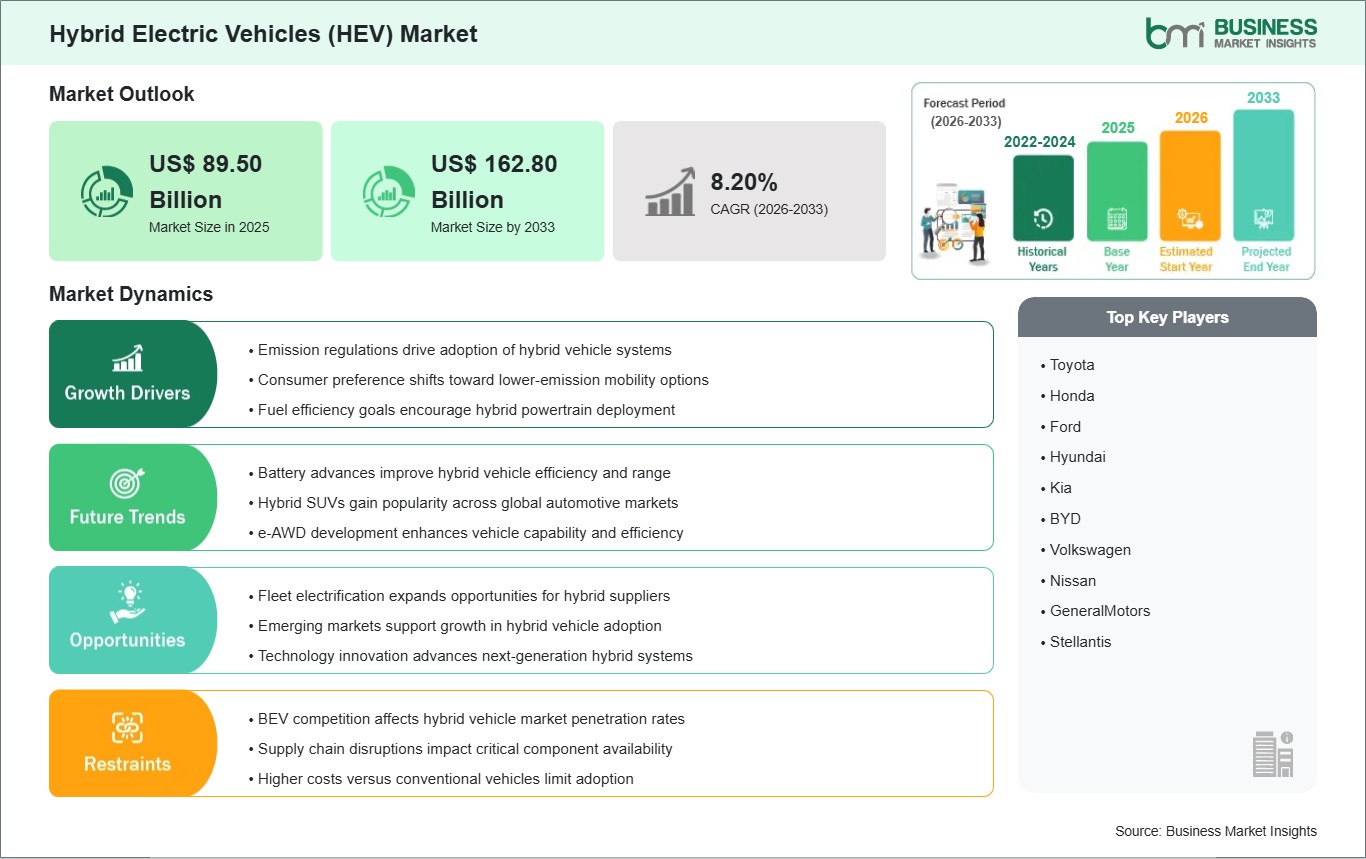
The Hybrid Electric Vehicle market size is expected to reach US$ 162.80 billion by 2033 from US$ 89.50 billion in 2025. The market is estimated to record a CAGR of 8.20% from 2026 to 2033.

Executive Summary and Global Market Analysis:

Rechargeable energy storage systems used in hybrid electric vehicles are engineered to support propulsion assistance, regenerative energy capture, and fuel-efficiency optimization. These batteries operate alongside internal combustion engines and electric motors, enabling balanced power delivery across changing driving conditions. Their functional role extends beyond energy supply, as they influence vehicle efficiency, response characteristics, thermal stability, and overall drivetrain integration.

The industry is advancing as automakers broaden electrified portfolios without committing every model solely to full battery-electric architecture. Hybrid platforms offer a practical transition path for markets where charging access, consumer familiarity, and fuel-economy regulations shape purchasing decisions. This has encouraged wider deployment of battery systems suited to partial electrification, particularly where energy recuperation and engine support must remain efficient across urban and highway use.

Segment distribution indicates full hybrid systems retain strong relevance because they provide a deeper level of electric assistance during normal driving cycles. Mild hybrid configurations remain important where cost control and incremental efficiency gains guide vehicle design. Plug-in variants expand the role of onboard batteries by allowing external charging and longer electric-only operation. Passenger vehicles represent the broadest utilization base, while commercial platforms gain traction where operating efficiency and emissions compliance influence fleet decisions. Component demand remains centered on battery packs and traction motors working as an integrated electrified unit.

Product development is increasingly focused on higher cycle durability, compact packaging, improved thermal management, and fast-response power delivery. Battery control software, cell chemistry refinement, and more efficient integration with motor systems are reshaping platform performance. These advancements help manufacturers reduce space constraints, improve drivability, and optimize lifecycle behavior in hybrid architectures.

Hybrid Electric Vehicles (HEV) Market - Strategic Insights:

global-market-strategic-framework
Get more information on this report

Hybrid Electric Vehicles (HEV) Market Segmentation Analysis:

The market is segmented based on platform, type, and composition requirements.

By Propulsion

  • Full - Enables substantial electric assistance and efficient regenerative energy utilization
  • Mild - Supports fuel-saving functions with simplified electrified drivetrain architecture
  • Plug-in - Extends electric driving capability through external charging compatibility

By Vehicle

  • Passenger - Accounts for broad deployment across sedans, SUVs, and urban mobility models
  • Commercial - Gains relevance where operating efficiency influences fleet replacement decisions

By Component

  • Battery - Serves as the core energy reservoir for hybrid power management
  • Motor - Delivers traction support, energy recovery, and engine assistance functions

Hybrid Electric Vehicles (HEV) Market Drivers and Opportunities:

Emission compliance accelerating hybrid battery integration

Global vehicle regulations increasingly reward lower tailpipe emissions and better fuel economy, prompting automakers to refine electrified drivetrains across mainstream product lines. Hybrid battery systems have become central to this transition because they support engine downsizing, regenerative braking, and assisted propulsion without requiring purely battery-electric infrastructure. As compliance frameworks tighten, manufacturers are using hybrid battery platforms to balance regulatory alignment with product versatility across different vehicle classes and customer expectations.

This regulatory context has elevated the relevance of battery efficiency, durability, and packaging within vehicle development programs. Hybrid architectures allow automakers to improve fleet performance while maintaining familiar refueling patterns for drivers. As a result, battery suppliers and system integrators are receiving greater strategic importance, especially where platform flexibility and broad model deployment influence production planning and long-term electrification roadmaps.

Next-generation battery systems opening broader vehicle applications

Advances in cell design, battery management software, and thermal control are expanding how hybrid batteries can be deployed across propulsion formats. Improvements in power density and lifecycle behavior support more responsive energy delivery while reducing performance compromise under repeated cycling. These enhancements strengthen use cases in heavier vehicles, premium segments, and mixed driving environments where smooth operation and dependable battery performance are both commercially significant.

Future opportunity lies in deeper electrification across passenger and commercial platforms that are not yet fully battery-electric. Hybrid batteries can support this expansion by enabling differentiated vehicle strategies across regions with uneven charging access and shifting consumer preferences. As automakers pursue multi-pathway electrification, battery systems optimized for hybrid architectures will gain stronger commercial relevance through wider model coverage and expanded production localization.

Hybrid Electric Vehicles (HEV) Market Size and Share Analysis:

The Hybrid Electric Vehicle Market was valued at US$ 89.50 Billion in 2025 to reach US$ 162.80 Billion by 2033, at a CAGR of 8.20% from 2026 to 2033. This expansion reflects a decisive shift toward practical electrification pathways that combine regulatory alignment with customer usability. The growth pattern indicates sustained investment in battery-supported hybrid platforms as manufacturers refine product portfolios around efficiency, drivability, and production scalability.

Among propulsion formats, full hybrid systems maintain a prominent position because they offer stronger electrified performance without relying on external charging behavior. Mild hybrid solutions continue to attract attention where affordability and streamlined integration remain important. Plug-in systems strengthen their relevance in applications where longer electric operation and flexible energy use support premium positioning and stricter emissions objectives.

From a vehicle standpoint, passenger models represent the primary deployment base due to wider consumer availability and ongoing brand electrification strategies. Commercial vehicles are steadily advancing as operators evaluate hybrid solutions for route efficiency, fuel savings, and compliance needs. This balance supports consistent demand for batteries and motors tailored to different duty cycles, platform sizes, and operating environments.

Hybrid Electric Vehicles (HEV) Market Report Highlights:

Report Attribute Details
Market size in 2025 US$ 89.50 Billion
Market Size by 2033 US$ 162.80 Billion
Global CAGR (2026 - 2033)8.20%
Historical Data 2022-2024
Forecast period 2026-2033
Segments Covered By Propulsion
  • Full
  • Mild
  • Plug-in
By Vehicle
  • Passenger
  • Commercial
By Component
  • Battery
  • Motor
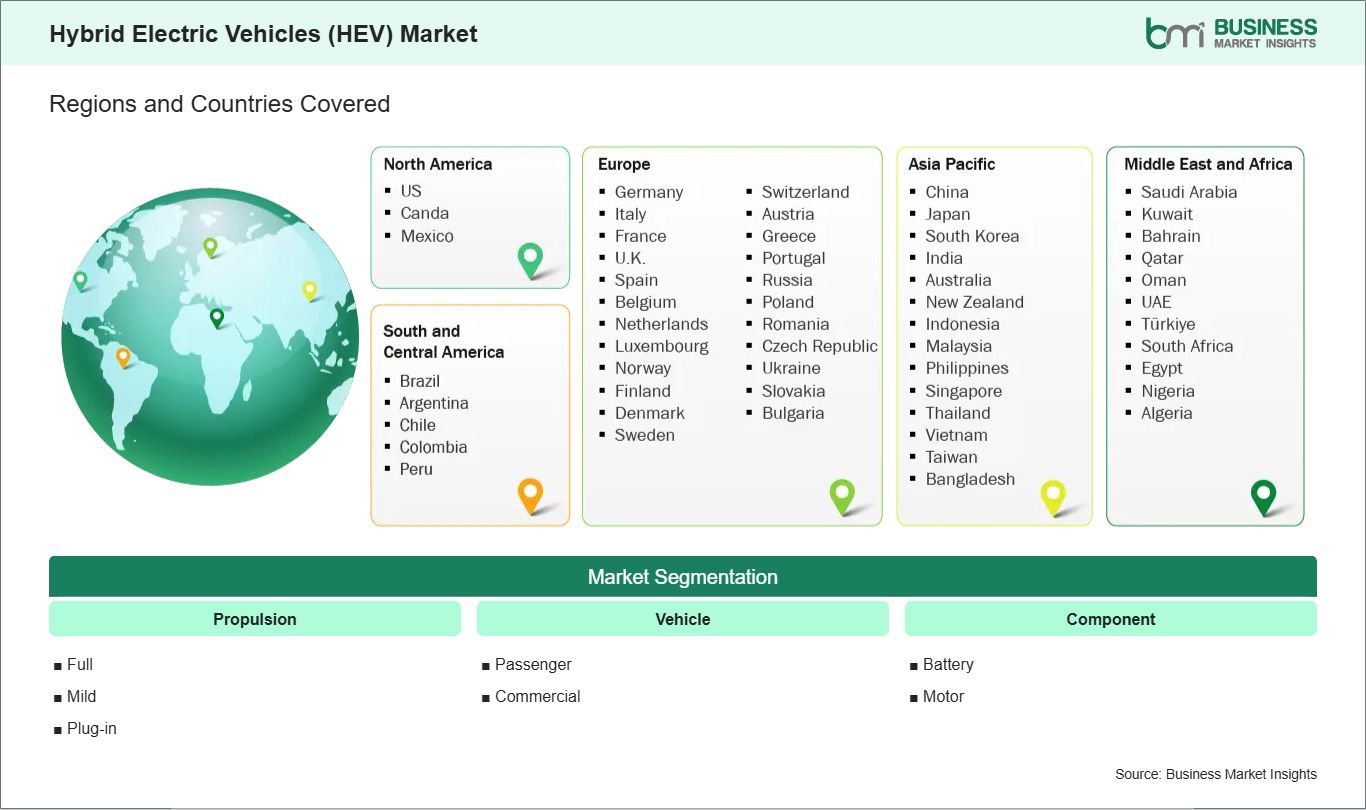
Regions and Countries Covered
North America US, Canada, Mexico
Europe Germany, Italy, France, U.K., Spain, Belgium, Netherlands, Luxembourg, Norway, Finland, Denmark, Sweden, Switzerland, Austria, Greece, Portugal, Russia, Poland, Romania, Czech Republic, Ukraine, Slovakia, Bulgaria
Asia-Pacific China, Japan, South Korea, India, Australia, New Zealand, Indonesia, Malaysia, Philippines, Singapore, Thailand, Vietnam, Taiwan, Bangladesh
South and Central America Brazil, Argentina, Chile, Colombia, Peru
Middle East and Africa Saudi Arabia, United Arab Emirates, Kuwait, Bahrain, Qatar, Oman, Turkiye, South Africa, Egypt, Nigeria, Algeria
Market leaders and key company profiles
  • Toyota
  • Honda
  • Ford
  • Hyundai
  • Kia
  • BYD
  • Volkswagen
  • Nissan
  • GeneralMotors
  • Stellantis
Get more information on this report

Hybrid Electric Vehicles (HEV) Market Report Coverage and Deliverables:

The "Hybrid Electric Vehicle Market Size and Forecast (2022-2033)" report provides a detailed analysis of the market covering below areas:

  • Market size and forecast at global, regional, and country levels for all market segments covered under the scope
  • Market trends, as well as drivers, restraints, and opportunities
  • Market analysis covering key trends, global and regional framework, major players, regulations, and recent developments
  • Industry landscape and competition analysis covering market concentration, heat map analysis, prominent players, and recent developments for the market
  • Detailed company profiles, including SWOT analysis

Hybrid Electric Vehicles (HEV) Market Geographic Insights:

The Hybrid Electric Vehicle market shows diverse regional adoption patterns influenced by defense modernization priorities, procurement structures, platform mix, and operational doctrine. Countries with mature defense ecosystems emphasize qualified, high-reliability energy systems, while developing programs focus on practical deployment, lifecycle management, and interoperability. Across the global landscape, energy storage decisions increasingly reflect mission endurance requirements, logistics simplification goals, and the electrification of critical subsystems within tactical and support platforms.

North America demonstrates a highly structured environment shaped by established defense contractors, demanding technical standards, and sustained investment in next-generation warfighting capabilities. Procurement attention extends beyond battery capacity toward ruggedization, charging architecture, and integration with portable electronics and tactical vehicles. This regional profile supports continuous refinement of rechargeable and reserve power solutions tailored to mission readiness, training requirements, and long-term sustainment planning.

Asia Pacific reflects expanding deployment patterns linked to force modernization, border security requirements, and regional investment in indigenous defense production. Military planners in this region increasingly value compact and efficient power systems that reduce equipment burden while supporting connected operational frameworks. Ground and naval applications remain especially relevant, with procurement strategies often favoring durable solutions capable of operating across diverse climates, mobility conditions, and extended operational tempos.

Europe maintains a disciplined procurement approach centered on interoperability, mission flexibility, and compliance with strict technical qualifications. Regional programs frequently prioritize batteries that align with soldier modernization, vehicle electronics, and portable communications requirements. Beyond Europe, emerging markets in the Middle East, Africa, and South America are strengthening defense capabilities through selective upgrades, creating opportunities for robust battery systems that combine reliability, manageable maintenance, and operational suitability for challenging field conditions.

global-market-geography
Get more information on this report

Hybrid Electric Vehicles (HEV) Market Research Report Guidance:

  • The report includes qualitative and quantitative data in the market across proplusion, vehicle, component, and geography.
  • The report starts with the key takeaways (chapter 2), highlighting the key trends and outlook of the market.
  • Chapter 3 focuses on the research methodology of the study.
  • Chapter 4 includes ecosystem analysis.
  • Chapter 5 highlights the major industry dynamics in the market, including factors that are driving the market, prevailing deterrents, potential opportunities, as well as future trends. Impact analysis of these drivers and restraints is also covered in this section.
  • Chapter 6 discusses the market scenario, in terms of historical market revenues, and forecast till the year 2033.
  • Chapters 7 to 10 cover market segments by proplusion, vehicle, component, and geography across North America, Europe, Asia Pacific, Middle East and Africa, and South and Central America. They cover the market revenue, forecast, and factors driving the market.
  • Chapter 11 describes the competitive analysis along with the heat map analysis for the key players operating in the market.
  • Chapter 12 describes the industry landscape analysis. It provides detailed descriptions of business activities such as market initiatives, new developments, mergers, and joint ventures globally, along with a competitive landscape.
  • Chapter 13 provides detailed profiles of the major companies operating in the market. Companies have been profiled on the basis of their key facts, business descriptions, products and services, financial overview, SWOT analysis, and key developments.
  • Chapter 14, i.e., the appendix, is inclusive of a brief overview of the company, list of abbreviations, and disclaimer.

Hybrid Electric Vehicles (HEV) Market News and Key Development:

The Hybrid Electric Vehicle market is evaluated by gathering qualitative and quantitative data post primary and secondary research, which includes important corporate publications, association data, and databases. Recent developments and news in the market include:

  • In, November 2025, Toyota began production at its North Carolina battery facility, its first battery plant outside Japan, with production lines intended to support hybrid electric vehicles, battery electric vehicles, and plug-in hybrid electric vehicles.
  • In April 2025, Hyundai Motor Group unveiled its next-generation hybrid system, introducing a new transmission with integrated motors and enhanced control of motor and battery functions to improve hybrid performance and efficiency.

Key Sources Referred:

Industry reports on electrified powertrain and battery market evolutionGovernment transportation and vehicle efficiency policy dataBattery engineering and automotive technology journalsCompany WebsitesCompany Annual ReportsCompany Investor Presentations
The List of Companies - Hybrid Electric Vehicles (HEV) Market
  • Toyota
  • Honda
  • Ford
  • Hyundai
  • Kia
  • BYD
  • Volkswagen
  • Nissan
  • GeneralMotors
  • Stellantis
Frequently Asked Questions
How big is the Hybrid Electric Vehicles (HEV) Market?

The Hybrid Electric Vehicles (HEV) Market is valued at US$ 89.50 Billion in 2025, it is projected to reach US$ 162.80 Billion by 2033.

What is the CAGR for Hybrid Electric Vehicles (HEV) Market by (2026 - 2033)?

As per our report Hybrid Electric Vehicles (HEV) Market, the market size is valued at US$ 89.50 Billion in 2025, projecting it to reach US$ 162.80 Billion by 2033. This translates to a CAGR of approximately 8.20% during the forecast period.

What segments are covered in this report?

The Hybrid Electric Vehicles (HEV) Market report typically cover these key segments-

  • Propulsion (Full, Mild, Plug-in)
  • Vehicle (Passenger, Commercial)
  • Component (Battery, Motor)

What is the historic period, base year, and forecast period taken for Hybrid Electric Vehicles (HEV) Market?

The historic period, base year, and forecast period can vary slightly depending on the specific market research report. However, for the Hybrid Electric Vehicles (HEV) Market report:

  • Historic Period : 2022-2024
  • Base Year : 2025
  • Forecast Period : 2026-2033
  • Who are the major players in Hybrid Electric Vehicles (HEV) Market?

    The Hybrid Electric Vehicles (HEV) Market is populated by several key players, each contributing to its growth and innovation. Some of the major players include:

  • Toyota
  • Honda
  • Ford
  • Hyundai
  • Kia
  • BYD
  • Volkswagen
  • Nissan
  • GeneralMotors
  • Stellantis
  • Who should buy this report?

    The Hybrid Electric Vehicles (HEV) Market report is valuable for diverse stakeholders, including:

    • Investors: Provides insights for investment decisions pertaining to market growth, companies, or industry insights. Helps assess market attractiveness and potential returns.
    • Industry Players: Offers competitive intelligence, market sizing, and trend analysis to inform strategic planning, product development, and sales strategies.
    • Suppliers and Manufacturers: Helps understand market demand for components, materials, and services related to concerned industry.
    • Researchers and Consultants: Provides data and analysis for academic research, consulting projects, and market studies.
    • Financial Institutions: Helps assess risks and opportunities associated with financing or investing in the concerned market.

    Essentially, anyone involved in or considering involvement in the Hybrid Electric Vehicles (HEV) Market value chain can benefit from the information contained in a comprehensive market report.

    Available Report Formats

    pdf-format excel-format pptx-format
    Buy Now
    Sales Assistance
    +1 646 791 7070 (US & UK)
    Customization Form

    Please tell us your area of interest
    (Market Segments/ Regions and Countries/ Companies)