Market Summary
Executive Summary and Global Market Analysis
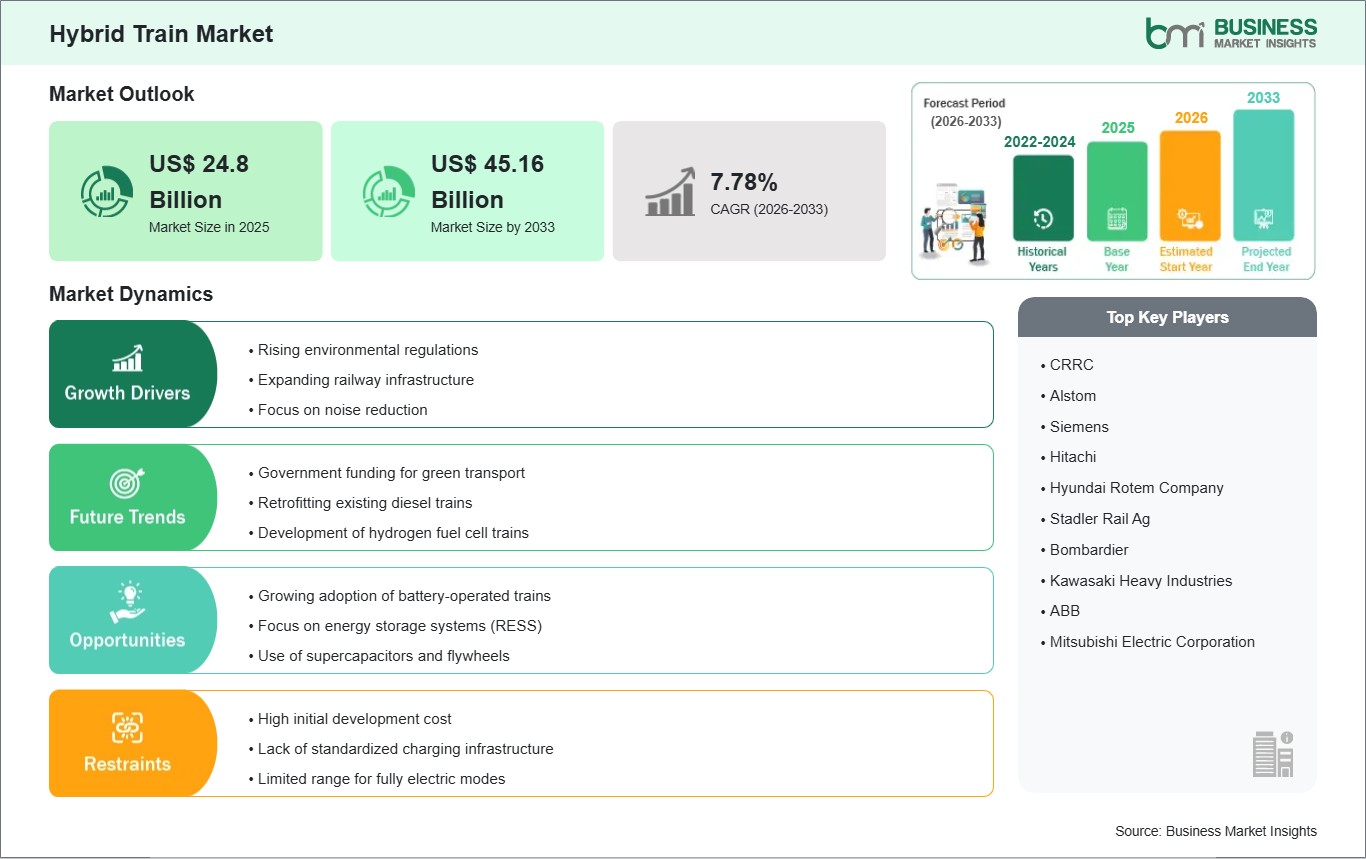
Hybrid trains refer to railway vehicles powered by an onboard rechargeable energy storage system (RESS) in combination with another fuel source such as diesel, or by battery-electric propulsion with catenary charging. By utilizing energy storage devices including batteries, supercapacitors, and flywheels, these systems capture and store energy produced from regenerative braking, enabling reduced fuel consumption, lower emissions, and quieter operation. This technology is fundamental to the operational architecture of modern sustainable rail transport, enabling decarbonization of non-electrified routes and urban passenger rail networks. Market expansion is being propelled by the rapid integration of green technologies into public transportation infrastructure, the rising institutional requirement for greenhouse gas emission reduction, and the increasing demand for noise reduction in urban rail corridors .
However, several factors may restrain market progression. The high initial development cost associated with hybrid powertrains and energy storage systems remains a primary hurdle for rail operators with limited capital budgets, particularly in developing economies. The industry also faces persistent technical challenges regarding the limited range of fully electric modes for battery-powered trains, requiring strategic placement of charging infrastructure. Additionally, the lack of standardized charging systems across different manufacturers and regions creates interoperability challenges for cross-border rail operations. These hurdles, compounded by the extended replacement cycles of railway rolling stock and competition from fully electrified solutions where catenary infrastructure exists, increase the total cost of ownership and the perceived financial risk for large-scale fleet conversions.
Despite these hurdles, the market outlook remains highly favorable as the sector transitions toward zero-emission rail transport. Opportunities are emerging through government funding programs for green transport and the development of hydrogen fuel cell trains for longer non-electrified routes. The expansion of battery technology and energy management systems is gaining significant traction, with hybrid trains achieving improved energy efficiency and operational flexibility. Furthermore, the growth of retrofitting programs for existing diesel trains aligns with global goals for extending asset life while reducing environmental impact. The adoption of supercapacitors and flywheels for rapid energy capture and release is playing a pivotal role in stop-start urban rail applications. Collectively, these innovations position the Hybrid Train industry for sustained long-term development as a cornerstone of sustainable mobility.
Segment Analysis
Hybrid Train Market Segmentation
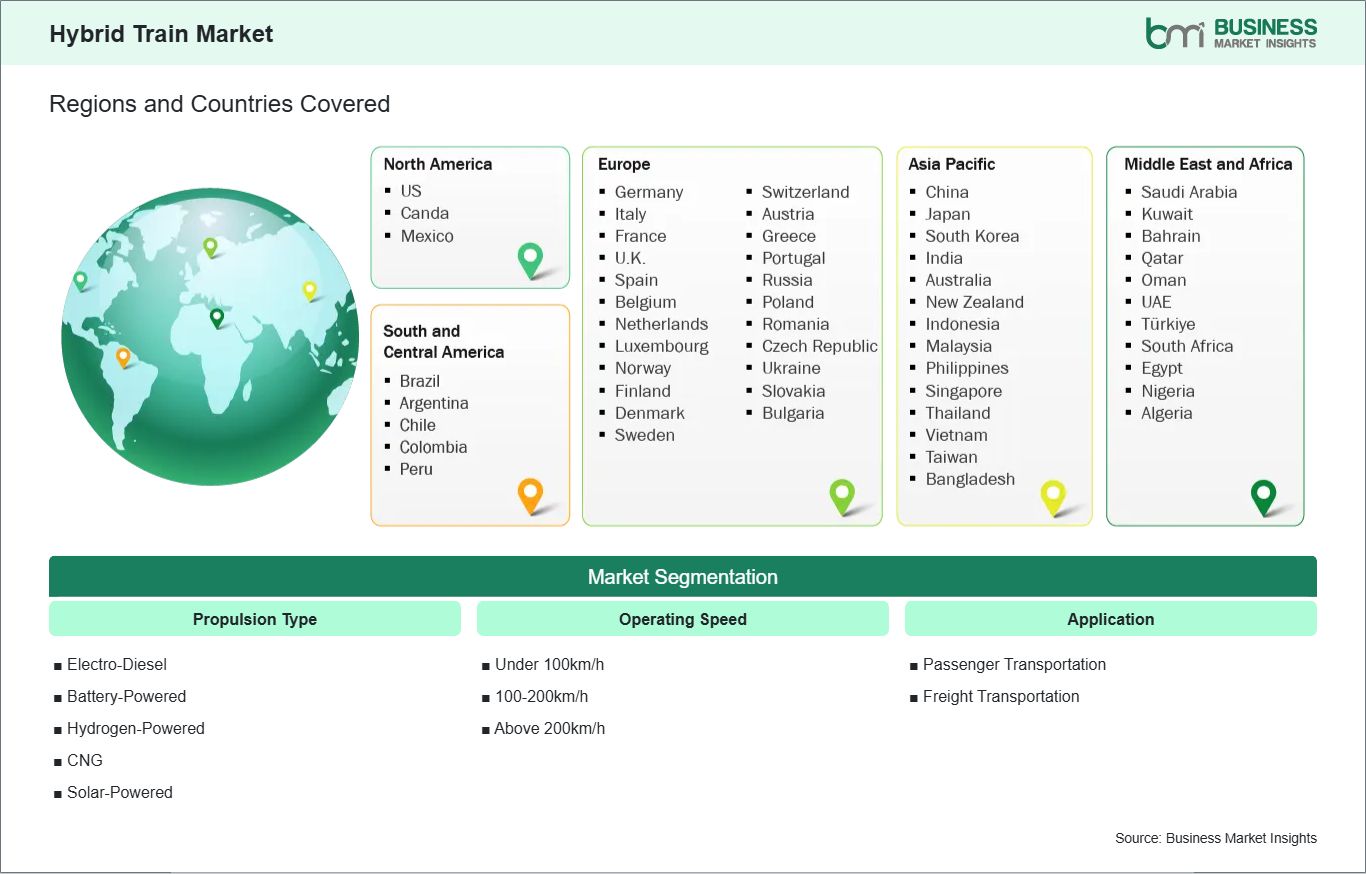
The Hybrid Train market is segmented based on propulsion type, operating speed, and application, reflecting the growing demand for sustainable and efficient rail transportation solutions.
By Propulsion Type
- Electro-Diesel: Combines diesel engine with electric traction; enables seamless transition between electrified and non-electrified routes
- Battery-Powered: Uses onboard batteries as primary power source with recharging via catenary or depot charging
- Hydrogen-Powered: Fuel cell systems generating electricity through hydrogen reaction; zero-emission solution for longer non-electrified routes
- CNG (Compressed Natural Gas): Lower-emission alternative to diesel for regional and freight applications
- Solar-Powered: Photovoltaic panels supplementing traction power; primarily for auxiliary systems in sunny regions
By Operating Speed
- Under 100 km/h: Urban and commuter rail applications with frequent stops; highest potential for regenerative braking energy recovery
- 100-200 km/h: Regional and intercity services; balanced efficiency and range requirements
- Above 200 km/h: High-speed hybrid configurations; limited adoption due to power requirements
By Application
- Passenger Transportation: Commuter, regional, and intercity passenger rail; largest market segment driven by urban sustainability goals
- Freight Transportation: Shunting locomotives and regional freight; steady growth with emphasis on yard emission reduction
Market Forces
Hybrid Train Market Drivers and Opportunities
Rising Environmental Regulations and Expanding Railway Infrastructure
The hybrid train market is being driven by growing environmental regulations targeting transportation sector emissions and the expanding railway infrastructure globally. Unlike conventional diesel trains, hybrid trains offer lower fuel consumption, reduced CO2 emissions, and quieter operation, making them particularly attractive for urban routes and environmentally sensitive areas. Rising government funding for green transport is amplifying demand, as transit authorities seek to meet climate targets while maintaining service levels on non-electrified lines. Stringent emission standards for rail transport in Europe and Asia are reinforcing the importance of hybrid solutions as cost-effective alternatives to full electrification. Additionally, the focus on noise reduction in urban rail corridors is driving adoption of battery-electric modes during nighttime and early morning operations. Collectively, environmental compliance and infrastructure expansion are fueling sustained growth in the global hybrid train market.
Government Funding and Hydrogen Fuel Cell Development
Opportunities in the hybrid train market are expanding through government funding programs for sustainable transport and the development of hydrogen fuel cell technology. Public funding commitments for green transport are opening lucrative opportunities for train manufacturers and component suppliers, enabling pilot projects and initial fleet rollouts. The retrofitting of existing diesel trains with hybrid powertrains is gaining traction, offering a cost-effective pathway for extending asset life while reducing emissions. In regional and freight applications, hydrogen fuel cell hybrid trains are emerging as zero-emission solutions for longer routes where battery range is insufficient. Additionally, advancements in battery technology are enabling higher energy density and faster charging, improving the operational viability of battery-electric hybrid trains. The expansion of smart charging infrastructure and depot-based energy management systems is creating new pathways for adoption. Vendors who focus on cost-effective retrofit solutions, interoperable systems, and hydrogen technology are well-positioned to capture growth.
Size and Share Analysis
Hybrid Train Market Size and Share Analysis
The Hybrid Train Market is projected to grow from US$ 24.8 Billion in 2025 to US$ 45.16 Billion by 2033 , registering a CAGR of 7.78% from 2026 to 2033..
By propulsion type, electro-diesel hybrid trains maintain the largest share due to their operational flexibility on partially electrified networks. Battery-powered trains are the fastest-growing segment, driven by urban rail applications and improving battery technology.
By operating speed, trains operating under 100 km/h account for the highest adoption due to frequent stop-start cycles maximizing regenerative braking benefits.
By application, passenger transportation dominates the market as cities invest in cleaner urban and commuter rail solutions. Freight applications are steadily growing, with shunting locomotives leading adoption.
Report Coverage
Hybrid Train Market Report Coverage and Deliverables
The "Hybrid Train Market Size and Forecast (2022–2033)" report provides a detailed analysis of the market covering below areas:
- Hybrid Train Market size and forecast at global, regional, and country levels for all market segments covered under the scope
- Hybrid Train Market trends, as well as drivers, restraints, and opportunities
- Hybrid Train Market analysis covering key trends, global and regional framework, major players, regulations, and recent developments
- Industry landscape and competition analysis covering market concentration, heat map analysis, prominent players, and recent developments
- Detailed company profiles, including SWOT analysis
Geographic Insights
Hybrid Train Market Geographic Insights
Europe leads the hybrid train market due to strict carbon emission reduction targets, strong governmental support for sustainable transportation, and the presence of extensive partially electrified railway networks. Hybrid trains are increasingly being adopted as a cost-effective alternative to full rail electrification, especially on regional and rural routes. Countries such as Germany, France, and United Kingdom are actively investing in battery-electric and hydrogen-powered train projects to replace diesel fleets and improve rail sustainability. Strong railway manufacturing capabilities, technological innovation, and favorable regulatory frameworks further strengthen Europe’s leadership position in the market.
Asia Pacific is the fastest-growing region in the hybrid train market, driven by rapid urbanization, railway expansion, and large-scale infrastructure modernization projects. Countries including China, India, Japan, and South Korea are heavily investing in advanced rail technologies to improve efficiency and reduce emissions. India’s extensive railway electrification program is creating demand for hybrid locomotives on partially electrified routes, while Japan and South Korea continue to innovate in battery-powered and energy-efficient train systems. The region’s growing population, industrialization, and government focus on sustainable transportation are accelerating hybrid train adoption.
North America is experiencing steady growth in the hybrid train market, mainly supported by the adoption of hybrid shunting locomotives and regional passenger rail systems. Rail operators in the United States and Canada are focusing on reducing fuel consumption, operational costs, and greenhouse gas emissions through battery-assisted and hybrid propulsion technologies. The market is particularly driven by applications in rail yards, switching operations, and short-distance commuter services where hybrid systems improve energy efficiency. Although the region has limited rail electrification compared to Europe, increasing environmental regulations and sustainability initiatives continue to support gradual market expansion.
Report Guidance
Hybrid Train Market Report Guidance
The report includes qualitative and quantitative data for the Hybrid Train Market across propulsion type, operating speed, application, and geography.
- The report starts with the key takeaways (chapter 2), highlighting the key trends and outlook of the Hybrid Train Market.
- Chapter 3 focuses on the research methodology of the study.
- Chapter 4 includes ecosystem analysis.
- Chapter 5 highlights the major industry dynamics in the Hybrid Train Market, including factors that are driving the market, prevailing deterrents, potential opportunities, as well as future trends.
- Chapter 6 discusses the Hybrid Train Market scenario, in terms of historical market revenues, and forecast till the year 2033.
- Chapters 7 to 10 cover Hybrid Train Market segments by propulsion type, operating speed, application, and geography across North America, Europe, Asia Pacific, Middle East and Africa, and South and Central America.
- Chapter 11 describes the competitive analysis along with the heat map analysis for the key players operating in the market.
- Chapter 12 describes the industry landscape analysis with market initiatives, new developments, mergers, and joint ventures globally.
- Chapter 13 provides detailed profiles of major companies operating in the Hybrid Train Market.
- Chapter 14 includes a brief overview of the company, list of abbreviations, and disclaimer.
Industry Activity
Recent Developments
The Hybrid Train Market is evaluated by gathering qualitative and quantitative data post primary and secondary research, which includes important corporate publications, association data, and databases. A few of the key developments in the Hybrid Train Market are:
- In September 2025, Škoda Group and RegioJet have announced the signing of a contract worth over CZK 9 billion for the delivery of 34 hybrid train units (18 two-car and 16 three-car) of the new BEDMU type (Battery Electric Diesel Multiple Unit). These trains represent the most efficient solution to provide environmentally friendly and comfortable transport on key routes in Northeast Bohemia that are not yet electrified. The new trains will enter service in December 2029. Passengers can look forward to faster journeys and improved customer service.
- In November 2025, NEXRAIL has placed an order with Stadler for the supply of up to 200 EURO9000 panto-battery hybrid locomotives. This EURO9000 combines up to 9MW of pantograph power with 1,2MW of high-performance battery power. It will be the first mainline corridor locomotive that can offer zero-emission transport from terminal to terminal. The smart battery module enables battery storage benefits such as brake energy storage, peak shaving and energy trading.
Trust & Transparency
Research Methodology
The market analysis combines proprietary research with secondary data from government agencies, company disclosures, regulatory filings, industry databases and expert interviews. Market estimates are validated through data triangulation, cross-market benchmarking and analyst
review.
View Full Research Methodology
Key Sources Referred:
International Union of Railways (UIC)
European Union Agency for Railways (ERA)
Company Annual Reports and Investor Presentations
Company Websites and Product Catalogs
Environmental Protection Agency (EPA)