
Electric Two Wheeler Powertrain Market Outlook: Size, Share, Trends, Growth Analysis, Competitive Landscape & Forecast, 2026-2033

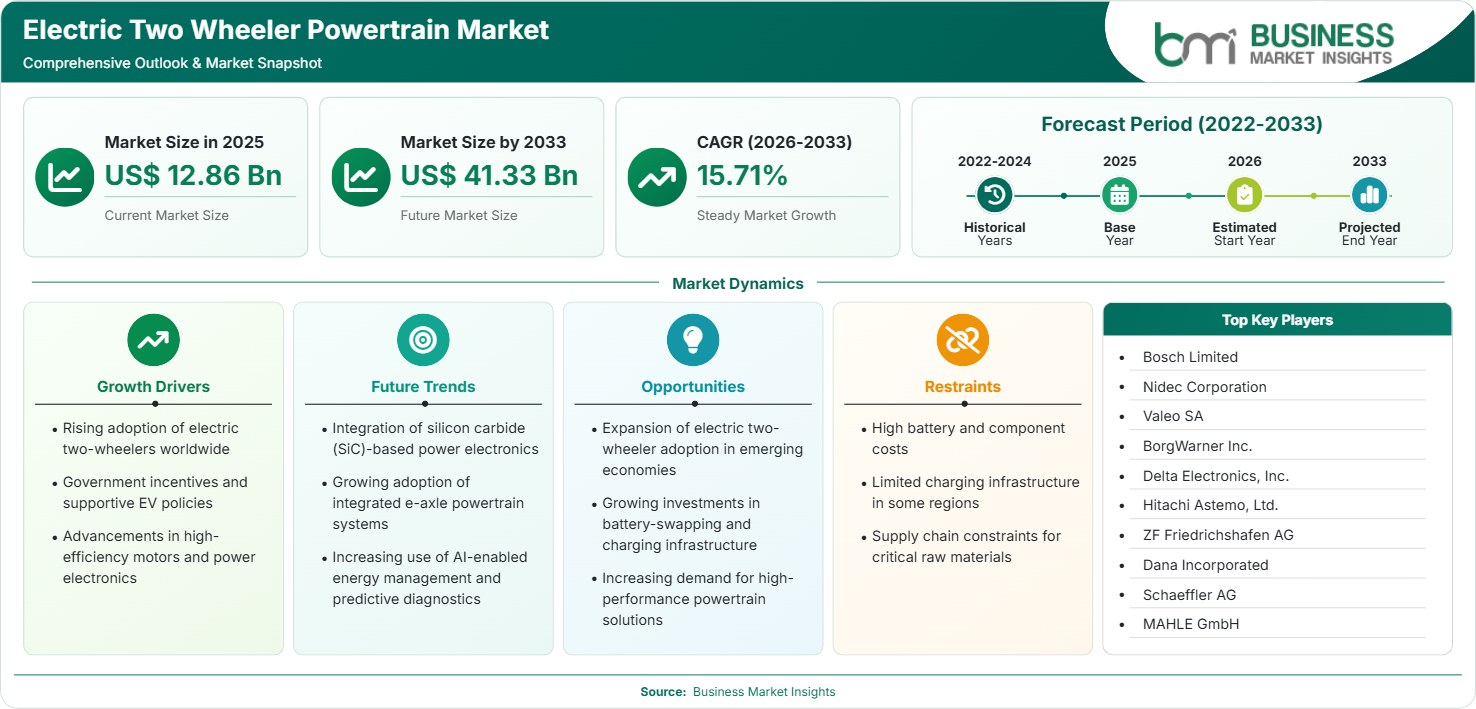
The Electric Two Wheeler Powertrain Market size was valued at US$ 12.86 Billion in 2025 and is projected to reach US$ 41.33 Billion by 2033, growing at a CAGR of 15.71% during 2026–2033. Market expansion is supported by accelerating electric two-wheeler adoption, government EV incentives, improvements in motor efficiency, and increasing investments in charging and battery ecosystem development.

Report Coverage
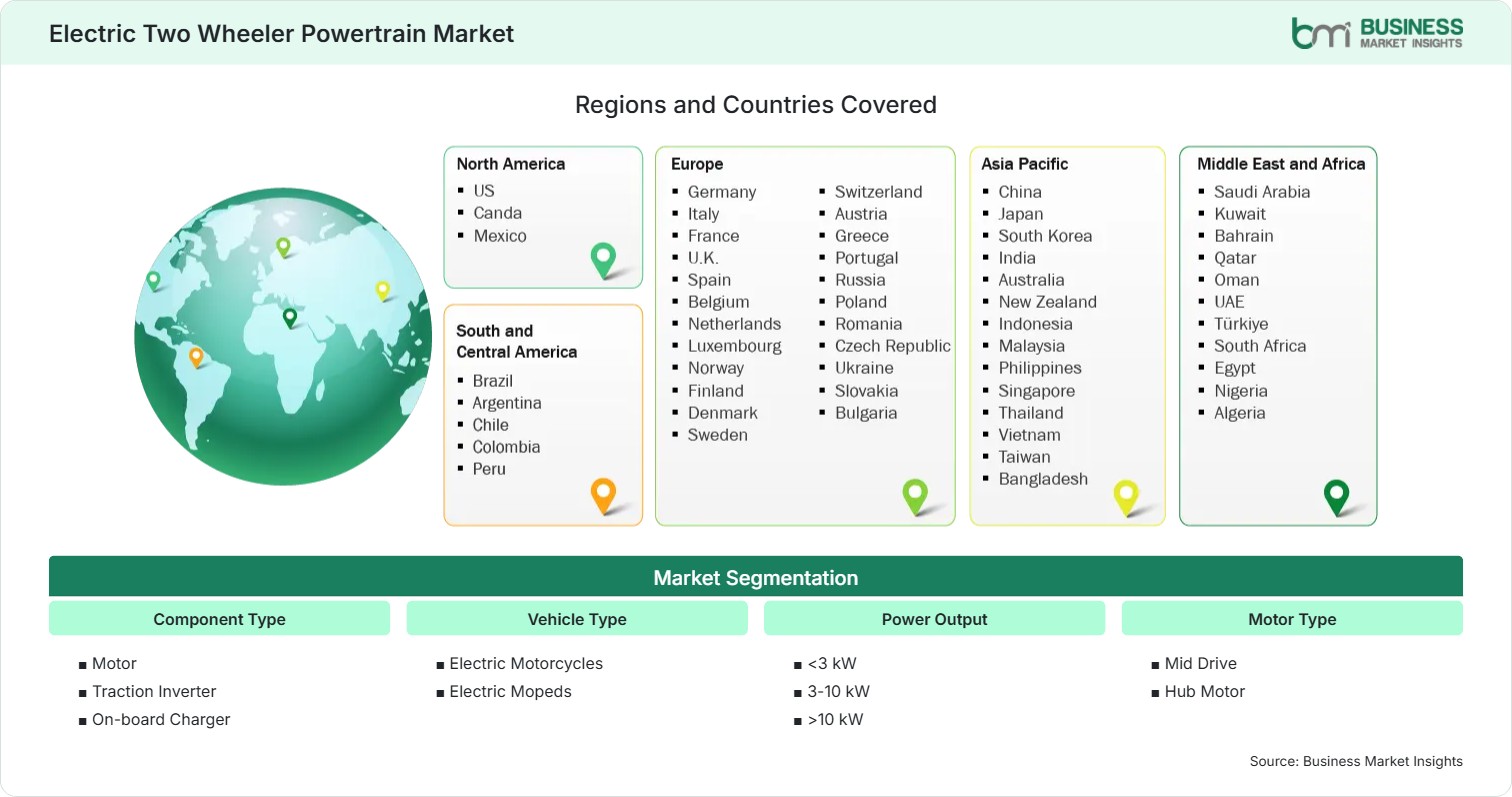
  • Component Type: Motor, Traction Inverter, On-board Charger
  • Vehicle Type: Electric Motorcycles, Electric Mopeds
  • Power Output: <3 kW, 3-10 kW, >10 kW
  • Motor Type: Mid Drive, Hub Motor
  • Battery Type: Lithium-Ion Batteries, Lithium Iron Phosphate, Lead-Acid Batteries
US$ 12.86 Bn Market size in 2025
US$ 41.33 Bn Market Size by 2033
15.71% CAGR, 2026 - 2033
2026-2033 Forecast Period

AI Overview

Electric Two Wheeler Powertrain Market Summary

  • North America Region: North America holds a 18%–22% share in 2025, growing at a CAGR of 14.2%–15.0% during 2026–2033, supported by EV infrastructure development, regulatory support, premium electric motorcycle adoption, and investments in advanced powertrain technologies. The U.S. market is expanding at a CAGR of 14.5%–15.3% during 2026–2033, driven by electric mobility initiatives, technology adoption, and rising demand for efficient propulsion systems.
  • Fastest Growing Region: Asia Pacific accounts for a 55%–60% share in 2025 and is projected to register a CAGR of 16.3%–17.0% during 2026–2033, supported by high electric two-wheeler penetration, government subsidies, battery manufacturing expansion, and increasing urban mobility requirements.
  • Leading Segment: Hub Motor represents a 58%–62% share in 2025 and is projected to grow at a CAGR of 15.0%–15.6% during 2026–2033, supported by compact design, cost efficiency, simpler vehicle integration, and widespread adoption in electric mopeds and scooters.
  • High Growth Segment: Lithium-Ion Batteries account for a 72%–76% share in 2025 and are expected to expand at a CAGR of 16.5%–17.2% during 2026–2033, driven by higher energy density, declining battery costs, improved lifecycle performance, and increasing demand for longer-range electric two-wheelers.
  • Key Market Opportunity: Expansion of electric mobility in emerging economies, battery-swapping networks, charging infrastructure investments, and demand for high-performance powertrain systems are creating significant opportunities for manufacturers.
  • Major Market Players: Bosch Limited, Nidec Corporation, Valeo SA, BorgWarner Inc., Delta Electronics, Inc., Hitachi Astemo, Ltd., ZF Friedrichshafen AG, Dana Incorporated, Schaeffler AG, and MAHLE GmbH.
Strategic Insights

Electric Two Wheeler Powertrain Market: Strategic Insights

Electric Two Wheeler Powertrain Market Strategic Framework
FREE PDF
Request your free sample
Request free sample
Stakeholder View

Key Takeaways

  • The electric two-wheeler powertrain ecosystem is evolving through stronger collaboration between motor manufacturers, battery suppliers, electronics providers, and vehicle producers to improve integration efficiency.
  • Battery-powered propulsion systems and advanced motor technologies represent major growth opportunities as manufacturers prioritize longer range, improved performance, and reduced operating costs.
  • Innovation is focused on high-efficiency motors, intelligent controllers, lightweight components, improved thermal management, and advanced battery integration for next-generation electric vehicles.
  • Asia Pacific remains the strongest investment opportunity due to large-scale electric two-wheeler adoption, supportive government policies, and expanding EV manufacturing ecosystems.
  • Companies are pursuing strategic partnerships, technology development initiatives, and production expansion to strengthen positions within the rapidly growing electric mobility value chain.
  • Charging infrastructure and battery-swapping networks are becoming important strategic areas as stakeholders seek solutions to improve electric two-wheeler ownership convenience.
Geographic Outlook

Electric Two Wheeler Powertrain Market Regional Highlights

North America Electric Two Wheeler Powertrain Market

North America accounted for 18%–22% of the market share in 2025 and is projected to grow at a CAGR of 14.2%–15.0% during 2026–2033. The region is experiencing increasing adoption of electric motorcycles and performance-oriented two-wheelers supported by emission reduction goals, charging infrastructure development, and government incentives. The United States represents the primary contributor due to growing EV investments and technology adoption. The Electric Two Wheeler Powertrain Market forecasts is influenced by demand for efficient motors, advanced battery systems, and premium electric mobility solutions.

  • Electric motorcycle adoption is increasing as consumers and commercial operators seek lower operating costs, reduced emissions, and efficient alternatives for urban transportation needs.
  • Manufacturers are investing in advanced power electronics, integrated controllers, and improved thermal management systems to enhance vehicle performance and reliability.
  • Government support through clean mobility programs and EV incentives is encouraging manufacturers to expand electric two-wheeler offerings across regional markets.
  • Growing interest in premium electric motorcycles is creating demand for high-output powertrain solutions with improved range and performance capabilities.

US Electric Two Wheeler Powertrain Market

The United States represented 78%–82% of North America's market share in 2025 and is expected to expand at a CAGR of 14.5%–15.3% during 2026–2033. Market development is supported by increasing interest in electric motorcycles, expanding charging infrastructure, and investments in advanced mobility technologies. Demand is particularly strong for efficient powertrains that deliver improved acceleration, extended range, and lower maintenance requirements compared with conventional internal combustion systems.

  • Electric motorcycle manufacturers are adopting advanced motors and battery systems to improve performance and attract technology-focused consumers.
  • Infrastructure expansion and clean transportation initiatives are supporting greater confidence among electric two-wheeler users.
  • Premium electric mobility segments are creating opportunities for high-performance powertrain component suppliers and technology developers.
  • Partnerships between vehicle manufacturers and component providers are strengthening domestic EV supply chain capabilities.

Europe Electric Two Wheeler Powertrain Market

Europe held 20%–24% of the market share in 2025 and is projected to register a CAGR of 14.8%–15.5% during 2026–2033. The region benefits from strict emission regulations, urban electrification programs, and strong demand for sustainable transportation solutions. Germany, France, Italy, and the Netherlands represent important markets due to developed EV ecosystems and increasing electric mobility investments.

  • Germany continues supporting market growth through automotive technology expertise, EV investments, and increasing demand for advanced electric mobility components.
  • France is expanding electric two-wheeler adoption through government support programs and urban mobility initiatives focused on emission reduction.
  • Italy remains an important market due to strong motorcycle culture, increasing electric scooter adoption, and growing manufacturer participation.
  • European companies are investing in localized production and advanced powertrain research to improve competitiveness in electric mobility markets.

Asia Pacific Electric Two Wheeler Powertrain Market

Asia Pacific represented 55%–60% of the market share in 2025 and is expected to achieve the fastest CAGR of 16.3%–17.0% during 2026–2033. The region dominates due to large-scale electric two-wheeler adoption, expanding battery manufacturing capacity, supportive government policies, and rising urban transportation demand. China, India, Vietnam, and Indonesia are major contributors as consumers increasingly adopt electric scooters and motorcycles for affordable mobility solutions.

  • China remains the largest regional market due to strong EV manufacturing capabilities, extensive battery supply chains, and high electric scooter adoption.
  • India is witnessing rapid growth through government electrification programs, increasing domestic manufacturing, and rising demand for affordable electric mobility.
  • Southeast Asian countries are expanding adoption as urban congestion, fuel costs, and environmental policies encourage electric transportation solutions.
  • Battery manufacturers and powertrain suppliers are increasing investments to support regional EV production expansion and technology development.

Rest of World Electric Two Wheeler Powertrain Market

The Rest of the World accounted for 5%–9% of the electric two wheeler powertrain market share in 2025 and is projected to grow at a CAGR of 13.5%–14.2% during 2026–2033. Latin America is experiencing gradual adoption through urban mobility programs and increasing interest in affordable electric transportation, while the Middle East and Africa are developing through sustainability initiatives and improving infrastructure.

  • Brazil and Mexico are emerging Latin American markets due to increasing urban transportation requirements and growing interest in electric mobility solutions.
  • Middle Eastern countries are exploring electric two-wheelers as part of broader sustainability and emissions reduction strategies.
  • African markets are developing through affordable electric mobility initiatives and increasing demand for efficient urban transportation alternatives.
  • Manufacturers are focusing on cost-effective powertrain solutions and localized partnerships to improve accessibility across developing markets.
Global Market Geography
FREE PDF
Request your free sample
Request free sample
Segment Analysis

Electric Two Wheeler Powertrain Market Segmentation

Component Type

Component Type segmentation is influenced by increasing demand for efficient electric propulsion systems, improved vehicle performance, and integration of advanced power electronics in electric two wheeler powertrain market. Motor represented the leading segment with a 48%–52% share in 2025 and is projected to grow at a CAGR of 15.2%–15.8% during 2026–2033, supported by rising electric two-wheeler production, efficiency improvements, and increasing adoption of compact motor technologies.

  • Motor: Motors remain the core powertrain component due to their direct impact on vehicle efficiency, acceleration, reliability, and overall electric two-wheeler performance.
  • Traction Inverter: Traction inverters are gaining importance through improved energy conversion efficiency, advanced control systems, and demand for optimized electric propulsion performance.
  • On-board Charger: On-board chargers support market expansion through improved charging compatibility, faster charging capabilities, and increasing integration with electric mobility platforms.

Vehicle Type

Vehicle Type segmentation is shaped by urban mobility requirements, consumer affordability, and increasing adoption of electric alternatives for short-distance transportation. Electric Mopeds represented the leading segment with a 58%–62% share in 2025 and are projected to grow at a CAGR of 15.5%–16.1% during 2026–2033, supported by lower ownership costs, compact designs, and widespread use in urban commuting applications in electric two wheeler powertrain market.

  • Electric Motorcycles: Electric motorcycles are gaining adoption among consumers seeking higher performance, longer range, and advanced mobility solutions compared with conventional motorcycles.
  • Electric Mopeds: Electric mopeds maintain strong demand due to affordability, ease of use, low maintenance requirements, and suitability for urban transportation needs.

Power Output

Power Output segmentation is influenced by vehicle application requirements, performance expectations, and battery efficiency improvements. 3–10 kW represented the leading segment with a 52%–56% share in 2025 and is projected to grow at a CAGR of 15.7%–16.3% during 2026–2033, supported by increasing adoption across commuter electric motorcycles and premium electric mopeds in electric two wheeler powertrain market.

  • <3 kW: Lower-power systems support entry-level electric two-wheelers through affordability, energy efficiency, and suitability for short-distance urban transportation applications.
  • 3–10 kW: Mid-range power systems provide a balance between performance, cost, and efficiency, making them suitable for mainstream electric two-wheeler applications.
  • >10 kW: High-power systems are expanding through demand for premium electric motorcycles requiring greater acceleration, speed capability, and enhanced riding performance.

Motor Type

Motor Type segmentation is driven by vehicle design preferences, efficiency requirements, and manufacturing strategies. Hub Motor represented the leading segment with a 58%–62% share in 2025 and is projected to grow at a CAGR of 15.0%–15.6% during 2026–2033, supported by simple integration, compact architecture, lower maintenance needs, and widespread adoption in electric scooters and mopeds in electric two wheeler powertrain market.

  • Mid Drive: Mid-drive motors are gaining attention in performance-focused applications due to improved weight distribution, higher efficiency, and better handling characteristics.
  • Hub Motor: Hub motors dominate due to cost advantages, simplified vehicle design, easy installation, and strong compatibility with mass-market electric two-wheelers.

Battery Type

Battery Type segmentation is influenced by energy density requirements, cost considerations, lifecycle performance, and consumer demand for extended vehicle range. Lithium-Ion Batteries represented the leading segment with a 72%–76% share in 2025 and are projected to grow at a CAGR of 16.5%–17.2% during 2026–2033, supported by superior energy density, declining costs, and increasing electric vehicle adoption in electric two wheeler powertrain market.

  • Lithium-Ion Batteries: Lithium-ion batteries remain dominant due to high energy density, longer operating life, faster charging capability, and suitability for modern electric mobility applications.
  • Lithium Iron Phosphate (LiFePO4): LiFePO4 batteries are gaining adoption through improved safety, thermal stability, longer lifecycle performance, and increasing preference for durable energy storage solutions.
  • Lead-Acid Batteries: Lead-acid batteries continue serving cost-sensitive applications due to affordability, established availability, and suitability for basic electric two-wheeler models.
Market Forces

Electric Two Wheeler Powertrain Market Dynamics

Key Market Drivers

Rising Adoption of Electric Two-Wheelers Worldwide

The increasing transition from conventional fuel-powered vehicles to electric mobility solutions is accelerating demand for advanced powertrain systems. Rising fuel costs, urban congestion, emission reduction initiatives, and lower operating expenses are encouraging consumers and fleet operators to adopt electric motorcycles and mopeds. The market growth is supported by increasing vehicle electrification programs, expanding manufacturing capacity, and improvements in battery-powered propulsion technologies. The electric two wheeler powertrain market trends indicate growing adoption of integrated motors, efficient controllers, and lightweight powertrain architectures. Manufacturers are focusing on improving range, performance, and reliability to address consumer expectations and strengthen electric two-wheeler adoption globally.

Government Incentives and Supportive EV Policies

Government efforts towards the transition to electric mobility are bringing favorable dynamics for powertrain suppliers and electric two-wheeler manufacturers. Subsidies, tax credits, emissions standards, and investments are driving consumers and organizations to adopt electric mobility solutions. Several nations are rolling out policies to develop local capacity for EV and battery production and charging network deployment. These initiatives are not only lowering barriers of entry but are helping in making technological progress in motors, inverters, and batteries. Regulatory support is also helping manufacturers to step up their research and development efforts geared towards efficiency, cost reduction, and local sourcing. Policy frameworks like this are now playing an increasingly significant role in facilitating long-term market growth.

Advancements in High-Efficiency Motors and Power Electronics

Advances in motor technology, traction inverters, and control systems are leading to improved performance in electric two-wheelers. There is a constant effort by manufacturers to develop small, lightweight, and powerful solutions that improve vehicle performance. Improvements in semiconductor and electronic control technologies are helping achieve higher power conversion efficiency and more efficient vehicle operations. Advanced thermal management and powertrain technologies are helping achieve vehicle reliability across various operating conditions. This will help manufacturers meet consumer demand for vehicle performance.

Key Market Opportunities

Expansion of Electric Two-Wheeler Adoption in Emerging Economies

Emerging economies present significant opportunities as urban populations increase and demand for affordable transportation solutions grows. Countries across Asia Pacific, Latin America, and Africa are witnessing rising interest in electric two-wheelers due to lower operating costs and increasing environmental awareness. Manufacturers have opportunities to expand through localized production, cost-efficient powertrain solutions, and partnerships with regional vehicle manufacturers Government programs for electrification, along with improved consumer awareness, are providing further support to this trend. The growth of electric mobility ecosystems in developing countries will drive demand for motors, controllers, batteries, and powertrains.

Growing Investments in Battery-Swapping and Charging Infrastructure

The expansion of charging networks and battery-swapping infrastructure is creating new opportunities for electric two-wheeler powertrain suppliers. Battery-swapping models can reduce charging downtime and improve vehicle utilization, particularly for commercial fleets and urban delivery applications. Investments in charging infrastructure are encouraging greater consumer confidence by addressing range concerns and improving ownership convenience. Powertrain manufacturers are collaborating with vehicle producers and infrastructure providers to develop compatible systems that support faster energy replenishment. These developments are expected to strengthen electric two-wheeler adoption while creating additional demand for efficient battery management systems and optimized powertrain components.

Increasing Demand for High-Performance Powertrain Solutions

Growing consumer interest in premium electric motorcycles and performance-oriented electric vehicles is creating opportunities for advanced powertrain technologies. Manufacturers are developing high-output motors, efficient inverters, and improved thermal systems to deliver enhanced acceleration, speed, and riding experience. Premium segments require advanced solutions that balance performance, energy efficiency, and reliability. These requirements are encouraging investment in innovative motor designs, lightweight materials, and intelligent control technologies. As electric two-wheelers expand beyond basic commuting applications, demand for higher-performance powertrain solutions is expected to increase among consumers seeking advanced mobility experiences.

Market Restraints and Challenges

High Battery and Component Costs

Factor: Electric two-wheeler powertrains depend on expensive components including lithium-based batteries, semiconductor systems, advanced motors, and electronic control units, which contribute significantly to overall vehicle costs. Impact: High component costs can increase electric two-wheeler prices, affecting consumer affordability and slowing adoption in price-sensitive markets. Manufacturers face challenges in achieving cost competitiveness while maintaining performance, safety, and durability standards. Battery price fluctuations and dependence on critical raw materials can also affect production planning and profitability. However, achieving cost parity with conventional vehicles remains a key challenge, particularly in emerging markets where affordability strongly influences purchasing decisions.

Limited Charging Infrastructure in Some Regions

Factor: Inadequate charging networks and limited battery-swapping availability in certain regions restrict convenient electric two-wheeler usage and create range-related concerns among consumers. Impact: Infrastructure limitations can slow adoption by reducing consumer confidence and affecting daily usability, especially for longer-distance travel and commercial applications. Manufacturers and governments need continued investment in charging stations, energy networks, and standardized battery solutions to improve accessibility. Limited infrastructure also creates challenges for fleet operators requiring reliable vehicle utilization. Expansion of charging ecosystems remains essential for supporting large-scale electric two-wheeler adoption.

Company Analysis

Competitive Landscape

The Electric Two Wheeler Powertrain Market analysis highlights a competitive environment driven by technological innovation, strategic partnerships, component integration, and expansion of electric mobility ecosystems. Leading companies are investing in high-efficiency motors, advanced power electronics, battery management solutions, and integrated powertrain platforms to support increasing electric two-wheeler production.

Company Name

Overview

Products and Services relevant to this market

Bosch Limited

Global technology and engineering company providing mobility solutions with expertise in automotive electronics and electric mobility systems.

Electric motors, power electronics, controllers, battery management solutions, and electric mobility components.

Nidec Corporation

Japanese manufacturer specializing in electric motors and precision technologies across automotive and industrial applications.

Traction motors, compact electric drive systems, motor technologies, and EV powertrain solutions.

Valeo SA

Global automotive technology company focused on electrification, intelligent mobility, and advanced vehicle systems.

Electric motors, power electronics, charging systems, and electrification components.

BorgWarner Inc.

Automotive technology company providing advanced propulsion solutions for electric and hybrid vehicles.

Electric motors, integrated drive modules, inverters, and EV powertrain technologies.

Delta Electronics, Inc.

Electronics manufacturer specializing in power management and energy-efficient solutions.

Power electronics, charging systems, motor control technologies, and EV-related components.

Hitachi Astemo, Ltd.

Mobility technology company offering advanced automotive components and electrification solutions.

Electric drive systems, inverters, controllers, and vehicle electrification technologies.

ZF Friedrichshafen AG

Global automotive supplier developing advanced mobility and electrification solutions.

Electric drives, powertrain systems, electronic control units, and EV components.

Dana Incorporated

Engineering company specializing in drivetrain and propulsion technologies for mobility applications.

Electric propulsion systems, e-drive solutions, thermal management systems, and powertrain components.

Schaeffler AG

Automotive and industrial technology company focused on efficient mobility solutions.

Electric motors, hybrid and electric drive components, bearings, and powertrain technologies.

MAHLE GmbH

Automotive supplier specializing in electrification, thermal management, and efficient mobility technologies.

Electric motors, battery thermal systems, power electronics, and EV propulsion solutions.

Trust & Transparency

Research Methodology

The market analysis combines proprietary research with secondary data from government agencies, company disclosures, regulatory filings, industry databases and expert interviews. Market estimates are validated through data triangulation, cross-market benchmarking and analyst review.

View Full Research Methodology

Questions Answered

Frequently Asked Questions

What does the Electric Two Wheeler Powertrain Market Report include?

The report includes market size, regional analysis, segmentation insights, competitive landscape, key trends, drivers, opportunities, restraints, recent developments, and forecasts from 2026 to 2033.

How is battery-swapping infrastructure supporting market growth?

Battery-swapping infrastructure reduces charging downtime, improves vehicle utilization, and supports commercial electric two-wheeler applications such as delivery and fleet operations.

Why are lithium-ion batteries widely used in electric two-wheelers?

Lithium-ion batteries are preferred due to higher energy density, longer lifecycle, faster charging capability, lightweight design, and suitability for modern electric mobility applications.

Which component segment dominates the Market?

The Motor segment represents the leading component segment due to its critical role in vehicle propulsion, performance improvement, efficiency optimization, and widespread adoption across electric motorcycles and mopeds.

What factors are driving the Electric Two Wheeler Powertrain Market growth?

Market growth is driven by increasing electric two-wheeler adoption, government EV incentives, improvements in battery technology, advancements in motor efficiency, and expansion of charging infrastructure.

Access the Full Electric Two Wheeler Powertrain Market Report

Get segment-level forecasts, regional estimates, competitive benchmarking, company profiles and downloadable Excel datasets.

Access the full Electric Two Wheeler Powertrain Market Report
350 pages PDF & Excel | 2026-08-06