
Two Wheeler Market Outlook: Size, Share, Trends, Growth Analysis, Competitive Landscape & Forecast, 2026-2033

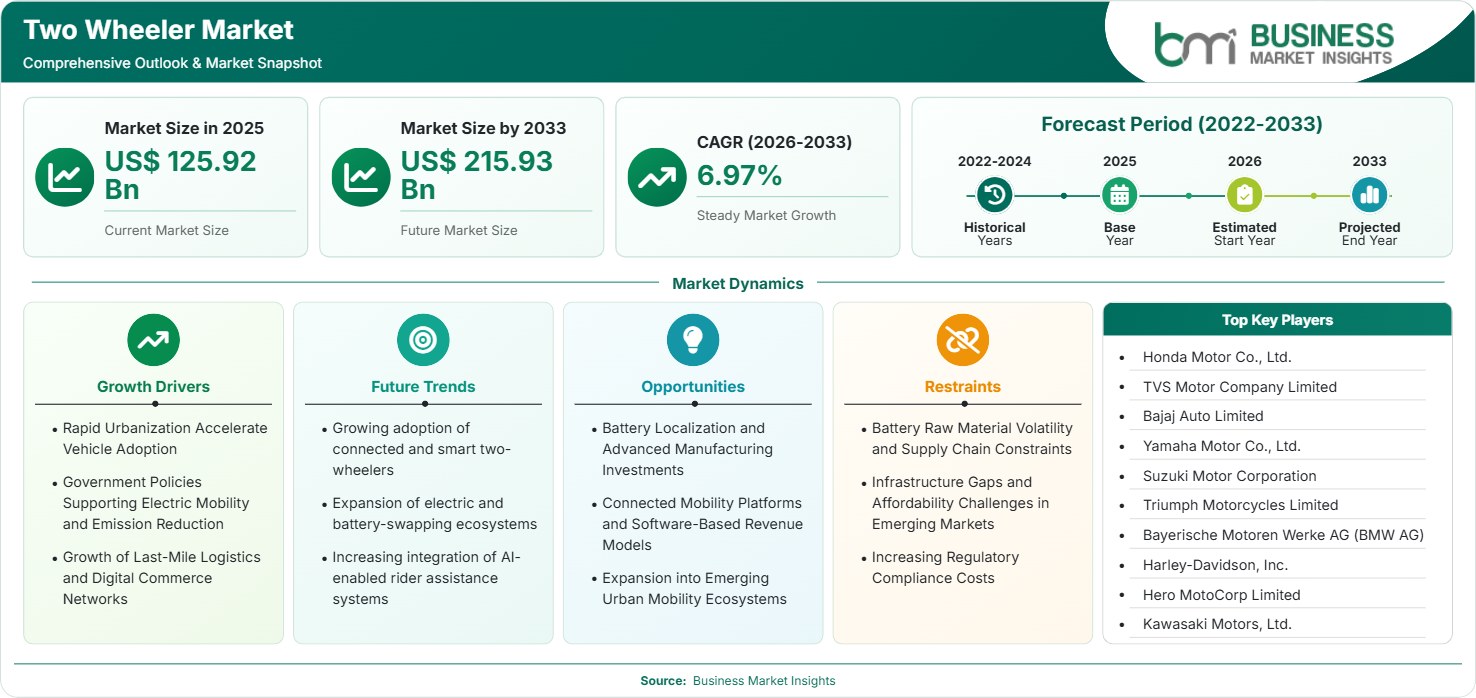
The Two Wheeler Market size was valued at US$ 125.92 Billion in 2025 and is projected to reach US$ 215.93 Billion by 2033, growing at a CAGR of 6.97% during 2026–2033, supported by rapid urbanization, rising electric mobility adoption, expanding shared mobility services, favorable government incentives, and continuous advancements in connected vehicle technologies.

Report Coverage
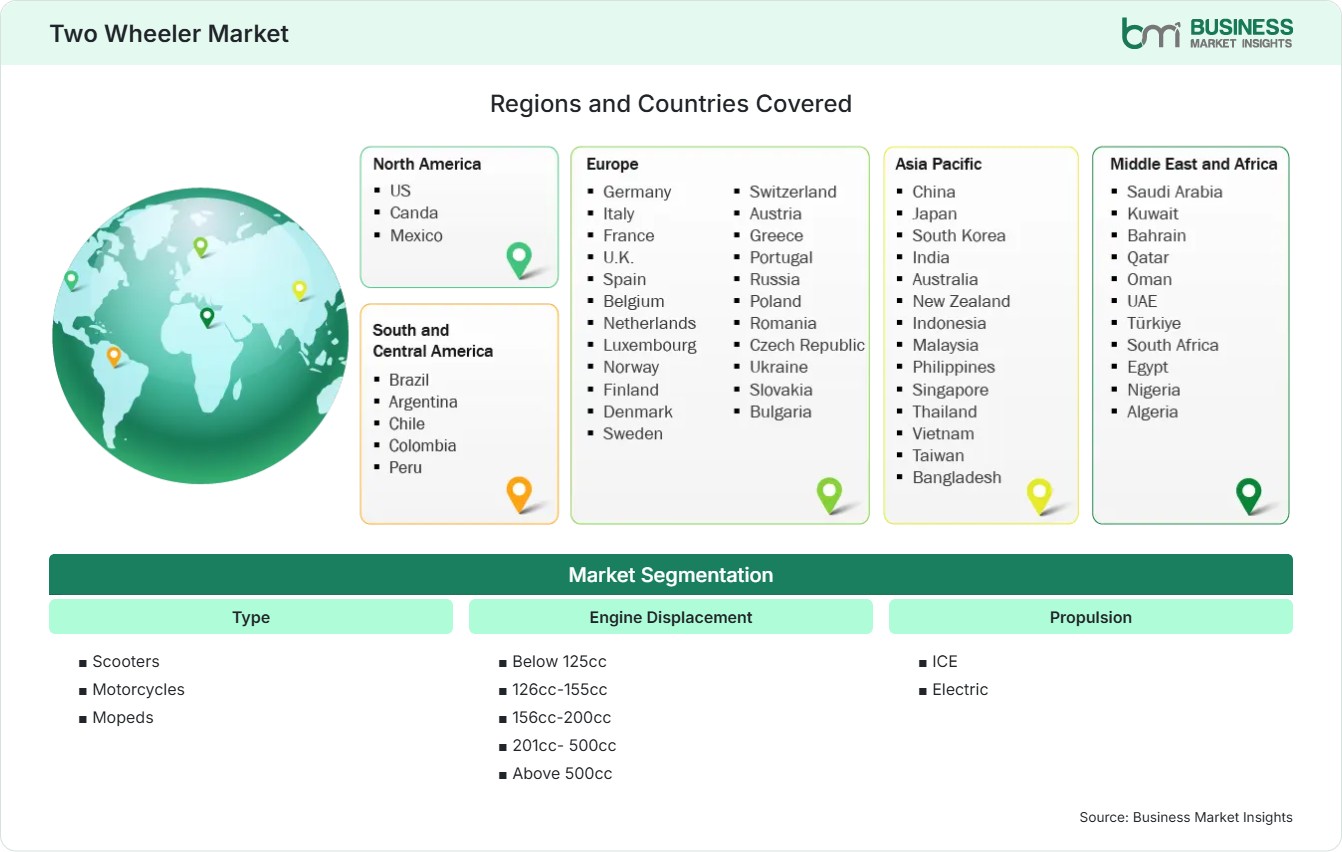
  • Type: Scooters, Motorcycles, Mopeds
  • Engine Displacement: Below 125cc, 126cc-155cc, 156cc-200cc, 201cc- 500cc, Above 500cc
  • Propulsion: ICE, Electric
US$ 125.92 Bn Market size in 2025
US$ 215.93 Bn Market Size by 2033
6.97% CAGR, 2026 - 2033
2026-2033 Forecast Period

AI Overview

Two Wheeler Market Summary

  • North America Region: North America holds a market share of 11%–13% in 2025, growing with a CAGR of 5.6%–6.2% during 2026–2033, supported by premium motorcycle demand, electric mobility investments, connected technologies, recreational riding culture, fleet electrification initiatives, digital retail expansion, supportive charging infrastructure, stronger financing availability, and evolving emission regulations encouraging cleaner transportation alternatives. The U.S. maintains regional leadership through premium motorcycle demand, expanding electric two-wheeler adoption, and projected CAGR of 5.8%–6.3% through 2033.
  • Fastest Growing Region: Asia Pacific accounts for 53%–56% market share in 2025 and is projected to expand at a CAGR of 7.8%–8.5% during 2026–2033, driven by urban mobility demand, affordable financing, manufacturing expansion, battery localization, government incentives, growing middle-income populations, increasing delivery fleets, and accelerating electric vehicle adoption.
  • Leading Segment: Motorcycles represent 62%–65% market share in 2025 and are expected to grow at a CAGR of 6.5%–7.1% through 2033, supported by commuter affordability, durable performance, expanding rural transportation, rising personal mobility demand, export opportunities, technological upgrades, enhanced fuel efficiency, and improved safety features.
  • High Growth Segment: Electric propulsion contributes 18%–21% market share in 2025 while advancing at a CAGR of 14.5%–15.8% during 2026–2033, fueled by battery innovations, government subsidies, charging infrastructure expansion, fleet electrification, lower ownership costs, environmental awareness, urban regulations, and continuous investments in domestic manufacturing capabilities.
  • Key Market Opportunity: Battery localization, intelligent connected mobility platforms, subscription ownership models, and integrated charging ecosystems provide manufacturers with opportunities to reduce costs, improve consumer adoption, strengthen profitability, expand exports, and accelerate sustainable transportation worldwide.
  • Major Market Players: Honda Motor Co., Ltd., TVS Motor Company Limited, Bajaj Auto Limited, Yamaha Motor Co., Ltd., Suzuki Motor Corporation, Triumph Motorcycles Limited, Bayerische Motoren Werke AG (BMW AG), Harley-Davidson, Inc., Hero MotoCorp Limited, and Kawasaki Motors, Ltd.
Strategic Insights

Two Wheeler Market: Strategic Insights

Two Wheeler Market Strategic Framework
FREE PDF
Request your free sample
Request free sample
Stakeholder View

Key Takeaways

  • The value chain is becoming increasingly localized as manufacturers invest in domestic battery production, semiconductor sourcing, digital manufacturing, and supplier partnerships to improve resilience, reduce logistics costs, and enhance production flexibility amid evolving global trade dynamics.
  • Premium motorcycles, electric scooters, and urban commuter vehicles present the strongest commercial opportunities as consumer demand shifts toward efficient, connected, and environmentally responsible transportation supported by government incentive programs and expanding charging infrastructure.
  • Innovation priorities continue shifting toward battery chemistry improvements, intelligent rider assistance systems, connected telematics, predictive maintenance, lightweight chassis engineering, and over-the-air software updates that enhance customer experience while reducing lifecycle ownership costs.
  • Asia Pacific remains the most attractive investment destination due to large consumer populations, established manufacturing ecosystems, supportive industrial policies, expanding urbanization, and growing exports, while Southeast Asian countries continue attracting substantial production investments.
  • Strategic mergers, technology partnerships, battery joint ventures, and software collaborations are accelerating product development timelines, strengthening competitive differentiation, improving manufacturing efficiency, and supporting long-term expansion into connected and electric mobility ecosystems.
  • Companies prioritizing integrated mobility services, digital sales channels, subscription ownership models, and circular battery recycling strategies are expected to improve customer retention, diversify revenue streams, and strengthen competitive positioning throughout the forecast period.
Geographic Outlook

Two Wheeler Market Regional Highlights

North America Two Wheeler Market

North America accounted for 11%–13% of the Two Wheeler Market share in 2025 and is projected to expand at a CAGR of 5.6%–6.2% during 2026–2033. Demand is primarily driven by premium motorcycles, recreational riding, electric scooter adoption, and connected mobility technologies. Increasing investments in charging infrastructure, digital retail platforms, and advanced rider assistance systems continue strengthening market competitiveness.

  • Premium touring and cruiser motorcycles see steady growth due to rising incomes, financing options, and leisure riding demand.
  • Electrification is driving connected electric scooters and motorcycles with better range, fast charging, and smart features.
  • Government incentives and charging infrastructure support electric two-wheeler adoption.
  • Digital sales channels, customization, and predictive maintenance improve customer engagement and revenue.
  • Lightweight materials, safety systems, and smart diagnostics enhance vehicle competitiveness.

US Two Wheeler Market

The United States contributes approximately 74%–77% of North American revenue while advancing at a CAGR of 5.8%–6.3% through 2033. The demand for luxurious motorcycles, growing initiatives on electric mobility and recreational rides remain driving the Two Wheeler Market further. Extensive research and development in battery, software-defined vehicle, connected mobility solutions, and digital dealer platforms improve domestic manufacturing competitiveness and attract investments from overseas manufacturers looking for sustainable growth avenues.

  • Premium motorcycles remain the largest revenue contributor due to strong consumer purchasing power, established dealer networks, and continuous product innovation emphasizing comfort, performance, and rider safety.
  • Commercial delivery companies increasingly evaluate electric two-wheelers for urban logistics applications, improving operational efficiency while reducing maintenance costs and emissions across densely populated metropolitan areas.
  • Connected vehicle technologies, smartphone integration, predictive diagnostics, and over-the-air software updates enhance ownership experiences while supporting recurring digital service revenues for manufacturers.
  • Expansion of charging infrastructure and battery technology partnerships continues improving consumer confidence, accelerating electric vehicle adoption across urban and suburban transportation ecosystems.

Europe Two Wheeler Market

Europe represented approximately 20%–22% market share during 2025 and is forecast to register a CAGR of 6.2%–6.8% through 2033. Germany remains the leading Two Wheeler market, while Italy maintains strong manufacturing capabilities. Spain demonstrates the fastest growth supported by urban mobility initiatives, charging infrastructure investments, and increasing adoption of electric scooters for city transportation.

  • Germany leads with premium motorcycle production, engineering expertise, and connected mobility adoption.
  • Italy remains a key manufacturing and export hub supported by strong brands and skilled workforce.
  • Spain shows rapid growth through incentives, sustainability programs, and electric scooter adoption.
  • Carbon reduction policies are driving investments in electrification, batteries, and lightweight vehicle platforms.
  • Smart city initiatives are supporting connected transportation and sustainable urban mobility.

Asia Pacific Two Wheeler Market

Asia Pacific dominated with 53%–56% of global revenue in 2025 and is anticipated to grow at a CAGR of 7.8%–8.5% during 2026–2033. Rapid urbanization, rising disposable income, expanding manufacturing capacity, and government support for electric mobility continue driving regional leadership. China and India remain the largest markets, while Vietnam records the fastest growth supported by increasing urban transportation demand, affordable financing, and strong domestic manufacturing investments in Two Wheeler Market.

  • China leads with strong manufacturing, battery production, domestic demand, and electric two-wheeler exports.
  • India grows through affordable motorcycles, localization initiatives, rural mobility, and EV investments.
  • Vietnam shows rapid expansion due to urban growth, supportive policies, and electric scooter demand.
  • Manufacturers are investing in local batteries, connected vehicles, and smart production systems.
  • E-commerce and delivery services are increasing demand for motorcycles and electric scooters.

Rest of World Two Wheeler Market

Rest of World accounted for approximately 10%–12% market share in 2025 and is expected to expand at a CAGR of 6.4%–7.0% during 2026–2033. South & Central America continues benefiting from increasing urban mobility demand and affordable commuter motorcycles.

Growth in the Middle East & Africa region is evident, with steady gains driven by improvements in infrastructure, population growth among youth, and investments in sustainable transport systems. In South & Central America, Brazil is the leading country, while the fastest Two Wheeler Market growth in the United Arab Emirates.

  • Brazil leads through rising motorcycle ownership, local production, financing support, and delivery applications.
  • Mexico expands manufacturing capacity with strong supply chains and global motorcycle investments.
  • UAE shows rapid growth through premium mobility demand, smart cities, and electric transport investments.
  • South Africa is increasing motorcycle adoption through logistics growth and affordable mobility needs.
  • Regional policies support sustainable transportation, infrastructure development, and cleaner mobility technologies.
Global Market Geography
FREE PDF
Request your free sample
Request free sample
Segment Analysis

Two Wheeler Market Segmentation

Type

The Type segment accounted for the largest portion of industry revenue, with motorcycles contributing significantly to overall demand. The segment is projected to maintain steady expansion with motorcycles holding 62%–65% market share in 2025 and recording a CAGR of 6.5%–7.1% during 2026–2033. The Two Wheeler Market scope continues expanding through changing commuting preferences, rising urbanization, electrification, and continuous product innovation across all vehicle categories.

  • Scooters: Preferred for urban commuting due to convenience, efficiency, compact design, and growing electric model availability.
  • Motorcycles: Lead the market with affordability, long-distance use, delivery demand, premium launches, and improved efficiency.
  • Mopeds: Remain popular for short-distance travel among users seeking affordable, lightweight, and low-maintenance mobility.

Engine Displacement

Engine displacement continues influencing purchasing decisions according to consumer affordability, riding purpose, and regulatory requirements. Mid-capacity motorcycles are experiencing stronger demand because they balance fuel efficiency, performance, and ownership costs. The 126cc – 155cc category accounts for approximately 29%–32% market share in 2025 while expanding at a CAGR of 7.2%–7.8% during the forecast period.

  • Below 125cc: Entry-level motorcycles and scooters dominate densely populated urban markets, offering economical ownership, superior fuel efficiency, and practical commuting capabilities for first-time buyers and commercial fleet operators.
  • 126cc – 155cc: This category benefits from increasing consumer preference for versatile commuter motorcycles delivering balanced performance, comfort, efficiency, and affordability across emerging economies.
  • 156cc – 200cc: Growing popularity among young professionals and recreational riders supports demand for motorcycles offering enhanced acceleration, improved comfort, and advanced digital features.
  • 201cc – 500cc: Mid-premium motorcycles experience increasing adoption among enthusiasts seeking touring capability, superior performance, premium styling, and advanced rider assistance technologies.
  • Above 500cc: Premium motorcycles continue attracting experienced riders through luxury features, powerful engines, advanced electronics, touring capabilities, and strong brand loyalty across developed markets.

Propulsion

Propulsion technologies continue transforming industry competition as governments promote lower-emission transportation and manufacturers accelerate battery innovation. Internal combustion engine models remain dominant with 79%–82% market share in 2025, while electric propulsion records the fastest expansion at a CAGR of 14.5%–15.8% between 2026 and 2033, driven by supportive policies, charging infrastructure expansion, and declining battery costs.

  • ICE: Remain dominant due to established fuel infrastructure, lower costs, reliability, and broad market availability.
  • Electric: Growing rapidly with better batteries, incentives, fleet adoption, lower operating costs, and environmental awareness.
Market Forces

Two Wheeler Market Dynamics

Key Market Drivers

Rapid Urbanization Accelerate Vehicle Adoption

Urbanization in emerging economies is constantly reshaping personal mobility trends, leading many people to choose two-wheelers as their primary mode of transportation. According to statistics from the United Nations, 68% of the world’s population will live in cities by 2050. These factors of traffic congestion, higher costs of vehicle ownership, and lack of parking facilities lead people to choose two-wheelers. The Two Wheeler Market trends is further supported by expanding e-commerce delivery fleets, food delivery platforms, and ride-sharing services that rely on affordable and fuel-efficient vehicles. Manufacturers continue introducing lightweight platforms, connected technologies, and improved fuel economy models, enabling broader adoption among urban consumers while strengthening long-term demand across both developed and emerging markets.

Government Policies Supporting Electric Mobility and Emission Reduction

Stringent emissions norms, incentives, and industry policies are being followed by all governments to drive the adoption of electric two-wheelers. Countries like India, China, Japan, Germany, and many South-East Asian countries offer subsidies, tax benefits, and manufacturing support for battery mobility vehicles. According to the International Energy Agency, the number of electric vehicles is growing steadily due to governments' focus on decarbonizing transport systems. Increased investment in battery production, infrastructure for charging, and localized production of components lowers the cost of ownership along with making the supply chain strong. Besides this, automakers are also increasing their electric vehicle range along with working on the chemistry and software of batteries.

Growth of Last-Mile Logistics and Digital Commerce Networks

The rapid growth in the use of e-commerce and on-demand delivery services has increased demand for motorcycles and scooters for business applications. Logistics companies need cost-efficient and dependable vehicles that can operate effectively in densely crowded urban areas. Companies in the food, courier, pharmaceutical, and quick commerce sectors have continued to expand their fleets to improve efficiency and reduce delivery times. Fleet companies are now increasingly relying on connected fleet management systems, predictive maintenance systems, and telematics to increase the efficiency of the vehicles. The manufacturers are responding by developing more robust, business-ready vehicles with greater payload capacity and lower operating costs.

Key Market Opportunities

Battery Localization and Advanced Manufacturing Investments

Localization of battery manufacturing represents one of the strongest investment opportunities for industry participants over the forecast period. Governments increasingly encourage domestic production of lithium-ion batteries, battery management systems, and power electronics to reduce import dependency and strengthen industrial competitiveness. The Two Wheeler Market Forecasts indicate growing investments in battery gigafactories, localized component ecosystems, and recycling facilities capable of lowering production costs while improving supply security. The alliances among battery makers, automakers, and technology firms will speed up innovations regarding high energy density batteries and future battery charging systems. Early adopters of the vertically integrated manufacturing process are projected to achieve better margins, competitive edge in exports, and increased demand from domestic and foreign consumers.

Connected Mobility Platforms and Software-Based Revenue Models

Technologies of connected vehicles offer manufacturers the possibility to generate new income streams through methods other than selling cars. Telematics, cloud connectivity, mobile apps, advanced diagnostics, and over-the-air software updates give many opportunities for digital services generation at different stages of the lifecycle of the car ownership. Fleet management companies need efficient platforms for managing their vehicles by improving routing and maintenance planning, as well as energy consumption. Customer demand for navigation systems, surveillance, diagnostics, and digital services subscriptions grows in both luxury and commuter categories. Moreover, software-defined mobility environments help to improve customer retention rates and gather operational information for further development.

Expansion into Emerging Urban Mobility Ecosystems

Infrastructure development at a rapid pace in Southeast Asia, Latin America, Africa, and certain Middle Eastern nations is conducive for future industry growth. The movement towards urban mobility shows a growing trend toward more compact, energy-efficient transportation that will alleviate congestion and increase accessibility. Partnerships between public and private organizations aimed at providing infrastructure for charging stations, intelligent transport systems, and sustainable mobility contribute to increased usage of electric vehicles. Banks and other financial institutions will also offer more affordable loan programs, making it easier for first-time buyers to purchase motorcycles and scooters.

Market Restraints and Challenges

Battery Raw Material Volatility and Supply Chain Constraints

Factor: The use of critical minerals such as lithium, nickel, cobalt, and rare earth minerals by manufacturers makes them vulnerable to supply chain disruptions and cost fluctuations due to geopolitical risks, limited mining capabilities, and logistics constraints. Impact: An increase in input costs affects the business's bottom line and makes electric cars more expensive, thus hindering consumer adoption. Manufacturers keep expanding their sources of supply, investing in battery recycling, and exploring alternative battery chemistries to overcome reliance on raw materials. However, even with these measures, supply chain risks persist.

Infrastructure Gaps and Affordability Challenges in Emerging Markets

Factor: Development of the charging infrastructure is uneven in many developing countries, even though the initial cost is high whereas running cost is low. Lack of funding options and weak execution of policies is a major barrier to consumer purchase decision. Impact: The lack of proper infrastructure hinders the electrification process especially in rural and semi-urban areas where there is availability of fuel supply system. The manufacturers have to ensure that they make the right balance between investments on the internal combustion platform and electric platform along with dealer expansion and finance options.

Company Analysis

Competitive Landscape

The competitive environment is characterized by global manufacturers expanding production capacity, electrifying product portfolios, strengthening connected mobility capabilities, and investing in localized supply chains. Two Wheeler Market analysis indicates that companies are increasingly focusing on premium motorcycles, affordable commuter models, electric scooters, digital retail platforms, and strategic technology partnerships to improve profitability and capture long-term growth opportunities.

Company Name

Overview

Products and Services relevant to this market

Honda Motor Co., Ltd.

Global motorcycle leader with strong manufacturing, R&D, and a broad portfolio across commuters, premium, and electric mobility segments.

Motorcycles, scooters, electric two-wheelers, connected mobility, powertrains, services, financing, and dealership support.

TVS Motor Company Limited

Indian manufacturer known for innovation, exports, premium motorcycles, scooters, and growing electric mobility solutions.

Motorcycles, scooters, electric scooters, fleet solutions, connected technologies, spare parts, and maintenance services.

Bajaj Auto Limited

Global exporter offer commuter and premium motorcycles through innovation and international partnerships.

Motorcycles, scooters, EVs, performance bikes, financing, aftermarket parts, exports, and digital solutions.

Yamaha Motor Co., Ltd.


Japanese manufacturer focused on performance motorcycles, scooters, and intelligent mobility technologies.

Motorcycles, scooters, electric mobility, connected services, accessories, maintenance, and rider assistance systems.

Suzuki Motor Corporation

Mobility company providing reliable motorcycles, scooters, advanced engineering, and global distribution.

Motorcycles, scooters, engine technologies, mobility solutions, replacement parts, and service support.

Triumph Motorcycles Limited

British premium motorcycle brand specializing in high-performance bikes and international expansion.

Premium and touring motorcycles, accessories, apparel, maintenance, and connected ownership services.

Bayerische Motoren Werke AG (BMW AG)

Premium motorcycle manufacturer investing in connected mobility, electrification, safety, and digital solutions.

Adventure motorcycles, touring bikes, electric scooters, connected technology, financing, and mobility services.

Harley-Davidson, Inc.

American motorcycle brand focused on premium touring, customization, and lifestyle experiences.

Cruiser and touring motorcycles, electric bikes, accessories, customization, financing, and dealership support.

Hero MotoCorp Limited

Leading motorcycle manufacturer with strong production, exports, and investments in electric mobility.

Motorcycles, scooters, electric mobility, connected services, spare parts, maintenance, and financing partnerships.

Kawasaki Motors, Ltd.

High-performance motorcycle manufacturer known for advanced engineering, sport models, and premium riding experiences.

Sport, touring, and adventure motorcycles, high-performance engines, accessories, and connected technologies.

Trust & Transparency

Research Methodology

The market analysis combines proprietary research with secondary data from government agencies, company disclosures, regulatory filings, industry databases and expert interviews. Market estimates are validated through data triangulation, cross-market benchmarking and analyst review.

View Full Research Methodology

Questions Answered

Frequently Asked Questions

What does a Two Wheeler Market Report typically evaluate?

The report analyzes market size, competition, regional trends, technologies, regulations, segments, investments, supply chains, innovations, and future growth opportunities for strategic decision-making.

Which regions present the strongest investment opportunities?

Asia Pacific remains the leading investment destination because of large consumer demand, established manufacturing ecosystems, supportive industrial policies, and rapid electric mobility adoption, while Latin America and the Middle East offer emerging long-term growth potential.

How are connected technologies transforming the industry?

Connected technologies enable real-time diagnostics, predictive maintenance, navigation, smartphone integration, theft protection, fleet monitoring, and over-the-air software updates, improving operational efficiency while enhancing rider safety and customer experience.

Which engine displacement category is expected to witness the strongest demand in Two Wheeler Market?

The 126cc–155cc category is expected to maintain strong demand because it balances affordability, fuel efficiency, commuting performance, and ownership costs, making it attractive for both personal transportation and commercial fleet applications.

What factors are encouraging consumers to shift toward electric two-wheelers?

Government incentives, lower battery costs, improved charging networks, reduced maintenance costs, and rising environmental awareness are driving electric scooter and motorcycle adoption among consumers and fleets.

Access the Full Two Wheeler Market Report

Get segment-level forecasts, regional estimates, competitive benchmarking, company profiles and downloadable Excel datasets.

Access the full Two Wheeler Market Report
350 pages PDF & Excel | 2026-08-17