
Two-Wheeler ABS Market Outlook: Size, Share, Trends, Growth Analysis, Competitive Landscape & Forecast, 2026-2033

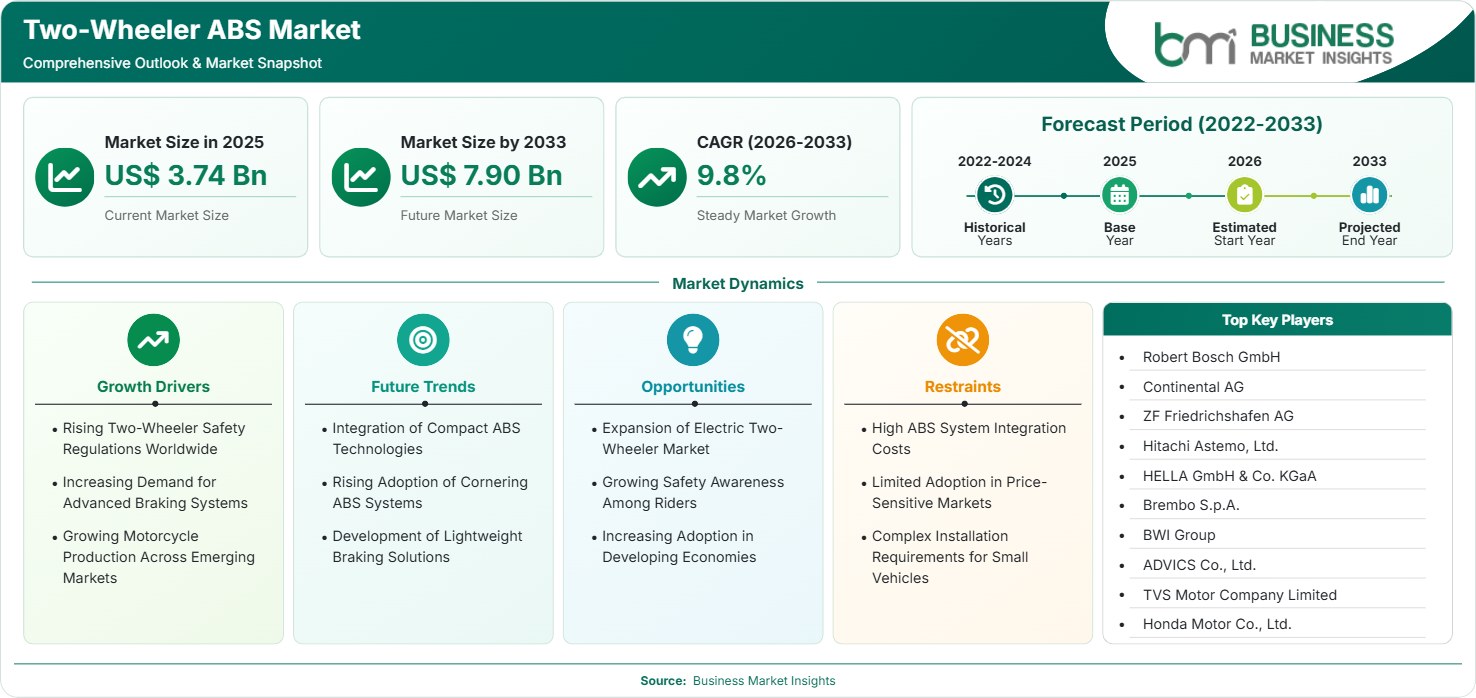
The Two-Wheeler ABS Market size was valued at US$ 3.74 Billion in 2025 and is projected to reach US$ 7.90 Billion by 2033, growing at a CAGR of 9.8% during 2026–2033. Rising government mandates for motorcycle safety, increasing adoption of advanced braking technologies, and growing motorcycle production across emerging economies are driving market growth, while electric two-wheelers, rider safety awareness, and expanding adoption in developing countries continue creating long-term opportunities.

Report Coverage
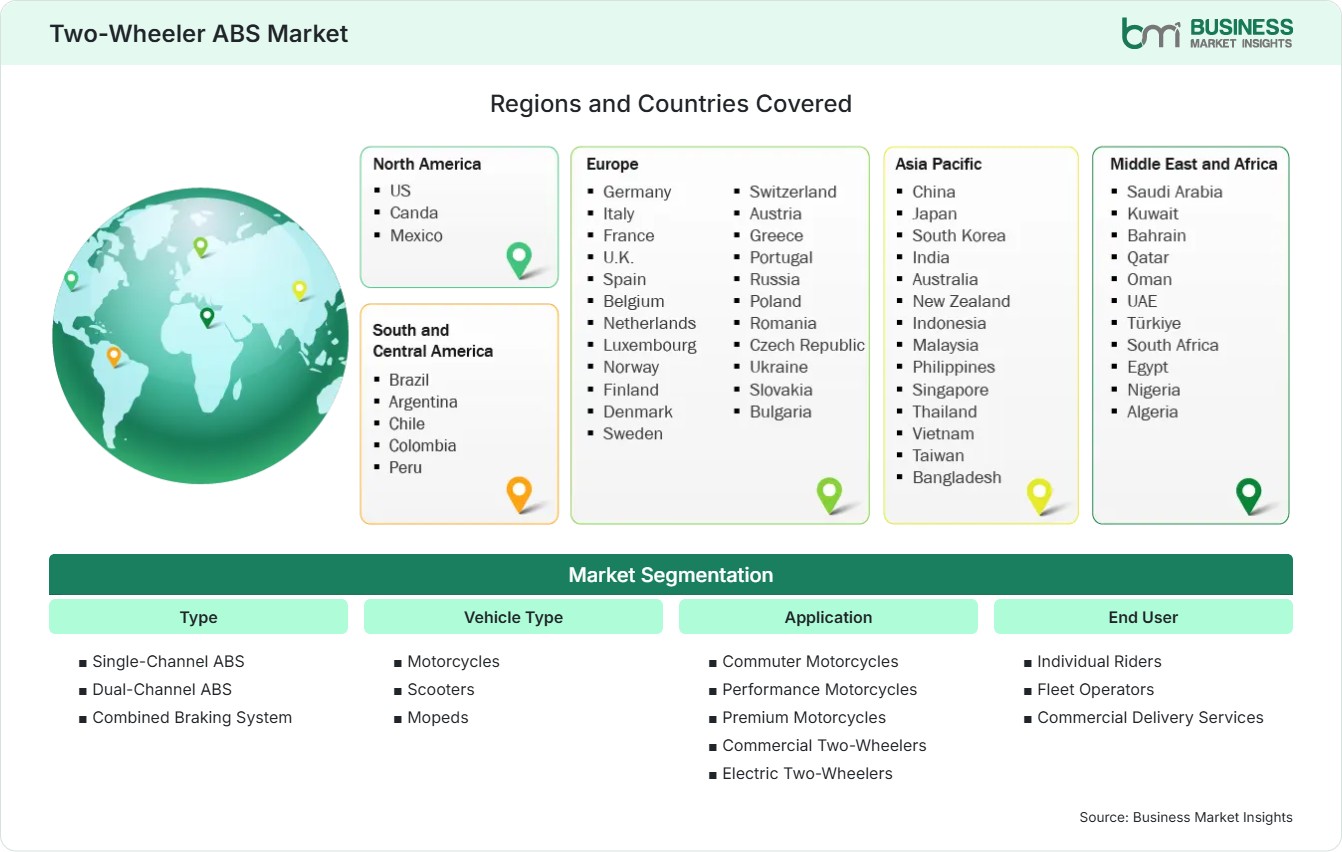
  • Type: Single-Channel ABS, Dual-Channel ABS, Combined Braking System
  • Vehicle Type: Motorcycles, Scooters, Mopeds
  • Application: Commuter Motorcycles, Performance Motorcycles, Premium Motorcycles, Commercial Two-Wheelers, Electric Two-Wheelers
  • End User: Individual Riders, Fleet Operators, Commercial Delivery Services
US$ 3.74 Bn Market size in 2025
US$ 7.90 Bn Market Size by 2033
9.8% CAGR, 2026 - 2033
2026-2033 Forecast Period

AI Overview

Two-Wheeler ABS Market Summary

  • North America Region: North America holds a market share of 14%–17% in 2025 and is projected to grow at a CAGR of 9.2%–9.7% during 2026–2033, supported by increasing premium motorcycle sales, rider safety awareness, and technological advancements in braking systems. The U.S. market is expected to expand at a CAGR of 9.4%–9.9%, driven by demand for high-performance motorcycles and stringent vehicle safety standards.
  • Fastest Growing Region: Asia Pacific accounts for 52%–55% of the market in 2025 and is expected to register a CAGR of 10.3%–10.8% through 2026–2033, supported by strong motorcycle production, expanding electric two-wheeler adoption, and mandatory ABS regulations across several countries.
  • Leading Segment: Single-Channel ABS accounts for 44%–47% of market revenue in 2025 while growing at a CAGR of 9.7%–10.2%, driven by its affordability and widespread adoption in commuter motorcycles.
  • High Growth Segment: Electric Two-Wheelers hold 16%–19% of the market in 2025 and are anticipated to expand at a CAGR of 11.6%–12.1%, supported by rapid EV adoption and increasing integration of advanced safety technologies.
  • Key Market Opportunity: Growing investments in electric mobility, increasing consumer awareness regarding motorcycle safety, and expanding ABS penetration across developing economies continue creating attractive long-term opportunities for manufacturers.
  • Major Market Players: Robert Bosch GmbH, Continental AG, ZF Friedrichshafen AG, Hitachi Astemo, Ltd., HELLA GmbH & Co. KGaA, Brembo S.p.A., BWI Group, ADVICS Co., Ltd., TVS Motor.
Strategic Insights

Two-Wheeler ABS Market: Strategic Insights

Two-Wheeler ABS Market Strategic Framework
FREE PDF
Request your free sample
Request free sample
Stakeholder View

Key Takeaways

  • Government mandates requiring ABS installation on motorcycles continue accelerating global market penetration, particularly across emerging economies.
  • Electric two-wheelers represent the fastest-growing application segment as manufacturers increasingly integrate advanced braking technologies into new EV platforms.
  • Manufacturers are focusing on lightweight, compact, and affordable ABS systems to expand adoption in entry-level and commuter motorcycles.
  • Asia Pacific remains the largest and fastest-growing regional market due to high motorcycle production, expanding urban mobility, and supportive government safety regulations.
  • Strategic collaborations between braking system manufacturers and motorcycle OEMs continue driving technological innovation and product commercialization.
Geographic Outlook

Two-Wheeler ABS Market Regional Highlights

North America Two-Wheeler ABS Market

North America accounted for 14%–17% of the global market in 2025 and is projected to expand at a CAGR of 9.2%–9.7% during 2026–2033. Rising consumer preference for premium motorcycles, increasing safety awareness, and stringent vehicle safety regulations continue supporting regional market growth. The Two-Wheeler ABS Market share remains strong due to growing adoption of advanced braking technologies across sports, touring, and commuter motorcycles.

  • The United States remains the largest regional market owing to increasing sales of premium motorcycles equipped with advanced rider assistance and braking technologies.
  • Motorcycle manufacturers continue integrating lightweight ABS modules and electronic braking control systems to improve vehicle safety and riding stability.
  • Growing popularity of electric motorcycles and connected vehicle technologies is accelerating adoption of next-generation braking systems.
  • Fleet operators and commercial delivery services increasingly prefer ABS-equipped motorcycles to reduce accident risks and maintenance costs.
  • Continued investments in intelligent mobility and rider safety technologies support sustained market expansion.

US Two-Wheeler ABS Market

The United States represented 11%–13% of the global market in 2025 and is anticipated to grow at a CAGR of 9.4%–9.9% through 2026–2033. Rising demand for premium motorcycles, expanding electric motorcycle adoption, and increasing consumer awareness regarding road safety continue driving Two-Wheeler ABS Market growth.

  • Premium motorcycle manufacturers continue equipping new models with dual-channel ABS and advanced braking technologies.
  • Increasing adoption of connected motorcycles and electronic rider assistance systems continues supporting ABS demand.
  • Government initiatives promoting motorcycle safety continue encouraging higher penetration of advanced braking systems.
  • Growing recreational motorcycle ownership further contributes to increasing demand for performance-oriented ABS technologies.

Europe Two-Wheeler ABS Market

Europe held 22%–25% of global market revenue in 2025 and is expected to register a CAGR of 9.3%–9.8% during 2026–2033. Strict vehicle safety regulations, increasing premium motorcycle production, and strong electric two-wheeler adoption continue supporting regional growth. Germany remains the leading regional market, while Poland is projected to register the fastest growth.

  • Germany dominates regional demand through its premium motorcycle manufacturing industry and stringent motorcycle safety regulations.
  • Poland is projected to register a CAGR of 10.1%–10.6%, supported by expanding motorcycle ownership and increasing automotive component manufacturing.
  • Italy and France continue to witness rising demand for premium motorcycles equipped with advanced electronic braking technologies.
  • European manufacturers continue investing in lightweight ABS modules to improve fuel efficiency and vehicle performance.
  • Increasing electric scooter adoption further strengthens regional demand for compact ABS solutions.

Asia Pacific Two-Wheeler ABS Market

Asia Pacific accounted for 52%–55% of global market revenue in 2025 and is projected to register the fastest CAGR of 10.3%–10.8% during 2026–2033. Rapid motorcycle production, mandatory ABS regulations, increasing urban mobility, and expanding electric two-wheeler adoption continue driving regional demand. China remains the largest regional market, while India is projected to witness the fastest growth.

  • China dominates regional demand through its extensive motorcycle manufacturing ecosystem and growing electric two-wheeler production.
  • India is projected to register a CAGR of 10.8%–11.3%, supported by mandatory ABS regulations, expanding motorcycle ownership, and increasing road safety awareness.
  • Japan continues advancing intelligent braking technologies through strong investments in motorcycle innovation.
  • Southeast Asian countries continue experiencing rising demand for commuter motorcycles equipped with affordable single-channel ABS systems.
  • Manufacturers continue expanding production facilities across Asia Pacific to meet rising domestic and export demand.

Rest of World Two-Wheeler ABS Market

The Rest of the World accounted for 8%–10% of global market revenue in 2025 and is expected to expand at a CAGR of 8.8%–9.3% during 2026–2033. Market growth is supported by expanding motorcycle ownership across Latin America, increasing safety regulations in the Middle East, and growing commercial two-wheeler adoption throughout Africa.

Rising investments in transportation infrastructure, increasing urbanization, and improving road safety standards continue creating opportunities for ABS manufacturers seeking expansion across emerging motorcycle markets.

  • Brazil remains the leading South & Central American market owing to strong commuter motorcycle demand.
  • Saudi Arabia continues increasing adoption of premium motorcycles equipped with advanced braking systems.
  • South Africa witnesses growing demand from commercial delivery services utilizing ABS-equipped motorcycles.
  • Expanding electric two-wheeler adoption across emerging economies continues supporting long-term market growth.
  • International motorcycle OEMs continue strengthening regional distribution and manufacturing networks to improve market penetration.
Global Market Geography
FREE PDF
Request your free sample
Request free sample
Segment Analysis

Two-Wheeler ABS Market Segmentation

Type

The Single-Channel ABS segment accounted for 44%–47% of the market in 2025 and is projected to expand at a CAGR of 9.7%–10.2% during 2026–2033. Cost-effectiveness, regulatory compliance, ease of integration, and widespread adoption across commuter motorcycles continue driving segment growth. The Market scope continues expanding as manufacturers introduce compact electronic braking systems offering improved safety, lower weight, and enhanced braking performance.

  • Single-Channel ABS: Single-channel ABS remains the largest segment owing to its affordability, simple integration, and widespread adoption in entry-level commuter motorcycles across emerging markets.
  • Dual-Channel ABS: Dual-channel ABS continues to witness strong demand in premium and performance motorcycles by providing superior braking stability, enhanced rider control, and improved safety under varying road conditions.
  • Combined Braking System (CBS): Combined Braking Systems remain widely adopted in low-displacement motorcycles and scooters by improving braking balance and offering a cost-effective alternative where full ABS adoption remains limited.

Vehicle Type

The Motorcycles segment accounted for 68%–71% of global revenue in 2025 and is projected to register a CAGR of 9.9%–10.4% during 2026–2033. Increasing motorcycle ownership, expanding premium motorcycle sales, and mandatory ABS regulations continue driving strong demand across global markets.

  • Motorcycles: Motorcycles dominate the market owing to higher production volumes, increasing safety regulations, and growing consumer preference for advanced braking technologies.
  • Scooters: Scooters continue experiencing significant growth due to increasing urban mobility, expanding electric scooter adoption, and rising demand for safe commuting solutions.
  • Mopeds: Mopeds maintain steady demand across developing economies where affordable personal transportation remains essential for daily commuting.

Application

The Commuter Motorcycles segment accounted for 41%–44% of the market in 2025 and is projected to grow at a CAGR of 9.8%–10.3% through 2026–2033. Government safety mandates, high production volumes, and increasing consumer awareness continue supporting widespread ABS adoption in commuter motorcycles.

  • Commuter Motorcycles: This segment remains the largest due to extensive deployment across daily transportation, increasing regulatory compliance, and growing motorcycle ownership in emerging economies.
  • Performance Motorcycles: Performance motorcycles increasingly utilize advanced dual-channel ABS systems integrated with traction control and cornering safety technologies.
  • Premium Motorcycles: Premium motorcycles continue adopting intelligent braking technologies featuring advanced electronic rider assistance and enhanced stability control.
  • Commercial Two-Wheelers: Commercial motorcycles used in logistics and delivery services increasingly adopt ABS to improve rider safety, reduce accident risks, and minimize operational downtime.
  • Electric Two-Wheelers: Electric two-wheelers represent the fastest-growing application owing to rapid electrification, premium safety features, and government incentives promoting electric mobility.

End User

The Individual Riders segment accounted for 76%–79% of global market revenue in 2025 and is projected to register a CAGR of 9.8%–10.3% during 2026–2033. Rising motorcycle ownership, increasing safety awareness, and expanding premium motorcycle purchases continue supporting segment growth.

  • Individual Riders: Individual consumers remain the largest end users due to increasing personal mobility, rising disposable income, and stronger preference for advanced motorcycle safety features.
  • Fleet Operators: Fleet operators increasingly deploy ABS-equipped motorcycles to improve operational safety, reduce accident-related expenses, and enhance fleet reliability.
  • Commercial Delivery Services: Delivery service providers continue expanding adoption of ABS-equipped motorcycles as e-commerce growth drives higher demand for safe and efficient last-mile transportation.
Market Forces

Two-Wheeler ABS Market Dynamics

Key Market Drivers

Rising Two-Wheeler Safety Regulations Worldwide

Stringent motorcycle safety standards have been put in place by governments in developed and developing countries, making it mandatory to have an Anti-lock Braking System installed in all newly launched two-wheelers. Such government regulatory mandates greatly help reduce brake-related accidents and enhance rider stability during emergency stops. In addition, current two-wheeler ABS Market trends show an increasing collaboration between two-wheeler original equipment manufacturers and braking systems manufacturers to develop cost-effective, compact, and intelligent ABS solutions.

Increasing Demand for Advanced Braking Systems

Growing consumer awareness of motorcycle safety is increasing the need for new braking technology that provides shorter stopping distances, greater vehicle control, and greater rider confidence. Manufacturers continue to combine ABS with traction control, stability control, and cornering aids to provide greater safety and performance.

Growing Motorcycle Production Across Emerging Markets

Motorcycle manufacturing is driven by factors such as fast-growing urbanization, rising disposable incomes, a growing middle class, and the need for cheaper personal mobility in Asia, Latin America, and Africa. With tightening safety rules for vehicles, manufacturers have been incorporating ABS systems in low-end motorcycles.

Two-Wheeler ABS Market: Key Trends and Dynamics

Key Market Opportunities

Expansion of Electric Two-Wheeler Market

The rapid expansion of electric motorcycles and scooters is creating significant growth opportunities for ABS manufacturers. Governments around the world are fostering electric mobility through subsidies, emissions-control measures, and the construction of infrastructure for electric vehicles, thereby urging OEMs to incorporate cutting-edge safety features in electric scooters. The use of compact ABS units developed exclusively for electric vehicles is gaining momentum to enhance rider safety and vehicle stability. Positive projections of the Two-Wheeler ABS market forecasts are motivating manufacturers to design advanced braking systems for electric scooters.

Growing Safety Awareness Among Riders

The increased focus on road safety and accident prevention is motivating customers to prefer motorcycles with efficient braking systems. Governments, along with insurance companies and motorcycle manufacturers, have launched educational campaigns to emphasize the importance of ABS, which helps prevent motorcycle skidding. This growing customer demand for safer motorcycles is creating strong growth prospects for ABS providers to expand product adoption across the commuter, premium, and performance motorcycle segments.

Increasing Adoption in Developing Economies

Emerging economies throughout the Asia Pacific region, Latin America, and Africa are seeing increased numbers of motorcycles owing to fast urbanization, growing income levels, and greater need for transport. At the same time, government regulation of automotive safety standards is also requiring the installation of ABS on motorcycles with larger engine capacities. With these new regulatory trends and the rise in local motorcycle manufacturing, opportunities remain plentiful for ABS producers to expand their presence across high-growth developing markets.

Market Restraints and Challenges

High ABS System Integration Costs

Factor: Integrating Anti-lock Braking Systems requires electronic control units, wheel speed sensors, hydraulic modulators, wiring systems, and software calibration, increasing manufacturing complexity and production costs. Impact: Higher integration costs raise vehicle prices, particularly affecting entry-level motorcycles where affordability remains a major purchasing factor. Consequently, manufacturers continue investing in compact, cost-efficient ABS technologies to improve accessibility while maintaining high safety standards.

Limited Adoption in Price-Sensitive Markets

Factor: In many developing countries, consumers prioritize vehicle affordability over advanced safety features, making cost a significant barrier to widespread ABS adoption. Lower-priced commuter motorcycles often compete in highly price-sensitive segments where even small increases in vehicle cost can influence purchasing decisions. Impact: Limited affordability slows penetration of advanced braking technologies despite regulatory support, encouraging manufacturers to develop economical ABS solutions and localized production strategies that reduce manufacturing costs while expanding market adoption.

Company Analysis

Competitive Landscape

The Two-Wheeler ABS Market analysis indicates that leading companies are investing in compact braking systems, software-controlled ABS platforms, and intelligent safety solutions to improve braking performance, rider stability, and regulatory compliance across global motorcycle markets.

Company Name

Overview

Products and Services Relevant to this Market

Robert Bosch GmbH

Global leader in automotive technologies and advanced braking systems for motorcycles and passenger vehicles.

Single-channel ABS, dual-channel ABS, motorcycle safety systems, electronic control units, and braking technologies.

Continental AG

Leading automotive technology supplier specializing in intelligent braking and vehicle safety systems.

Motorcycle ABS, electronic brake systems, sensors, control units, and integrated rider safety technologies.

ZF Friedrichshafen AG

Global mobility technology company providing advanced chassis and braking solutions.

Motorcycle braking systems, electronic safety technologies, ABS modules, and vehicle control systems.

Hitachi Astemo, Ltd.

Automotive technology manufacturer delivering advanced mobility and braking solutions.

Motorcycle ABS, electronic braking systems, ECUs, wheel speed sensors, and integrated vehicle safety systems.

HELLA GmbH & Co. KGaA

Global automotive supplier specializing in electronic components and safety technologies.

Brake electronics, sensors, electronic control modules, lighting systems, and vehicle safety solutions.

Brembo S.p.A.

Global manufacturer of premium braking systems for motorcycles, racing, and automotive applications.

Motorcycle brake calipers, ABS-compatible braking systems, master cylinders, brake discs, and performance braking solutions.

BWI Group

Global supplier of intelligent chassis and suspension technologies for mobility applications.

Electronic braking components, chassis control systems, suspension technologies, and vehicle dynamics solutions.

ADVICS Co., Ltd.

Automotive braking specialist providing integrated braking technologies worldwide.

Motorcycle ABS, hydraulic brake systems, electronic braking components, and vehicle safety technologies.

TVS Motor Company

Leading motorcycle manufacturer integrating advanced braking technologies across its product portfolio.

ABS-equipped motorcycles, scooters, electronic braking systems, and connected two-wheeler technologies.

Industry Activity

Recent Developments

June 2026

Brembo S.p.A. established a joint venture with Ningbo SAFE Brake Systems to manufacture motorcycle ABS systems in India, targeting increasing demand for active safety solutions in the country’s two-wheeler market.

April 2026

Astemo, Ltd. announced a motorcycle ABS production demonstration project in India using digital transformation and AI-based manufacturing approaches to improve production efficiency and support advanced motorcycle safety systems.

November 2025

Robert Bosch GmbH highlighted three decades of motorcycle ABS innovation and showcased its advanced two-wheeler safety portfolio, including Motorcycle Stability Control (MSC), ABS systems, and intelligent safety technologies designed to improve rider protection.

October 2025

Hitachi Astemo, Ltd. presented next-generation motorcycle safety technologies at EICMA 2025, including advanced rider assistance and braking-related solutions aimed at improving motorcycle safety, stability, and riding comfort.

Trust & Transparency

Research Methodology

The market analysis combines proprietary research with secondary data from government agencies, company disclosures, regulatory filings, industry databases and expert interviews. Market estimates are validated through data triangulation, cross-market benchmarking and analyst review.

View Full Research Methodology

Questions Answered

Frequently Asked Questions

Why is the Two-Wheeler ABS Market Report valuable for stakeholders?

The Market Report provides comprehensive insights into regional demand, technological advancements, competitive strategies, regulatory developments, and future growth opportunities, supporting informed business and investment decisions.

Which application is expected to witness the fastest growth?

Electric Two-Wheelers are expected to witness the fastest growth due to increasing EV adoption, government incentives, and growing integration of advanced electronic safety systems.

Which type holds the largest market share?

Single-Channel ABS holds the largest market share owing to its affordability, regulatory compliance, and widespread adoption in commuter motorcycles.

Which region dominates the market?

Asia Pacific dominates the market due to its large motorcycle manufacturing base, mandatory ABS regulations, expanding electric two-wheeler production, and growing consumer awareness regarding rider safety.

What is driving the Two-Wheeler ABS Market?

Increasing motorcycle safety regulations, rising demand for advanced braking systems, growing motorcycle production, and expanding electric two-wheeler adoption are the primary market growth drivers.

Access the Full Two-Wheeler ABS Market Report

Get segment-level forecasts, regional estimates, competitive benchmarking, company profiles and downloadable Excel datasets.

Access the full Two-Wheeler ABS Market Report
350 pages PDF & Excel | 2026-08-03
Similar Research

Related Market Reports