Buses Coaches Market Regional Highlights
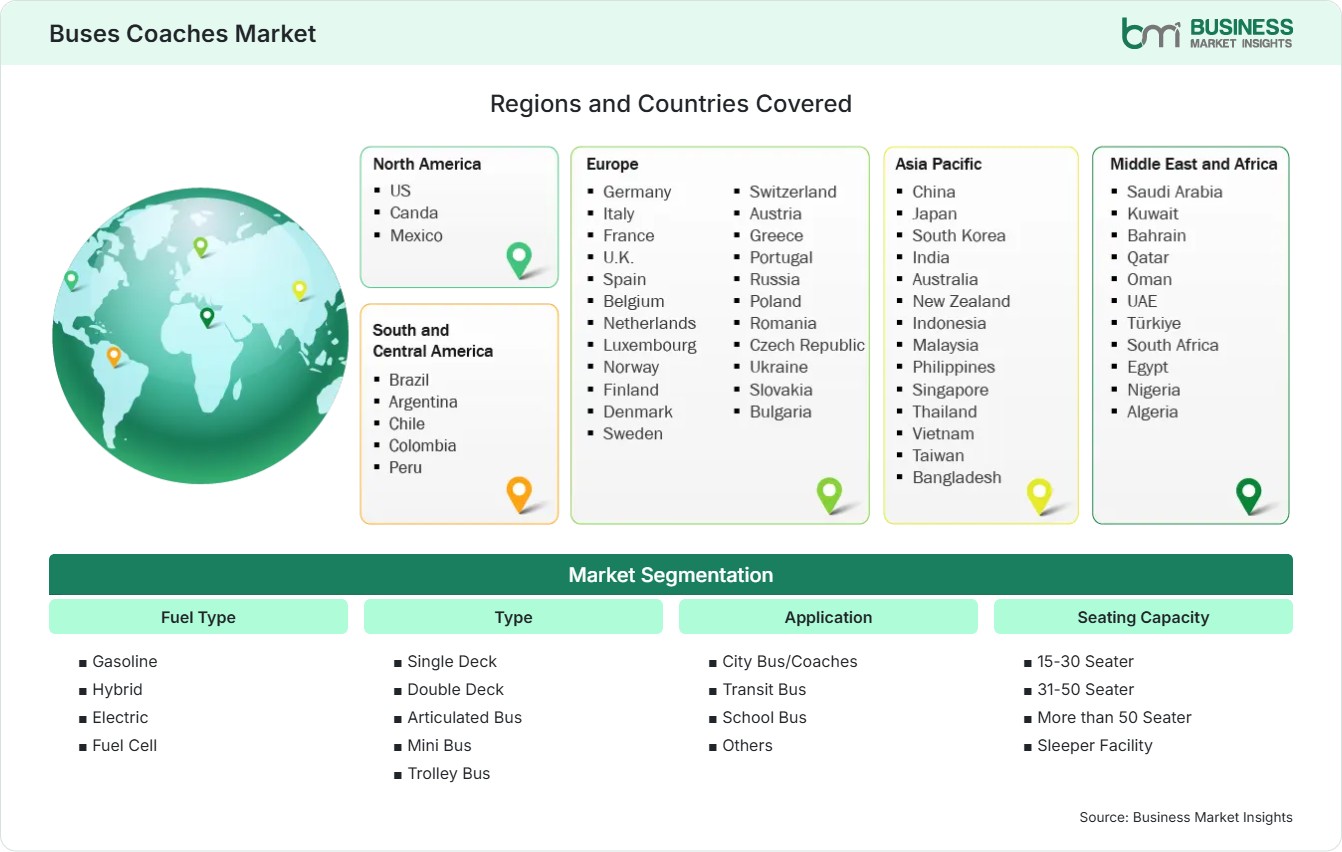
North America Buses Coaches Market
North America accounted for 24%–27% of global demand in 2025 and is projected to expand at a CAGR of 9.4%–10.2% through 2033. Federal transit investments, fleet modernization programs, and clean transportation policies continue supporting procurement activities. Transit agencies across the United States and Canada increasingly prioritize battery-electric and fuel-cell buses to reduce emissions and operating expenses. Growing investments in charging infrastructure, intelligent transportation systems, and fleet management technologies strengthen operational efficiency while improving service reliability across urban and regional transportation networks.
- Federal government continues funding initiatives on transit fleet renewal programs, with an aim of deploying electric and hydrogen vehicles in order to enhance modernization processes within the largest transportation agencies in metropolitan areas.
- Fleet management companies utilize technology for improving routing, maintenance, and optimization of power usage in order to improve fleet efficiency and customer experience.
- School transportation businesses switch to zero-emission fleets because of various regulations, savings, and programs aimed at encouraging the use of modern transport solutions.
- The growth of charging infrastructure and hydrogen refueling stations is easing operations and improving the environment for deploying alternative fuel vehicles.
- The Buses Coaches Market share remains significant across municipal transit projects due to strong government support and established public transportation infrastructure.
US Buses Coaches Market
The United States represents approximately 76%–80% of regional demand and is anticipated to record a CAGR of 9.6%–10.4% through 2033. Infrastructure modernization initiatives, urban mobility investments, and environmental targets are driving procurement of low-emission transit vehicles. Transit authorities increasingly prioritize fleet electrification while integrating digital monitoring systems to improve route efficiency, maintenance planning, and passenger experience. Strong domestic manufacturing capabilities and federal incentive programs continue supporting large-scale fleet replacement projects across major cities and suburban transportation networks.
- Major metropolitan transit authorities continue ordering battery-electric buses to meet emission reduction goals while improving operational performance and reducing fuel expenditure over vehicle lifecycles.
- School districts increasingly invest in electric transportation solutions supported by federal grants and sustainability objectives, creating substantial opportunities for vehicle manufacturers and technology suppliers in buses coaches market.
- Connected mobility platforms enable predictive maintenance and real-time fleet monitoring, reducing downtime while improving safety and operational efficiency across transportation systems.
- Public-private partnerships support deployment of charging infrastructure, creating a favorable environment for continued adoption of alternative-fuel transportation solutions.
Europe Buses Coaches Market
Europe held 22%–25% of global demand in 2025 and is forecast to expand at a CAGR of 10.1%–10.9% through 2033. Stringent emission regulations, urban decarbonization targets, and sustainable mobility strategies support strong procurement activity. Countries including Germany, France, and the United Kingdom lead regional adoption, while Eastern European markets demonstrate accelerated fleet modernization. Investments in electric mobility ecosystems, battery production facilities, and smart transportation networks continue strengthening market competitiveness and supporting long-term fleet transformation objectives.
- Germany continues to be the biggest market in the region due to large investments in the electrification of public transport as well as sustainable urban mobility projects.
- The United Kingdom shows good adoption of zero emission buses thanks to government funded projects and green public transport commitments in cities.
- Scandinavian countries are continuing their development of electric and hydrogen powered transport systems.
- Eastern European markets have fast growth rates because of new infrastructure and European Union green funding mechanisms.
- State-of-the-art safety features and technologies of digital fleet management become increasingly used in public transport.
Asia Pacific Buses Coaches Market
Asia Pacific accounted for 38%–42% of global demand in 2025 and is projected to achieve the fastest CAGR of 12.3%–13.1% through 2033. Rapid urbanization, expanding metropolitan populations, and significant public transportation investments support robust demand. China dominates regional production and adoption, while India and Southeast Asian economies continue investing in transit modernization. Government incentives, domestic manufacturing capabilities, and large-scale electrification programs accelerate deployment of advanced transportation fleets across urban and intercity mobility applications.
- China continues to lead as the major regional market by means of deployment of electric buses and robust manufacturing capabilities.
- India is one of the rapidly growing markets due to fleet electrification projects, investment in public transportation, and procurement plans from the government side.
- Countries in Southeast Asia have been developing their urban transport system to cope with increased demand for transportation.
- Expansion of local manufacturing helps create resilient supply chains along with competitive prices.
- The Buses Coaches Market growth trajectory in Asia Pacific benefits from supportive industrial policies and accelerating clean transportation investments.
Rest of World Buses Coaches Market
Rest of World represented 10%–13% of global demand in 2025 and is anticipated to expand at a CAGR of 9.8%–10.6% through 2033. South and Central America are witnessing increasing investments in urban transportation modernization, particularly in Brazil, Chile, and Colombia. Meanwhile, Middle East and Africa markets benefit from smart city initiatives, tourism infrastructure development, and public transit expansion projects. Adoption of alternative-fuel vehicles remains gradual but continues gaining momentum as governments pursue sustainability objectives and transportation efficiency improvements.
- Brazil is leading regional demand owing to well-established public transport systems and efforts towards fleet upgradation.
- Chile is gaining traction as a high-growth market because of the adoption of electric transportation systems and mobility programs centered on sustainability.
- The Gulf Cooperation Council countries are putting in large investments for developing their smart mobility projects.
- The urban population centers in Africa are focusing on enhancing the public transport system due to increasing congestion and population growth.
- Tourism-related transportation demand facilitates the purchase of luxury coaches in the Middle East and selected African markets.