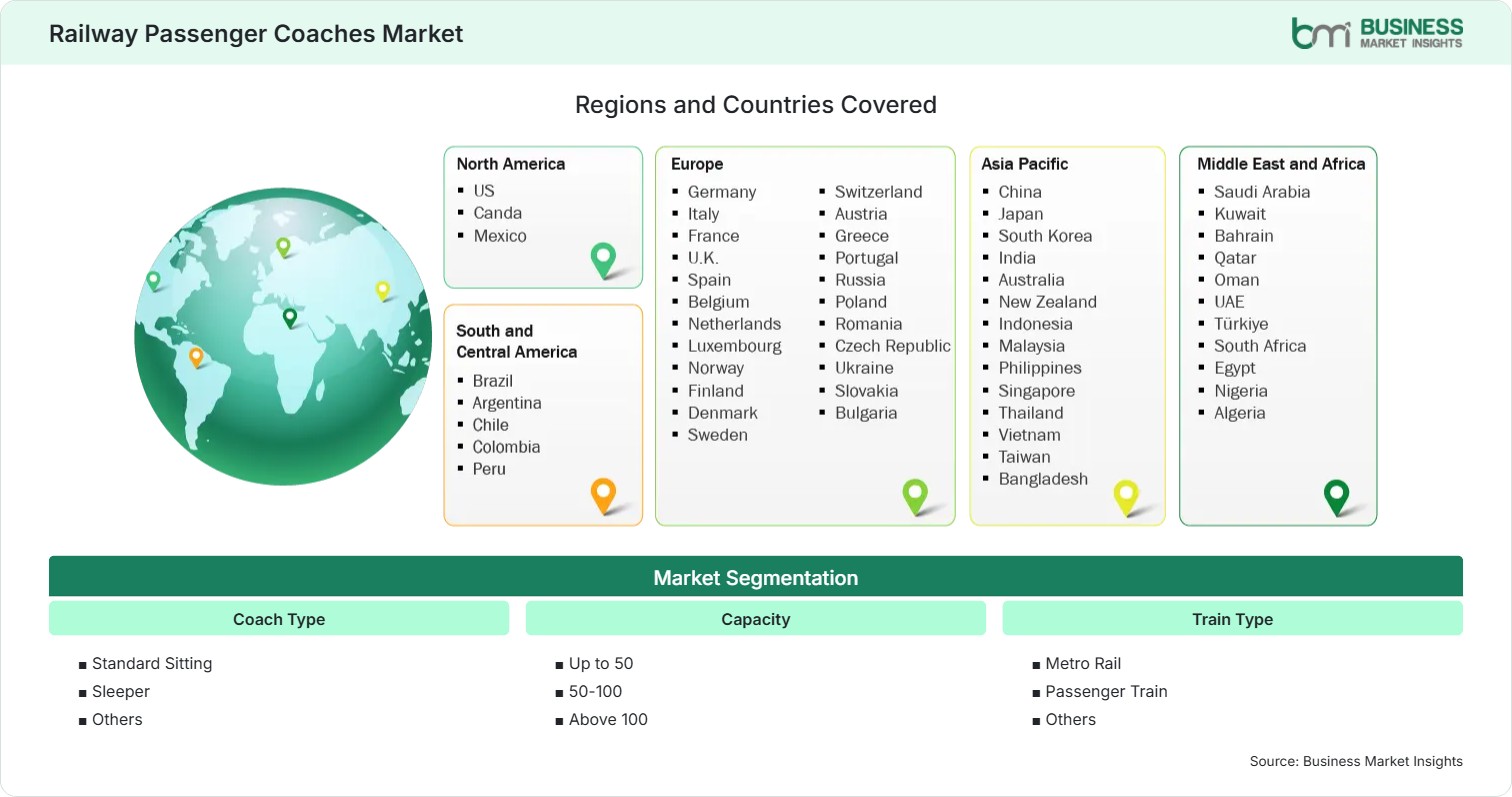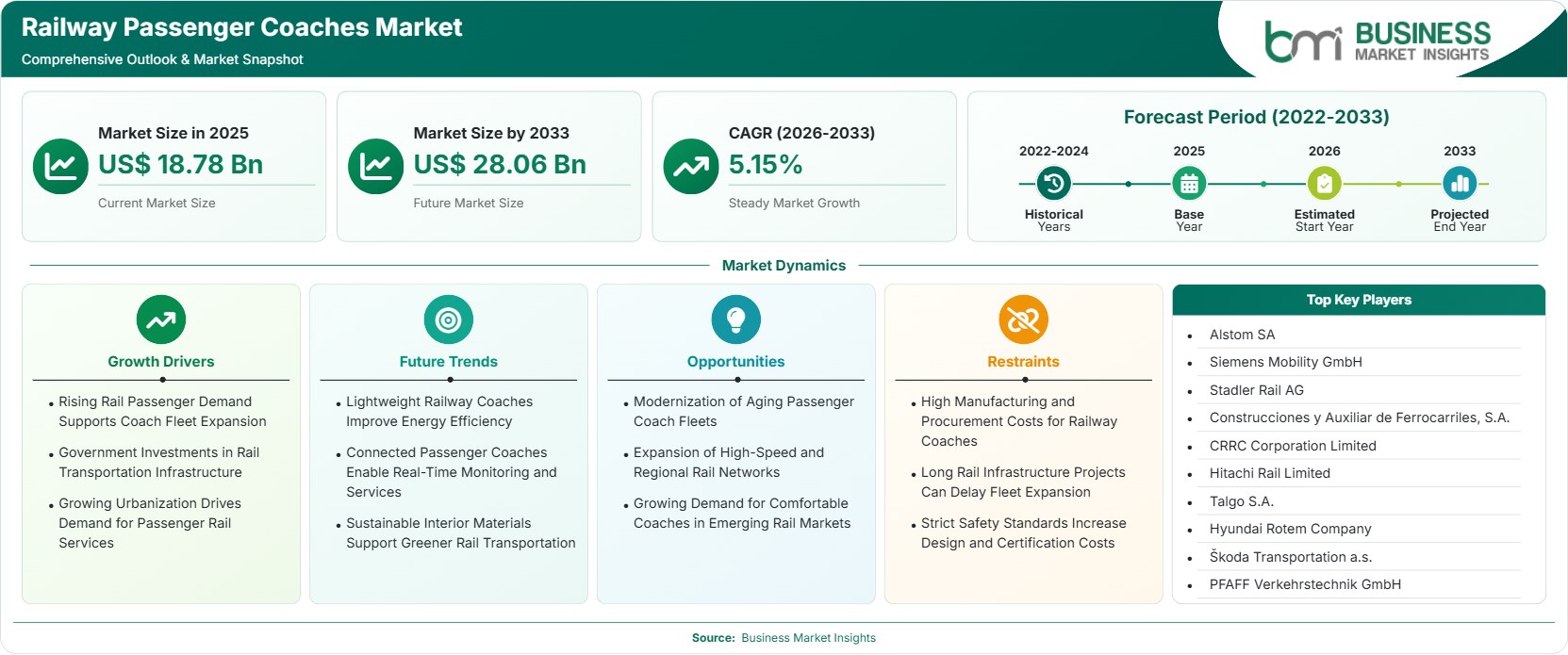
Railway Passenger Coaches Market Regional Highlights
North America Railway Passenger Coaches Market
North America Railway Passenger Coaches Market holds a 19%–23% share in 2025 and grows at a 4.7%–5.3% CAGR during 2026–2033. Demand is concentrated around commuter and regional rail systems requiring replacement of older rolling stock and improved passenger capacity. The US accounts for the majority of regional demand, while Canada contributes through commuter and intercity fleet modernization.
- Commuter rail operators are prioritizing replacement of aging vehicles, creating demand for higher-capacity coaches with improved accessibility, passenger information, climate control, and interior layouts.
- Government transportation programs support fleet modernization by improving funding visibility for operators planning long-term rolling-stock replacement and network capacity upgrades.
- Local manufacturing capabilities are becoming more important as procurement policies encourage domestic production, supplier localization, workforce development, and resilient rail-equipment supply chains.
- Passenger expectations are influencing vehicle specifications, with greater emphasis on comfortable seating, accessibility, connectivity, luggage arrangements, and improved onboard passenger information.
US Railway Passenger Coaches Market
The US Railway Passenger Coaches Market represents 76%–81% of North American demand in 2025 and grows at a 4.8%–5.4% CAGR during 2026–2033. Market expansion is supported by commuter fleet renewal, intercity rail improvements, capacity requirements, and replacement of legacy coaches. Operators are increasingly specifying accessible interiors, improved passenger amenities, efficient boarding, and higher reliability.
- Fleet replacement programs are creating sustained demand as operators seek modern coaches that reduce reliability constraints associated with aging rolling stock.
- Higher-capacity vehicles provide an efficient response to growing ridership without requiring equivalent increases in train frequency or infrastructure expansion.
- Domestic manufacturing and localized supply chains strengthen the position of suppliers with established US production, engineering, service, and maintenance capabilities.
Europe Railway Passenger Coaches Market
Europe Railway Passenger Coaches Market holds a 24%–28% share in 2025 and grows at a 4.6%–5.2% CAGR through 2033. Germany, France, the United Kingdom, Italy, Spain, and Switzerland represent leading markets, while Poland and the Czech Republic provide stronger growth opportunities through fleet modernization. European procurement emphasizes interoperability, accessibility, energy efficiency, passenger comfort, and lifecycle performance.
- Germany remains a major market because regional and metropolitan operators continue modernizing fleets while emphasizing capacity, accessibility, reliability, and passenger experience.
- France supports demand through high-speed and regional rolling-stock modernization, with manufacturers increasingly focusing on efficient platforms and passenger-oriented interior configurations.
- Poland and the Czech Republic offer stronger growth potential as rail operators modernize regional fleets and improve cross-border passenger connectivity.
- European interoperability requirements encourage standardized vehicle architectures, advanced signaling integration, and engineering platforms capable of serving multiple national rail systems.
Asia Pacific Railway Passenger Coaches Market
Asia Pacific Railway Passenger Coaches Market holds a 38%–42% share in 2025 and grows at a 5.8%–6.5% CAGR through 2033, making it the largest and fastest-expanding regional market. China, India, Japan, South Korea, and Australia represent leading markets, while India and Southeast Asia provide stronger growth opportunities. Urbanization, metro expansion, regional connectivity, passenger mobility requirements, and domestic rolling-stock manufacturing are supporting procurement. Operators increasingly seek high-capacity, energy-efficient, accessible, and digitally enabled coaches for expanding rail networks.
- China maintains substantial demand through extensive urban, regional, intercity, and high-speed rail networks requiring continuous fleet expansion and modernization.
- India provides strong growth potential as passenger rail modernization, metro expansion, regional connectivity, and domestic manufacturing initiatives increase rolling-stock procurement.
- Japan and South Korea support technologically advanced demand through high-quality passenger services, efficient rolling stock, digital systems, and specialized rail applications.
- Southeast Asian markets provide expanding opportunities as governments improve urban mobility, regional connectivity, and public transportation capacity through new rail infrastructure.
Rest of World Railway Passenger Coaches Market
Rest of World holds a 10%–14% share in 2025 and grows at a 4.7%–5.4% CAGR through 2033. South and Central America are supported by urban rail modernization, commuter transportation requirements, and infrastructure investment. Brazil, Mexico, Argentina, Chile, and Colombia represent leading markets, while Colombia and Chile offer stronger growth opportunities. Middle East and Africa contribute through metro expansion, regional connectivity, intercity modernization, and government-supported transportation projects. Saudi Arabia, the UAE, Egypt, South Africa, and Türkiye represent important markets, while Saudi Arabia and Egypt provide stronger growth opportunities.
- Brazil and Mexico provide diversified demand through commuter and urban rail modernization, while infrastructure development creates opportunities for replacement and new-build passenger coaches.
- Saudi Arabia and the UAE are developing modern passenger rail ecosystems where high-quality coaches, accessibility, comfort, and climate-adapted systems are increasingly important.
- Egypt provides opportunities through urban rail development and modernization programs requiring reliable passenger vehicles and integrated fleet-support capabilities.
- South Africa supports demand through commuter rail modernization and the need to improve fleet reliability, passenger capacity, safety, and service quality.