
Railway HVAC System Market Outlook: Size, Share, Trends, Growth Analysis, Competitive Landscape & Forecast, 2026-2033

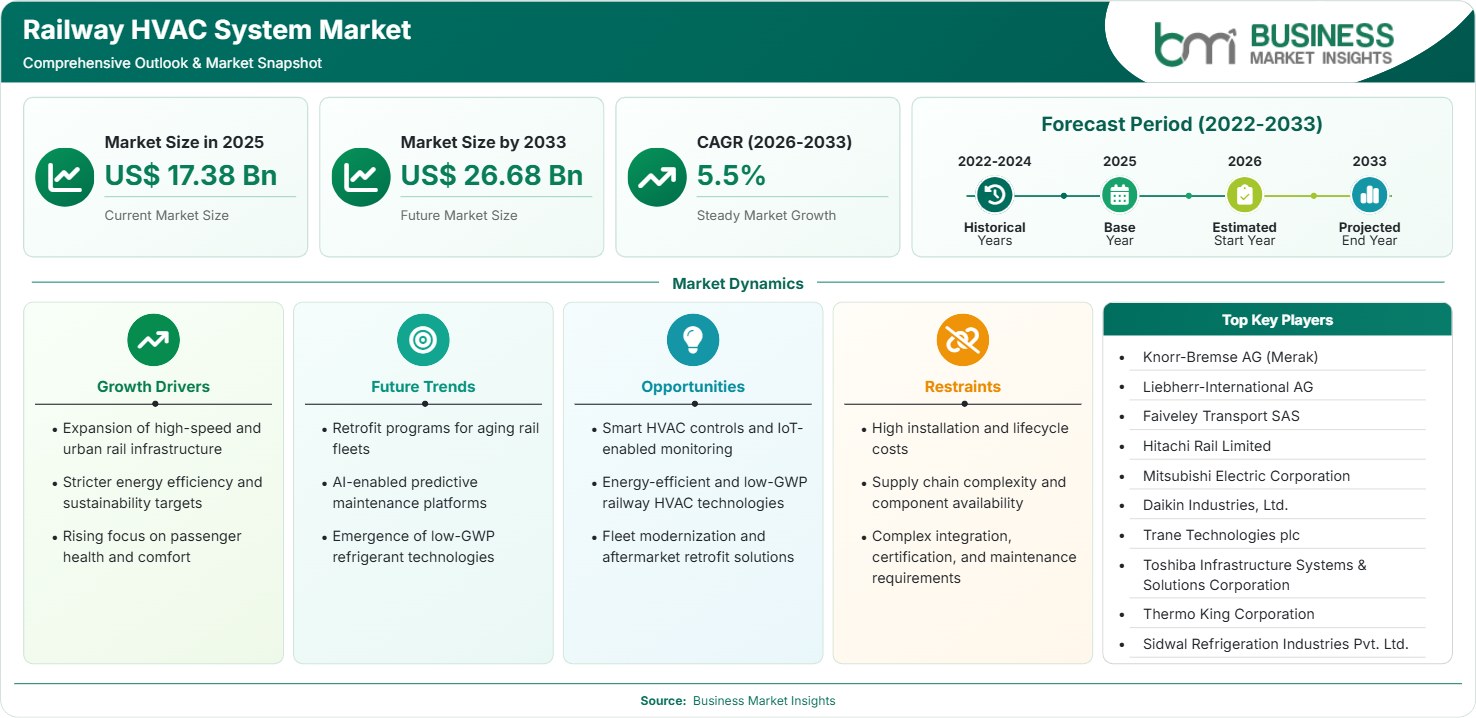
The Railway HVAC System Market size was valued at US$ 17.38 Billion in 2025 and is projected to reach US$ 26.68 Billion by 2033, growing at a CAGR of 5.5% during 2026–2033. Key drivers include rail electrification, passenger comfort standards, energy-efficient climate systems, metro expansion, and fleet modernization, while opportunities arise from smart HVAC controls, low-GWP refrigerants, predictive maintenance, and emerging rail infrastructure investments.

Report Coverage
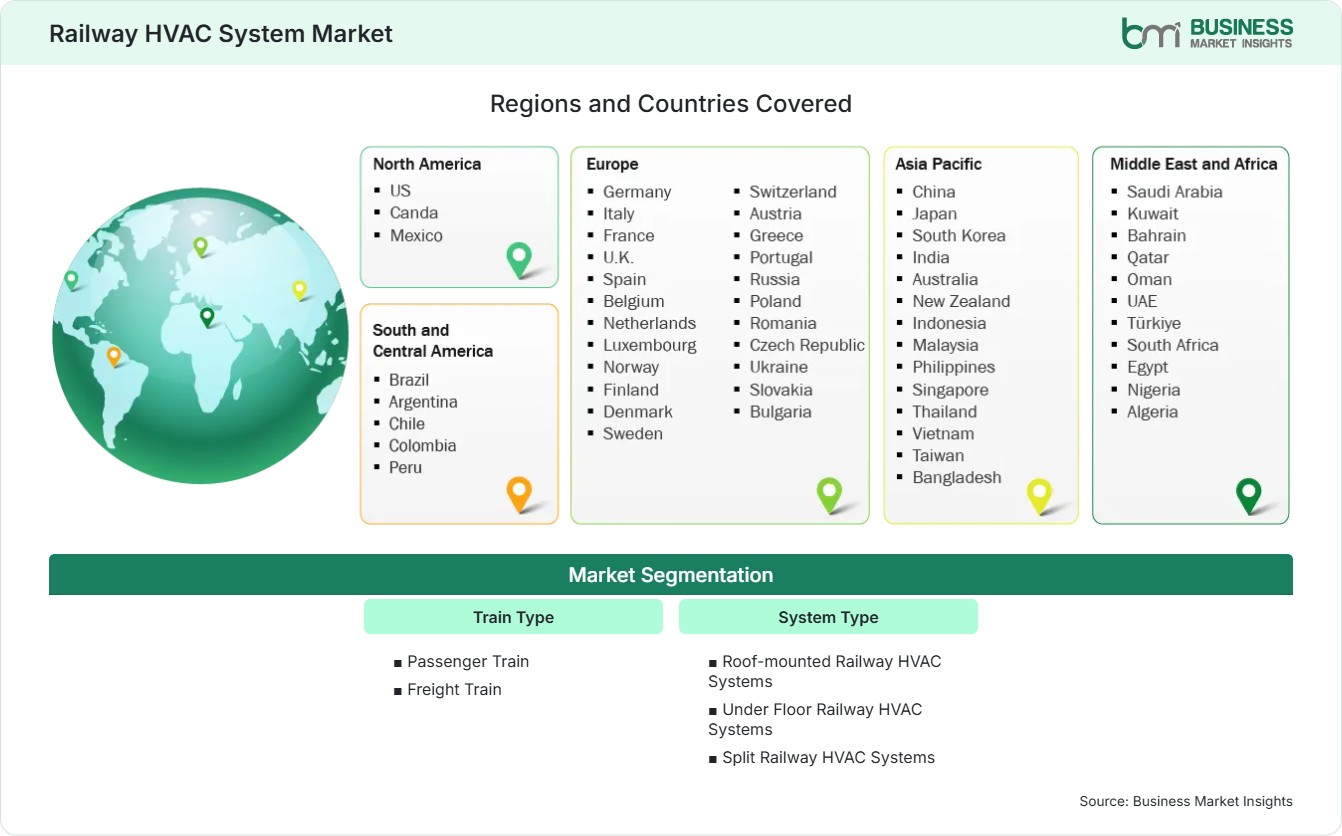
  • Train Type: Passenger Train, Freight Train
  • System Type: Roof-mounted Railway HVAC Systems, Under Floor Railway HVAC Systems, Split Railway HVAC Systems
US$ 17.38 Bn Market size in 2025
US$ 26.68 Bn Market Size by 2033
5.5% CAGR, 2026 - 2033
2026-2033 Forecast Period

AI Overview

Railway HVAC System Market Summary

  • North America Region: Holds a 24%–27% share in 2025, growing at a CAGR of 4.8%–5.2% during 2026–2033. Key drivers include fleet refurbishment, energy-efficient cooling adoption, transit upgrades, regulatory compliance, digital monitoring integration, passenger comfort initiatives, OEM partnerships, climate resilience investments, sustainability programs, and modernization spending. The U.S. accounts for 75%–79% of regional demand and advances at 4.9%–5.3% CAGR through fleet modernization programs.
  • Fastest Growing Region: Asia Pacific holds a 38%–42% share in 2025 and expands at 6.4%–6.8% CAGR during 2026–2033. Growth is supported by high-speed rail projects, metro network expansion, urbanization, government investment, localized manufacturing, energy-efficient technologies, rolling stock procurement, smart transportation initiatives, electrification programs, and capacity additions.
  • Leading Segment: Passenger Train represents 68%–72% share in 2025 and advances at 5.2%–5.7% CAGR. Demand benefits from rising ridership, comfort expectations, intercity rail deployment, environmental standards, HVAC retrofits, high-speed services, digital controls, efficient ventilation technologies, lifecycle optimization initiatives, and premium passenger experiences.
  • High Growth Segment: Roof-mounted Railway HVAC Systems account for 48%–52% share in 2025 and record 5.9%–6.4% CAGR. Adoption is driven by installation flexibility, maintenance accessibility, lightweight designs, modular architecture, space optimization, energy savings, smart monitoring functions, retrofit suitability, reliability improvements, and fleet modernization.
  • Key Market Opportunity: Deployment of AI-enabled diagnostics and low-emission refrigerant technologies across aging rail fleets creates opportunities for efficiency gains, lifecycle cost reduction, predictive maintenance enhancement, sustainability compliance, and operational reliability improvements.
  • Major Market Players: Knorr-Bremse AG (Merak), Liebherr-International AG, Faiveley Transport SAS, Hitachi Rail Limited, Mitsubishi Electric Corporation, Daikin Industries, Ltd., Trane Technologies plc, Toshiba Infrastructure Systems & Solutions Corporation, Thermo King Corporation, and Sidwal Refrigeration Industries Pvt. Ltd.
Strategic Insights

Railway HVAC System Market: Strategic Insights

Railway HVAC System Market Strategic Framework
FREE PDF
Request your free sample
Request free sample
Stakeholder View

Key Takeaways

  • Rail OEMs, component suppliers, software providers, and maintenance contractors are building integrated value chains focused on lifecycle efficiency and asset reliability.
  • Passenger rail applications offer the strongest commercial upside due to metro expansion, intercity rail investments, and comfort-focused procurement standards.
  • Innovation is shifting toward IoT-enabled monitoring, smart sensors, energy recovery features, and environmentally responsible refrigerant technologies.
  • Asia-Pacific presents the most compelling investment case, supported by high-speed rail deployment, urban transit expansion, and manufacturing localization policies.
  • Strategic acquisitions increasingly target digital diagnostics, thermal-management expertise, and service-network expansion to strengthen competitive positioning.
  • Retrofit demand across aging fleets represents an attractive recurring-revenue stream for HVAC manufacturers and maintenance specialists.
Geographic Outlook

Railway HVAC System Market Regional Highlights

North America Railway HVAC System Market

North America represents 24%–27% of the Railway HVAC System Market share in 2025 and is projected to expand at a CAGR of 4.8%–5.2% through 2033. Demand is supported by fleet modernization, commuter rail upgrades, sustainability requirements, and replacement of aging HVAC assets. Transit agencies increasingly favor energy-efficient systems equipped with remote diagnostics and enhanced air-filtration capabilities. Public funding programs and electrification initiatives continue supporting equipment procurement across passenger and regional rail networks.

  • Transit authorities prioritize lifecycle efficiency and reliability while upgrading aging railcar fleets.
  • Enhanced indoor air-quality standards encourage advanced filtration and ventilation technologies.
  • Digital monitoring solutions improve maintenance scheduling and reduce unexpected operational disruptions.
  • Electrified rail projects increase demand for lightweight and energy-efficient thermal-management systems.

US Railway HVAC System Market

The United States accounts for 75%–79% of North American demand and advances at a CAGR of 4.9%–5.3% through 2033. Major investments in commuter rail, metro systems, and fleet refurbishment support adoption. Operators seek improved passenger comfort, energy management capabilities, and predictive maintenance integration. Federal infrastructure spending continues creating opportunities for HVAC suppliers serving urban transportation networks.

  • Metropolitan transit agencies prioritize climate-resilient rolling-stock upgrades.
  • Retrofit programs create recurring aftermarket demand for component suppliers.
  • Energy-performance requirements accelerate adoption of efficient compressor technologies.
  • Smart maintenance platforms reduce downtime and optimize railway operations.

Europe Railway HVAC System Market

Europe maintains approximately 28%–31% market share in 2025 and records a CAGR of 4.9%–5.4%. Regional growth is driven by rail decarbonization strategies, cross-border high-speed connectivity, and stringent environmental regulations. Germany remains the leading market, while Eastern European modernization programs contribute additional momentum. Advanced sustainability requirements encourage adoption of low-GWP refrigerants and energy-efficient temperature-control systems.

  • Germany leads regional demand, supported by rolling-stock renewal programs.
  • Poland and Romania emerge as relatively high-growth markets with modernization investments.
  • Sustainability regulations accelerate replacement of legacy HVAC technologies.
  • High-speed rail expansion supports premium thermal-comfort requirements.
  • Digital asset-management systems improve maintenance efficiency and reliability.

Asia Pacific Railway HVAC System Market

Asia Pacific commands 38%–42% share in 2025 and remains the fastest-growing region with a CAGR of 6.4%–6.8%. Railway HVAC System growth is driven by urbanization, metro construction, high-speed rail development, and government transportation investments. China leads regional demand, while India represents the fastest-expanding national market. Manufacturing capacity expansion and local sourcing initiatives further strengthen long-term industry prospects.

  • China remains the dominant revenue contributor through extensive rail infrastructure.
  • India benefits from metro expansion and national rail modernization initiatives.
  • High-speed rail deployment increases demand for advanced HVAC configurations.
  • Local manufacturing improves supply-chain resilience and cost competitiveness.
  • Passenger comfort expectations stimulate procurement of premium climate-control systems.

Rest of World Railway HVAC System Market

The Rest of World region accounts for 8%–10% market share in 2025 and expands at a CAGR of 5.6%–6.1%. Middle Eastern railway developments, freight corridors, and passenger transit investments underpin demand. South and Central America continue gradual modernization efforts. Saudi Arabia leads regional opportunities, while the United Arab Emirates demonstrates strong technology adoption rates across rail infrastructure projects.

  • GCC rail investments support adoption of high-performance cooling solutions.
  • Extreme climate conditions increase demand for durable HVAC technologies.
  • Urban transit projects create opportunities for specialized equipment providers.
  • Latin American fleet refurbishment encourages aftermarket service growth.
  • Cross-border logistics initiatives stimulate rail infrastructure development.
Global Market Geography
FREE PDF
Request your free sample
Request free sample
Segment Analysis

Railway HVAC System Market Segmentation

Train Type

This segment holds a central position within the Railway HVAC System Market scope. Train-type demand patterns reflect passenger mobility requirements, freight network expansion, comfort standards, and infrastructure investment. Passenger-focused deployments dominate with 68%–72% share in 2025 and grow at 5.2%–5.7% CAGR through the forecast period.

  • Passenger train: Strong adoption is supported by metro expansion, intercity connectivity improvements, ridership growth, and increasing focus on passenger comfort, air quality, and operational efficiency across railway networks.
  • Freight train: Demand is driven by crew comfort requirements, modernization projects, reliability needs, and deployment of durable climate-control systems suited for long operating cycles.

System Type

System architecture selection depends on train design, operating environment, maintenance strategies, and energy goals. Roof-mounted Railway HVAC Systems lead with 48%–52% share in 2025 and expand at 5.9%–6.4% CAGR. Railway HVAC System market trends indicate growing preference for modular and service-friendly configurations.

  • Roof-mounted Railway HVAC Systems: Preferred for installation flexibility, maintenance convenience, modular construction, and suitability across metro, commuter, regional, and high-speed train applications.
  • Under Floor Railway HVAC Systems: Adopted where roof space is constrained, enabling design optimization while maintaining temperature-control performance and passenger comfort requirements.
  • Split Railway HVAC Systems: Selected for specialized rolling-stock applications requiring installation flexibility, distributed cooling capability, efficient climate management, and improved equipment accessibility.
Market Forces

Railway HVAC System Market Dynamics

Key Market Drivers

Expansion of High-Speed and Urban Rail Infrastructure

Railway investment programs globally have continued to sustain HVAC demands through the procurement of more rolling stocks and the development of their networks. There has been a rise in investments in railways in major economies as part of efforts to reduce traffic and carbon emissions in cities. Railway HVAC System growth benefits from rising passenger expectations regarding comfort, ventilation quality, and operational reliability. Equipment suppliers gain opportunities through both original installations and aftermarket service contracts. Growing public transportation adoption further strengthens equipment replacement cycles and supports long-term demand across developed and emerging markets.

Stricter Energy Efficiency and Sustainability Targets

Rail operators increasingly focus on reducing energy consumption and environmental impact. HVAC systems may account for a significant portion of energy consumption on board and therefore will promote the use of intelligent control systems, variable speed drives, and low GWP refrigerants. Sustainable development goals will lead to a push for replacing old systems. The manufacture of lightweight systems that reduce the energy consumption of trains is being considered. ESG and decarbonization programs will play a role in making these purchases.

Rising Focus on Passenger Health and Comfort

Increasingly, passenger demands are moving from simple requirements of heating/cooling efficiency into air quality, filtration efficiency, and a comfortable environment. Operators use HVAC improvements as a way of increasing passenger satisfaction and distinguishing themselves from competitors. Railway HVAC System trends also reflect increased attention to indoor environmental quality following heightened awareness regarding public transportation hygiene. These requirements support premium product adoption and create opportunities for manufacturers offering integrated monitoring and diagnostic capabilities.

Key Market Opportunities

Retrofit Programs for Aging Rail Fleets

Large numbers of passenger and commuter railcars worldwide remain in operation beyond their original design expectations. Operators frequently pursue HVAC modernization instead of full vehicle replacement to reduce capital expenditure. Retrofit initiatives create recurring revenue opportunities for component suppliers, software vendors, and maintenance providers. Railway HVAC System market Forecasts increasingly incorporate demand generated by upgrade cycles involving smart controls, efficient compressors, and environmentally compliant refrigerants. Service contracts and long-term maintenance agreements further enhance commercial attractiveness across mature rail markets.

AI-Enabled Predictive Maintenance Platforms

Artificial intelligence, IoT sensors, and condition-monitoring technologies are transforming rail HVAC maintenance by enabling operators to detect potential failures before they cause service disruptions. The linked system continuously produces operational data, enabling performance evaluation, maintenance, and proper spares planning at any moment in time. Predictive maintenance methods increase the effectiveness of asset usage, increase equipment life span, and minimize downtime and repair costs. Suppliers that offer advanced analytics, cloud connectivity, remote diagnostics, and digital service features in their thermal management products can enhance their market position. With the increasing digitalization of railroads, new business areas such as software, services, and lifecycle management are becoming available.

Emergence of Low-GWP Refrigerant Technologies

The emergence of low-global-warming-potential (Low-GWP) refrigerant technologies is transforming the rail HVAC market as environmental regulations become increasingly stringent worldwide. Governments and industry organizations are promoting the switch to environmentally friendly alternatives to traditional refrigerants that decrease the release of greenhouse gases. Manufacturers with cutting-edge technology of Low-GWP solutions will be able to take advantage of the increasing demand and modernization activities. Adoption of such solutions is forecasted to increase rapidly in countries with high environmental standards, whereas railway companies will receive better sustainability results.

Market Restraints and Challenges

High Installation and Lifecycle Costs

Factor: The design and deployment of such advanced heating and cooling systems requires a certain level of engineering, coordination, testing, and certification process that increases their cost substantially compared to traditional systems. Such systems need custom-made solutions that can satisfy the requirements of the specific train or transport application. Other expenses connected with the installation, integration, and testing raise the financial threshold for rail transportation companies.

Impact: Higher initial and lifetime costs can result in delayed purchasing decisions, especially from budget-limited transit companies and rail operators. The rail operator might prefer to extend the lifespan of the current HVAC system rather than purchase a replacement, thus decreasing the need for newer products in the short term. The integration with the rail vehicle is another factor that increases the project period and cost of installation. Even though energy efficiency, higher comfort, and lower maintenance costs would provide economic advantages in the future, high capital costs constitute an issue for the industry.

Supply Chain Complexity and Component Availability

Factor: Manufacturing of HVAC systems is dependent on a broad range of parts sourced globally, which include compressors, electronic control systems, sensors, heat exchangers, and thermal management systems. Suppliers who specialize in parts meeting high railway standards of operation, safety, and durability are also used by manufacturers. Shortages in the availability of such parts could result in manufacturing challenges, thus creating production bottlenecks.

Impact: Disruptions within the supply chain can affect the scheduling of manufacturing processes, delivery, inventory, and project costs. In the rail industry, there is a tendency for rail companies to need custom-made HVAC systems, which could mean that they have less room for flexibility when it comes to procuring supplies or components. This could result in increased lead times and difficulties in managing inventories. For a solution to this, manufacturers have to enhance local sourcing efforts, supplier diversity, inventory, and supply chain resilience.

Company Analysis

Competitive Landscape

Railway HVAC System market analysis indicates competition is centered on energy efficiency, rail-specific engineering expertise, aftermarket service capability, smart controls, and global manufacturing presence.

Company Name

Overview

Products and Services relevant to this market

Knorr-Bremse AG (Merak)

Global rail systems supplier with strong HVAC specialization and extensive international service network.

Roof-mounted HVAC, underfloor HVAC, controls, diagnostics, retrofit solutions, aftermarket services.

Liebherr-International AG

Engineering group serving transportation sectors through advanced thermal-management technologies.

Rail HVAC units, pressure protection systems, cooling technologies, maintenance services.

Faiveley Transport SAS

Established rail equipment specialist with broad rolling-stock technology portfolio.

Passenger HVAC systems, ventilation equipment, thermal-control technologies.

Hitachi Rail Limited

Major rail solutions provider supporting rolling-stock and infrastructure projects.

Integrated train climate-control systems and fleet-support services.

Mitsubishi Electric Corporation

Global technology company with expertise in transport and air-conditioning systems.

Energy-efficient HVAC systems, controls, monitoring technologies.

Daikin Industries, Ltd.

Leading climate-control manufacturer with advanced refrigeration expertise.

Rail cooling solutions, efficient compressors, refrigerant technologies.

Trane Technologies plc

Provider of sustainable climate solutions across transportation applications.

HVAC equipment, energy-management systems, maintenance services.

Toshiba Infrastructure Systems & Solutions Corporation

Infrastructure-focused technology company serving rail transportation markets.

Rail environmental-control systems and monitoring technologies.

Thermo King Corporation

Temperature-control specialist with global engineering and service capabilities.

Thermal-management products, climate-control systems, service support.

Sidwal Refrigeration Industries Pvt. Ltd.

Specialist manufacturer focused on railway and transport HVAC solutions.

Railway air-conditioning systems, ventilation products, retrofit services.

Trust & Transparency

Research Methodology

The market analysis combines proprietary research with secondary data from government agencies, company disclosures, regulatory filings, industry databases and expert interviews. Market estimates are validated through data triangulation, cross-market benchmarking and analyst review.

View Full Research Methodology

Questions Answered

Frequently Asked Questions

What does a Railway HVAC System Market Report typically evaluate?

A Railway HVAC System Market Report evaluates market size, technology trends, competitive positioning, regional demand patterns, regulatory impacts, investment opportunities, and long-term growth prospects.

What regions offer the strongest future investment potential?

Asia Pacific offers the strongest potential because of rapid urbanization, large-scale railway construction, metro expansion, and substantial public transportation investments.

What role does digitalization play in HVAC deployment?

Digital tools enable predictive maintenance, remote diagnostics, fault detection, and performance monitoring, helping operators reduce downtime and maintenance costs.

Why are roof-mounted systems gaining stronger adoption?

Roof-mounted configurations simplify maintenance access, support modular installation, optimize internal vehicle space, and suit a wide range of rolling-stock platforms.

Which application generates the highest revenue demand in this industry?

Passenger trains generate the largest revenue contribution due to extensive deployment across metro, regional, intercity, and high-speed rail networks that prioritize passenger comfort and air-quality performance.

Access the Full Railway HVAC System Market Report

Get segment-level forecasts, regional estimates, competitive benchmarking, company profiles and downloadable Excel datasets.

Access the full Railway HVAC System Market Report
350 pages PDF & Excel | 2026-08-31