
Automotive HVAC Market Outlook: Size, Share, Trends, Growth Analysis, Competitive Landscape & Forecast, 2026-2033

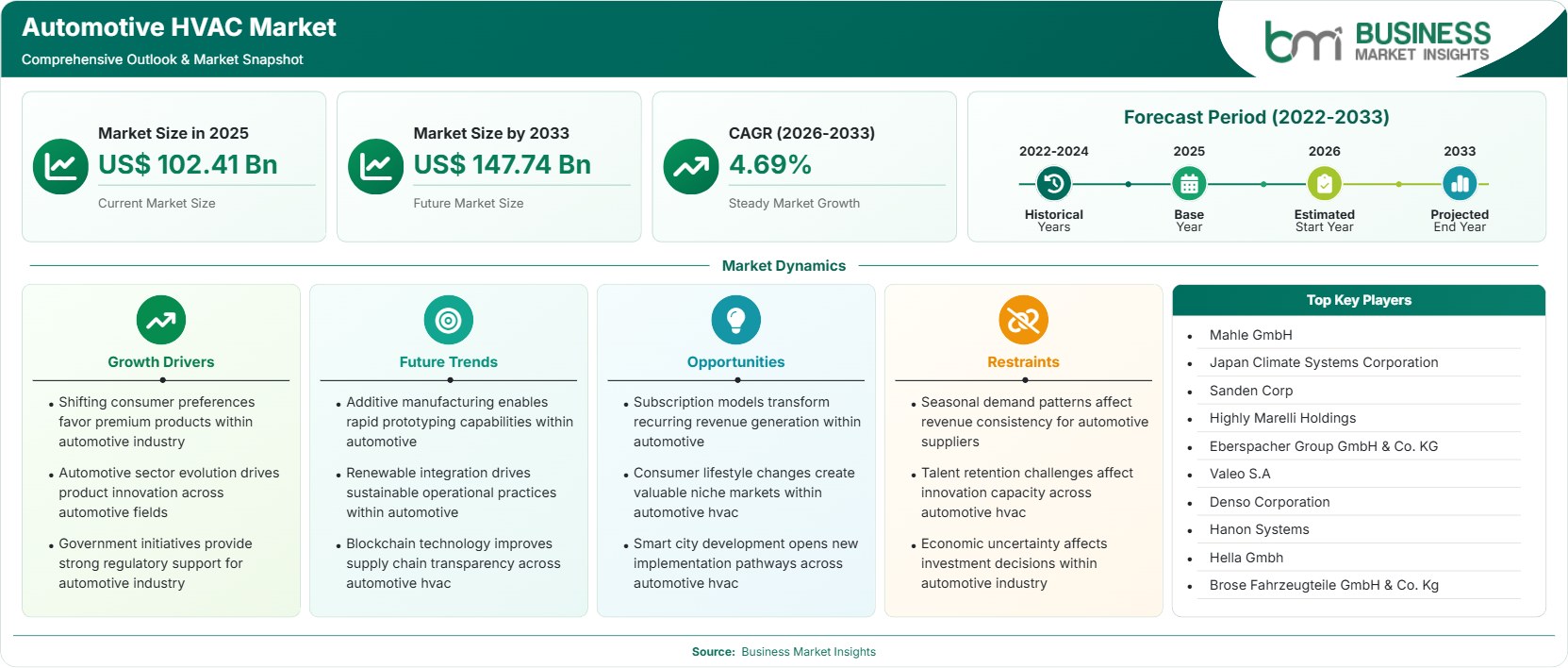
The Automotive HVAC Market size was valued at US$ 102.41 Billion in 2025 and is projected to reach US$ 147.74 Billion by 2033, growing at a CAGR of 4.69% during 2026–2033. Growth is driven by rising cabin electrification, stringent thermal-comfort regulations, and expanding EV heat-pump adoption, while lightweight compressor innovation and aftermarket retrofits open fresh opportunities across mature and emerging vehicle fleets.

Report Coverage
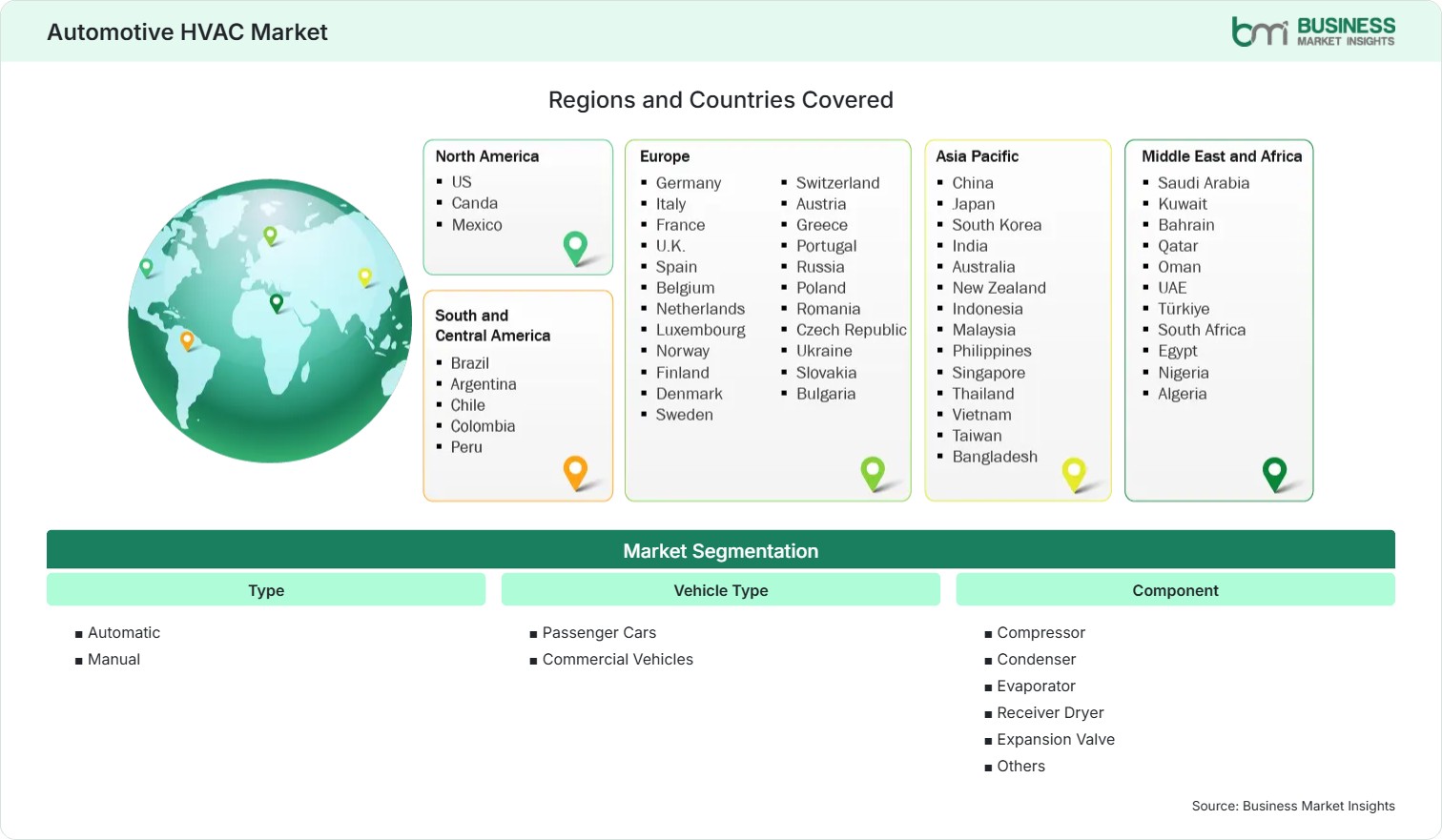
  • Type: Automatic, Manual
  • Vehicle Type: Passenger Cars, Commercial Vehicles
  • Component: Compressor, Condenser, Evaporator, Receiver Dryer, Expansion Valve, Others
US$ 102.41 Bn Market size in 2025
US$ 147.74 Bn Market Size by 2033
4.69% CAGR, 2026 - 2033
2026-2033 Forecast Period

AI Overview

Automotive HVAC Market Summary

  • North America Region: 25%–28% share (2025) , 3.8%–4.3% CAGR (2026–2033) driven by stringent cabin-emission norms, premium SUV demand, and rapid EV heat-pump retrofitting across US and Canadian assembly lines. US market analysis shows steady 3.9%–4.2% CAGR, anchored by Detroit-based electrified platform investments.
  • Fastest Growing Region: Asia Pacific, 34%–37% share (2025) , 5.6%–6.1% CAGR (2026–2033), propelled by China and India's expanding passenger-vehicle output, rising urban temperatures, and government-backed EV thermal-management incentives across manufacturing hubs.
  • Leading Segment: Passenger Cars, 61%–64% share (2025) , 4.6%–5.0% CAGR (2026–2033), supported by rising per-capita ownership, climate-comfort expectations, and compact compressor integration in hatchbacks and sedans.
  • High Growth Segment: Automatic type, 42%–45% share (2025) , 5.8%–6.3% CAGR (2026–2033), fueled by consumer preference for dual-zone climate control, sensor-based automation, and premiumization across mid-range trims.
  • Key Market Opportunity: Heat-pump-based thermal systems for battery-electric platforms present a compelling upside, as automakers seek range-preserving cabin conditioning solutions without compromising battery efficiency or driving range.
  • Major Market Players: MAHLE GmbH, Japan Climate Systems Corporation, Sanden Holdings Corporation, Marelli Holdings Co., Ltd., Eberspächer Group GmbH & Co. KG, Valeo SA, DENSO Corporation, Hanon Systems, HELLA GmbH & Co. KGaA, Brose Fahrzeugteile GmbH & Co. KG.
Strategic Insights

Automotive HVAC Market: Strategic Insights

Automotive HVAC Market Strategic Framework
FREE PDF
Request your free sample
Request free sample
Stakeholder View

Key Takeaways

  • Value-chain consolidation is intensifying as compressor and condenser specialists merge with electronics integrators, reflecting a shift from mechanical assemblies toward sensor-driven, software-calibrated thermal modules embedded within centralized vehicle domain controllers.
  • Commercial-vehicle fleets represent an underpenetrated upside, since long-haul cabin comfort mandates and driver-retention pressures are pushing fleet operators toward automatic dual-zone systems previously reserved for passenger-car premium trims.
  • Electric compressor miniaturization and integrated heat-pump modules mark the clearest innovation trajectory, with suppliers filing patents around refrigerant-loop sharing between cabin and battery thermal circuits to cut system weight and cost.
  • India's expanding compact-SUV segment offers a compelling regional investment case, combining rising disposable income, extreme-climate cooling demand, and government localization incentives that favor domestic component manufacturing partnerships.
  • Recent M&A activity shows established suppliers acquiring smaller sensor and control-software firms, signaling consolidation aimed at bundling hardware with climate-prediction algorithms rather than competing purely on compressor efficiency.
  • Aftermarket retrofit demand for R-1234yf-compliant systems is rising sharply across aging vehicle fleets in regulated markets, creating a parallel revenue stream distinct from OEM-fitted new-vehicle production volumes.
Geographic Outlook

Automotive HVAC Market Regional Highlights

North America Automotive HVAC Market

Regional Automotive HVAC Market share is led by Asia Pacific, though North America held a 25%–28% share in 2025, expanding at a 3.8%–4.3% CAGR through 2033. Demand is anchored by premium SUV and pickup segments where dual-zone automatic climate control is standard, alongside accelerating EV heat-pump retrofits across Detroit-based and Tesla-aligned assembly plants nationwide.

  • Rising EV production mandates are compelling suppliers to redesign compressor architectures for battery-integrated thermal loops, reducing energy draw while preserving cabin comfort across extended winter driving cycles in colder states.
  • Stringent EPA refrigerant transition rules are phasing out older GWP chemicals, forcing OEMs to retrofit production lines with R-1234yf-compatible compressor and condenser assemblies well ahead of scheduled deadlines.
  • Premiumization trends among light trucks are boosting demand for multi-zone climate systems, as consumers increasingly expect rear-seat independent temperature controls even in mid-tier trim packages.
  • Aftermarket replacement demand remains resilient given the aging US vehicle fleet, sustaining steady component turnover for condensers, evaporators, and expansion valves across independent repair networks.

US Automotive HVAC Market

The United States commands the majority of North American share in 2025, growing near 3.9%–4.2% CAGR through 2033. Electrified platform investments from Detroit automakers and California emissions rules are jointly accelerating heat-pump adoption across new passenger and light-commercial vehicle programs nationwide.

  • California's aggressive zero-emission vehicle targets are compelling regional suppliers to prioritize heat-pump-compatible compressor lines ahead of federal mandates, creating early-mover component supply advantages.
  • Fleet electrification among ride-hailing and logistics operators is driving bulk procurement of automatic climate units engineered for extended duty cycles and predictable maintenance intervals.
  • Domestic reshoring incentives under recent industrial policy are encouraging component localization, reducing lead times for compressors and receiver-dryers previously sourced from Asian suppliers.

Europe Automotive HVAC Market

Europe accounted for 22%–25% share in 2025, advancing at a 4.0%–4.5% CAGR through 2033. Germany leads regional output given its automotive manufacturing density, while Eastern European markets including Poland post the fastest sub-regional CAGR near 5.2%–5.7%, aided by component-plant relocations.

  • EU F-gas regulation phase-downs are compelling suppliers to accelerate low-GWP refrigerant transitions, reshaping compressor and condenser specifications across German, French, and Italian assembly plants simultaneously.
  • Luxury-segment demand for multi-zone automatic systems remains concentrated in Germany, where premium marques integrate predictive climate algorithms tied to occupancy and solar-load sensors.
  • Poland and Czechia are emerging as component-manufacturing hubs, benefiting from labor-cost advantages and proximity to Western European OEM assembly operations requiring just-in-time delivery.
  • Commercial-vehicle thermal-comfort mandates across the EU logistics sector are expanding automatic HVAC penetration in trucks previously equipped with manual-only systems.

Asia Pacific Automotive HVAC Market

Asia Pacific led global Automotive HVAC Market share at 34%–37% in 2025, the fastest-growing region at 5.6%–6.1% CAGR through 2033. China dominates regional output on volume, while India posts the highest sub-regional CAGR near 7.0%–7.5%, driven by expanding compact-SUV and EV manufacturing capacity.

  • China's domestic EV champions are integrating proprietary heat-pump thermal systems, pressuring established component suppliers to localize production and compress delivery lead times across regional plants.
  • India's compact-SUV boom is driving automatic climate-control penetration upward, as extreme summer temperatures push consumers toward previously premium-only dual-zone cabin comfort features.
  • Japan and South Korea remain innovation hubs for compressor miniaturization, with domestic suppliers filing patents around integrated cabin-battery refrigerant sharing architectures for next-generation platforms.
  • Southeast Asian assembly expansion, particularly in Thailand and Indonesia, is attracting component-plant investment as OEMs diversify manufacturing away from single-country concentration risk.

Rest of World Automotive HVAC Market

Rest of World, spanning South & Central America and the Middle East & Africa, held 12%–15% combined Automotive HVAC Market share in 2025, growing near 4.3%–4.8% CAGR through 2033. Brazil leads South American output while the UAE and Saudi Arabia post the fastest sub-regional growth given extreme-climate cooling requirements.

  • Brazil's expanding domestic assembly base is driving steady demand for cost-efficient manual and entry-level automatic climate units suited to mid-market passenger vehicle segments.
  • Gulf Cooperation Council markets require oversized evaporator and condenser capacity given extreme ambient temperatures, pushing suppliers toward heavy-duty component variants engineered specifically for regional conditions.
  • South Africa's growing commercial-vehicle fleet is adopting automatic HVAC systems to meet driver-comfort and retention standards across long-haul logistics and mining-support operations.
  • Mexico's proximity to US assembly plants is attracting nearshored component manufacturing, benefiting from tariff advantages and shortened supply-chain lead times for regional automakers.
Global Market Geography
FREE PDF
Request your free sample
Request free sample
Segment Analysis

Automotive HVAC Market Segmentation

Type

Automatic systems dominate with 42%–45% share in 2025 and post the faster 5.8%–6.3% CAGR through 2033, driven by consumer expectations for sensor-calibrated dual-zone comfort, while manual systems retain relevance in entry-level and price-sensitive vehicle segments across developing markets globally.

  • Automatic: Sensor-driven dual-zone units automatically regulate cabin temperature using occupancy and solar-load data, increasingly standard across mid-range trims as premiumization accelerates worldwide.
  • Manual: Cost-efficient manually adjusted systems remain prevalent in entry-level passenger cars and commercial vehicles, particularly across price-sensitive emerging markets prioritizing affordability over automation.

Vehicle Type

Passenger Cars command 61%–64% share in 2025, growing at 4.6%–5.0% CAGR through 2033, given rising global per-capita ownership, while Commercial Vehicles present notable Automotive HVAC Market scope as fleet operators upgrade driver-comfort standards across long-haul logistics networks.

  • Passenger Cars: Rising urban ownership and climate-comfort expectations sustain steady compressor and evaporator demand across hatchback, sedan, and SUV body styles worldwide.
  • Commercial Vehicles: Fleet operators increasingly specify automatic climate units to reduce driver fatigue and improve retention across long-haul trucking and logistics operations.

Component

Compressors lead component-level share at 28%–31% of the Automotive HVAC Market in 2025, advancing at 4.9%–5.4% CAGR through 2033, as electrified variable-displacement designs replace belt-driven units, while Receiver Dryers and Expansion Valves post steady incremental demand tied to overall vehicle production volumes.

  • Compressor: Electrically driven variable-displacement compressors are replacing belt-driven units to support hybrid and battery-electric drivetrain compatibility requirements across global platforms.
  • Condenser: Compact, high-efficiency condensers are increasingly integrated with battery cooling circuits to optimize under-hood packaging space in electrified vehicle architectures.
  • Evaporator: Evaporator designs are evolving toward multi-flow configurations that improve cooling efficiency while reducing overall refrigerant charge requirements across passenger platforms.
  • Receiver Dryer: Receiver dryers ensure refrigerant purity and moisture removal, remaining essential replacement components across both automatic and manual system architectures.
  • Expansion Valve: Electronic expansion valves are gaining share over thermal variants, enabling precise refrigerant flow modulation for improved automatic climate-control responsiveness.
Market Forces

Automotive HVAC Market Dynamics

Key Market Drivers

Accelerating Electrified Vehicle Platform Integration

Global EV production surpassed 17 million units in 2024 according to International Energy Agency estimates, and each electrified platform requires a re-engineered thermal-management architecture since resistive cabin heating can reduce driving range by up to 30% in cold climates. This has pushed automakers toward heat-pump-based Automotive HVAC Market trends, where waste heat recovered from powertrain and battery circuits offsets cabin conditioning loads. Suppliers able to integrate refrigerant circuits across battery, electric motor, and passenger areas are winning platform contracts for longer periods, as carmakers are now looking for single thermal architecture suppliers rather than component-based suppliers. This process will help to keep steady growth in the sector as electrified platforms will be launched for mass markets until 2033.

Rising Cabin Air-Quality and Comfort Regulations

Regulatory bodies across the European Union, China, and North America are tightening cabin air-quality standards following heightened post-pandemic consumer awareness around filtration and particulate exposure inside vehicles. In response to the issue, automotive companies are equipping their cars with multi-level filtration directly built into HVAC assemblies. In addition to making the components more complex, it also adds additional value to them for each car that is equipped. The connection established between the health risks posed by urban particulates and respiratory diseases by the WHO has helped the willingness of automotive companies to equip their vehicles with advanced filtration systems even in mid-range trim packages. This trend will drive component value above and beyond the base cooling function.

Expanding Premiumization Across Mid-Tier Vehicle Segments

The demands of consumers for automatic dual-zone and quad-zone climate control technology have shifted from expensive brands to affordable mid-range cars, especially in North America and Western Europe, where comfort features, rather than engine configurations, are used as trim levels. Automakers report that climate-control automation ranks among the top three purchase-influencing comfort features in recent consumer surveys conducted across mature markets. The premiumization trend will drive up average value per component per car due to the increasing inclusion of sensor arrays, solar load detection systems, and occupancy sensors, thereby ensuring sustained revenue generation for suppliers capable of offering integrated and software-calibrated climate modules.

Key Market Opportunities

Heat-Pump Retrofit Potential Across Existing EV Fleets

A substantial installed base of early-generation battery-electric vehicles still relies on resistive cabin heating, creating retrofit and next-generation replacement opportunities as automakers issue mid-cycle platform refreshes. Suppliers offering modular heat-pump kits compatible with existing battery architectures stand to capture incremental revenue without requiring full platform redesigns. Automotive HVAC Market Forecasts anticipate that the proportion of heat pump deployment in new electric vehicle launches may rise from about one-third to a majority, driven by continued customer concerns about cold-weather effects on range. The rationale for investment is to support players with platform-independent refrigerant systems, enabling service to more than one OEM at a time.

Localized Component Manufacturing in Emerging Markets

Government incentives for localized parts sourcing in India, Southeast Asia, and Eastern Europe are creating opportunities for manufacturers to set up manufacturing operations in these regions rather than just importing. It reduces currency exposure and shortens shipping time to rapidly growing OEM assembly plants in these regions. The applications emerging include localized compressors that have been optimized in terms of costs for use in small SUVs and hatchbacks. Suppliers establishing early manufacturing partnerships stand to benefit from preferential procurement policies and reduced import tariffs, positioning them advantageously as regional vehicle production volumes continue expanding faster than mature-market counterparts through the remainder of the forecast period.

Software-Defined Predictive Climate Control Systems

Rising vehicle connectivity is enabling predictive climate-control algorithms that precondition cabins based on occupant calendar data, weather forecasts, and historical usage patterns, creating new software-licensing revenue streams beyond traditional hardware sales. For providers of climate systems, incorporating cloud-based climate intelligence will allow them to offer value through software subscriptions rather than one-off sales of components. The new applications being developed include fleetwide alerts for predictive maintenance of components before they break down. This is an emerging investment theme that goes beyond the traditional hardware-focused business model as providers of climate systems evolve into software/data providers rather than simple component suppliers.

Market Restraints and Challenges

Refrigerant Transition Compliance Costs

Factor: The global phase-down of high-GWP refrigerants under the Kigali Amendment framework requires suppliers to redesign compressor, condenser, and expansion-valve tolerances to accommodate lower-charge, higher-pressure alternative refrigerants such as R-1234yf and emerging CO2-based systems.

Impact: Such changes require significant investments in tooling and validation that hit the mid-tier suppliers particularly hard because of their weaker balance sheets than those of the Tier-1 behemoths. The compliance deadline varies by country, making the manufacturers develop separate production lines according to various refrigerants used in the export markets. Such fragmentation increases the unit cost of manufacturing and makes planning of inventories more difficult, especially in the case of suppliers providing to manufacturers with global production facilities in different countries.

Semiconductor and Sensor Component Shortages

Factor: Automatic and predictive climate-control systems increasingly depend on semiconductor-based sensors and control modules, exposing the broader supply chain to automotive chip-supply volatility experienced industry-wide since 2021.

Impact: The shortages have occasionally slowed the manufacture of automated systems, prompting some manufacturers to revert to offering only manual versions for certain models, thereby undermining premiumization efforts. Increased delays in the delivery of microcontrollers required in the occupancy and solar load sensors have raised the cost of components, affecting the margins of the suppliers who are already under pressure from the need to invest in alternative refrigerants.

Company Analysis

Competitive Landscape

The competitive landscape reflects a mature, moderately consolidated supplier base where established European and Japanese manufacturers compete alongside specialized Korean and German entrants. This overview highlights growing emphasis on electrified-platform compatibility and software integration as key differentiators shaping supplier positioning through 2033.

Company Name

Overview

Products and Services relevant to this market

MAHLE GmbH

German engineering group supplying thermal-management and powertrain components to global automakers across passenger and commercial segments.

Compressors, condensers, evaporators, and integrated cabin-battery thermal-management modules for electrified platforms.

Japan Climate Systems Corporation

Japanese specialist manufacturer dedicated to automotive climate-control systems and components for domestic and export automakers.

HVAC units, compressors, and control modules supplied primarily to Japanese and Southeast Asian OEM programs.

Sanden Holdings Corporation

Japanese climate-control pioneer with decades of compressor manufacturing expertise serving global passenger vehicle platforms.

Electric and variable-displacement compressors, condensers, and complete HVAC assemblies for light vehicles.

Marelli Holdings Co., Ltd.

Global automotive supplier formed through Calsonic Kansei and Magneti Marelli merger, spanning multiple vehicle systems.

Climate-control units, compressors, and thermal-management systems integrated across electrified vehicle architectures.

Eberspächer Group GmbH & Co. KG

German thermal-management specialist known for heating, cooling, and exhaust-technology solutions across vehicle segments.

Auxiliary heating systems, battery thermal-management components, and cabin climate-conditioning modules.

Valeo SA

French Tier-1 supplier with broad thermal-systems division serving passenger and commercial vehicle manufacturers worldwide.

Compressors, HVAC modules, heat pumps, and thermal-management systems for combustion and electrified platforms.

DENSO Corporation

Japanese Tier-1 giant supplying thermal, powertrain, and electronics systems to automakers across all major regions.

Compressors, condensers, evaporators, and integrated climate-control systems for passenger and commercial vehicles.

Hanon Systems

South Korean thermal-management specialist focused exclusively on automotive climate and powertrain cooling solutions.

Compressors, HVAC modules, heat pumps, and battery cooling systems for electrified vehicle platforms.

HELLA GmbH & Co. KGaA

German automotive lighting and electronics supplier with expanding thermal-management and sensor-integration portfolio.

Climate-control sensors, control units, and electronic components integrated within HVAC modules.

Brose Fahrzeugteile GmbH & Co. KG

German mechatronics specialist supplying motors, actuators, and climate-related components to global automakers.

Blower motors, actuators, and mechatronic components integrated within automotive HVAC assemblies.

Trust & Transparency

Research Methodology

The market analysis combines proprietary research with secondary data from government agencies, company disclosures, regulatory filings, industry databases and expert interviews. Market estimates are validated through data triangulation, cross-market benchmarking and analyst review.

View Full Research Methodology

Questions Answered

Frequently Asked Questions

What is the primary technology shift shaping supplier strategy?

Suppliers are prioritizing electric, variable-displacement compressors and heat-pump integration to serve hybrid and battery-electric drivetrain thermal-management requirements.

Where can stakeholders access the complete industry data set?

This Automotive HVAC Market Report provides detailed regional, segment, and competitive breakdowns supporting strategic planning and investment decisions across the forecast period.

Which component segment holds the largest revenue share?

Compressors lead component-level revenue, reflecting their essential role across both conventional and electrified climate-control architectures worldwide.

Which region is expected to grow fastest through 2033?

Asia Pacific is projected to post the fastest growth, driven by expanding Chinese and Indian vehicle production, rising temperatures, and government EV thermal-management incentives.

What is the projected Automotive HVAC Market value by 2033?

The market is projected to reach US$ 147.74 Billion by 2033, up from US$ 102.41 Billion in 2025, reflecting steady electrified-platform-driven demand across global vehicle production.

Access the Full Automotive HVAC Market Report

Get segment-level forecasts, regional estimates, competitive benchmarking, company profiles and downloadable Excel datasets.

Access the full Automotive HVAC Market Report
350 pages PDF & Excel | 2026-08-17
Similar Research

Related Market Reports