
Passenger Cars Market Outlook: Size, Share, Trends, Growth Analysis, Competitive Landscape & Forecast, 2026-2033

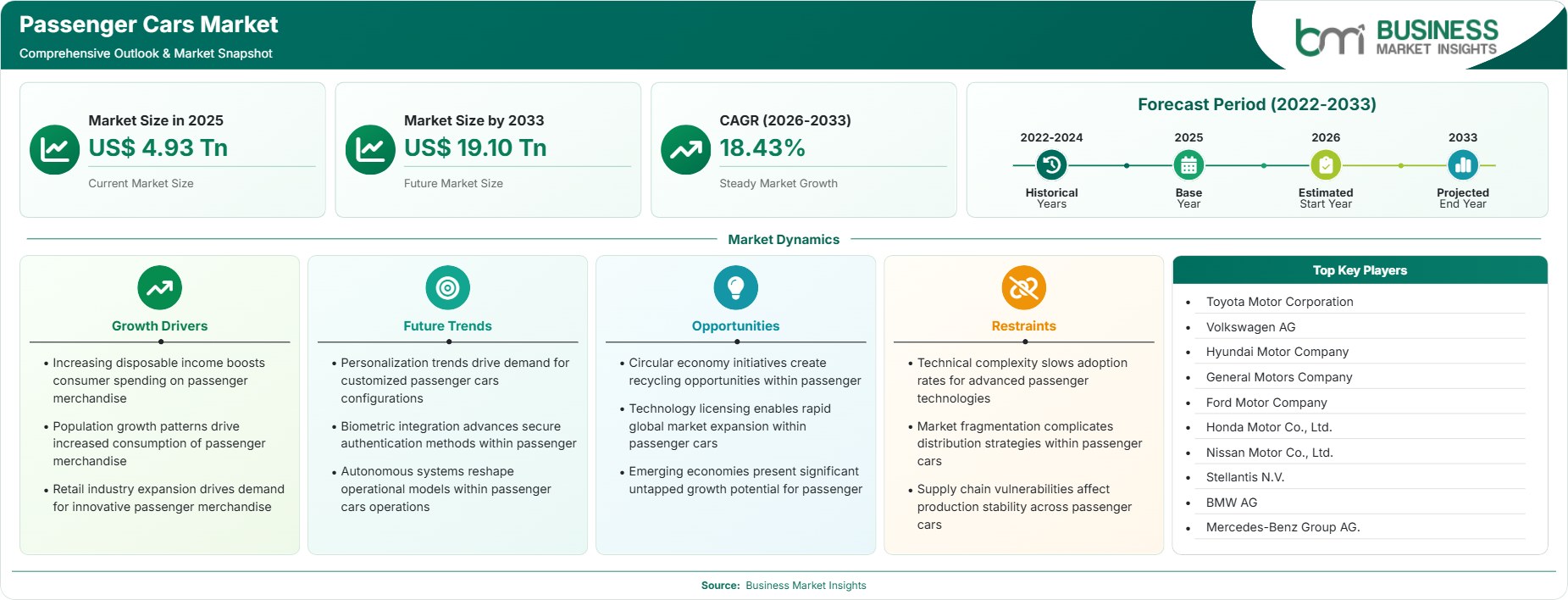
The Passenger Cars Market size was valued at US$ 4.93 Trillion in 2025 and is projected to reach US$ 19.10 Trillion by 2033, growing at a CAGR of 18.43% during 2026–2033, driven by vehicle electrification, software-defined mobility, autonomous driving integration, premiumization strategies, urban mobility demand, and expanding investments in connected-car ecosystems worldwide.

Report Coverage
  • Fuel Type: Petrol, Diesel, Hybrid, Electric
  • Vehicle Type: Hatchback, Sedan, Compact-SUV, SUV
US$ 4.93 Tn Market size in 2025
US$ 19.10 Tn Market Size by 2033
18.43% CAGR, 2026 - 2033
2026-2033 Forecast Period

AI Overview

Passenger Cars Market Summary

  • North America Region: North America holds a market share of 24%–27% in 2025, growing with a CAGR of 16%–18% during 2026–2033, supported by EV infrastructure expansion, advanced financing models, connected mobility adoption, domestic manufacturing incentives, software-based vehicle upgrades, fleet electrification investments, consumer preference shifts, and robust technological ecosystems. US market remains innovation-led, benefiting from EV incentives and connected vehicle deployments, expanding at 16.5%–18.5% CAGR.
  • Fastest Growing Region: Asia Pacific holds a Passenger Cars Market share of 42%–45% in 2025, growing with a CAGR of 20%–22% during 2026–2033, driven by rising incomes, domestic manufacturing strengths, EV subsidies, expanding urban populations, battery investments, smart mobility ecosystems, digital retailing channels, localized innovation, and supportive policy frameworks.
  • Leading Segment: Petrol accounts for a 39%–42% share in 2025 and advances at a 14%–16% CAGR, supported by widespread fueling networks, affordability advantages, broad model availability, consumer familiarity, developing-market demand, improved engine efficiency, dealer penetration, and replacement purchasing cycles across mass-market categories.
  • High Growth Segment: Electric vehicles represent 18%–22% of the Passenger Cars Market share in 2025 and expand at a 26%–29% CAGR, supported by charging infrastructure deployment, battery cost reductions, government incentives, emission standards, software-enabled ownership experiences, energy-transition goals, corporate fleet electrification programs, and consumer sustainability preferences.
  • Key Market Opportunity: Vehicle software platforms, over-the-air updates, intelligent cockpit technologies, subscription services, battery ecosystems, mobility data monetization, and AI-enabled driving functions are creating new recurring revenue streams beyond vehicle sales.
  • Major Market Players: Toyota Motor Corporation, Volkswagen AG, Hyundai Motor Company, General Motors Company, Ford Motor Company, Honda Motor Co., Ltd., Nissan Motor Co., Ltd., Stellantis N.V., BMW AG, Mercedes-Benz Group AG.
Strategic Insights

Passenger Cars Market: Strategic Insights

Passenger Cars Market Strategic Framework
FREE PDF
Request your free sample
Request free sample
Stakeholder View

Key Takeaways

  • Global automotive value chains are increasingly centered on batteries, software platforms, semiconductors, and connected services, shifting competitive advantage from mechanical engineering alone toward integrated digital ecosystems.
  • Electric and Compact-SUV categories present the strongest long-term volume opportunities due to urban mobility requirements, consumer preference changes, and supportive environmental regulations.
  • R&D priorities increasingly focus on intelligent cockpits, AI-assisted driving functions, battery efficiency improvements, and vehicle-to-cloud connectivity capabilities.
  • Asia Pacific offers the most compelling investment environment, supported by manufacturing scale, supplier ecosystem depth, rising household incomes, and strong electrification momentum.
  • Strategic partnerships involving battery producers, software developers, semiconductor firms, and mobility platform providers have become a dominant investment and consolidation trend.
  • Subscription-based digital services and over-the-air feature upgrades are creating recurring revenue streams that improve manufacturer margins throughout vehicle lifecycles.
Geographic Outlook

Passenger Cars Market Regional Highlights

North America Passenger Cars Market

North America holds 24% to 27% market share of Passenger Cars and is expected to grow at a CAGR of 16% to 18% between 2026 and 2033. The growth can be attributed to demand from premium car sales, an increase in EV infrastructure, easy availability of car financing, and incentives for domestic production. The United States leads the region in contributions, while Canada and Mexico play an increasing role in the localization of production. Connected vehicle technologies, ADAS deployment, and software-enabled ownership models continue to reshape purchasing preferences and competitive strategies across the region.

  • Federal and state-level electrification incentives are accelerating EV adoption while encouraging localized battery and vehicle manufacturing investments across supply chains.
  • Connected mobility technologies, telematics adoption, and software-defined vehicle architectures are improving customer engagement and generating recurring digital-service revenues.
  • Premium SUVs and crossovers remain dominant demand categories, supported by consumer preference for larger vehicles with advanced safety technologies.
  • Supply chain diversification strategies are reducing dependence on overseas sourcing while improving resilience against geopolitical and logistics disruptions.
  • Fleet modernization initiatives are increasing adoption of hybrid and electric platforms among corporate, government, and mobility-service operators.

US Passenger Cars Market

The United States is expected to account for 78% to 82% of the North American share and achieve a CAGR of 16.5% to 18.5% through 2033. High consumer buying power, technology integration, and wide dealer networks fuel the demand for electric vehicles. The development of charging infrastructure, battery gigafactories, and self-driving vehicles is still highly relevant. Digital vehicle sales and new ownership models continue to influence customers' decisions.

  • EV production investments are strengthening domestic manufacturing capabilities and encouraging supply-chain localization across strategic automotive components.
  • Advanced driver-assistance technologies are becoming mainstream across mid-range and premium vehicle categories, expanding software-related revenues.
  • Leasing and financing availability continue supporting replacement vehicle demand despite fluctuations in interest-rate environments.
  • Autonomous mobility pilots and connected services platforms are influencing long-term product development roadmaps among leading manufacturers.

Europe Passenger Cars Market

Europe accounts for 21%-24% market share in 2025 and is projected to grow at a CAGR of 17%-19% until 2033. High emissions standards, government-set electric-vehicle targets, and the advanced automotive industry help drive market growth. Germany remains the dominant country in the region, but Spain and Poland stand out as the fastest-growing manufacturing regions. Domestic car makers in Europe are speeding up the introduction of EVs and software solutions. Investments in charging infrastructure and renewable-energy integration continue to strengthen the adoption of low-emission vehicles across consumer and fleet segments.

  • Germany maintains leadership through automotive innovation, premium manufacturing capabilities, and advanced engineering ecosystems.
  • Spain experiences higher growth through production investments, competitive labor costs, and expanding EV manufacturing projects.
  • Fleet electrification mandates are encouraging replacement demand across corporate and municipal transportation operators.
  • Vehicle software integration and digital service ecosystems are becoming important differentiation tools across brands.
  • Sustainability targets are accelerating battery recycling investments and circular-economy initiatives throughout European automotive supply chains.

Asia Pacific Passenger Cars Market

The Asia-Pacific region is expected to account for 42% to 45% of the market in 2025 and will have the highest CAGR of 20% to 22% until 2033. China is expected to be the leading market, while India is expected to be the leader in growth opportunities. The growing middle-class population, manufacturing ecosystem, and pro-EV policies continue to drive up demand. Automakers are scaling up their capacities in the region. Strong battery production capabilities and digital retail adoption further enhance competitiveness and long-term growth prospects.

  • China leads global EV volumes through extensive charging infrastructure, domestic battery capabilities, and supportive industrial policies.
  • India records strong expansion because of urbanization, rising disposable income, and increasing financing penetration among buyers.
  • Regional governments continue supporting domestic automotive manufacturing through incentive programs and infrastructure development.
  • Hybrid and electric models experience accelerated demand as fuel-efficiency concerns influence purchasing decisions.
  • Technology partnerships among automakers, battery suppliers, and software providers are enhancing innovation speed and commercialization efficiency.

Rest of World Passenger Cars Market

Rest of World accounts for a 10%–12% share in 2025 and expands at a CAGR of 15%–17% through 2033. South and Central America benefit from growing vehicle ownership rates and localized manufacturing activities. Brazil remains the leading regional market.

Middle East and Africa demonstrate increasing demand driven by urbanization, infrastructure growth, and economic diversification initiatives. Saudi Arabia and the UAE represent high-growth destinations, while South Africa continues serving as an important automotive production base within the broader regional ecosystem.

  • Brazil benefits from expanding domestic production and steady replacement demand across passenger vehicle segments.
  • Saudi Arabia is investing heavily in mobility transformation, EV infrastructure, and localized vehicle manufacturing capabilities.
  • UAE demand is supported by premium vehicle purchases and smart mobility initiatives linked to urban development.
  • South Africa remains an important assembly hub supporting vehicle exports into regional markets.
  • Rising financing access and dealership expansion continue improving vehicle affordability across developing economies.
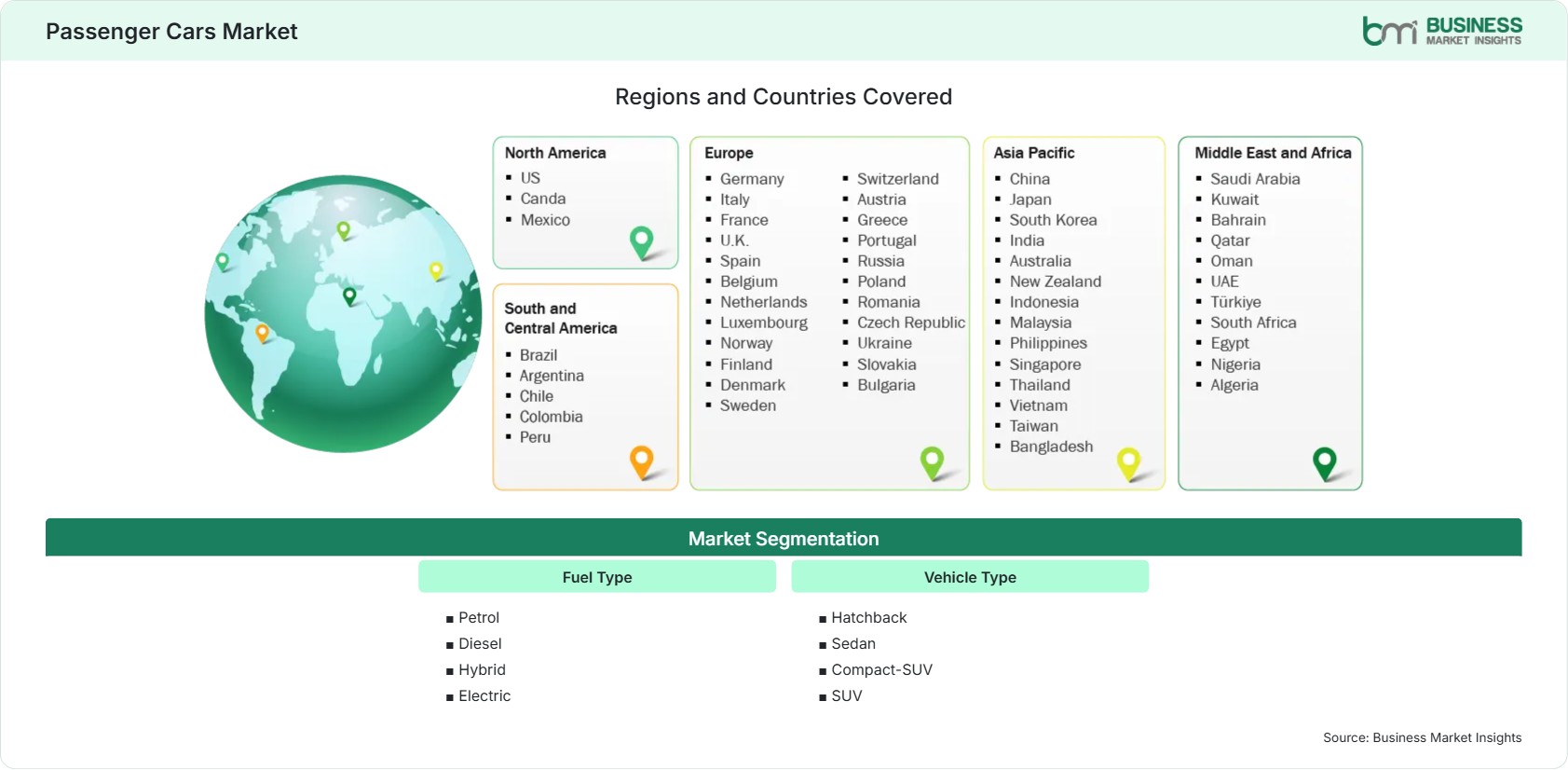
Global Market Geography
FREE PDF
Request your free sample
Request free sample
Segment Analysis

Passenger Cars Market Segmentation

Fuel Type

Fuel Type contributes the most to total sales revenue and reflects changing consumer preferences and energy transition concerns. In this segment, there was 100% market coverage, with petrol being the dominant product. Sales growth will continue to be driven by the adoption of hybrid and electric cars. The Passenger Cars Market encompasses more fuel technologies, with considerations of cost and efficiency. The segment advances at an estimated 18%–20% CAGR.

  • Petrol: Maintains strong relevance through affordability, extensive fueling infrastructure, varied model availability, and continued demand across emerging economies where infrastructure for alternative fuels remains under development.
  • Diesel: Demand remains concentrated in selected markets emphasizing fuel efficiency, long-distance travel requirements, and specific consumer preferences despite tightening emissions regulations.
  • Hybrid: Increasingly adopted as a transition technology combining emission reductions, fuel savings, and consumer convenience without requiring charging infrastructure dependence.
  • Electric: Rapidly expanding because of battery technology improvements, infrastructure deployment, policy incentives, and growing consumer interest in sustainable transportation solutions.

Vehicle Type

Vehicle Type Segmentation emphasizes the shifting consumer mobility behavior driven by lifestyle changes, urbanization, and rising incomes. The SUV segment has the highest proportion, at 52%-56%, whereas the Compact-SUV segment is the fastest-growing, with a CAGR of 21%-24%. The Passenger Cars Market trends point to an increased preference for vehicles that offer comfort and safety technologies and are perceived to offer greater value for money.

  • Hatchback: Remains popular in dense urban environments due to affordability, compact dimensions, parking convenience, and favorable ownership economics for first-time buyers.
  • Sedan: Maintains stable demand within fleet, executive, and family transportation applications where comfort, efficiency, and driving dynamics remain purchasing priorities.
  • Compact-SUV: Gains momentum through balanced practicality, fuel efficiency, elevated driving position, and suitability for both urban and long-distance mobility requirements.
  • SUV: Continues leading consumer preference because of spacious interiors, advanced safety features, premium positioning, and increasing electrified powertrain availability.
Market Forces

Passenger Cars Market Dynamics

Key Market Drivers

Electrification Policies Accelerating Vehicle Replacement Cycles

The governments of nations with a significant presence in the automotive industry have been encouraging the use of environmentally friendly transport methods by providing incentives, carbon-reduction programs, and investing in infrastructure development. According to the International Energy Agency, by 2024, there were over 17 million electric car sales worldwide, thereby establishing a structural shift in the automotive industry. The increased level of environmental awareness, reduced cost of batteries, and availability of a wide range of products are creating substitution demand. Auto manufacturers are focusing more on electrifying their vehicle ranges to comply with regulations and remain competitive.

Connected Mobility and Software Integration Increasing Value Creation

The software capabilities of vehicles have become a significant differentiator. There is an increased use of over-the-air updating, cloud integration, digital dashboards, and subscription-based features in vehicles. Consumer demand for intelligent navigation, remote diagnosis, predictive maintenance, and customized driving experiences continues to rise. Software-defined architectures boost profitability throughout the product life cycle and enable feature upgrades even after purchase. The inclusion of AI and driver assistance systems is another important development that enhances competitive advantage.

Rising Urbanization and Income Growth Supporting Ownership Demand

According to development statistics from the IMF and the World Bank, population growth in urban areas remains concentrated in Asia and selected emerging nations, thereby sustaining demand for transportation solutions. Factors such as the increasing number of middle-income groups, improved financial access, and infrastructure investments facilitate an increase in car ownership. Consumers are demanding safer, more comfortable transport by pursuing options as urban areas launch affordable models through expanding local production, affordable car models, and online marketing tools.

Key Market Opportunities

Expansion of Software-Defined Vehicle Business Models

Other possibilities come with software-driven vehicles beyond the sale of hardware components. The software-based features can be used to generate revenue through subscriptions, improve navigation systems, enhance cybersecurity, enable remote diagnostics, and support infotainment systems. Ownership experience is evolving into more service-driven relationships, with connected cars becoming the norm. Investments in computing and cloud computing systems enable the generation of recurring revenue. Passenger Cars Market Forecasts incorporate the value of digital services in addition to the manufacturing revenues. Companies that can leverage the software ecosystems are likely to improve profits and customer retention.

Growth Potential in Emerging Automotive Economies

Rapid urbanization, growing middle classes, and infrastructure advancements have created many attractive opportunities in India, Southeast Asia, South America, and some markets in the Middle East. Car companies are setting up production facilities in the regions to reduce costs and be more market-sensitive. Government policies aimed at industrialization and transportation have also made the investment more feasible. Increasing distribution networks, e-commerce, and finance solutions have also increased the availability of cars.

Battery Ecosystem Localization and Circular Economy Development

The manufacturing, recycling, and energy storage applications of batteries present considerable long-term investment potential. With increasing uptake of electric vehicles, there is a need for local supply chains. Recycling helps optimize resource use and reduce dependence on raw materials. The partnership between automotive companies and energy storage providers creates an ecosystem. Governments are increasingly supportive of building battery factories in their own countries. Companies that create value chains for batteries have better supply security, economic efficiency, and sustainability, thereby improving their competitiveness.

Market Restraints and Challenges

High Vehicle Costs and Affordability Pressure

Factor: Rising costs associated with batteries, advanced electronics, software integration, and regulatory compliance increase vehicle prices. Impact: Higher acquisition costs can delay purchasing decisions and constrain adoption among cost-sensitive consumers, particularly in emerging economies. Inflationary pressures, financing costs, and supply-chain volatility further influence affordability. Although manufacturers pursue cost reductions through scale production and localized sourcing, pricing challenges remain significant. Premium technology content often increases ownership costs despite operational savings. These constraints may temporarily limit demand acceleration within specific consumer segments and create pressure on automakers to balance innovation with affordability.

Supply Chain Complexity and Raw Material Dependence

Factor: Automotive production depends on semiconductors, battery minerals, and globally distributed supplier networks. Impact: Disruptions can affect production schedules, inventory availability, and profitability. Geopolitical uncertainties, trade restrictions, logistics bottlenecks, and concentration of critical mineral processing capacities increase operational risks. Automakers are pursuing regional sourcing strategies and supplier diversification, yet restructuring supply networks requires considerable investment and time. Persistent uncertainty surrounding critical raw materials can influence capacity planning and product launch schedules, creating challenges for long-term operational stability and predictable growth execution.

Company Analysis

Competitive Landscape

The competitive environment remains shaped by electrification, digital transformation, manufacturing scale, and brand strength. Current Passenger Cars Market analysis highlights intensifying competition among established global manufacturers investing in software platforms, battery partnerships, and intelligent mobility solutions.

Company Name

Overview

Products and Services relevant to this market

Toyota Motor Corporation

Global automotive leader with extensive manufacturing footprint and strong hybrid vehicle leadership.

Passenger cars, hybrids, EVs, connected mobility services, financing solutions, and digital vehicle technologies.

Volkswagen AG

Diversified automotive group advancing electrification, software platforms, and global manufacturing operations.

Passenger vehicles, EVs, ADAS systems, digital mobility platforms, and connected vehicle ecosystems.

Hyundai Motor Company

Innovation-focused manufacturer expanding EV, hydrogen, and intelligent mobility capabilities globally.

Passenger cars, EVs, connected mobility solutions, infotainment systems, and autonomous technology development.

General Motors Company

Major automaker emphasizing electrification, software services, and advanced vehicle technologies.

Passenger vehicles, EV platforms, connected services, autonomous mobility technologies, and financing solutions.

Ford Motor Company

Established manufacturer pursuing electrification and software-enabled customer experiences.

Sedans, SUVs, EVs, fleet solutions, connected vehicle services, and mobility technologies.

Honda Motor Co., Ltd.

Strong global automotive brand recognized for efficiency, reliability, and engineering expertise.

Passenger cars, hybrids, EVs, safety technologies, powertrains, and mobility solutions.

Nissan Motor Co., Ltd.

Early EV pioneer strengthening electrified mobility and intelligent driving capabilities.

Passenger vehicles, EVs, connected systems, driver-assistance technologies, and mobility services.

Stellantis N.V.

Multi-brand automotive group with broad geographic reach and electrification strategies.

Passenger vehicles, electrified models, software services, fleet solutions, and digital mobility offerings.

BMW AG

Premium automaker focusing on intelligent mobility, digital experiences, and electrification.

Luxury passenger cars, EVs, connected platforms, ADAS technologies, and subscription services.

Mercedes-Benz Group AG

Premium automotive manufacturer emphasizing software, luxury, and electric mobility innovation.

Luxury sedans, SUVs, EVs, digital vehicle ecosystems, financing, and connectivity services.

Trust & Transparency

Research Methodology

The market analysis combines proprietary research with secondary data from government agencies, company disclosures, regulatory filings, industry databases and expert interviews. Market estimates are validated through data triangulation, cross-market benchmarking and analyst review.

View Full Research Methodology

Questions Answered

Frequently Asked Questions

Which region offers the strongest investment potential through 2033?

Asia Pacific presents the strongest opportunity because of manufacturing scale, rising incomes, electrification momentum, supportive policies, and expanding automotive consumer bases.

What does a Passenger Cars Market Report typically evaluate?

A Market Report generally examines industry size, competition, technological developments, regional opportunities, consumer behavior, regulatory influences, and future growth prospects.

How are software-defined vehicles changing industry competition?

Manufacturers increasingly compete through digital services, over-the-air updates, intelligent cockpits, data-driven features, and subscription revenues rather than relying solely on hardware differentiation.

What vehicle category is positioned for the strongest long-term demand?

Compact SUVs combine practicality, fuel efficiency, safety features, and affordability, making them one of the most attractive categories for long-term volume expansion.

What factors are accelerating electrification in passenger vehicles?

Government incentives, charging infrastructure expansion, battery cost reductions, stricter emission standards, and growing consumer preference for sustainable transportation continue supporting electrified vehicle adoption globally.

Access the Full Passenger Cars Market Report

Get segment-level forecasts, regional estimates, competitive benchmarking, company profiles and downloadable Excel datasets.

Access the full Passenger Cars Market Report
350 pages PDF & Excel | 2026-08-31