Passenger Car Bushing Market Regional Highlights
North America Passenger Car Bushing Market
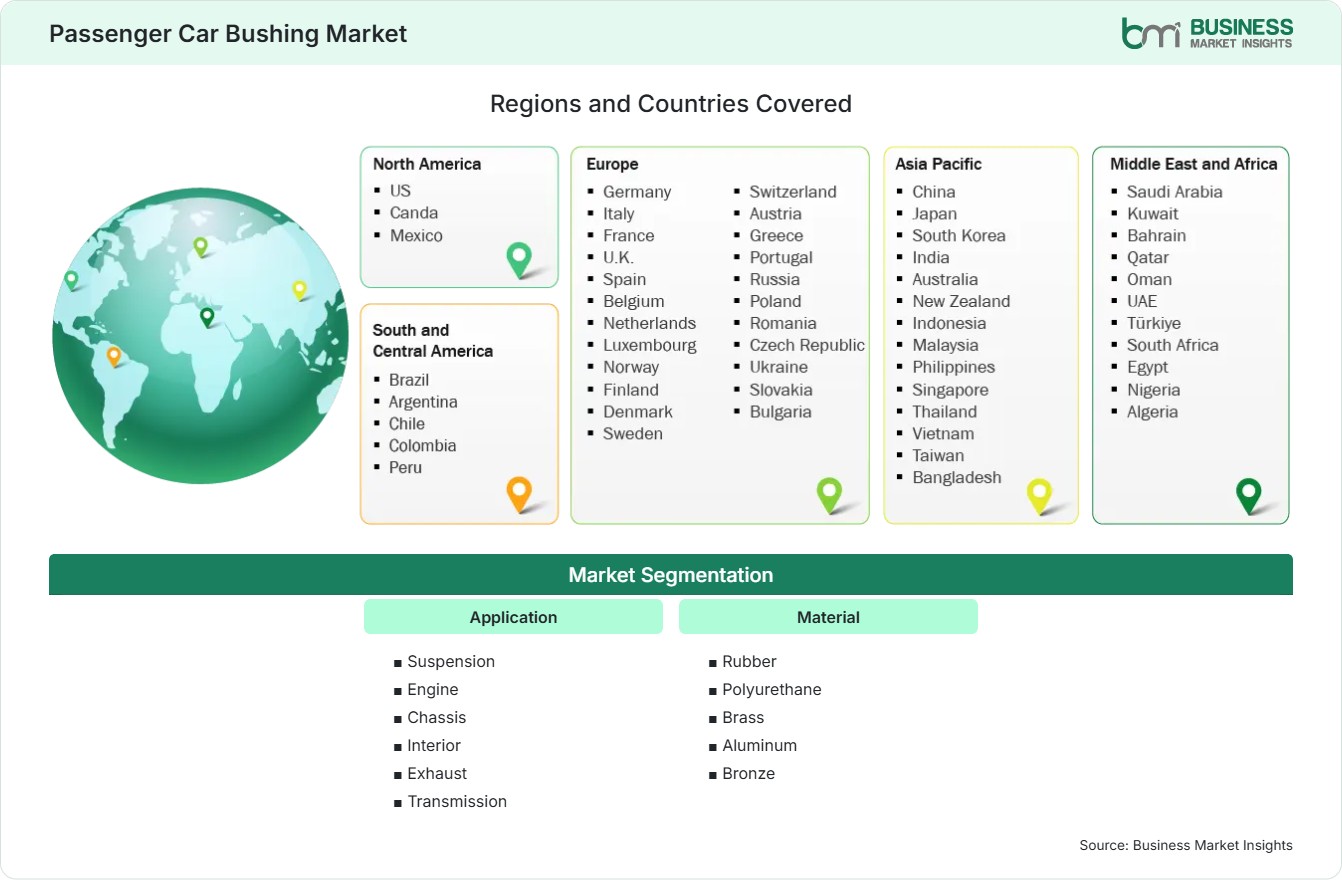
North America commands 22%–25% Passenger Car Bushing Market share by 2025 and 4.8%–5.4% CAGR up to 2033. Passenger car manufacturing is in an established phase; however, the existing vehicle fleet drives replacement demand in North America. There is a preference for high-performance suspension systems, enhanced rubber technologies, and superior aftermarket solutions. The United States leads regional consumption, while Mexico increases its prominence as an automotive manufacturing hub. Electric cars place greater demands on vibration isolation, as noise-free cabins magnify road, tire, and driveline vibrations.
- Mature vehicle parc supports recurring replacement demand, particularly for control-arm, suspension, subframe, and chassis bushings exposed to road loads and aging.
- Electric vehicles require specialized vibration-control solutions because motor frequencies differ from combustion engines, making elastomer stiffness and damping characteristics increasingly important.
- Mexico strengthens regional supply-chain integration by combining lower manufacturing costs with proximity to U.S. vehicle assembly plants and established automotive supplier networks.
- Premium passenger vehicles increasingly require bushings optimized for ride comfort, steering precision, durability, and low noise across multiple operating conditions.
US Passenger Car Bushing Market
The United States accounts for 68%–72% of North America's share, and it is expected to grow at a CAGR of 4.9%–5.5% until 2033. The Passenger Car Bushing Market includes both high replacement demand and complex engineering needs of OEMs. Aftermarket companies are helped by wide workshop networks and high numbers of installed passenger cars. In 2025, ZF introduced 130 new parts for TRW chassis, bringing the number of covered vehicles to 29 million and underscoring the commercial value of replacement chassis components.
- Aftermarket replacement remains commercially attractive because suspension bushings experience repeated mechanical loading, environmental exposure, and gradual stiffness changes throughout vehicle life.
- EV adoption increases demand for low-noise chassis solutions as reduced powertrain masking makes tire, road, and structural vibration more noticeable inside passenger cabins.
- Advanced diagnostic and catalog systems improve replacement accuracy, enabling distributors and workshops to match bushings with increasingly diverse vehicle platforms and suspension architectures.
Europe Passenger Car Bushing Market
The Europe share stands at about 24% to 27% in 2025, with a CAGR rate of 4.9% to 5.5% till 2033. In Europe, Germany, France, Spain, Italy, and the UK are the dominant industrial centers. Germany is the leading country in manufacturing capacity, while Spain and some Central European countries have growth potential in vehicle assembly and supplier sectors. The demands in Europe are increasingly being influenced by electrification, durability concerns, emission regulations, and high-end car manufacturing. According to an IEA report, sales of electric cars in Europe grew by over 30% in 2025, reinforcing the need for EV-compatible vibration-control components.
- Germany remains central to advanced bushing development because major OEM and Tier 1 engineering ecosystems demand precise durability, NVH, and suspension performance.
- Spain provides manufacturing opportunities through strong vehicle assembly activity and increasing integration of electrified passenger-car platforms.
- Central European production locations attract component investment because proximity to OEM plants reduces logistics exposure and supports just-in-time supply requirements.
- France and Italy retain opportunities in passenger vehicles requiring comfort-oriented suspension components and specialized vibration-control solutions.
Asia Pacific Passenger Car Bushing Market
Asia Pacific accounts for 44%-48% in 2025 and continues to grow at a 6.6%-7.3% CAGR through 2033. The five manufacturing zones of Asia Pacific comprise China, Japan, India, South Korea, and Southeast Asia. China manufactured 27.48 million passenger vehicles in 2024, while Japan manufactured 7.14 million and India 4.99 million. The adoption rate of EVs is also higher in this region, particularly in China, necessitating specialized mounting and suspension bushing applications.
- China provides the largest addressable production base and increasingly sophisticated EV engineering requirements, supporting high-volume bushing demand across domestic and export-oriented platforms.
- Japan maintains strong expertise in polymer formulation, vibration control, durability engineering, and precision manufacturing, supporting high-value bushing development.
- India combines expanding passenger-car production with supplier localization, creating opportunities for domestic manufacturing, engineering centers, and cost-optimized component platforms.
- Southeast Asia is emerging as an EV and automotive manufacturing destination, encouraging suppliers to establish regional production and reduce dependence on distant component imports.
Rest of World Passenger Car Bushing Market
Rest of World contributes about 7%-10% of market share in 2025, registering a 5.2%–6.0% CAGR until 2033. South & Central America includes Brazil & Mexico, whereas the Middle East sees growth owing to rising automobile imports and the automotive service industry. Brazil manufactured 1.90 million passenger cars in 2024, underscoring its status as the region's production hub. Mexico helps support North American supply chains. There is a growing preference for more durable replacement parts that suit changing road situations in emerging markets.
Demand from the Middle East will be largely influenced by foreign passenger cars and replacement uses, with Saudi Arabia and the UAE among the main customers. Africa is quite small, but it offers an aftermarket as demand increases. Demand for electric cars has been rising in Latin American countries. According to the International Energy Agency, over 125,000 sales of electric cars have been reported in Brazil in 2024
- Brazil provides the strongest South American manufacturing opportunity, supported by domestic vehicle production, replacement demand, and a large automotive service ecosystem.
- Mexico benefits from integrated North American manufacturing, providing opportunities for localized bushing production serving passenger-car assembly and aftermarket channels.
- Saudi Arabia and the UAE provide attractive aftermarket opportunities because of large imported vehicle fleets and high vehicle utilization in demanding climatic conditions.
- Latin American electrification creates incremental demand for components engineered around higher vehicle mass, altered drivetrain vibration, and improved cabin refinement.