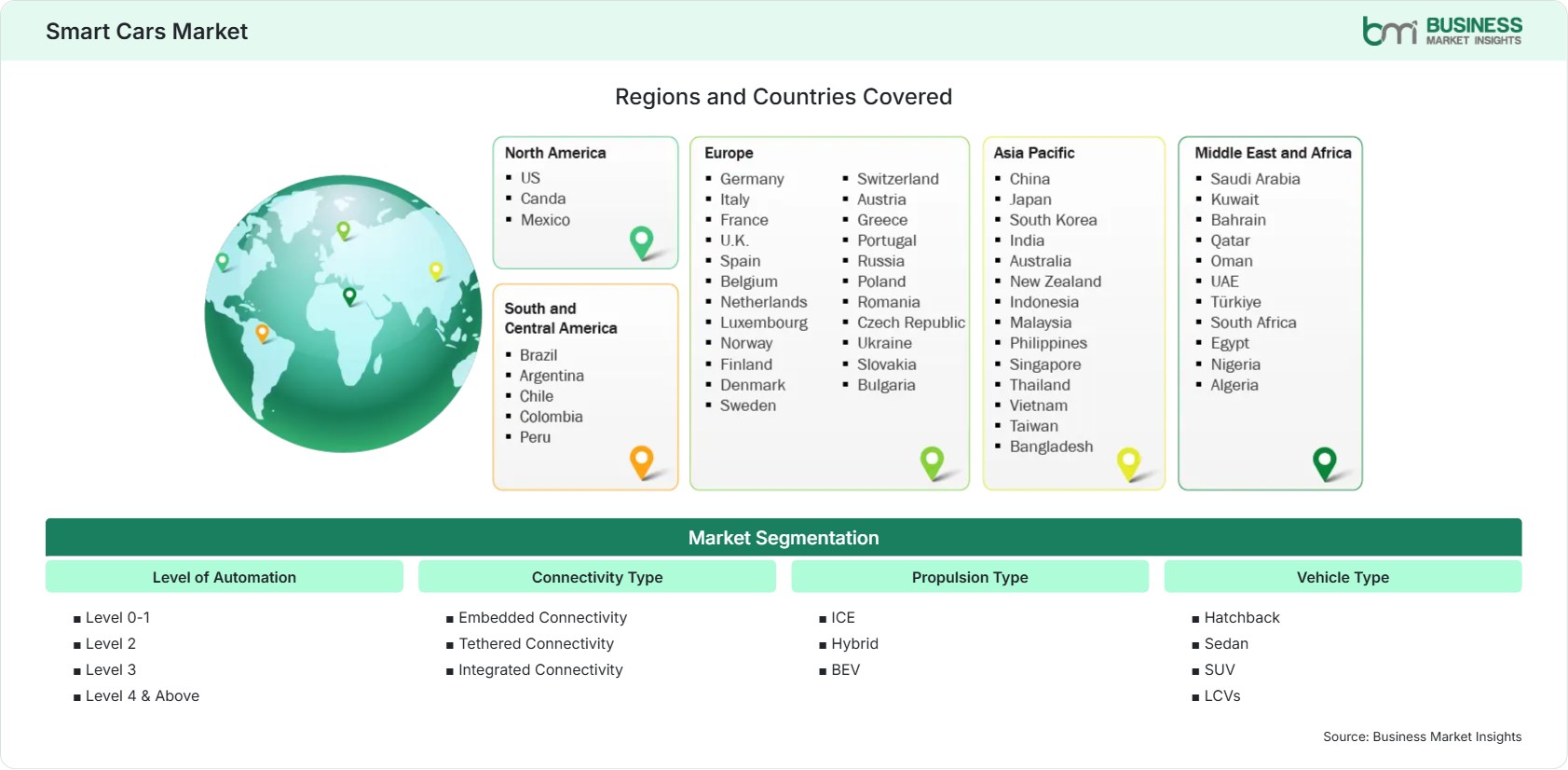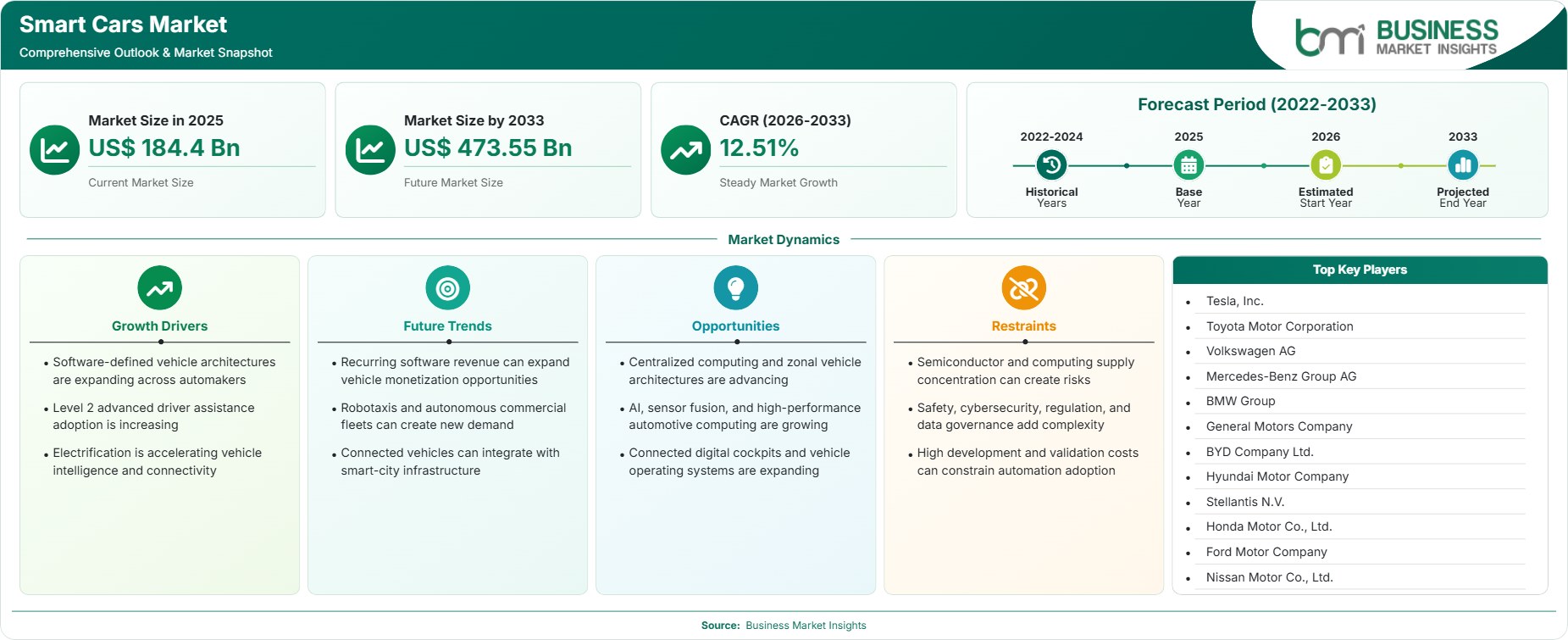
Smart Cars Market Regional Highlights
North America Smart Cars Market
North America accounts for a 28%–32% share in 2025 and is projected to expand at a CAGR of 11%–13% through 2033. The region benefits from mature connectivity infrastructure, premium vehicle penetration, established technology companies, and consumer familiarity with driver-assistance systems. The US remains the dominant regional market, while Canada contributes through connected mobility and electrification programs. Regional Smart Cars Market share is reinforced by strong investment in autonomous driving, cloud-connected services, cybersecurity, and vehicle software. Regulatory scrutiny around automated driving is also encouraging manufacturers to strengthen validation and driver-monitoring capabilities.
- Hands-free driving is moving beyond premium niches as General Motors expands Super Cruise across 23 vehicle models and more than 600,000 compatible road miles in the US and Canada.
- Software-defined architectures are becoming strategic priorities as manufacturers seek recurring digital revenue through connected features, remote diagnostics, OTA updates, and subscription-based functionality.
- EV adoption strengthens automation integration because battery-electric platforms provide stable high-voltage electrical architectures and precise torque control for automated driving systems.
- US technology leadership in artificial intelligence, cloud computing, and semiconductor development supports rapid commercialization of connected vehicle applications.
US Smart Cars Market
The US accounts for about 68%-72% of North America's demand in 2025 and is forecasted to register a CAGR of 10%-12% until 2033. The US has good road connectivity, high rates of premium car ownership, an automotive software ecosystem, and consumer demand for connectivity. The growth in the US Smart Cars Market is driven by ADAS adoption, autonomous driving tests, EV investments, and the expansion of subscription services. State-to-state regulation variance is a significant factor in the commercial adoption of automated driving, especially for higher levels of automation.
- Super Cruise had been installed in more than 500,000 vehicles by June 2025, more than double the year-earlier level, while GM expected 2025 Super Cruise revenue to exceed US$200 million.
- Tesla continues expanding supervised automated driving capabilities across selected markets, supported by fleet-generated driving data and OTA software updates.
- Demand is shifting toward integrated digital cockpits, remote vehicle controls, connected navigation, predictive diagnostics, and smartphone-based vehicle access.
Europe Smart Cars Market
Europe accounts for 25%–29% of the Smart Cars market in 2025 and is expected to have a CAGR of 11%–13%. Germany, the UK, France, and Sweden still stand out in automotive technology, with Germany excelling in manufacturing premium connected cars. Sweden and the UK constitute the high-growth regions in Europe, having modeled CAGRs of 13%–15% and 12%–14%, respectively. The Smart Cars segment in Europe benefits from emission standards, EVs, safety, and software-defined platforms.
- Germany remains central to intelligent vehicle innovation because Volkswagen AG, BMW Group, and Mercedes-Benz Group AG are integrating software, electrification, connectivity, and automated driving into new vehicle architectures.
- The IEA reported that European electric car sales increased by more than 30% in 2025, reaching 28% of total sales, strengthening the technological foundation for connected vehicles.
- European manufacturers increasingly emphasize centralized computing, OTA functionality, cybersecurity, and digital cockpit integration to differentiate premium and mass-market models.
- UK investment in autonomous mobility, artificial intelligence, and connected infrastructure creates opportunities for controlled-domain automated transport and fleet applications.
Asia Pacific Smart Cars Market
Asia Pacific accounts for 34%-38% of market share in 2025 and is projected to grow at a 14%-16% CAGR. It will be the fastest-growing region due to its expected CAGR. The key demand regions are China, Japan, South Korea, and India. China is the biggest producer of vehicles and has the highest number of electric vehicles in the region. South Korea and Japan have a strong electronics and automotive engineering base. Growth drivers in the Asia Pacific Smart Cars Market include cost-effective EVs, artificial intelligence, connectivity, semiconductors, and growing customer demands.
- China remains the region’s largest market, with electric cars accounting for nearly 55% of total car sales in 2025, creating a large installed base for intelligent vehicle technologies.
- South Korea combines automotive manufacturing strength with advanced electronics and software capabilities, supporting rapid development of ADAS, infotainment, and vehicle operating systems.
- Japan is progressing toward software-defined mobility through platforms that combine safety, connectivity, digital services, and automated driving capabilities.
- India offers long-term growth potential as connected features move from premium vehicles toward higher-volume passenger cars and commercial fleets.
Rest of World Smart Cars Market
South and Central America represent a relatively small but growing share of global demand due to the increasing availability of EVs and smartphones, fleet digitization, and urban mobility needs. Brazil and Mexico are the largest automobile markets in the region, while Chile and Colombia provide high growth potential. Adoption within the region will depend on factors such as car affordability, charging infrastructure, the cost of imported technologies, and digital infrastructure.
Middle East and Africa provide an emerging opportunity driven by demand for premium vehicles, smart cities, smart infrastructure, and autonomous mobility trials. The UAE and Saudi Arabia are the largest adopters of smart-car technologies in the region, while South Africa serves as an important manufacturing base for automobiles. Rest of World demand is estimated at 9%-11% CAGR to 2033.
- Latin American EV sales increased strongly in early 2026, with the IEA reporting a 75% year-on-year increase during the first quarter.
- Gulf countries are developing smart-city ecosystems where connected vehicles can integrate with intelligent infrastructure, digital identity, mobility platforms, and automated transport.
- Mexico benefits from its automotive manufacturing base and proximity to the US market, supporting connected vehicle production and technology localization.
- South Africa provides opportunities for connected fleet management, telematics, remote diagnostics, and commercial vehicle digitization.