
Smart Fleet Management Market Outlook: Size, Share, Trends, Growth Analysis, Competitive Landscape & Forecast, 2026-2033

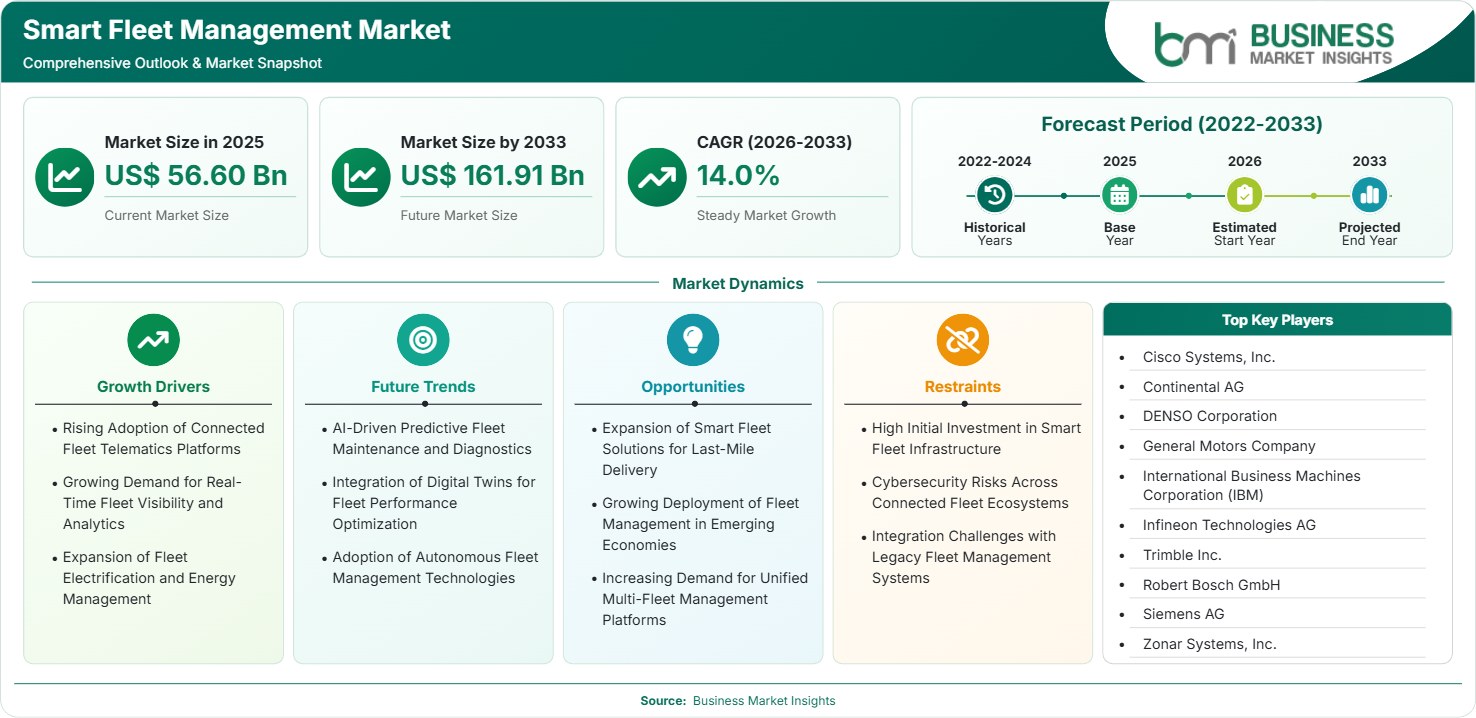
The Smart Fleet Management Market size was valued at US$ 56.60 Billion in 2025 and is projected to reach US$ 161.91 Billion by 2033, growing at a CAGR of US$ 14.0% during 2026–2033. Growth is supported by connected vehicle adoption, telematics integration, AI-enabled fleet optimization, fuel-efficiency mandates, and expanding demand for real-time asset visibility across transportation, logistics, retail, and industrial operations.

Report Coverage
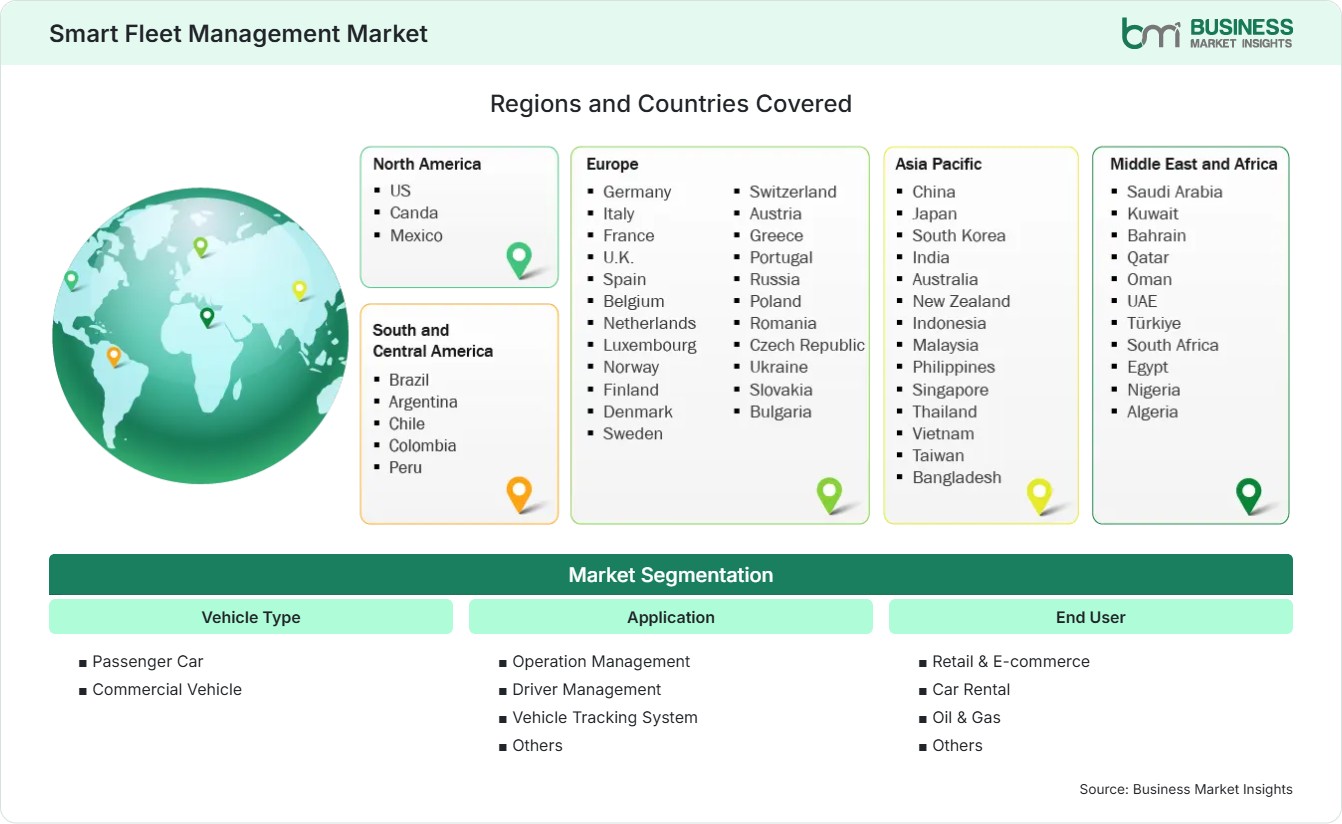
  • Vehicle Type: Passenger Car,Commercial Vehicle
  • Application: Operation Management, Driver Management, Vehicle Tracking System, Others
  • End User: Retail & E-commerce, Car Rental, Oil & Gas, Others
US$ 56.60 Bn Market size in 2025
US$ 161.91 Bn Market Size by 2033
14.0% CAGR, 2026 - 2033
2026-2033 Forecast Period

01 AI Overview

Smart Fleet Management Market Summary

  • North America Region: North America holds a smart fleet management market share of 34%–37% in 2025, growing at a CAGR of 12.5%–13.5% during 2026–2033. Growth is supported by advanced telematics deployment, strong commercial fleet digitization, regulatory focus on vehicle safety, and growing investments in AI-driven fleet analytics. The U.S. represents the largest regional contributor, supported by large logistics fleets and connected mobility investments, advancing at a CAGR of 12.8%–13.8%.
  • Fastest Growing Region: Asia Pacific accounts for 24%–27% of the market in 2025 and is forecast to expand at a CAGR of 15.5%–16.5% during 2026–2033. Rapid fleet expansion, increasing e-commerce deliveries, digital transportation programs, and growing adoption of IoT-enabled vehicle management solutions continue to create substantial growth opportunities.
  • Leading Segment: Commercial Vehicle (LCV and HCV) maintains a market share of 60%–63% in 2025 and is expected to grow at a CAGR of 13.8%–14.8% through 2033. Fleet operators prioritize operational visibility, compliance monitoring, predictive maintenance, and route optimization to improve vehicle utilization and profitability.
  • High Growth Segment: Operation Management accounts for 31%–34% of revenue in 2025 and is projected to register a CAGR of 15.0%–16.0% over the forecast period. Rising demand for automated scheduling, dispatch optimization, fuel management, and integrated fleet intelligence platforms supports segment expansion.
  • Key Market Opportunity: Global fleet operators are increasingly investing in AI-enabled predictive maintenance, fleet electrification monitoring, and integrated mobility platforms capable of reducing operational costs while enhancing driver productivity and asset utilization.
  • Major Market Players: Cisco Systems, Inc.; Continental AG; DENSO Corporation; General Motors Company; International Business Machines Corporation (IBM); Infineon Technologies AG; Trimble Inc.; Robert Bosch GmbH; Siemens AG; Zonar Systems, Inc.
02 Strategic Insights

Smart Fleet Management Market: Strategic Insights

smart-fleet-management-market-market-strategic-framework
FREE PDF
Request your free sample
Request free sample
03 Stakeholder View

Key Takeaways

  • The smart fleet management market analysis suggest an evolving move toward integrated platforms where telematics providers, cloud software developers, connectivity vendors, vehicle manufacturers, and analytics companies collaborate to provide end-to-end fleet visibility and operational optimization.
  • Retail and e-commerce operators present one of the strongest growth opportunities due to increasing last-mile delivery volumes, rising customer expectations for real-time tracking, and growing fleet utilization requirements.
  • Artificial intelligence, machine learning, predictive maintenance engines, and digital twin technologies are becoming central innovation priorities as fleet operators seek measurable reductions in downtime and maintenance expenses.
  • Asia Pacific presents a compelling investment case due to accelerating logistics modernization, expanding commercial transportation networks, increasing connected vehicle penetration, and supportive smart mobility initiatives across key economies.
  • Strategic acquisitions continue to focus on telematics software, vehicle connectivity platforms, and fleet analytics capabilities as technology providers seek integrated offerings and recurring subscription-based revenue streams.
  • The growing convergence of fleet management systems with electric vehicle monitoring platforms is creating new opportunities for battery analytics, charging optimization, and sustainability-focused fleet operations.
04 Geographic Outlook

Smart Fleet Management Market Regional Highlights

North America Smart Fleet Management Market

North America held 34%–37% of global revenue in 2025 and is projected to grow at a CAGR of 12.5%–13.5% during 2026–2033. The region remains the largest market due to widespread telematics deployment, advanced transportation infrastructure, strong digital logistics adoption, and continuous investment in connected fleet technologies. Growing demand for real-time vehicle monitoring, predictive maintenance, and driver safety solutions continues to strengthen Smart Fleet Management Market share across commercial transportation, construction, utility, and field service fleets.

  • Large fleet operators increasingly deploy AI-powered analytics platforms to improve route planning, reduce fuel consumption, and enhance asset utilization across extensive transportation networks.
  • Regulatory requirements related to driver safety, electronic logging, and compliance reporting continue driving investments in integrated fleet management and vehicle monitoring systems.
  • Commercial vehicle electrification programs are encouraging adoption of battery monitoring, charging optimization, and energy management capabilities within fleet operations.
  • Cloud-based fleet intelligence platforms are replacing legacy systems by offering enhanced scalability, centralized visibility, cybersecurity protection, and operational efficiency.
  • Logistics and distribution companies continue prioritizing real-time tracking technologies to improve delivery accuracy, customer satisfaction, and supply chain transparency.

US Smart Fleet Management Market

The United States accounted for 26%–29% of global revenue in 2025 and is expected to register a CAGR of 12.8%–13.8% through 2033. The country benefits from one of the world's largest commercial vehicle populations, high connected vehicle penetration, and mature telematics infrastructure. Increasing digitalization of freight operations, expansion of e-commerce logistics, and growing adoption of data-driven fleet optimization solutions continue supporting Smart Fleet Management Market growth nationwide.

  • E-commerce expansion continues increasing demand for dispatch management, route optimization, and real-time fleet visibility solutions to improve delivery performance.
  • Fleet operators are investing in driver monitoring technologies to strengthen safety compliance, lower accident risks, and reduce insurance-related costs.
  • Enterprise transportation providers are integrating telematics, maintenance, fuel management, and compliance applications into unified operational platforms.
  • Rising adoption of electric commercial vehicles is generating demand for charging management, battery analytics, and vehicle energy optimization systems.

Europe Smart Fleet Management Market

Europe represented 28%–31% of global revenue in 2025 and is forecast to expand at a CAGR of 13.0%–14.0% during the forecast period. Strong environmental regulations, advanced logistics infrastructure, and increasing adoption of connected mobility technologies continue supporting market expansion. Germany remains the leading country with a CAGR of 13.2%–14.2%, while Poland emerges as the fastest-growing country, advancing at a CAGR of 14.8%–15.8%.

  • Fleet decarbonization strategies across European economies are accelerating investments in vehicle analytics, route optimization, and fuel-efficiency management technologies.
  • Cross-border transportation activities continue increasing demand for centralized fleet visibility, compliance monitoring, and real-time operational intelligence.
  • Germany maintains market leadership through strong automotive innovation, extensive telematics adoption, and advanced transportation technology ecosystems.
  • Poland is experiencing rapid growth due to logistics infrastructure investments, fleet modernization initiatives, and rising transportation sector digitization.
  • Predictive maintenance solutions are increasingly adopted to improve vehicle reliability, reduce operating costs, and maximize fleet uptime.

Asia Pacific Smart Fleet Management Market

Asia Pacific accounted for 24%–27% of global revenue in 2025 and is expected to record the fastest expansion with a CAGR of 15.5%–16.5% through 2033. Strong growth in logistics activities, increasing connected vehicle deployment, and government-backed smart transportation initiatives are creating favorable smart fleet management market conditions. China leads the region with a CAGR of 15.2%–16.2%, while India records the highest growth rate at 16.8%–17.8%.

  • Rapid expansion of e-commerce and last-mile delivery services is increasing demand for vehicle tracking, route optimization, and fleet analytics solutions.
  • China continues benefiting from large-scale deployment of connected mobility technologies and investments in intelligent transportation infrastructure.
  • India is witnessing accelerated adoption as logistics operators focus on reducing operational costs and improving fleet productivity through digital solutions.
  • Growing commercial vehicle populations across Southeast Asia are creating substantial opportunities for telematics and fleet software providers.
  • Smart city programs and transportation modernization initiatives continue supporting investments in integrated fleet supervision platforms.

Rest of World Smart Fleet Management Market

The Rest of World region captured 9%–11% of global revenue in 2025 and is anticipated to grow at a CAGR of 13.5%–14.5% through 2033. Market expansion is supported by increasing modernization of transportation infrastructure, growing logistics investments, and rising demand for operational visibility across commercial fleets. Adoption continues to increase as fleet operators pursue greater efficiency, compliance, and fuel optimization.

Brazil is the leading market in South & Central America and is projected to grow at a CAGR of 13.8%–14.8%. In the Middle East and Africa, the United Arab Emirates represents the fastest-growing country with a CAGR of 14.2%–15.2%, supported by logistics expansion and smart mobility initiatives.

  • Brazil continues investing in transportation digitalization projects that improve fleet visibility, freight efficiency, and operational performance.
  • The United Arab Emirates is accelerating connected mobility deployment through smart infrastructure projects and transportation modernization initiatives.
  • Fleet operators increasingly adopt cloud-based management systems to improve scalability, operational transparency, and centralized decision-making.
  • Demand for fuel management and productivity optimization continues supporting adoption of advanced analytics and real-time monitoring technologies.
  • Increasing international trade and logistics activity are generating opportunities for integrated tracking, compliance, and fleet optimization solutions.
global-market-geography
FREE PDF
Request your free sample
Request free sample
05 Segment Analysis

Smart Fleet Management Market Segmentation

Vehicle Type

Vehicle Type represented one of the largest revenue-generating segments, accounting for approximately 55%–58% of the market in 2025 and expected to grow at a CAGR of 13.8%–14.8% through 2033. Adoption is driven by increasing deployment of connected vehicle technologies, telematics integration, and operational monitoring requirements. The Smart Fleet Management Market scope continues expanding across both personal mobility and commercial transportation applications as fleet owners prioritize cost efficiency, compliance, and asset visibility.

  • Passenger Car (Hatchback/Sedan): Growing adoption of connected mobility solutions, vehicle diagnostics, driver monitoring, and usage-based management systems is supporting demand among corporate fleets, mobility providers, and subscription-based transportation services.
  • Passenger Car (SUV): Rising utilization of SUVs in corporate transportation, field services, and shared mobility applications is encouraging deployment of advanced monitoring, route optimization, and driver performance management capabilities.
  • Commercial Vehicle (LCV): Light commercial vehicles are increasingly equipped with intelligent fleet solutions to support last-mile delivery operations, route planning efficiency, fuel optimization, and real-time operational visibility.
  • Commercial Vehicle (HCV): Heavy commercial vehicles utilize fleet intelligence platforms for predictive maintenance, compliance monitoring, cargo tracking, and driver safety enhancement across long-distance transportation networks.

Application

Application-based deployment continues to evolve as organizations seek greater automation and operational intelligence. This segment accounted for approximately 30%–33% market share in 2025 and is expected to expand at a CAGR of 14.5%–15.5% during the forecast period. Growing demand for centralized visibility, predictive analytics, and workflow automation is accelerating Smart Fleet Management Market trends across transportation, logistics, retail, and industrial operations.

  • Operation Management: Organizations increasingly invest in automated scheduling, route planning, dispatch optimization, and fuel management solutions to improve productivity while reducing transportation-related operational costs.
  • Driver Management: Driver-focused applications help improve safety performance, monitor behavior, ensure regulatory compliance, and reduce accident-related costs through data-driven operational insights.
  • Vehicle Tracking System: Real-time location tracking technologies support improved fleet visibility, theft prevention, route optimization, and delivery performance monitoring across diverse transportation environments.

End User

End-user adoption is expanding as industries increasingly rely on digital fleet ecosystems to improve efficiency, reduce costs, and strengthen operational control. The segment accounted for nearly 28%–31% of the market in 2025 and is projected to register a CAGR of 14.2%–15.2% through 2033. The Smart Fleet Management Market share across end-use industries is supported by growing transportation complexity, expanding logistics requirements, and increasing investments in fleet digitization technologies.

  • Retail & E-commerce: Rapid growth in last-mile delivery operations and increasing customer expectations for shipment transparency continue driving adoption of route optimization, vehicle tracking, and fleet analytics solutions.
  • Car Rental: Rental operators are deploying connected fleet platforms to track vehicle utilization, improve maintenance scheduling, monitor driver behavior, and enhance customer service quality.
  • Oil & Gas: Fleet management systems support remote asset monitoring, vehicle safety compliance, route visibility, and operational efficiency across challenging field environments and distributed transportation networks.
06 Market Forces

Smart Fleet Management Market Dynamics

Key Market Drivers

Rising Adoption of Connected Fleet Telematics Platforms

Connected fleet telematics systems have proved indispensable in contemporary transportation thanks to their ability to provide insights into vehicle performance, driving habits, and asset utilization. With developments in technologies including IoT, cloud technology, edge computing, and embedded vehicle connectivity, it is now possible to monitor operations and make decisions based on information. Telematics are becoming popular among sectors including logistics, commercial transport, construction, and utilities, which are using telematics solutions to optimize routing, cut down fuel expenditure, schedule maintenance more effectively, and adhere to regulations. In addition, fleets can use telematics to ensure driver safety, reduce costs, and boost the availability of vehicles.

Growing Demand for Real-Time Fleet Visibility and Analytics

The growing complexity of transportation networks and delivery operations is increasing demand for real-time fleet visibility and advanced analytics. Fleet operators need instant access to vehicle location, fuel consumption, driver behavior, maintenance status, and route performance to improve decision-making. Rising e-commerce activity and customer expectations for shipment transparency further accelerate adoption of connected fleet platforms. Advanced analytics help reduce idle time, optimize dispatch, improve asset utilization, and lower operating costs. The integration of artificial intelligence and machine learning also enables predictive insights, helping organizations enhance productivity, strengthen safety, and improve overall fleet efficiency across diverse industries.

Expansion of Fleet Electrification and Energy Management

The global shift toward electric mobility is increasing demand for smart fleet management market that monitor battery health, charging schedules, vehicle range, and energy consumption. Fleet operators are adopting electric commercial vehicles to reduce operating costs and achieve sustainability goals, creating the need for advanced digital management platforms. These solutions optimize charging, improve route planning, track energy usage, and enhance battery performance across mixed fleets. As governments promote decarbonization and stricter emission standards, organizations are investing in intelligent fleet management systems to support efficient electric vehicle integration while maintaining productivity, operational efficiency, and reliable transportation services.

Key Market Opportunities

Expansion of Smart Fleet Solutions for Last-Mile Delivery

Rapid growth in e-commerce and on-demand delivery services is generating substantial opportunities for intelligent fleet management platforms focused on last-mile logistics. Delivery operators face increasing pressure to improve route efficiency, reduce operational costs, and meet shorter delivery timelines while maintaining high customer satisfaction levels. Smart fleet technologies enable dynamic route optimization, vehicle tracking, driver performance monitoring, and real-time delivery visibility. The continued expansion of urban logistics networks and same-day delivery services is expected to accelerate investments in digital fleet solutions. Providers capable of delivering scalable and analytics-driven platforms tailored for last-mile operations are likely to benefit from sustained demand across retail, e-commerce, food delivery, and parcel distribution applications.

Growing Deployment of Fleet Management in Emerging Economies

Emerging economies present significant growth opportunities for the smart fleet management market as transportation operators increasingly adopt digital technologies to improve productivity and competitiveness. Expanding logistics infrastructure, rising commercial vehicle populations, and ongoing investments in smart transportation initiatives are encouraging adoption of connected fleet solutions. Many fleet operators in Asia Pacific, Latin America, the Middle East, and Africa are transitioning from manual fleet supervision methods toward cloud-based management systems that provide greater operational visibility and reporting capabilities. Improving mobile connectivity, declining technology costs, and supportive government transportation modernization programs are expected to accelerate deployment. Vendors with localized solutions and scalable offerings are well positioned to capitalize on increasing digital transformation across regional transportation ecosystems.

Increasing Demand for Unified Multi-Fleet Management Platforms

Organizations managing diverse vehicle fleets increasingly require unified platforms that integrate passenger vehicles, commercial trucks, electric vehicles, and specialized equipment into a single system. This creates opportunities for software providers offering centralized dashboards, analytics, maintenance management, and compliance monitoring. Unified platforms eliminate operational silos, improve data consistency, and support faster decision-making across multiple fleet types. As enterprises accelerate digital transformation and seek greater operational efficiency, demand is rising for interoperable solutions that connect various vehicle types, telematics devices, and enterprise systems, driving investment in next-generation fleet intelligence platforms throughout the forecast period.

Market Restraints and Challenges

High Initial Investment in Smart Fleet Infrastructure

Factor: Smart fleet management deployment requires significant upfront investment in telematics hardware, sensors, connectivity infrastructure, software subscriptions, system integration, and employee training.

Impact: High implementation costs can discourage adoption, especially among small and medium-sized fleet operators with limited budgets. Many organizations delay investments due to concerns about return on investment and capital expenditure. Ongoing expenses for maintenance, software upgrades, and platform customization further increase the total cost of ownership. As a result, adoption remains slower among cost-sensitive businesses, particularly in developing regions and fragmented transportation sectors where fleet modernization competes with other operational priorities.

Cybersecurity Risks Across Connected Fleet Ecosystems

Factor: Smart fleet platforms depend on connected devices, cloud infrastructure, wireless networks, and real-time data exchange, increasing exposure to cybersecurity and data privacy risks.

Impact: Cyberattacks can compromise sensitive fleet data, disrupt operations, affect regulatory compliance, and damage organizational reputation. As connected vehicles and telematics endpoints increase, maintaining strong cybersecurity becomes more complex and expensive. Concerns over network vulnerabilities, unauthorized access, and system reliability may slow adoption, particularly in critical transportation sectors. To maintain customer trust, vendors must continuously strengthen encryption, authentication, threat detection, and cybersecurity governance across their fleet management platforms.

07 Company Analysis

Competitive Landscape

The market remains highly competitive, with established automotive technology providers, telematics platform developers, semiconductor manufacturers, and industrial software companies focusing on connectivity, predictive analytics, vehicle intelligence, and fleet optimization capabilities. The Smart Fleet Management Market analysis indicates increasing emphasis on AI-enabled fleet visibility, cloud-native management platforms, predictive maintenance solutions, and integrated mobility ecosystems.

Company Name

Overview

Products and Services Relevant to this Market

Cisco Systems, Inc.

Network infrastructure and connectivity leader supporting intelligent transportation and connected vehicle ecosystems.

IoT connectivity platforms, edge networking, cybersecurity solutions, cloud-enabled fleet communication systems.

Continental AG

Global automotive technology provider focused on connected mobility and vehicle intelligence solutions.

Telematics systems, fleet connectivity technologies, vehicle sensors, mobility management platforms.

DENSO Corporation

Automotive technology company developing advanced connected vehicle and fleet optimization solutions.

Vehicle monitoring systems, sensors, telematics hardware, fleet analytics technologies.

General Motors Company

Global vehicle manufacturer expanding connected vehicle and commercial fleet technologies.

Connected fleet services, vehicle telematics, electric fleet solutions, fleet management software.

International Business Machines Corporation (IBM)

Enterprise technology company providing AI, cloud, and analytics capabilities.

Artificial intelligence platforms, predictive analytics, cloud infrastructure, fleet data management tools.

Infineon Technologies AG

Semiconductor manufacturer supporting intelligent connected transportation applications.

Automotive semiconductors, connectivity chips, sensing technologies, fleet electronics solutions.

Trimble Inc.

Leading transportation technology provider serving commercial fleet operators worldwide.

Fleet tracking solutions, transportation management software, telematics systems, logistics optimization platforms.

Robert Bosch GmbH

Mobility technology leader delivering connected fleet and maintenance intelligence solutions.

Fleet management platforms, predictive maintenance systems, telematics solutions, vehicle diagnostics.

Siemens AG

Industrial and digital technology company supporting fleet electrification and mobility management.

Fleet electrification solutions, energy management software, mobility analytics, connected infrastructure.

Zonar Systems, Inc.

Fleet technology specialist focused on safety, compliance, and operational efficiency.

Fleet tracking, driver management, compliance monitoring, vehicle diagnostics and analytics platforms.

08 Industry Activity

Recent Developments

July 2026

Heavy Duty Journal announced the launch of its Smart Fleet Maintenance Initiative, designed to help fleet operators reduce vehicle downtime, improve maintenance planning, and enhance commercial truck performance through data-driven maintenance strategies.

June 2026

Trimble Inc. introduced a next-generation cloud-native transportation management system designed to support AI-powered workflows, fleet visibility, predictive insights, and transportation process automation.

April 2026

Samsara announced the launch of Smart Compliance, a fleet management solution for the EU and UK that combines tachograph compliance, safety monitoring, real-time driver alerts, and coaching tools into a single platform to improve operational efficiency and regulatory compliance.

July 2025

Robert Bosch GmbH launched FleetME, an AI-enabled fleet maintenance management solution integrating telematics, diagnostics, maintenance workflows, and predictive analytics within a unified platform for commercial fleet operators.

10 Trust & Transparency

Research Methodology

The market analysis combines proprietary research with secondary data from government agencies, company disclosures, regulatory filings, industry databases and expert interviews. Market estimates are validated through data triangulation, cross-market benchmarking and analyst review.

View Full Research Methodology

11 Questions Answered

Frequently Asked Questions

Why are cloud-based fleet platforms gaining popularity?

Cloud-based platforms offer centralized fleet visibility, scalable deployment, lower infrastructure requirements, remote accessibility, cybersecurity enhancements, and seamless integration with enterprise systems, providing greater operational efficiency.

What technologies are shaping the Smart Fleet Management Market Report?

Artificial intelligence, machine learning, telematics, cloud computing, IoT connectivity, predictive maintenance analytics, driver behavior monitoring, and advanced vehicle tracking technologies are significantly shaping industry development.

How does fleet electrification influence market demand?

Fleet electrification increases demand for software that monitors battery health, charging schedules, energy utilization, vehicle range, and charging infrastructure performance while supporting mixed fleet operations.

Which industries are the primary users of smart fleet management solutions?

Key end users include retail & e-commerce, transportation and logistics, car rental providers, oil & gas companies, utilities, construction businesses, and field service organizations that operate vehicle fleets.

What is smart fleet management?

Smart fleet management refers to the use of connected technologies, telematics, cloud platforms, AI analytics, and IoT devices to monitor, manage, and optimize vehicle fleets, drivers, routes, fuel usage, and maintenance activities in real time.

Access the Full Smart Fleet Management Market Report

Get segment-level forecasts, regional estimates, competitive benchmarking, company profiles and downloadable Excel datasets.

Access the full Smart Fleet Management Market Report
350 pages PDF & Excel | 2026-07-30