IoT in Warehouse Management Market Regional Highlights
North America IoT in Warehouse Management Market
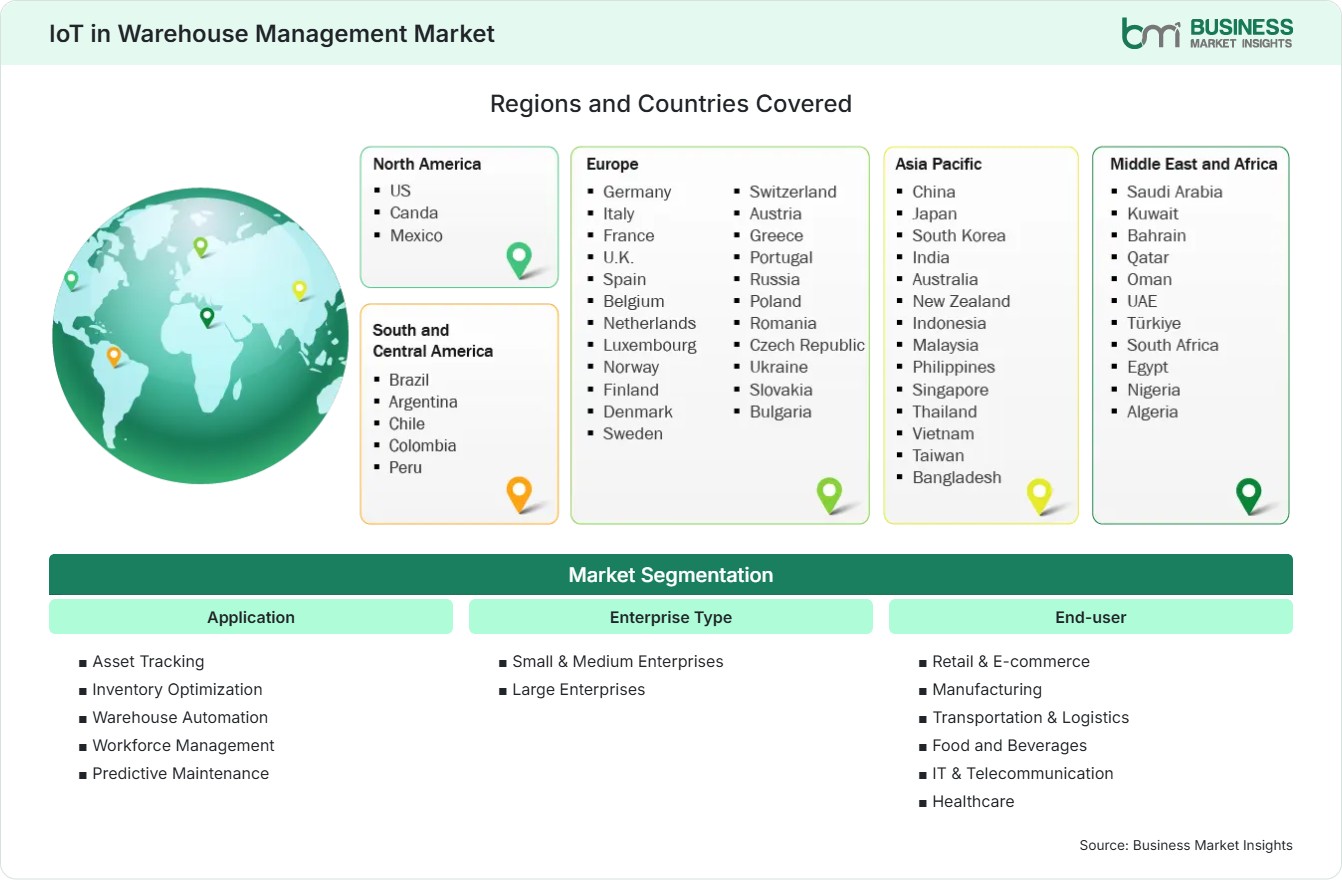
North America represents 34%–37% of global demand in 2025 and advances at a CAGR of 10.5%–11.5% through 2033. The region benefits from widespread cloud adoption, advanced fulfillment infrastructure, and strong investments in automation technologies. The IoT in Warehouse Management Market share remains highest here because enterprises prioritize operational visibility and labor productivity. Large retailers, logistics providers, and manufacturers continue expanding connected warehouse networks to improve throughput, inventory accuracy, and predictive maintenance outcomes. Technology interoperability and analytics maturity strengthen deployment economics across complex supply chains.
- E-commerce fulfillment operators increasingly deploy RFID, machine vision, and real-time location technologies to reduce stock discrepancies and enhance order accuracy.
- Third-party logistics providers are integrating AI and IoT platforms to improve warehouse utilization, labor management, and equipment performance monitoring.
- Labor shortages continue encouraging autonomous technologies and connected workflow systems that improve productivity without proportional workforce expansion.
- Cloud-native warehouse architectures support advanced analytics, digital twins, and predictive maintenance applications across multi-site operations.
US IoT in Warehouse Management Market
The United States accounts for 76%–79% of North American revenue and records a CAGR of 10.8%–11.8%. Investments in warehouse modernization, robotics, and industrial IoT platforms remain robust. Major retailers and logistics companies are implementing connected assets, sensor-rich facilities, and AI-enabled inventory intelligence to support rapid fulfillment requirements. Expanding omnichannel distribution models, combined with growing demand for visibility across supply chains, continue supporting long-term deployment momentum.
- Large fulfillment networks are integrating edge analytics and automation technologies to optimize throughput and asset utilization.
- Cloud service providers are enabling digital twin initiatives and connected warehouse ecosystems with scalable infrastructure.
- Healthcare and food-sector warehousing increasingly relies on environmental monitoring and compliance-focused IoT solutions.
- Asset tracking adoption remains strong due to requirements for real-time equipment, inventory, and pallet visibility.
Europe IoT in Warehouse Management Market
Europe captures 27%–30% share in 2025 and is projected to expand at a CAGR of 10.8%–11.8%. Germany leads regional adoption, while Poland demonstrates among the fastest growth rates near 12.5%–13.5% due to logistics infrastructure expansion. Regulatory focus on supply-chain transparency and sustainability encourages deployment of connected monitoring systems. Warehouses across retail, manufacturing, and transportation sectors increasingly utilize sensor networks, predictive maintenance platforms, and automated inventory technologies to improve operational resilience.
- Germany maintains leadership through advanced manufacturing ecosystems and widespread industrial digitalization initiatives.
- Poland benefits from distribution-center investments supporting European logistics corridors and e-commerce expansion.
- Sustainability regulations encourage energy monitoring and efficiency-focused warehouse technologies.
- Growing adoption of connected forklifts and smart material-handling assets improves equipment lifecycle management.
- Cross-border logistics operations favor interoperable cloud-connected warehouse platforms.
Asia Pacific IoT in Warehouse Management Market
Asia Pacific holds 26%–29% share in 2025 and delivers the strongest CAGR of 13.2%–14.5%. China remains the largest market, while India records high-growth performance around 14.5%–15.5%. Strong manufacturing output, warehouse construction activity, and digital logistics programs underpin expansion. The region contributes significantly to IoT in Warehouse Management Market growth as enterprises modernize facilities to support domestic consumption and export-driven supply chains. Increasing adoption of robotics, cloud platforms, and smart sensors continues accelerating investment.
- China leads demand through manufacturing scale, logistics modernization, and extensive automation deployment.
- India benefits from expanding organized retail, e-commerce infrastructure, and national digitalization initiatives.
- Southeast Asian economies are witnessing increased investments in smart warehousing and connected logistics facilities.
- Automation adoption rises as labor management complexity increases across industrial corridors.
- Government-backed smart industry programs support broader IoT ecosystem development.
Rest of World IoT in Warehouse Management Market
Rest of World contributes 9%–12% share and grows at a CAGR of 11.8%–12.8%. South and Central America benefit from logistics modernization and retail supply-chain investments, particularly in Brazil and Mexico. Meanwhile, Middle East and Africa markets are supported by industrial diversification programs, smart infrastructure initiatives, and growing logistics hubs in the Gulf region.
Regional adoption remains linked to warehouse construction activity and technology investments. Saudi Arabia and the UAE demonstrate notable growth momentum, while Brazil continues leading demand across Latin America. Connected inventory visibility, asset tracking, and warehouse automation solutions are becoming increasingly important competitive differentiators.
- Gulf countries are investing in logistics corridors, free zones, and smart infrastructure supporting connected warehousing.
- Brazil remains the leading Latin American market due to retail modernization and transportation network upgrades.
- Asset-tracking technologies gain traction where inventory shrinkage and visibility challenges remain significant.
- Cloud adoption improves accessibility of advanced warehouse management capabilities across mid-sized enterprises.
- Cross-border trade growth supports demand for real-time warehouse monitoring and inventory optimization solutions.