
Fleet Management Software Market Outlook: Size, Share, Trends, Growth Analysis, Competitive Landscape & Forecast, 2026-2033

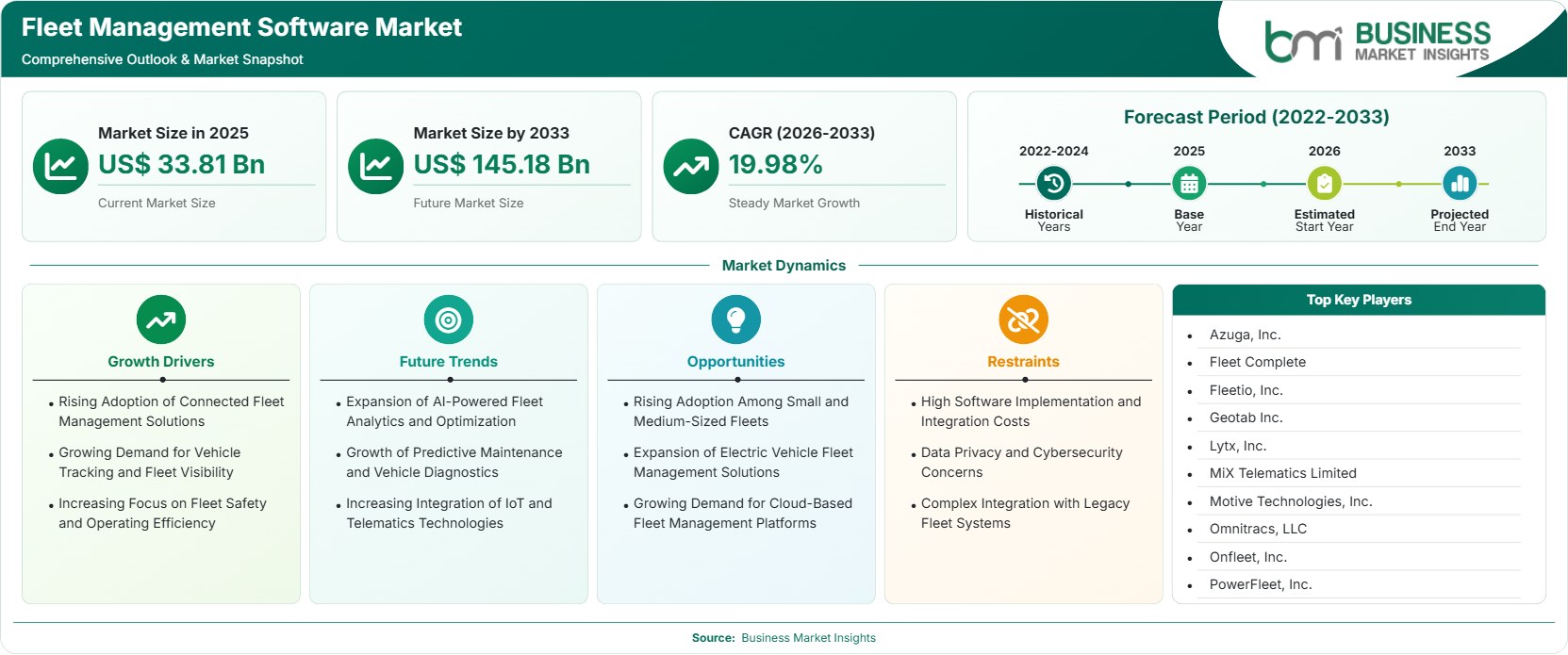
The Fleet Management Software Market size was valued at US$ 33.81 Billion in 2025 and is projected to reach US$ 145.18 Billion by 2033, growing at a CAGR of 19.98% during 2026–2033. Rising adoption of connected fleet technologies, increasing demand for operational efficiency, growing focus on fuel optimization and vehicle safety, and expanding deployment of telematics and cloud-based fleet solutions are supporting market growth globally.

Report Coverage
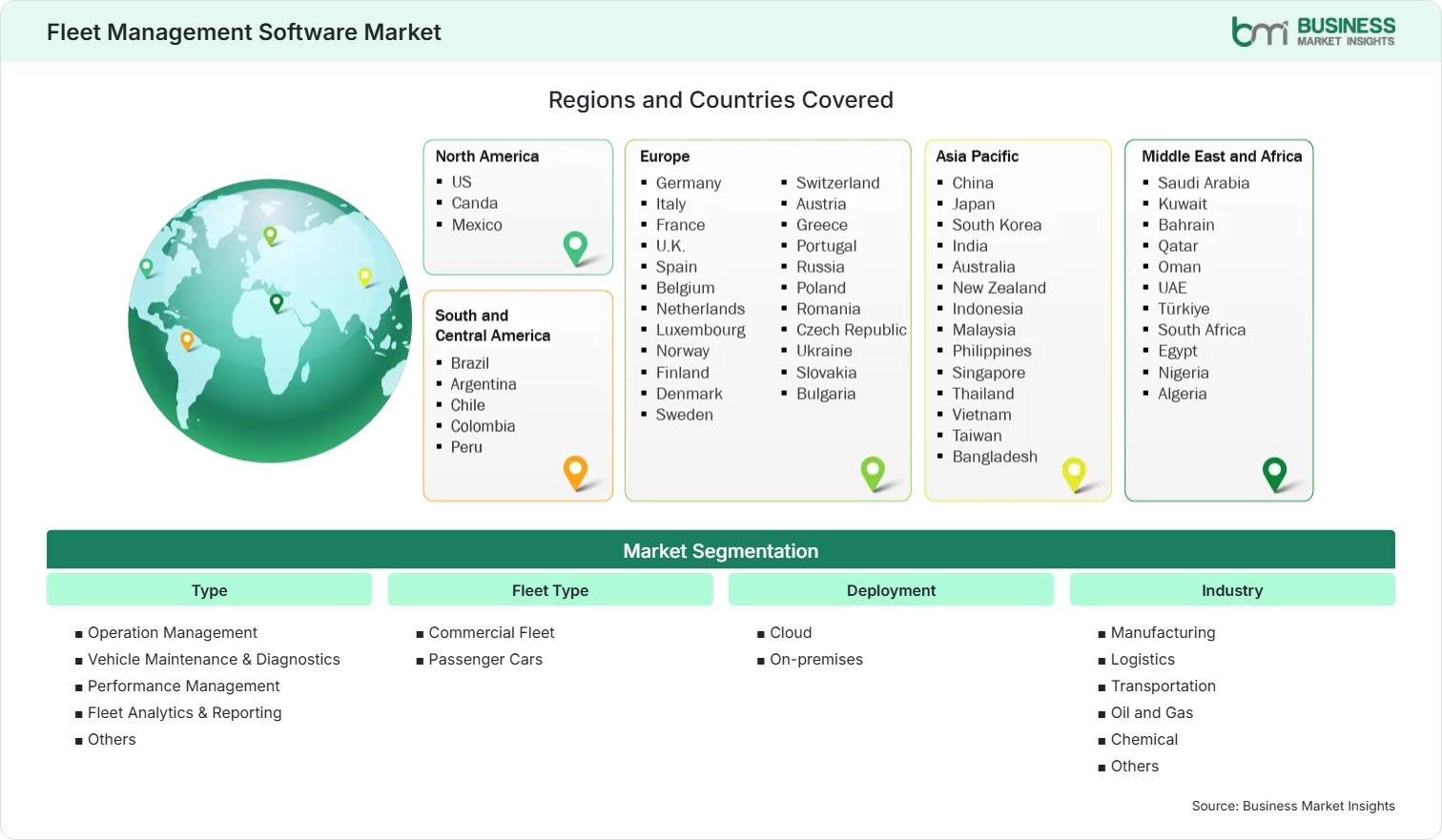
  • Type: Operation Management, Vehicle Maintenance & Diagnostics, Performance Management, Fleet Analytics & Reporting, Others
  • Fleet Type: Commercial Fleet, Passenger Cars
  • Deployment: Cloud, On-premises
  • Industry: Manufacturing, Logistics, Transportation, Oil and Gas, Chemical, Others
US$ 33.81 Bn Market size in 2025
US$ 145.18 Bn Market Size by 2033
19.98% CAGR, 2026 - 2033
2026-2033 Forecast Period

AI Overview

Fleet Management Software Market Summary

  • North America Region: North America holds a market share of 36%–39% in 2025, growing with a CAGR of 19.1%–19.8% during 2026–2033. Strong telematics adoption, high logistics activity, and increasing investments in digital fleet operations continue supporting regional leadership. The U.S. fleet management software market is expected to register a CAGR of 19.3%–20.0%.
  • Fastest Growing Region: Asia Pacific accounts for 29%–32% share in 2025 and is projected to grow at a CAGR of 20.8%–21.5% through 2033. Expanding transportation networks, rapid digital transformation, and growing vehicle fleet sizes continue driving regional growth.
  • Leading Segment: Operation Management represents 27%–30% share in 2025 and is expected to grow at a CAGR of 20.1%–20.8% through 2033. Growing demand for route optimization, dispatch management, and productivity enhancement solutions continues supporting segment dominance.
  • High Growth Segment: Commercial Fleet accounts for 72%–75% share in 2025 and is forecast to grow at a CAGR of 20.4%–21.1% during 2026–2033. Increasing digitization of logistics and transportation operations continues accelerating segment growth.
  • Key Market Opportunity: Expansion of AI-powered fleet analytics, electric vehicle fleet management platforms, predictive maintenance solutions, and cloud-based fleet ecosystems is creating substantial growth opportunities.
  • Major Market Players: Azuga, Inc., Fleet Complete, Fleetio, Inc., Geotab Inc., Lytx, Inc., MiX Telematics Limited, Motive Technologies, Inc., Omnitracs, LLC, Onfleet, Inc., and PowerFleet, Inc.
Strategic Insights

Fleet Management Software Market: Strategic Insights

Fleet Management Software Market Strategic Framework
FREE PDF
Request your free sample
Request free sample
Stakeholder View

Key Takeaways

  • Fleet management software has become a critical component of modern transportation and logistics operations.
  • Operation management solutions continue dominating due to their role in route planning and fleet optimization.
  • Commercial fleets account for the largest share of software adoption globally.
  • Cloud-based platforms are increasingly preferred because of scalability and accessibility benefits.
  • AI and predictive analytics are transforming fleet operations and maintenance practices.
  • North America remains the leading fleet management software market due to strong telematics adoption and logistics activity.
  • Asia Pacific is projected to witness the fastest growth owing to transportation infrastructure expansion.
  • Electric vehicle fleet management solutions are expected to create significant future opportunities.
Geographic Outlook

Fleet Management Software Market Regional Highlights

North America Fleet Management Software Market

North America accounts for 36%–39% Fleet Management Software Market share in 2025 and is projected to grow at a CAGR of 19.1%–19.8% through 2033. The region benefits from extensive adoption of telematics technologies, strong transportation networks, increasing regulatory compliance requirements, and growing investments in connected vehicle ecosystems.

  • Fleet operators increasingly deploy real-time vehicle monitoring solutions to improve fleet visibility, track vehicle locations, monitor driver behavior, and enhance operational control.
  • Logistics companies continue investing in route optimization platforms to reduce travel time, fuel consumption, delivery costs, and operational inefficiencies.
  • Regulatory compliance requirements are accelerating software adoption as fleet operators seek automated reporting, electronic documentation, safety monitoring, and compliance management capabilities.
  • Predictive maintenance technologies remain a major growth area by helping operators identify potential vehicle issues, reduce downtime, and optimize maintenance schedules.
  • Connected fleet solutions continue expanding across transportation, logistics, construction, utilities, and other commercial industries.
  • AI-driven analytics platforms are supporting operational improvements through predictive insights, automated decision-making, and performance optimization.

US Fleet Management Software Market

The United States contributes approximately 89%–93% of North American revenue and is expected to register a CAGR of 19.3%–20.0% through 2033. The country remains the largest market due to advanced telematics infrastructure, strong logistics activity, and increasing emphasis on fleet efficiency and safety.

  • Commercial fleet operators continue expanding digital fleet management capabilities to improve vehicle visibility, operational efficiency, and resource utilization.
  • Demand for compliance and driver management solutions remains strong as businesses focus on regulatory requirements, driver safety, performance monitoring, and risk reduction.
  • Cloud-based deployment models continue witnessing significant adoption due to scalability, remote accessibility, simplified maintenance, and lower infrastructure requirements.
  • Fleet analytics applications are improving operational performance by providing actionable insights into fuel consumption, vehicle utilization, maintenance needs, and route efficiency.
  • Connected mobility initiatives are supporting fleet management software market expansion by enabling real-time communication, vehicle connectivity, automated data collection, and integration with broader transportation management systems.

Europe Fleet Management Software Market

Europe represents 22%–25% of global revenue in 2025 and is anticipated to expand at a CAGR of 19.8%–20.5% through 2033. Growing fleet electrification initiatives, transportation modernization programs, and sustainability goals continue supporting regional growth. Germany remains the leading market while Poland demonstrates stronger growth momentum.

  • Germany continues leading regional demand through advanced transportation infrastructure.
  • Poland is among the fastest-growing markets and is estimated to register a CAGR of 20.7%–21.4% during the forecast period.
  • Fleet operators increasingly utilize performance management solutions.
  • Sustainability objectives are encouraging digital fleet optimization.
  • Connected vehicle technologies continue gaining traction.
  • Transportation companies are increasing software investments.

Asia Pacific Fleet Management Software Market

Asia Pacific accounts for 29%–32% of global revenue in 2025 and is expected to achieve the fastest CAGR of 20.8%–21.5% through 2033. Increasing commercial vehicle deployment, rapid fleet digitization, growing e-commerce logistics networks, and expanding transportation infrastructure continue supporting strong regional growth.

  • China remains the largest regional market due to extensive logistics operations and digital transformation.
  • India is projected to achieve approximately 21.7%–22.4% CAGR, supported by transportation expansion, fleet modernization, and increasing telematics adoption.
  • Logistics providers continue investing in fleet visibility solutions.
  • Cloud-based software deployment remains highly attractive.
  • Growing vehicle populations continue supporting demand.
  • Advanced analytics solutions are increasingly adopted by operators.

Rest of World Fleet Management Software Market

Rest of World accounts for 8%–11% of global revenue in 2025 and is projected to expand at a CAGR of 18.2%–18.9% through 2033. Increasing adoption of connected mobility technologies, transportation modernization efforts, and expanding fleet operations are supporting market growth across Latin America, the Middle East, and Africa.

  • Brazil continues generating demand through logistics and transportation sector growth.
  • The UAE is witnessing increasing adoption of smart fleet management technologies.
  • Saudi Arabia is expected to achieve approximately 19.1%–19.8% CAGR through 2033, supported by digital transformation and transportation modernization initiatives.
  • Fleet operators continue investing in telematics and monitoring technologies.
  • Growing commercial vehicle fleets are supporting software adoption.
  • Data-driven fleet management practices continue creating long-term opportunities.
Global Market Geography
FREE PDF
Request your free sample
Request free sample
Segment Analysis

Fleet Management Software Market Segmentation

Type

The type segment represents the primary software functionalities utilized by fleet operators to improve vehicle utilization, safety, compliance, maintenance, and operational efficiency. This segment accounts for approximately 27%–30% share in 2025 and is projected to grow at a CAGR of 20.1%–20.8% through 2033. The expanding Fleet Management Software Market Scope is supported by increasing telematics adoption, rising digital transformation initiatives, and growing demand for real-time fleet monitoring across transportation-intensive industries.

  • Operation Management: Operation management dominates the market due to extensive usage in route optimization, dispatch planning, scheduling, resource allocation, and fleet utilization improvement.
  • Vehicle Maintenance & Diagnostics: These solutions help organizations minimize downtime, improve asset reliability, and optimize maintenance schedules through predictive diagnostics.
  • Performance Management: Performance management solutions support driver behavior monitoring, fuel efficiency analysis, and productivity enhancement initiatives.
  • Fleet Analytics & Reporting: Analytics platforms provide actionable operational insights, real-time reporting, and performance benchmarking capabilities.
  • Others: Other solutions include fuel management, compliance monitoring, accident management, and asset tracking applications.

Fleet Type

The fleet type segment highlights the major vehicle categories utilizing fleet management software for operational control and performance optimization. This segment accounts for approximately 72%–75% share in 2025 and is expected to register a CAGR of 20.4%–21.1% through 2033. Current Fleet Management Software Market Trends indicate increasing deployment of connected fleet technologies, AI-driven fleet optimization tools, and telematics-based monitoring systems.

  • Commercial Fleet: Commercial fleets dominate the market due to significant adoption across logistics, transportation, manufacturing, utilities, and field service operations.
  • Passenger Cars: Passenger vehicle fleets continue expanding adoption across corporate mobility, rental services, government agencies, and ride-sharing operations.

Deployment

The deployment segment reflects the primary infrastructure models through which fleet management software solutions are delivered and managed. This segment accounts for approximately 61%–64% share in 2025 and is forecast to grow at a CAGR of 21.0%–21.7% through 2033.

  • Cloud: Cloud deployment leads the market owing to scalability, remote accessibility, lower infrastructure requirements, and seamless software updates.
  • On-premises: On-premises solutions remain relevant for organizations seeking greater control over data security, customization, and infrastructure management.

Industry

The industry segment represents the major end-use sectors deploying fleet management software to improve transportation efficiency, operational visibility, and asset utilization. This segment accounts for approximately 31%–34% share in 2025 and is projected to grow at a CAGR of 20.2%–20.9% through 2033.

  • Manufacturing: Manufacturers utilize fleet software to optimize supply chain operations, inventory movement, and distribution efficiency.
  • Logistics: Logistics companies increasingly deploy fleet management platforms to enhance route planning, delivery performance, and operational visibility.
  • Transportation: Transportation operators rely on fleet management solutions to improve compliance, vehicle utilization, and driver productivity.
  • Oil and Gas: Oil and gas companies utilize fleet software for remote asset monitoring, field workforce management, and operational efficiency.
  • Chemical: Chemical manufacturers deploy fleet solutions to improve transportation safety, regulatory compliance, and hazardous material logistics management.
  • Others: Other industries include construction, utilities, mining, retail, and public sector fleet operations.
Market Forces

Fleet Management Software Market Dynamics

Key Market Drivers

Rising Adoption of Connected Fleet Management Solutions

Rise in usage of connected fleets is one of the key factors that will contribute towards increasing demand for fleet management software solutions. Companies are making use of telematics solutions, IoT sensors, GPS systems, and real-time communication solutions in order to increase visibility and make better decisions. Connected solutions can give valuable information on vehicle locations, fleet utilization, fuel usage, and driver behavior. Such information will lead towards improved productivity and decreased cost and downtime for operations. Digital transformation and intelligent transportation management will remain vital factors contributing towards growth in this market.

Growing Demand for Vehicle Tracking and Fleet Visibility

Firms maintaining vehicle fleets need real-time visibility of fleet activities in order to increase operational control and quality of service delivery. Fleet management software helps track the location of the vehicles, their route efficiency, deliveries, and resource utilization. Real-time tracking technology allows firms to optimize their schedules and resolve operational problems faster while improving customer satisfaction levels. Growing demands for increased transparency in logistics and transportation activities are increasing the need for sophisticated tracking technologies. With the increasing complexity of supply chain networks, firms are supposed to make significant investments in fleet visibility and operational technologies.

Increasing Focus on Fleet Safety and Operating Efficiency

Fleet operators are increasingly prioritizing safety, compliance, and efficiency to reduce risks and improve profitability. Fleet management software provides tools for monitoring driver behavior, vehicle health, maintenance requirements, fuel consumption, and operational performance. These capabilities enable organizations to reduce accidents, minimize maintenance expenses, improve fuel efficiency, and ensure regulatory compliance. Growing focus on operational excellence and risk reduction is encouraging wider adoption of intelligent fleet management platforms. As organizations seek sustainable ways to improve performance and protect assets, investments in fleet safety and efficiency solutions are expected to continue increasing.

Key Market Opportunities

Rising Adoption Among Small and Medium-Sized Fleets

Small and medium-sized fleet operators are increasingly adopting digital fleet management solutions to improve competitiveness and operational efficiency. Cloud-based software platforms have reduced implementation complexity and improved affordability, making advanced fleet technologies accessible to a broader user base. These organizations are recognizing the benefits of real-time monitoring, route optimization, predictive maintenance, and automated reporting capabilities. Growing awareness regarding efficiency improvements and cost savings is accelerating adoption across smaller fleet segments. As software providers continue developing scalable and user-friendly solutions, significant market opportunities are expected to emerge within this underserved customer group.

Expansion of Electric Vehicle Fleet Management Solutions

The growing transition toward electric fleets is creating new opportunities for specialized fleet management platforms. Electric vehicle operators require advanced software capable of monitoring battery performance, charging infrastructure utilization, energy consumption, range management, and fleet availability. Organizations adopting electric mobility solutions are increasingly seeking integrated platforms that support both conventional and electric vehicle operations. As fleet electrification initiatives accelerate across logistics, transportation, public services, and corporate mobility sectors, software providers are expected to benefit from rising demand for EV-specific fleet management capabilities and analytics solutions.

Growing Demand for Cloud-Based Fleet Management Platforms

Cloud-based fleet management platforms continue gaining popularity due to their scalability, accessibility, and cost-efficiency advantages. Organizations can manage geographically dispersed fleets through centralized platforms while benefiting from real-time data synchronization and continuous software updates. Cloud deployments also support integration with telematics systems, analytics tools, and enterprise applications. Increasing demand for flexible and remote fleet management capabilities is encouraging businesses to transition away from traditional infrastructure models. Long-term Fleet Management Software Market Forecast projections remain highly favorable as cloud technologies continue becoming the preferred deployment model across fleet-intensive industries.

Market Restraints and Challenges

High Software Implementation and Integration Costs

Factor: Deployment of fleet management software often requires investments in telematics hardware, software licenses, system integration, training programs, and ongoing support services. Large fleet operations may also require significant customization and infrastructure upgrades.

Impact: High implementation costs can create adoption barriers for smaller organizations and budget-constrained fleet operators. Financial considerations may delay digital transformation initiatives and reduce deployment scope in certain industries and regions.

Data Privacy and Cybersecurity Concerns

Factor: Fleet management platforms collect large volumes of operational, location-based, and driver-related data through connected devices and telematics networks. This creates concerns regarding data security, privacy protection, and unauthorized access.

Impact: Cybersecurity risks and regulatory compliance requirements may increase operational complexity and implementation costs. Organizations must invest in secure data management practices and cybersecurity solutions, which can influence adoption decisions and long-term technology strategies.

Company Analysis

Competitive Landscape

The Fleet Management Software Market Analysis is characterized by intense competition among telematics providers, fleet analytics companies, cloud software developers, and connected mobility solution providers. Market participants are focusing on AI-driven fleet intelligence, predictive maintenance platforms, vehicle tracking technologies, driver safety monitoring systems, and cloud-based fleet management solutions to strengthen their market positions. Rising demand for operational efficiency, increasing adoption of connected vehicle technologies, and growing emphasis on fleet safety and compliance continue driving innovation across the market. Companies are investing in real-time analytics, electric vehicle fleet management capabilities, automation technologies, and integrated mobility platforms to address evolving fleet operator requirements.

Company Name

Overview

Products and Services relevant to this market

Azuga, Inc.

Fleet management and telematics solutions provider serving commercial fleet operators.

Fleet tracking, driver behavior monitoring, safety solutions, and fleet management software.

Fleet Complete

Connected fleet and asset management technology company.

Fleet management platforms, vehicle tracking solutions, telematics systems, and mobility management services.

Fleetio, Inc.

Fleet maintenance and operations software provider.

Fleet maintenance management, vehicle diagnostics, fleet reporting, and operational management software.

Geotab Inc.

Global telematics and connected vehicle technology company.

Fleet tracking, telematics platforms, fleet analytics, compliance solutions, and connected mobility technologies.

Lytx, Inc.

Fleet safety and video telematics company.

Driver safety monitoring, video telematics, fleet analytics, and risk management solutions.

MiX Telematics Limited

Fleet and mobile asset management solutions provider.

Fleet tracking, telematics services, vehicle performance monitoring, and compliance management solutions.

Motive Technologies, Inc.

Technology company providing fleet operations and safety solutions.

Fleet management software, driver safety systems, vehicle tracking, and compliance management platforms.

Omnitracs, LLC

Transportation technology and fleet intelligence provider.

Fleet management platforms, route optimization tools, telematics systems, and transportation management solutions.

Onfleet, Inc.

Delivery management and logistics software company.

Route planning software, fleet tracking platforms, delivery management tools, and logistics optimization solutions.

PowerFleet, Inc.

Fleet intelligence and asset management technology provider.

Fleet management software, IoT-enabled tracking systems, telematics platforms, and operational analytics solutions.

Trust & Transparency

Research Methodology

The market analysis combines proprietary research with secondary data from government agencies, company disclosures, regulatory filings, industry databases and expert interviews. Market estimates are validated through data triangulation, cross-market benchmarking and analyst review.

View Full Research Methodology

Questions Answered

Frequently Asked Questions

How is cloud deployment influencing the fleet management software industry?

Cloud deployment is accelerating market adoption by providing scalable infrastructure, real-time accessibility, lower implementation costs, centralized fleet visibility, and seamless integration with telematics and analytics platforms.

What does this Fleet Management Software Market Report cover?

This report covers type analysis, fleet type assessment, deployment evaluation, industry analysis, regional trends, competitive landscape analysis, market drivers, opportunities, restraints, challenges, and future growth prospects through 2033.

Why does Commercial Fleet lead the market?

Commercial fleets lead the market because logistics, transportation, manufacturing, and service companies increasingly rely on fleet management software to optimize operations, reduce costs, and improve productivity.

Which type segment dominates the market?

Operation Management dominates the market due to its extensive use in route planning, dispatch management, scheduling optimization, fleet utilization improvement, and operational efficiency enhancement.

What is driving growth in the Fleet Management Software market?

Rising adoption of connected fleet management solutions, growing demand for vehicle tracking and fleet visibility, increasing focus on fleet safety and operating efficiency, and expanding telematics adoption are major factors driving market growth.

Access the Full Fleet Management Software Market Report

Get segment-level forecasts, regional estimates, competitive benchmarking, company profiles and downloadable Excel datasets.

Access the full Fleet Management Software Market Report
350 pages PDF & Excel | 2026-08-20
Similar Research

Related Market Reports