
Autonomous Driving Software Market Outlook: Size, Share, Trends, Growth Analysis, Competitive Landscape & Forecast, 2026-2033

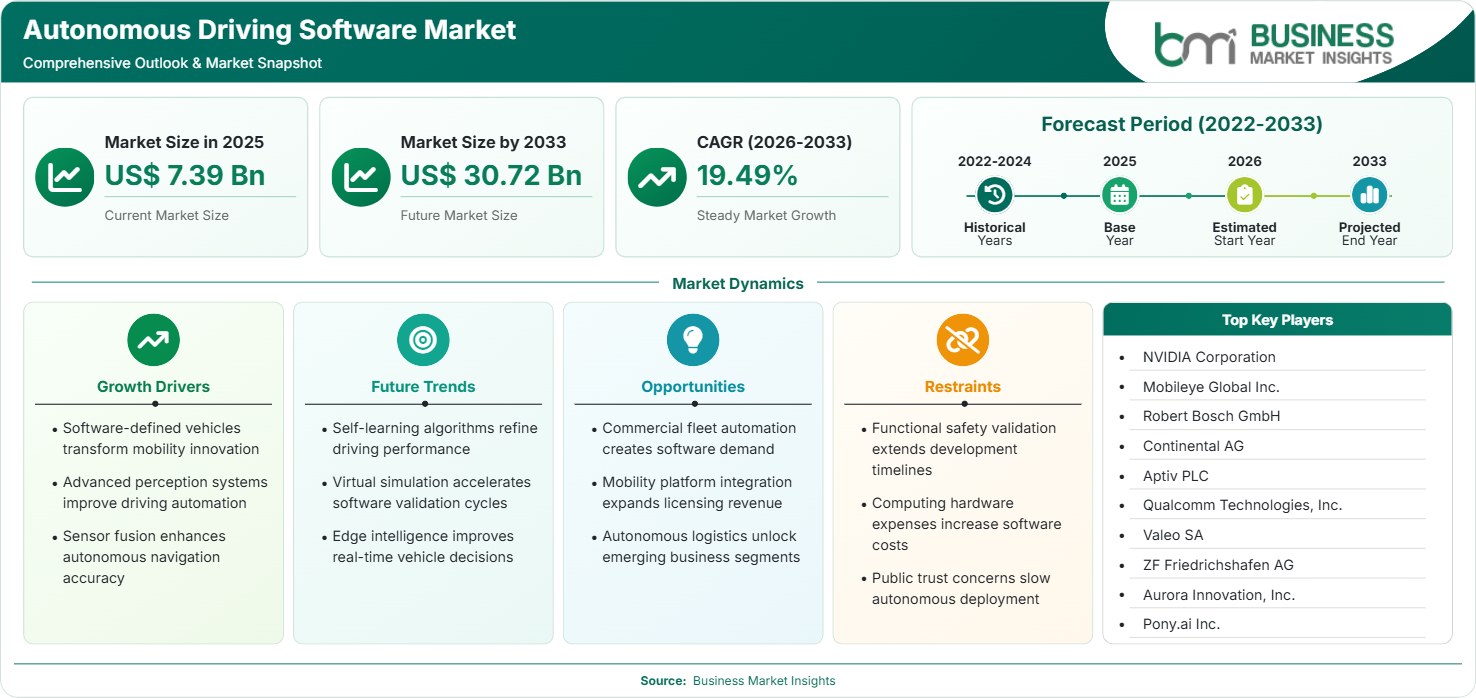
The Autonomous Driving Software Market size was valued at US$ 7.39 billion in 2025 and is projected to reach US$ 30.72 billion by 2033, growing at a CAGR of 19.49% during 2026–2033. Rising software-defined vehicle adoption, continuous advancements in perception technologies, and increasing investments in intelligent mobility platforms are creating substantial opportunities across passenger and commercial vehicle applications.

Report Coverage
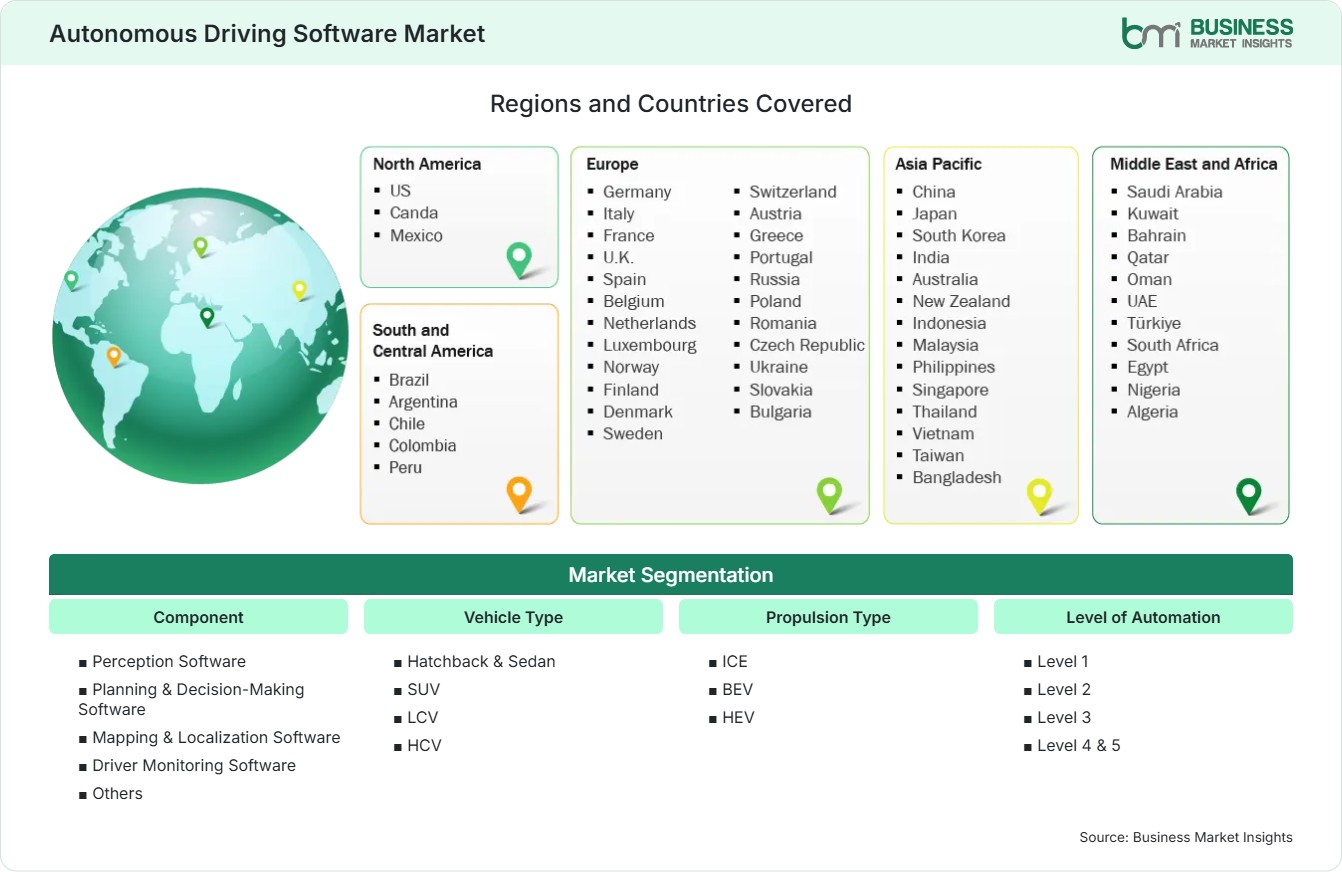
  • Component: Perception Software, Planning & Decision-Making Software, Mapping & Localization Software, Driver Monitoring Software, Others
  • Vehicle Type: Hatchback & Sedan, SUV, LCV, HCV
  • Propulsion Type: ICE, BEV, HEV
  • Level of Automation: Level 1, Level 2, Level 3, and Level 4 & 5
  • Deployment Mode: On-Premises, Cloud-Based
US$ 7.39 Bn Market size in 2025
US$ 30.72 Bn Market Size by 2033
19.49% CAGR, 2026 - 2033
2026-2033 Forecast Period

AI Overview

Autonomous Driving Software Market Summary

  • North America Region: North America holds 35%–38% market share in 2025 and is projected to expand at a CAGR of 18.8%–19.5% during 2026–2033. Strong autonomous vehicle testing, advanced semiconductor capabilities, and increasing software investments continue supporting regional leadership. The U.S. represents the largest market with a CAGR of 18.9%–19.6%, driven by autonomous mobility pilots, AI innovation, and collaborations between automotive manufacturers and technology companies.
  • Fastest Growing Region: Asia Pacific accounts for 29%–32% market share in 2025 and is expected to register the fastest CAGR of 20.8%–21.6%, supported by smart mobility initiatives, expanding electric vehicle production, and government-backed autonomous driving programs.
  • Leading Segment: Planning & Decision-Making Software captures 28%–31% market share in 2025 and is projected to grow at a CAGR of 19.9%–20.6%, supported by continuous improvements in artificial intelligence algorithms, route optimization, and vehicle control systems.
  • High Growth Segment: Level 4 & 5 automation represents 17%–20% market share in 2025 and is anticipated to register the highest CAGR of 24.5%–25.3%, driven by robotaxi deployments, commercial autonomous fleets, and smart city mobility programs.
  • Key Market Opportunity: Expanding autonomous logistics, cloud-connected vehicle platforms, and intelligent fleet software continue creating new revenue opportunities for software developers, automotive manufacturers, and mobility service providers.
  • Major Market Players: NVIDIA Corporation, Mobileye Global Inc., Robert Bosch GmbH, Continental AG, Aptiv PLC, Qualcomm Technologies, Inc., Valeo SA, ZF Friedrichshafen AG, Aurora Innovation, Inc., and Pony.ai Inc.
Strategic Insights

Autonomous Driving Software Market: Strategic Insights

Autonomous Driving Software Market Strategic Framework
FREE PDF
Request your free sample
Request free sample
Stakeholder View

Key Takeaways

  • Software development is gaining prominence as a key competitive advantage, as automotive companies focus more on digital car architectures than on traditional hardware innovations.
  • Commercial mobility use cases, such as automated logistics, robotaxis, and fleet management, offer the best long-term business opportunities for software vendors.
  • Artificial intelligence, sensor fusion, and cloud-native vehicle operating systems continue driving innovation in perception, localization, and autonomous decision-making capabilities.
  • Asia Pacific remains the fastest-growing regional investment destination owing to supportive government policies, expanding electric vehicle production, and growing autonomous mobility deployments.
  • Strategic partnerships among semiconductor suppliers, software developers, automotive OEMs, and cloud providers continue accelerating commercialization and reducing technology development risks.
  • Continuous over-the-air software updates and scalable computing platforms are reshaping long-term product lifecycle management across autonomous vehicle ecosystems.
Geographic Outlook

Autonomous Driving Software Market Regional Highlights

North America Autonomous Driving Software Market

North America accounts for 35%–38% Autonomous Driving Software Market share in 2025 and is expected to register a CAGR of 18.8%–19.5% during 2026–2033. Strong investments in artificial intelligence, autonomous vehicle testing programs, semiconductor development, and advanced automotive software continue supporting regional leadership. Technology firms and automotive manufacturers are expanding partnerships to commercialize autonomous driving platforms while improving safety, scalability, and software reliability.

  • Autonomous vehicle pilot programs continue expanding across commercial delivery, passenger mobility, and logistics applications.
  • Semiconductor innovation strengthens computing capabilities required for advanced autonomous driving software.
  • Cloud-based vehicle platforms improve software deployment, diagnostics, and continuous feature enhancement.
  • Collaboration between technology companies and OEMs accelerates commercialization of intelligent driving systems.

US Autonomous Driving Software Market

The United States contributes 84%–87% of North American revenue and is projected to expand at a CAGR of 18.9%–19.6% throughout the forecast period. Continued investment in autonomous mobility startups, AI research, and connected vehicle infrastructure supports rapid software innovation and commercial deployment.

  • Technology companies continue expanding autonomous vehicle testing programs across multiple states.
  • Strong venture capital funding accelerates software innovation and commercialization activities.
  • Cloud computing and AI platforms improve autonomous driving software development efficiency.
  • Regulatory pilot projects support real-world validation of advanced autonomous mobility technologies.

Europe Autonomous Driving Software Market

Europe represents 25%–28% market share in 2025 and is anticipated to expand at a CAGR of 18.3%–19.0% through 2026–2033. Strong automotive manufacturing capabilities, advanced safety regulations, and increasing software integration continue driving regional demand. Germany leads software development activities, while Sweden records the fastest growth through investments in connected mobility, autonomous transport, and intelligent vehicle technologies.

  • Premium automotive manufacturers continue investing in autonomous software platforms.
  • Vehicle safety regulations encourage adoption of advanced driver assistance technologies.
  • Automotive software partnerships strengthen regional innovation capabilities.
  • Smart mobility initiatives support deployment of connected transportation ecosystems.

Asia Pacific Autonomous Driving Software Market

Asia Pacific holds 29%–32% market share in 2025 and is projected to register the fastest 20.8%–21.6% CAGR through 2026–2033. Rapid expansion of electric vehicle production, strong government support for intelligent transportation, and increasing investments in semiconductor manufacturing continue driving market expansion. China leads regional deployment, while South Korea records the fastest growth through advanced automotive electronics and software innovation.

  • Smart city initiatives accelerate deployment of autonomous mobility infrastructure.
  • Automotive OEMs continue integrating AI-powered driving software into next-generation vehicles.
  • Government investments support autonomous vehicle testing and commercialization.
  • Growing semiconductor production strengthens regional autonomous computing capabilities.

Rest of World Autonomous Driving Software Market

The Rest of World region accounts for 6%–9% market share in 2025 and is projected to grow at a CAGR of 18.6%–19.3% during 2026–2033. Expanding intelligent transportation initiatives, connected infrastructure investments, and fleet modernization programs continue supporting adoption across Latin America, the Middle East, and Africa.

  • The UAE leads autonomous mobility pilot programs through smart city investments and connected transport initiatives.
  • Brazil continues expanding intelligent transportation technologies across commercial mobility applications.
  • Fleet digitalization supports increasing software adoption within logistics and transportation sectors.
  • Public-private partnerships accelerate development of autonomous transportation infrastructure across emerging economies.
Global Market Geography
FREE PDF
Request your free sample
Request free sample
Segment Analysis

Autonomous Driving Software Market Segmentation

Component

The component segment represents the technological foundation of autonomous mobility, integrating artificial intelligence, computer vision, sensor processing, and vehicle control software. It accounted for 28%–31% market share in 2025 and is expected to register a CAGR of 19.9%–20.6% during 2026–2033. Continuous innovation in perception algorithms, high-definition mapping, and decision intelligence is expanding the Autonomous Driving Software Market scope, enabling safer and more reliable automated driving across passenger and commercial vehicles.

  • Perception Software: Processes information from cameras, radar, LiDAR, and ultrasonic sensors to identify vehicles, pedestrians, road signs, and surrounding obstacles, enabling accurate environmental awareness under diverse driving conditions.
  • Planning & Decision-Making Software: Holds the largest adoption due to its capability to evaluate traffic conditions, predict vehicle movements, optimize routes, and execute safe driving decisions in real time.
  • Mapping & Localization Software: Supports precise vehicle positioning using high-definition maps, GNSS, sensor fusion, and localization algorithms to ensure accurate navigation across complex road networks.
  • Driver Monitoring Software: Gains increasing adoption through advanced camera systems and artificial intelligence that detect driver attention, fatigue, distraction, and occupant behavior to improve overall vehicle safety.

Vehicle Type

Vehicle manufacturers continue integrating autonomous driving software across multiple vehicle categories to improve safety, operational efficiency, and user experience. This segment accounted for 34%–37% market share in 2025 and is projected to register a CAGR of 19.2%–19.9% during 2026–2033. Current Autonomous Driving Software Market trends indicate growing software deployment across both premium passenger vehicles and commercial transportation fleets.

  • Hatchback & Sedan: Continue representing substantial software adoption owing to increasing deployment of advanced driver assistance systems and intelligent driving functions in mainstream passenger vehicles.
  • SUV: Experiences strong demand driven by premium vehicle sales, connected mobility features, and increasing integration of Level 2 and Level 3 autonomous driving technologies.
  • LCV: Commercial fleet operators increasingly adopt autonomous software to improve delivery efficiency, route optimization, fleet safety, and operating cost management across urban logistics.
  • HCV: Heavy commercial vehicles utilize autonomous driving software to enhance highway automation, predictive driving, fuel efficiency, fleet coordination, and long-distance freight transportation.

Propulsion Type

Propulsion technologies influence software architecture, computing integration, and autonomous system performance across modern vehicles. The segment accounted for 45%–48% market share in 2025 and is anticipated to expand at a CAGR of 19.0%–19.7% throughout the forecast period as software becomes increasingly vehicle agnostic.

  • ICE: Continues accounting for significant deployments as automakers integrate advanced driver assistance and semi-autonomous capabilities into existing internal combustion vehicle platforms.
  • BEV: Rapid electrification and centralized vehicle computing architectures accelerate adoption of autonomous software across battery electric vehicles with continuous over-the-air software updates.
  • HEV: Hybrid vehicles increasingly incorporate intelligent driving software to improve safety, energy management, adaptive cruise control, and automated driving capabilities.

Level of Automation

Automation levels determine software complexity, sensor requirements, processing capabilities, and regulatory compliance across autonomous vehicle platforms. This segment accounted for 17%–20% market share in 2025 and is forecast to register the highest CAGR of 24.5%–25.3% during 2026–2033, reflecting increasing commercialization of highly automated mobility solutions.

  • Level 1: Provides driver assistance functions such as adaptive cruise control and lane-keeping support while maintaining continuous driver supervision.
  • Level 2: Combines steering, braking, and acceleration assistance through integrated software platforms while requiring active driver engagement during vehicle operation.
  • Level 3: Enables conditional automation under defined operating environments using advanced perception, decision-making, and safety management software.
  • Level 4 & 5: Represents the fastest-growing category with autonomous mobility solutions supporting robotaxis, logistics vehicles, commercial transportation, and future driverless mobility ecosystems.

Deployment Mode

Deployment strategies are evolving as automotive software increasingly combines onboard computing with cloud-enabled services for continuous updates and data-driven optimization. This segment accounted for 61%–64% market share in 2025 and is projected to grow at a CAGR of 19.4%–20.1% during 2026–2033, supported by increasing software complexity and connected vehicle ecosystems.

  • On-Premises: Remains essential for safety-critical autonomous driving functions requiring ultra-low latency, real-time processing, and continuous vehicle operation without external network dependence.
  • Cloud-Based: Expands rapidly by enabling over-the-air software updates, fleet analytics, simulation, remote diagnostics, high-definition map management, and continuous artificial intelligence model improvements.
Market Forces

Autonomous Driving Software Market Dynamics

Key Market Drivers

Software-defined vehicles transform mobility innovation

The use of software-defined vehicles is transforming car development by focusing on creating value through intelligent software platforms rather than hardware components. The current trend sees automakers incorporating computing systems that can be updated continuously and support functions such as autonomous driving. In addition, these companies are partnering with semiconductor firms and cloud service providers to boost innovation in software. These developments continue supporting Autonomous Driving Software Market growth, creating scalable software ecosystems capable of delivering increasingly sophisticated automated driving capabilities.

Advanced perception systems improve driving automation

Perception software has become one of the most critical components of autonomous driving by enabling vehicles to recognize surrounding objects, traffic conditions, pedestrians, and road infrastructure with greater precision. The artificial intelligence algorithms analyze data received from cameras, radars, LiDAR, and ultrasonic sensors in order to make an environment more aware under different conditions. The advances in deep learning algorithms and processing of sensors in real time increase the accuracy of recognition and decrease the number of false positives. Car industry manufacturers keep making investments in the perception systems.

Sensor fusion enhances autonomous navigation accuracy

Sensor fusion techniques use data from multiple sensors to produce an integrated, accurate picture of the driving environment. By fusing data from cameras, radars, LiDARs, GPS, and Inertial Measurement Units, autonomous software can better estimate its location, detect obstacles, and navigate in different weather and traffic conditions. Development in AI and edge computing is still making improvements in real-time processing. These innovations are influencing Autonomous Driving Software Market trends, enabling safer automated driving and supporting wider deployment of autonomous mobility solutions.

Key Market Opportunities

Commercial fleet automation creates software demand

Transportation service providers are now making greater efforts to develop self-driving vehicles to increase efficiency, reduce labor dependence, enhance safety, and better manage their fleets. Autonomous driving software can help fleet operators plan intelligent routes, drive predictively, optimize fuel use, and control the fleet remotely across logistics, freight transportation, mining, and industrial processes. Autonomous Driving Software Market Forecasts indicate that commercial fleet automation will remain one of the strongest long-term revenue opportunities for software developers and automotive technology providers.

Mobility platform integration expands licensing revenue

The connected mobility platforms are developing new business models for developers of autonomous driving software, including subscriptions, software licensing, fleet management platforms, and a mobility-as-a-service (MaaS) ecosystem. Automotive companies are increasingly incorporating cloud-based solutions, digital vehicle solutions, and smart mobility platforms that enable ongoing software upgrades throughout the vehicle lifecycle. This move towards the recurring software revenues allows software developers to generate revenues from software feature innovations and over-the-air software upgrades.

Autonomous logistics unlock emerging business segments

Self-driving logistics solutions are increasingly being used not only for passenger transportation but also for logistics automation in warehouses, last mile deliveries, industrial mobility and long haul trucking. Software vendors are working on develthat supportving systems that will be able to manage inmous commercial vehicles bothon  in controlled and uncontrolled environments. Investment in smart logistics technology is fueling commercialization trends for these companies. Vendors of scalable software solutions for logistics automation will benefit from increasing demand.

Market Restraints and Challenges

Functional safety validation extends development timelines

Autonomous driving software must comply with rigorous functional safety requirements before commercial deployment across public road networks. Factor: The process of validation, simulation, closed track tests, and real-world testing adds to the complexity of software development and the time taken to develop the software. Impact: The time taken to commercialize products, increased costs of research and development, and the time taken to recoup investment are affected negatively by this factor.

Computing hardware expenses increase software costs

Advanced autonomous driving software requires high-performance processors, artificial intelligence accelerators, graphics processing units, and sophisticated sensor interfaces capable of processing massive volumes of real-time data. Factor: High-quality computers raise the system cost and complexity level for car companies. Impact: Increased car production costs can be a barrier to implementation in certain sensitive vehicle categories and may pose an affordability problem for mass implementation of autonomous car systems worldwide.

Company Analysis

Competitive Landscape

Competition is centered on artificial intelligence, high-performance computing, perception software, and autonomous driving platforms capable of supporting multiple vehicle categories. Autonomous Driving Software Market analysis indicates that leading companies are strengthening their competitive positions through strategic partnerships with automotive OEMs, investments in software-defined vehicle architectures, and continuous innovation in perception, localization, and autonomous decision-making technologies.

Company Name

Overview

Products and Services Relevant to this Market

NVIDIA Corporation

Leading AI computing company providing advanced automotive platforms for autonomous driving and intelligent vehicle development.

DRIVE platform, AI processors, autonomous driving software, simulation tools, perception software, and in-vehicle computing solutions.

Mobileye Global Inc.

Autonomous driving technology company specializing in computer vision and advanced driver assistance solutions for global automotive manufacturers.

EyeQ processors, perception software, mapping technology, autonomous driving platforms, and driver assistance systems.

Robert Bosch GmbH

Global automotive technology supplier developing intelligent mobility solutions and software platforms for connected vehicles.

Autonomous driving software, ADAS technologies, vehicle control systems, perception software, and mobility solutions.

Continental AG

Automotive supplier delivering integrated software and electronic systems supporting automated and connected driving applications.

Autonomous driving software, sensor integration, vehicle computing, ADAS platforms, and intelligent mobility technologies.

Aptiv PLC

Technology company focused on software-defined vehicle platforms and intelligent automotive architectures.

Autonomous driving software, centralized vehicle computing, ADAS solutions, software platforms, and connected mobility technologies.

Qualcomm Technologies, Inc.

Semiconductor and software provider delivering high-performance automotive computing platforms for intelligent vehicles.

Snapdragon Digital Chassis, AI computing platforms, autonomous driving software, connectivity solutions, and automotive processors.

Valeo SA

Automotive technology company developing advanced driver assistance and autonomous mobility solutions worldwide.

Perception systems, parking automation software, LiDAR integration, driver assistance software, and vehicle safety technologies.

ZF Friedrichshafen AG

Global mobility technology company providing autonomous driving systems and intelligent vehicle software platforms.

Autonomous driving software, motion control systems, vehicle electronics, ADAS platforms, and commercial vehicle automation solutions.

Aurora Innovation, Inc.

Autonomous vehicle technology developer focused on scalable self-driving software for commercial transportation.

Aurora Driver platform, autonomous trucking software, perception technology, mapping systems, and fleet automation solutions.

Pony.ai Inc.

Autonomous mobility company commercializing intelligent driving software across passenger and commercial vehicle applications.

Autonomous driving platform, robotaxi software, autonomous trucking solutions, perception systems, and fleet management technologies.

Trust & Transparency

Research Methodology

The market analysis combines proprietary research with secondary data from government agencies, company disclosures, regulatory filings, industry databases and expert interviews. Market estimates are validated through data triangulation, cross-market benchmarking and analyst review.

View Full Research Methodology

Questions Answered

Frequently Asked Questions

What does the Autonomous Driving Software Market Report include?

The Market Report provides comprehensive insights into market dynamics, technology trends, competitive landscape, segmentation, regional outlook, investment opportunities, software innovations, and long-term commercialization prospects.

Which region is expected to experience the fastest growth?

Asia Pacific is projected to record the highest growth due to expanding electric vehicle production, government-backed autonomous mobility initiatives, strong semiconductor manufacturing capabilities, and increasing investments in intelligent transportation infrastructure.

Why are software-defined vehicles becoming increasingly important?

Software-defined vehicles allow continuous over-the-air updates, feature enhancements, centralized computing, and flexible deployment of autonomous capabilities, enabling manufacturers to improve vehicle performance throughout its operational lifecycle.

Which component holds the largest market share?

Planning & Decision-Making Software represents the leading component because it enables route optimization, vehicle control, obstacle avoidance, and intelligent decision-making required for autonomous vehicle operation.

What factors are driving the Autonomous Driving Software Market?

The market is driven by software-defined vehicle development, artificial intelligence adoption, sensor fusion technologies, expanding autonomous mobility programs, and increasing investments in connected vehicle platforms across passenger and commercial transportation.

Access the Full Autonomous Driving Software Market Report

Get segment-level forecasts, regional estimates, competitive benchmarking, company profiles and downloadable Excel datasets.

Access the full Autonomous Driving Software Market Report
350 pages PDF & Excel | 2026-08-25