Highway Driving Assist Market Outlook: Size, Share, Trends, Growth Analysis, Competitive Landscape & Forecast, 2026-2033

Historic Data: 2022-2024   |   Base Year: 2025   |   Forecast Period: 2026-2033
Report Content: Market Scope, Market Segmentation, Market Dynamics, and Competitive Analysis

Report Coverage:
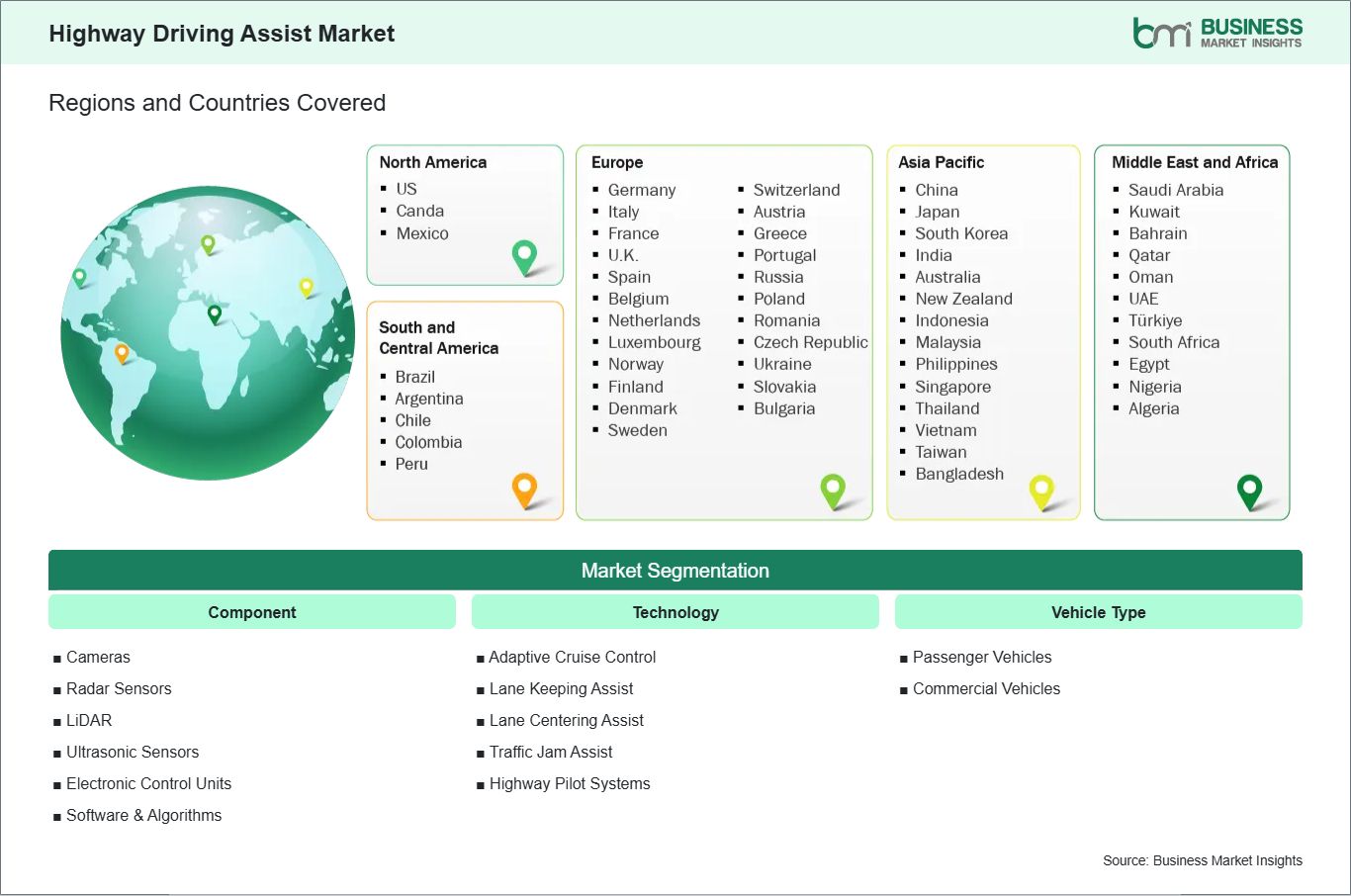
  • Component (Cameras, Radar Sensors, LiDAR, Ultrasonic Sensors, Electronic Control Units (ECUs), Software & Algorithms)
  • Technology (Adaptive Cruise Control (ACC), Lane Keeping Assist (LKA), Lane Centering Assist, Traffic Jam Assist, Highway Pilot Systems)
  • Vehicle Type (Passenger Vehicles, Commercial Vehicles)

No. of Pages: 400
Report Code: BMIPUB00035417
Category: Automotive and Transportation
Highway Driving Assist Market

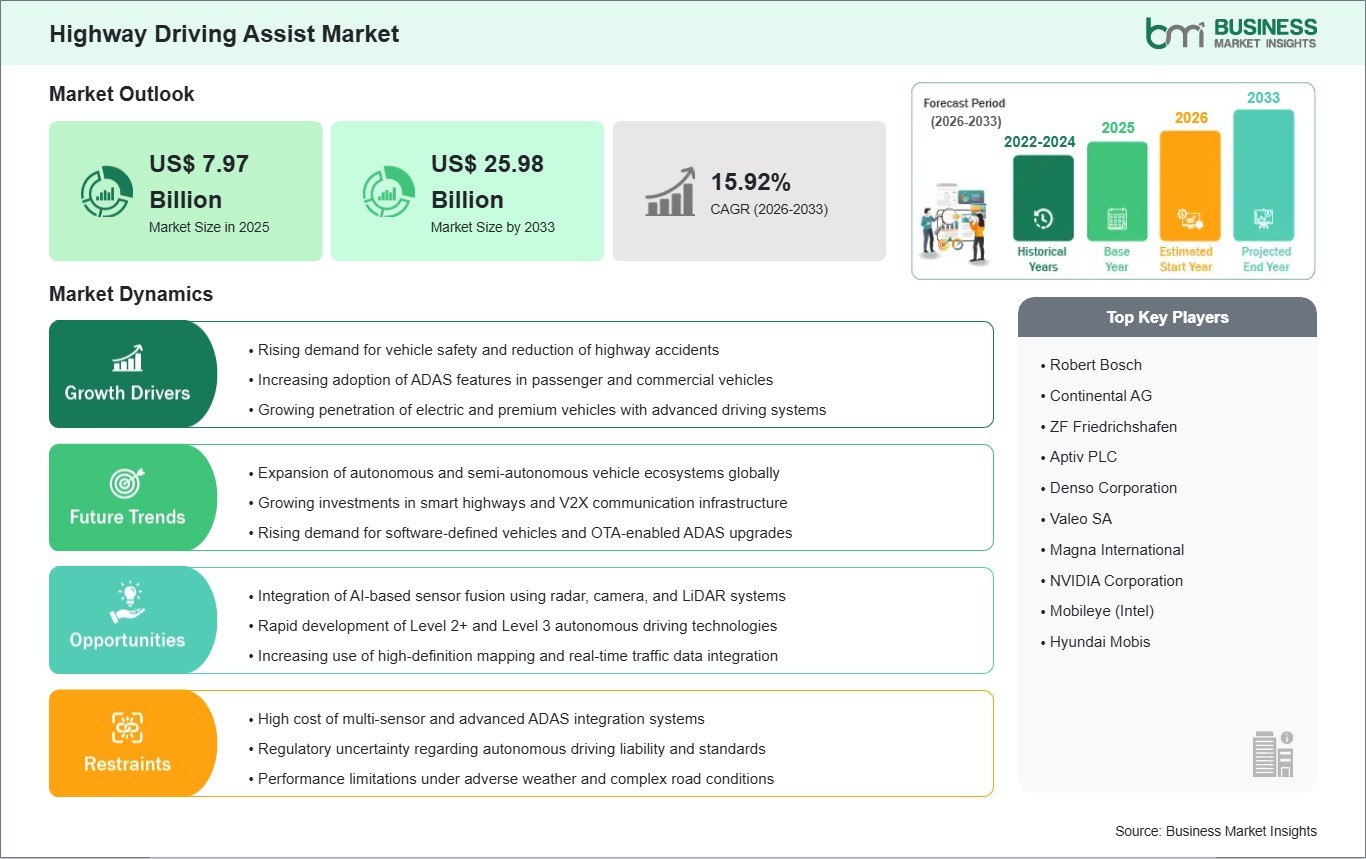
The Highway Driving Assist Market size is expected to reach US$ 25.98 Billion by 2033 from US$ 7.97 Billion in 2025.The market is estimated to record a CAGR of 15.92% from 2026 to 2033.

Executive Summary and Global Market Analysis:

Highway Driving Assist (HDA) Market refers to advanced automotive driver assistance systems designed to support safe, semi-autonomous driving on highways by integrating adaptive cruise control, lane centering, lane keeping assist, traffic-aware speed control, and automated steering assistance. These systems leverage a combination of radar sensors, LiDAR, cameras, ultrasonic sensors, GPS, and AI-powered control algorithms to continuously monitor road conditions, surrounding traffic, and vehicle dynamics. Highway Driving Assist technologies are a key component of Advanced Driver Assistance Systems (ADAS) and are increasingly being integrated into modern passenger vehicles, especially premium cars and electric vehicles. The growing demand for enhanced driving safety, reduced driver fatigue during long-distance highway travel, and improved traffic management efficiency is significantly driving market growth. Additionally, increasing consumer preference for semi-autonomous driving features and rising automotive safety regulations are accelerating the adoption of HDA systems across global automotive markets.

However, several factors may restrain market expansion. High development and integration costs associated with multi-sensor fusion systems, AI-based control units, and high-precision mapping technologies remain a major barrier, particularly in mid-range and economy vehicle segments. The complexity of integrating highway driving assist systems with existing vehicle architectures and ensuring seamless coordination between sensors, ECUs, and software platforms also increases system development challenges. The market is further constrained by regulatory differences across regions regarding autonomous driving capabilities and liability frameworks. In addition, limitations in sensor accuracy under adverse weather conditions such as heavy rain, fog, or snow can impact system reliability and performance. Cybersecurity risks associated with connected and semi-autonomous vehicles also pose growing concerns for OEMs and technology providers.

Despite these challenges, the long-term outlook for the highway driving assist market remains highly positive as the automotive industry transitions toward higher levels of vehicle automation and intelligent mobility ecosystems. Significant opportunities are emerging through the integration of AI-based predictive driving models, sensor fusion technologies, and high-definition mapping systems that enable safer and more precise highway navigation. The rapid expansion of electric vehicles (EVs), autonomous vehicles, and software-defined vehicles is further accelerating demand for advanced driver assistance features such as HDA. Additionally, increasing investments in smart transportation infrastructure and vehicle-to-everything (V2X) communication systems are enabling real-time interaction between vehicles and road environments, improving safety and traffic efficiency. Continuous advancements in radar, camera, and LiDAR technologies are enhancing system accuracy and reliability across diverse driving conditions. Collectively, these developments position the highway driving assist market for sustained long-term growth as a critical enabler of next-generation autonomous and semi-autonomous driving systems..

Highway Driving Assist Market - Strategic Insights:

global-market-strategic-framework
Get more information on this report

Highway Driving Assist Market Segmentation Analysis:

The highway driving assist market is segmented based on component, technology, vehicle type, level of autonomy, and sales channel, reflecting the growing integration of advanced driver assistance systems (ADAS) and semi-autonomous driving technologies in modern vehicles.

By Component

  • Cameras: Used for lane detection, object recognition, and road sign identification to support highway navigation
  • Radar Sensors: Enables adaptive cruise control, collision avoidance, and real-time distance monitoring
  • LiDAR: Provides high-precision 3D mapping and environmental sensing for enhanced highway driving accuracy
  • Ultrasonic Sensors: Supports close-range detection for lane positioning and low-speed maneuvering assistance
  • Electronic Control Units (ECUs): Processes sensor data and executes driving assist functions in real time
  • Software & Algorithms: Includes AI-based decision-making systems, path planning, and predictive driving models

By Technology

  • Adaptive Cruise Control (ACC): Maintains safe distance and adjusts vehicle speed based on traffic conditions
  • Lane Keeping Assist (LKA): Helps keep the vehicle centered within highway lanes
  • Lane Centering Assist: Provides continuous steering support for improved highway driving stability
  • Traffic Jam Assist: Enables semi-automated driving in congested highway traffic conditions
  • Highway Pilot Systems: Advanced automation systems enabling hands-free or partially autonomous highway driving

By Vehicle Type

  • Passenger Vehicles: Includes sedans, hatchbacks, SUVs, and luxury vehicles equipped with ADAS features
  • Commercial Vehicles: Includes trucks and long-haul transport vehicles using driver assist systems to reduce fatigue and improve safety

Highway Driving Assist Market Drivers and Opportunities:

Rising Demand for Advanced Driver Assistance Systems, Road Safety Enhancement, and Driver Comfort in Long-Distance Travel

The Highway Driving Assist Market is primarily driven by the increasing adoption of Advanced Driver Assistance Systems (ADAS) and the growing emphasis on improving road safety, reducing driver fatigue, and enhancing driving comfort during long highway journeys. Highway Driving Assist technologies integrate adaptive cruise control, lane centering, lane keeping assist, and traffic-aware speed management to enable semi-autonomous driving experiences, significantly reducing the cognitive load on drivers. The rising number of road accidents caused by driver fatigue and distraction is compelling automotive manufacturers to integrate intelligent highway driving systems across passenger and commercial vehicles. Additionally, increasing consumer preference for semi-autonomous driving features, especially in premium and electric vehicle segments, is accelerating market adoption. Regulatory initiatives focused on improving vehicle safety standards and reducing highway collision rates are further supporting widespread deployment of HDA technologies.

The growing penetration of electric vehicles (EVs) and software-defined vehicles is also contributing significantly to market expansion, as these platforms are inherently designed to support advanced electronic architectures and AI-based driving assistance systems. Automakers are increasingly integrating multi-sensor fusion systems combining cameras, radar, LiDAR, and ultrasonic sensors to improve system accuracy and reliability in diverse driving conditions. Furthermore, advancements in vehicle connectivity, high-definition mapping, and real-time traffic data integration are enhancing the performance and responsiveness of highway driving assist systems. Collectively, these factors are driving strong and sustained growth in the highway driving assist market as automotive intelligence becomes a core component of modern mobility ecosystems..

Advancements in Autonomous Driving Technologies, Sensor Fusion, and Connected Mobility Ecosystems

Opportunities in the Highway Driving Assist Market are expanding rapidly due to continuous advancements in autonomous driving technologies, artificial intelligence, and connected vehicle ecosystems. The development of Level 2+ and Level 3 autonomous driving systems is significantly increasing demand for sophisticated highway pilot and semi-autonomous driving features capable of handling complex driving scenarios with minimal driver intervention. AI-powered predictive driving models are enabling vehicles to anticipate traffic behavior, optimize lane positioning, and enhance decision-making accuracy in real time.

The increasing deployment of Vehicle-to-Everything (V2X) communication systems is creating new opportunities for highway driving assist technologies by enabling real-time interaction between vehicles, infrastructure, and traffic management systems. This connectivity improves situational awareness, reduces collision risks, and enhances traffic efficiency on highways. Additionally, advancements in LiDAR, high-resolution cameras, and radar technologies are improving environmental perception accuracy under challenging conditions such as low visibility and high-speed traffic. The expansion of smart highway infrastructure, including intelligent traffic systems and connected road networks, is further accelerating adoption. Moreover, the rising integration of over-the-air (OTA) software updates and cloud-based driving analytics is enabling continuous system improvement and feature upgrades. Collectively, the convergence of AI, sensor fusion, connectivity, and autonomous driving technologies is positioning the highway driving assist market for strong long-term growth as a critical enabler of next-generation intelligent mobility solutions.

Highway Driving Assist Market Size and Share Analysis:

The Highway Driving Assist Market is projected to grow from US$ 7.97 Billion in 2025 to US$ 25.98 Billion by 2033 , registering a CAGR of 15.92% from 2026 to 2033.

By component, radar sensors account for a significant share due to their critical role in adaptive cruise control, collision avoidance, and real-time distance measurement at highway speeds. Cameras also hold a strong share as they enable lane detection, object recognition, and road sign identification, which are essential for lane keeping and lane centering functions. LiDAR is witnessing rapid growth due to increasing adoption in advanced semi-autonomous and autonomous driving systems requiring high-precision 3D mapping and environmental perception. ECUs and software & algorithms are expanding significantly as vehicles transition toward software-defined architectures and AI-based decision-making platforms. Ultrasonic sensors continue to play a supporting role, primarily in low-speed and close-range assistance functions.

By technology, adaptive cruise control (ACC) holds a major share as it is one of the most widely deployed highway assistance features across mid-range and premium vehicles. Lane keeping assist (LKA) and lane centering assist are also witnessing strong adoption driven by increasing demand for improved driving stability and safety on highways. Traffic jam assist systems are growing steadily due to rising urban congestion and the need for semi-automated driving in stop-and-go highway traffic conditions. Highway pilot systems represent the fastest-growing segment as automakers move toward Level 2+ and Level 3 autonomous driving capabilities, especially in luxury and electric vehicles.

Highway Driving Assist Market Report Highlights:

Report Attribute Details
Market size in 2025 US$ 7.97 Billion
Market Size by 2033 US$ 25.98 Billion
Global CAGR (2026 - 2033)15.92%
Historical Data 2022-2024
Forecast period 2026-2033
Segments Covered By Component
  • Cameras
  • Radar Sensors
  • LiDAR
  • Ultrasonic Sensors
  • Electronic Control Units
  • Software & Algorithms
By Technology
  • Adaptive Cruise Control
  • Lane Keeping Assist
  • Lane Centering Assist
  • Traffic Jam Assist
  • Highway Pilot Systems
By Vehicle Type
  • Passenger Vehicles
  • Commercial Vehicles
Regions and Countries Covered
North America US, Canada, Mexico
Europe Germany, Italy, France, U.K., Spain, Belgium, Netherlands, Luxembourg, Norway, Finland, Denmark, Sweden, Switzerland, Austria, Greece, Portugal, Russia, Poland, Romania, Czech Republic, Ukraine, Slovakia, Bulgaria
Asia-Pacific China, Japan, South Korea, India, Australia, New Zealand, Indonesia, Malaysia, Philippines, Singapore, Thailand, Vietnam, Taiwan, Bangladesh
South and Central America Brazil, Argentina, Chile, Colombia, Peru
Middle East and Africa Saudi Arabia, United Arab Emirates, Kuwait, Bahrain, Qatar, Oman, Turkiye, South Africa, Egypt, Nigeria, Algeria
Market leaders and key company profiles
  • Robert Bosch
  • Continental AG
  • ZF Friedrichshafen
  • Aptiv PLC
  • Denso Corporation
  • Valeo SA
  • Magna International
  • NVIDIA Corporation
  • Mobileye (Intel)
  • Hyundai Mobis
Get more information on this report

Highway Driving Assist Market Report Coverage and Deliverables:

The "Highway Driving Assist Market Size and Forecast (2022–2033)" report provides a detailed analysis of the market covering below areas:

  • highway driving assist market size and forecast at global, regional, and country levels for all market segments covered under the scope
  • highway driving assist market trends, as well as drivers, restraints, and opportunities
  • highway driving assist market analysis covering key trends, global and regional framework, major players, regulations, and recent developments
  • Industry landscape and competition analysis covering market concentration, heat map analysis, prominent players, and recent developments for the highway driving assist market
  • Detailed company profiles, including SWOT analysis

Highway Driving Assist Market Geographic Insights:

The Highway Driving Assist Market shows strong regional variation driven by ADAS adoption rates, automotive electrification trends, regulatory safety mandates, and the development of autonomous driving ecosystems across major economies.

North America holds a significant share of the highway driving assist market due to the strong presence of advanced automotive OEMs, high consumer adoption of ADAS technologies, and early deployment of semi-autonomous driving features. The United States and Canada are witnessing increasing integration of adaptive cruise control, lane centering assist, and highway pilot systems, particularly in premium vehicles and electric vehicle platforms. The region benefits from advanced road infrastructure, strong connectivity ecosystems, and high investment in autonomous driving research and development. Additionally, increasing regulatory emphasis on vehicle safety and collision prevention is accelerating adoption of highway driving assist systems across passenger and commercial vehicles.

Asia Pacific is the fastest-growing region in the highway driving assist market, driven by rapid automotive production, rising EV adoption, and increasing demand for advanced vehicle safety systems. Countries such as China, Japan, South Korea, and India are witnessing strong growth in ADAS integration across passenger and commercial vehicles. China, in particular, is a major hub for autonomous driving innovation, supported by strong government initiatives, smart highway development, and large-scale investments in connected mobility infrastructure. Japan and South Korea are also leading in advanced sensor technologies and automotive electronics, further driving regional growth. Increasing urbanization, rising disposable income, and growing consumer preference for premium vehicles are accelerating market penetration across Asia Pacific.

Overall, all major regions are contributing to the expansion of the Highway Driving Assist Market, with growth strongly driven by increasing vehicle automation, electrification, and the global transition toward intelligent and connected mobility ecosystems.

global-market-geography
Get more information on this report

Highway Driving Assist Market Research Report Guidance:

  • The report includes qualitative and quantitative data for the highway driving assist market across component, technology, vehicle type, and geography.
  • The report starts with the key takeaways (chapter 2), highlighting the key trends and outlook of the highway driving assist market.
  • Chapter 3 focuses on the research methodology of the study.
  • Chapter 4 includes ecosystem analysis.
  • Chapter 5 highlights the major industry dynamics in the highway driving assist market, including factors that are driving the market, prevailing deterrents, potential opportunities, as well as future trends. Impact analysis of these drivers and restraints is also covered in this section.
  • Chapter 6 discusses the highway driving assist marketscenario, in terms of historical market revenues, and forecast till the year 2033.
  • Chapters 7 to 10 cover highway driving assist marketsegments by technology, vehicle type, application, and geography across North America, Europe, Asia Pacific, Middle East and Africa, and South and Central America. They cover the market revenue, forecast, and factors driving the market.
  • Chapter 11 describes the competitive analysis along with the heat map analysis for the key players operating in the market.
  • Chapter 12 describes the industry landscape analysis. It provides detailed descriptions of business activities such as market initiatives, new developments, mergers, and joint ventures globally, along with a competitive landscape.
  • Chapter 13 provides detailed profiles of the major companies operating in the highway driving assist market. Companies have been profiled on the basis of their key facts, business descriptions, products and services, financial overview, SWOT analysis, and key developments.
  • Chapter 14, i.e., the appendix, is inclusive of a brief overview of the company, list of abbreviations, and disclaimer.

Highway Driving Assist Market News and Key Development:

The highway driving assist market is evaluated by gathering qualitative and quantitative data post primary and secondary research, which includes important corporate publications, association data, and databases. A few of the key developments in the highway driving assist marketare:

  • In May 2026, Stellantis and Wayve announced they have entered a strategic technology partnership under which Stellantis plans to integrate the Wayve AI Driver – Wayve’s automated driving intelligence – into the STLA AutoDrive platform, enabling hands-free, supervised Level 2++ driving in both urban and highway environments.
  • In April 2026, HERE Technologies announced a major milestone in their global collaboration with the debut of Lotus’ first overseas integrated navigation and Highway Navigation on Autopilot (NOA) solution. This launch marks the first time a Chinese automaker has introduced a unified cockpit navigation and Highway NOA system for international markets, signaling a significant step in China’s automotive push toward global innovation leadership.

Key Sources Referred:

  • World Bank – Global Trade Indicators
  • World Trade Organization (WTO)
  • (International Monetary Fund )IMF
  • International Trade Administration (ITA)
  • Company website
  • Company annual reports
  • Company investor presentations
The List of Companies - Highway Driving Assist Market
  • Robert Bosch
  • Continental AG
  • ZF Friedrichshafen
  • Aptiv PLC
  • Denso Corporation
  • Valeo SA
  • Magna International
  • NVIDIA Corporation
  • Mobileye (Intel)
  • Hyundai Mobis
Frequently Asked Questions
How big is the Highway Driving Assist Market?

The Highway Driving Assist Market is valued at US$ 7.97 Billion in 2025, it is projected to reach US$ 25.98 Billion by 2033.

What is the CAGR for Highway Driving Assist Market by (2026 - 2033)?

As per our report Highway Driving Assist Market, the market size is valued at US$ 7.97 Billion in 2025, projecting it to reach US$ 25.98 Billion by 2033. This translates to a CAGR of approximately 15.92% during the forecast period.

What segments are covered in this report?

The Highway Driving Assist Market report typically cover these key segments-

  • Component (Cameras, Radar Sensors, LiDAR, Ultrasonic Sensors, Electronic Control Units (ECUs), Software & Algorithms)
  • Technology (Adaptive Cruise Control (ACC), Lane Keeping Assist (LKA), Lane Centering Assist, Traffic Jam Assist, Highway Pilot Systems)
  • Vehicle Type (Passenger Vehicles, Commercial Vehicles)

What is the historic period, base year, and forecast period taken for Highway Driving Assist Market?

The historic period, base year, and forecast period can vary slightly depending on the specific market research report. However, for the Highway Driving Assist Market report:

  • Historic Period : 2022-2024
  • Base Year : 2025
  • Forecast Period : 2026-2033
  • Who are the major players in Highway Driving Assist Market?

    The Highway Driving Assist Market is populated by several key players, each contributing to its growth and innovation. Some of the major players include:

  • Robert Bosch
  • Continental AG
  • ZF Friedrichshafen
  • Aptiv PLC
  • Denso Corporation
  • Valeo SA
  • Magna International
  • NVIDIA Corporation
  • Mobileye (Intel)
  • Hyundai Mobis
  • Who should buy this report?

    The Highway Driving Assist Market report is valuable for diverse stakeholders, including:

    • Investors: Provides insights for investment decisions pertaining to market growth, companies, or industry insights. Helps assess market attractiveness and potential returns.
    • Industry Players: Offers competitive intelligence, market sizing, and trend analysis to inform strategic planning, product development, and sales strategies.
    • Suppliers and Manufacturers: Helps understand market demand for components, materials, and services related to concerned industry.
    • Researchers and Consultants: Provides data and analysis for academic research, consulting projects, and market studies.
    • Financial Institutions: Helps assess risks and opportunities associated with financing or investing in the concerned market.

    Essentially, anyone involved in or considering involvement in the Highway Driving Assist Market value chain can benefit from the information contained in a comprehensive market report.

    Available Report Formats

    pdf-format excel-format pptx-format
    Buy Now
    Sales Assistance
    +1 646 791 7070 (US & UK)
    Customization Form

    Please tell us your area of interest
    (Market Segments/ Regions and Countries/ Companies)