
Off-Highway Electric Vehicles Market Outlook: Size, Share, Trends, Growth Analysis, Competitive Landscape & Forecast, 2026-2033

Historic Data: 2022-2024   |   Base Year: 2025   |   Forecast Period: 2026-2033
Report Content: Market Scope, Market Segmentation, Market Dynamics, and Competitive Analysis

Report Coverage:
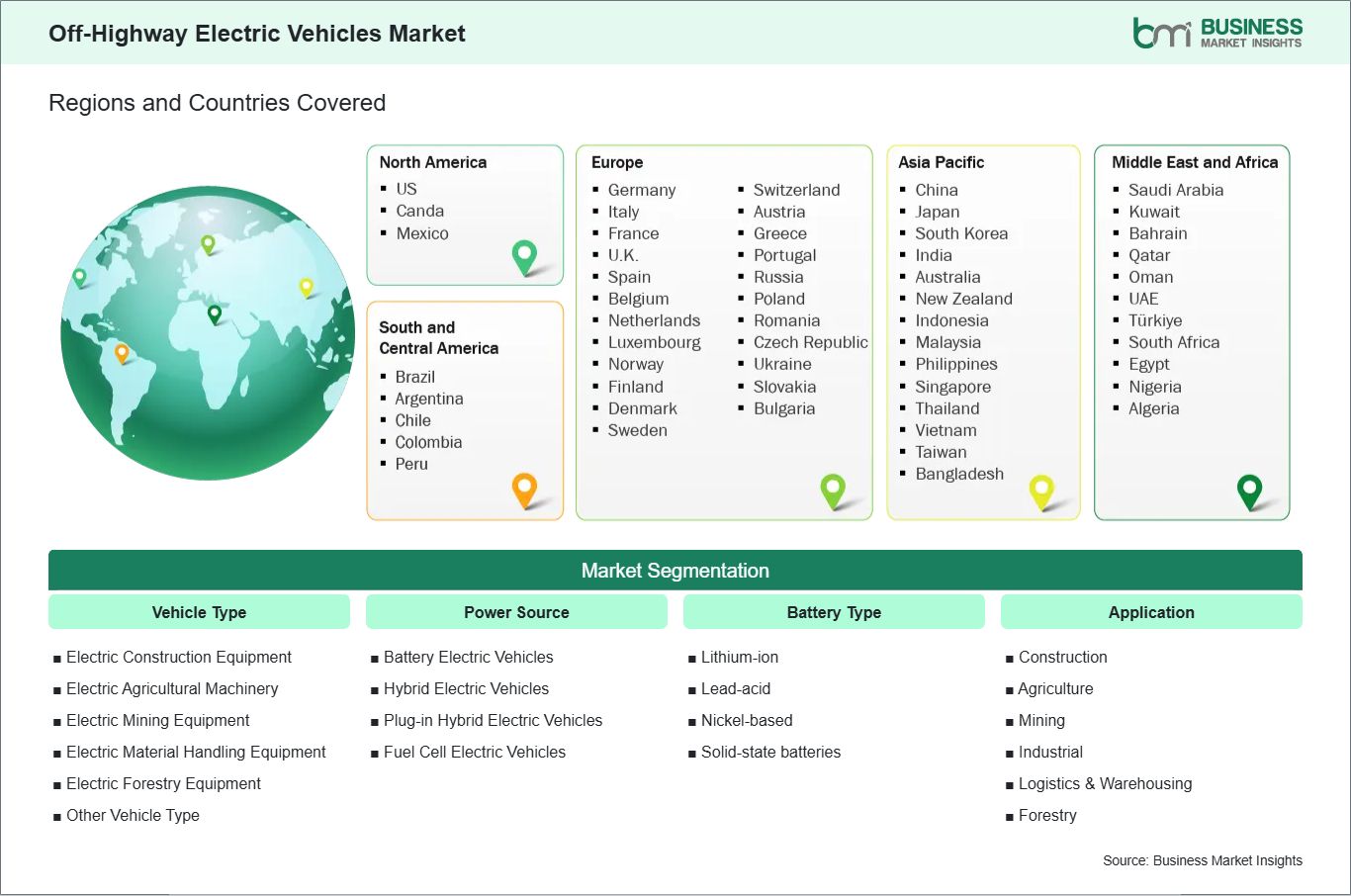
  • Vehicle Type (Electric Construction Equipment, Electric Agricultural Machinery, Electric Mining Equipment, Electric Material Handling Equipment, Electric Forestry Equipment, Other Vehicle Type)
  • Power Source (Battery Electric Vehicles (BEV), Hybrid Electric Vehicles (HEV), Plug-in Hybrid Electric Vehicles (PHEV), Fuel Cell Electric Vehicles (FCEV))
  • Battery Type (Lithium-ion, Lead-acid, Nickel-based, Solid-state batteries)
  • Application (Construction, Agriculture, Mining, Industrial, Logistics & Warehousing, Forestry)

No. of Pages: 400
Report Code: BMIPUB00035389
Category: Automotive and Transportation
Off-Highway Electric Vehicles Market

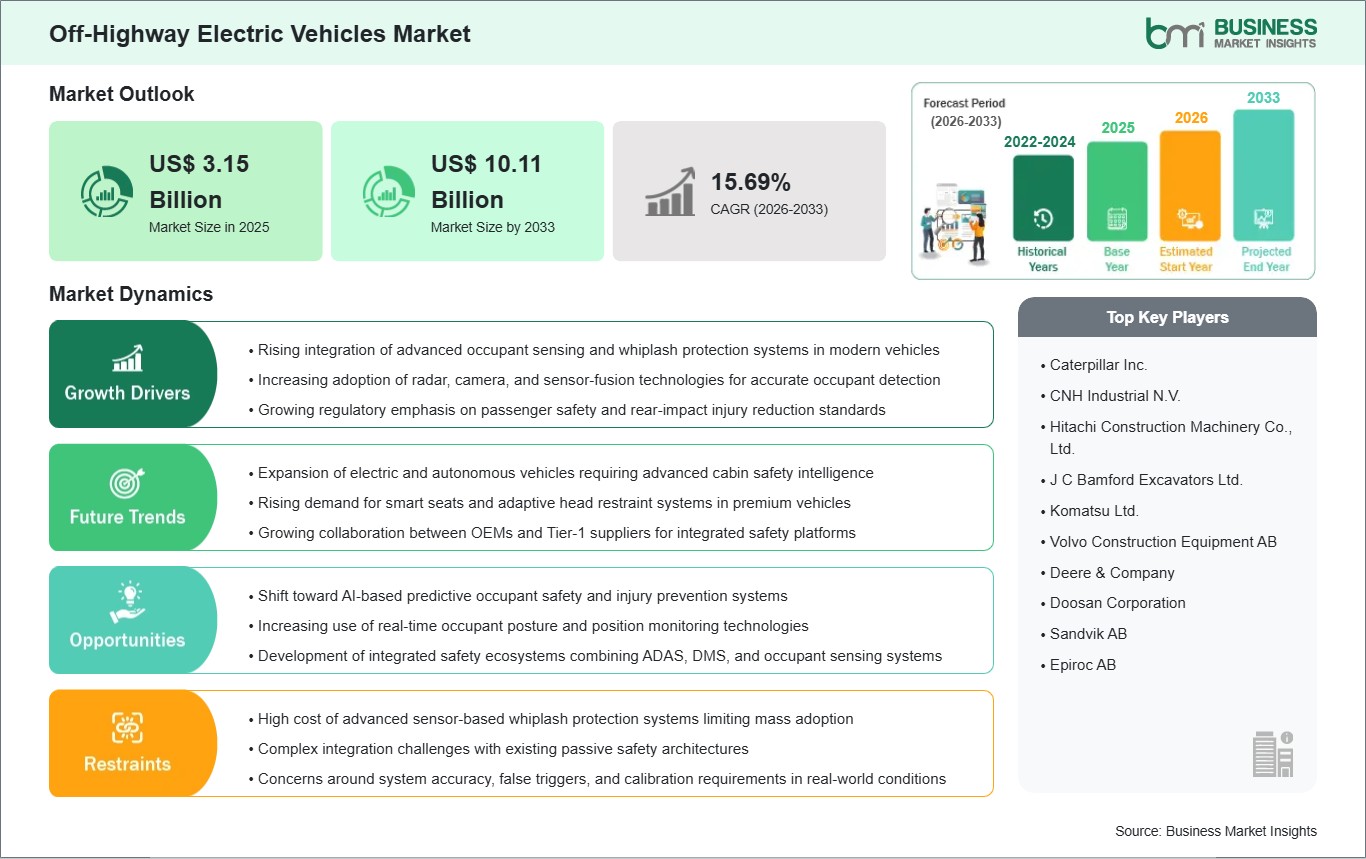
The Off-Highway Electric Vehicles Market size is expected to reach US$ 10.11 Billion by 2033 from US$ 3.15 Billion in 2025.The market is estimated to record a CAGR of 15.69% from 2026 to 2033.

Executive Summary and Global Market Analysis:

Off-Highway Electric Vehicle Market refers to the development and deployment of electric propulsion systems in non-road vehicles such as construction machinery, agricultural equipment, mining trucks, and material handling systems. These vehicles are powered primarily by battery electric, hybrid electric, plug-in hybrid, and fuel cell technologies, supported by high-capacity lithium-ion batteries, advanced power electronics, and electric drivetrains. The market is transitioning from conventional diesel-powered machinery to electrified alternatives that reduce emissions, improve energy efficiency, and lower operating costs. Integration of smart battery management systems, regenerative braking, and IoT-enabled fleet monitoring is further enhancing performance and operational intelligence. Market growth is strongly supported by global decarbonization targets, strict emission regulations for off-highway equipment, rising fuel costs, and increasing adoption of sustainable construction and mining practices, especially in urban infrastructure and industrial automation projects.

However, several factors may restrain market progression. The high upfront cost of electric off-highway vehicles, particularly due to expensive battery systems and power electronics, remains a key barrier to widespread adoption. Limited charging infrastructure in remote construction, mining, and agricultural sites further restricts operational feasibility. Additionally, challenges related to energy density, long charging times, and reduced operational endurance compared to diesel counterparts impact productivity in heavy-duty applications. Harsh operating environments such as extreme temperatures, dust, vibration, and heavy load cycles also create durability and reliability concerns for electric drivetrains and battery packs. Integration complexity with existing fleet ecosystems and concerns over lifecycle battery degradation and replacement costs add further constraints for end users.

Despite these challenges, the market outlook remains highly favorable as industries accelerate electrification to meet sustainability and regulatory targets. Opportunities are emerging through rapid advancements in high-density battery technologies, fast-charging systems, and modular electric powertrains designed specifically for off-highway applications. The development of hybrid electric solutions for heavy-duty operations is enabling a gradual transition pathway for traditional equipment users. Additionally, government incentives, carbon reduction mandates, and green infrastructure investments are driving large-scale adoption across construction and mining sectors. The integration of autonomous off-highway vehicles with electric platforms is also creating new opportunities for efficiency gains and remote operations. Collectively, these developments position the off-highway electric vehicle market for strong long-term growth as a key pillar of sustainable industrial mobility.

Off-Highway Electric Vehicles Market - Strategic Insights:

global-market-strategic-framework
Get more information on this report

Off-Highway Electric Vehicles Market Segmentation Analysis:

The off-highway electric vehicles market is segmented based on vehicle type, power source, battery type, and application, reflecting the rapid electrification of construction, agriculture, mining, and industrial equipment.

By Vehicle Type

  • Electric Construction Equipment: Includes excavators, loaders, dumpers, and cranes powered by electric drivetrains for reduced emissions and improved efficiency in urban construction sites
  • Electric Agricultural Machinery: Covers tractors, harvesters, and farming equipment adopting electric and hybrid systems for sustainable farming operations
  • Electric Mining Equipment: Includes haul trucks, drilling machines, and loaders designed for underground and surface mining with reduced diesel dependency
  • Electric Material Handling Equipment: Comprises forklifts, automated guided vehicles (AGVs), and warehouse equipment used in logistics and industrial operations
  • Electric Forestry Equipment: Includes logging machines and forest harvesters optimized for low-noise and low-emission operations in sensitive environments

By Power Source

  • Battery Electric Vehicles (BEV): Fully electric off-highway machines powered by rechargeable battery systems for zero-emission operations
  • Hybrid Electric Vehicles (HEV): Combine internal combustion engines with electric propulsion for improved fuel efficiency and flexibility in heavy-duty applications
  • Plug-in Hybrid Electric Vehicles (PHEV): Allow external charging with extended electric operation capability for medium-duty off-highway applications
  • Fuel Cell Electric Vehicles (FCEV): Use hydrogen fuel cells to generate electricity, offering long-range and fast refueling for heavy industrial use

By Battery Type

  • Lithium-ion Batteries: Dominant technology offering high energy density, long lifecycle, and fast charging capability
  • Lead-acid Batteries: Cost-effective solution used in light-duty and legacy industrial equipment applications
  • Nickel-based Batteries: Provide durability and stable performance in harsh operating environments
  • Solid-state Batteries: Emerging next-generation technology offering higher safety, energy density, and improved thermal stability

By Application

  • Construction: Electrified machinery used in infrastructure development, urban construction, and smart city projects
  • Agriculture: Electric farming equipment used for plowing, harvesting, and soil management with reduced emissions
  • Mining: Heavy-duty electric vehicles used in underground and surface mining operations for emission-free extraction
  • Industrial: Factory and plant-based electric equipment supporting material movement and production efficiency
  • Logistics & Warehousing: Electric forklifts and automated systems used in storage, distribution, and supply chain operations
  • Forestry: Sustainable forestry equipment used for logging and environmental conservation activities

Off-Highway Electric Vehicles Market Drivers and Opportunities:

Rising Demand for Emission Reduction, Operational Efficiency, and Sustainable Industrial Mobility

The Off-Highway Electric Vehicle market is being driven by increasing global pressure to reduce carbon emissions and transition toward sustainable industrial operations. Governments and regulatory bodies are enforcing stricter emission standards for construction, mining, and agricultural machinery, accelerating the shift away from diesel-powered equipment. Electric off-highway vehicles, powered by battery electric, hybrid, and fuel cell systems, offer significant advantages in terms of lower emissions, reduced fuel dependency, and improved energy efficiency. The growing adoption of green construction practices and sustainable mining operations is further strengthening demand. Additionally, rising fuel costs and the need to reduce total cost of ownership (TCO) are encouraging fleet operators and contractors to adopt electrified alternatives. Integration of advanced battery management systems, regenerative braking, and smart energy optimization technologies is also enhancing operational performance and accelerating market penetration across heavy-duty applications.

Rising Integration of Advanced Electrification Technologies, Automation, and Smart Fleet Ecosystems

Opportunities in the Off-Highway Electric Vehicle market are expanding rapidly due to advancements in high-density battery technologies, fast-charging infrastructure, and modular electric powertrains tailored for heavy-duty applications. The development of next-generation lithium-ion and solid-state batteries is improving energy efficiency, range, and durability in harsh operating environments. Additionally, the integration of IoT-enabled fleet management systems, predictive maintenance, and telematics platforms is enabling real-time monitoring and optimization of equipment performance. The convergence of electrification and automation is creating strong opportunities for autonomous construction and mining equipment, where electric drivetrains support quieter, safer, and more precise operations. Government incentives, carbon neutrality targets, and large-scale infrastructure investments are further accelerating adoption across developed and emerging markets. Moreover, retrofitting of existing diesel-powered machinery with electric drivetrains is emerging as a cost-effective transition pathway, expanding market accessibility. Collectively, these advancements position the Off-Highway Electric Vehicle market for strong long-term growth as a key enabler of sustainable and intelligent industrial mobility.

Off-Highway Electric Vehicles Market Size and Share Analysis:

The Off-Highway Electric Vehicles Market is projected to grow from US$ 3.15 Billion in 2025 to US$ 10.11 Billion by 2033 , registering a CAGR of 15.69% from 2026 to 2033.

By vehicle type, electric construction equipment dominates adoption as it is widely used in infrastructure development, urban construction projects, and smart city initiatives, where low emissions, reduced noise levels, and high operational efficiency are critical requirements. Electric excavators, loaders, and dumpers are increasingly preferred due to stricter environmental regulations and the need to reduce dependence on diesel-powered machinery in densely populated areas.

Electric agricultural machinery is also witnessing strong growth, driven by the shift toward sustainable farming practices, rising fuel costs, and the need for higher energy efficiency in farming operations. Electric tractors, harvesters, and irrigation equipment are being increasingly adopted to support precision agriculture, reduce carbon footprint, and improve long-term operational cost savings for farmers and agribusiness operators..

Off-Highway Electric Vehicles Market Report Highlights:

Report Attribute Details
Market size in 2025 US$ 3.15 Billion
Market Size by 2033 US$ 10.11 Billion
Global CAGR (2026 - 2033)15.69%
Historical Data 2022-2024
Forecast period 2026-2033
Segments Covered By Vehicle Type
  • Electric Construction Equipment
  • Electric Agricultural Machinery
  • Electric Mining Equipment
  • Electric Material Handling Equipment
  • Electric Forestry Equipment
  • Other Vehicle Type
By Power Source
  • Battery Electric Vehicles
  • Hybrid Electric Vehicles
  • Plug-in Hybrid Electric Vehicles
  • Fuel Cell Electric Vehicles
By Battery Type
  • Lithium-ion
  • Lead-acid
  • Nickel-based
  • Solid-state batteries
By Application
  • Construction
  • Agriculture
  • Mining
  • Industrial
  • Logistics & Warehousing
  • Forestry
Regions and Countries Covered
North America US, Canada, Mexico
Europe Germany, Italy, France, U.K., Spain, Belgium, Netherlands, Luxembourg, Norway, Finland, Denmark, Sweden, Switzerland, Austria, Greece, Portugal, Russia, Poland, Romania, Czech Republic, Ukraine, Slovakia, Bulgaria
Asia-Pacific China, Japan, South Korea, India, Australia, New Zealand, Indonesia, Malaysia, Philippines, Singapore, Thailand, Vietnam, Taiwan, Bangladesh
South and Central America Brazil, Argentina, Chile, Colombia, Peru
Middle East and Africa Saudi Arabia, United Arab Emirates, Kuwait, Bahrain, Qatar, Oman, Turkiye, South Africa, Egypt, Nigeria, Algeria
Market leaders and key company profiles
  • Caterpillar Inc.
  • CNH Industrial N.V.
  • Hitachi Construction Machinery Co., Ltd.
  • J C Bamford Excavators Ltd.
  • Komatsu Ltd.
  • Volvo Construction Equipment AB
  • Deere & Company
  • Doosan Corporation
  • Sandvik AB
  • Epiroc AB
Get more information on this report

Off-Highway Electric Vehicles Market Report Coverage and Deliverables:

The "Off-highway Electric Vehicles Market Size and Forecast (2022–2033)" report provides a detailed analysis of the market covering below areas:

  • Off-highway electric vehicles market size and forecast at global, regional, and country levels for all market segments covered under the scope
  • Off-highway electric vehicles market trends, as well as drivers, restraints, and opportunities
  • Off-highway electric vehicles market analysis covering key trends, global and regional framework, major players, regulations, and recent developments
  • Industry landscape and competition analysis covering market concentration, heat map analysis, prominent players, and recent developments for the off-highway electric vehicles market
  • Detailed company profiles, including SWOT analysis

Off-Highway Electric Vehicles Market Geographic Insights:

The Off-Highway Electric Vehicle Market shows diverse regional adoption patterns influenced by rising emission regulations, increasing electrification of construction and mining equipment, and growing demand for sustainable and fuel-efficient industrial machinery across heavy-duty applications.

North America, being a highly advanced industrial and technology-driven region, holds a strong position in the market due to the presence of leading construction equipment manufacturers, mining operators, and agricultural machinery providers. The United States and Canada are witnessing increasing integration of electric off-highway vehicles across construction, material handling, and industrial logistics applications. The region is heavily focused on reducing carbon emissions, improving fuel efficiency, and lowering total cost of ownership in heavy machinery operations. Strong investments in infrastructure development, smart construction projects, and warehouse automation are further supporting market expansion. Additionally, well-established regulatory frameworks promoting zero-emission machinery, along with rapid adoption of battery-electric and hybrid off-highway systems, are accelerating deployment across multiple industrial sectors.

Asia Pacific is experiencing significant growth, driven by rapid industrialization, large-scale infrastructure development, and expanding construction, mining, and agricultural activities. Countries such as China, Japan, South Korea, and India are actively promoting electrification of off-highway vehicles to reduce pollution and improve operational efficiency in dense urban and industrial environments. The region’s strong manufacturing base and cost-competitive battery and electronics ecosystem are enabling large-scale deployment of electric excavators, loaders, forklifts, and mining equipment. The growing demand for logistics expansion, smart agriculture solutions, and sustainable construction practices is further contributing to adoption, particularly in high-growth economies. Additionally, rising investments in battery technology, charging infrastructure, and industrial automation are supporting continuous innovation and market expansion across the region.

Both regions are contributing significantly to the growth of the Off-Highway Electric Vehicle Market, driven by technological advancements, sustainability initiatives, and the accelerating transition toward electrified and low-emission industrial mobility solutions across diverse end-use applications.

global-market-geography
Get more information on this report

Off-Highway Electric Vehicles Market Research Report Guidance:

  • The report includes qualitative and quantitative data for the off-highway electric vehicles market across vehicle type, power source, battery type, application, and geography.
  • The report starts with the key takeaways (chapter 2), highlighting the key trends and outlook of the off-highway electric vehicles market.
  • Chapter 3 focuses on the research methodology of the study.
  • Chapter 4 includes ecosystem analysis.
  • Chapter 5 highlights the major industry dynamics in the off-highway electric vehicles market, including factors that are driving the market, prevailing deterrents, potential opportunities, as well as future trends. Impact analysis of these drivers and restraints is also covered in this section.
  • Chapter 6 discusses the off-highway electric vehicles market scenario, in terms of historical market revenues, and forecast till the year 2033.
  • Chapters 7 to 10 cover off-highway electric vehicles market segments by vehicle type, power source, battery type, application, and geography across North America, Europe, Asia Pacific, Middle East and Africa, and South and Central America. They cover the market revenue, forecast, and factors driving the market.
  • Chapter 11 describes the competitive analysis along with the heat map analysis for the key players operating in the market.
  • Chapter 12 describes the industry landscape analysis. It provides detailed descriptions of business activities such as market initiatives, new developments, mergers, and joint ventures globally, along with a competitive landscape.
  • Chapter 13 provides detailed profiles of the major companies operating in the off-highway electric vehicles market. Companies have been profiled on the basis of their key facts, business descriptions, products and services, financial overview, SWOT analysis, and key developments.
  • Chapter 14, i.e., the appendix, is inclusive of a brief overview of the company, list of abbreviations, and disclaimer.

Off-Highway Electric Vehicles Market News and Key Development:

The off-highway electric vehicles market is evaluated by gathering qualitative and quantitative data post primary and secondary research, which includes important corporate publications, association data, and databases. A few of the key developments in the off-highway electric vehicles market are:

  • Reflecting on India's commitment to address environmental concerns, reduce emission intensity of its gross domestic product (GHG emissions per unit GDP) by 33%–35% over 2005 levels by 2030, and embrace sustainable transportation solutions, electric mobility is emerging as one of the cardinal segments in the automobile industry in India. It is estimated that E-Two Wheelers will reach a market of 5 Mn by 2025, with E-Three Wheelers accounting for 30% of sales. Growing at a compounded annual growth rate of 49% between 2021 and 2030, the government anticipates the EV segment to cross annual sales of 17 Mn units by 2030. To encourage the adoption of electric vehicles, the Government of India initiated the second phase of Faster Adoption and Manufacturing of (Hybrid &) Electric Vehicles in 2019. This initiative spans a period of 5 years, with a total budgetary support of INR 10,000 Cr. The primary focus is on electrifying public and shared transportation, with the aim of providing subsidies for 7262 e-Buses, 1.6 lakh e-3 Wheelers, 30461 e-4 Wheeler Passenger Cars, and 15 lakh e-2 Wheelers. The overall Electric Vehicle penetration of India is projected to grow 8x by 2030 from the current 5%..
  • In October 2025, Electreon (TASE: ELWS) a global leader in wireless electric road technology, announced a historic milestone: the successful launch of the world's first highway that wirelessly charges vehicles in motion. The shared system enables passenger vehicles, vans, buses, and heavy- and medium-duty trucks—to charge simultaneously, creating a universal model for electric mobility and proving that highways themselves can serve as charging assets in the shift to electric travel.

Key Sources Referred:

  • World Bank – Global Trade Indicators
  • World Trade Organization (WTO)
  • (International Monetary Fund )IMF
  • International Trade Administration (ITA)
  • Company website
  • Company annual reports
  • Company investor presentations
The List of Companies - Off-Highway Electric Vehicles Market
  • Caterpillar Inc.
  • CNH Industrial N.V.
  • Hitachi Construction Machinery Co., Ltd.
  • J C Bamford Excavators Ltd.
  • Komatsu Ltd.
  • Volvo Construction Equipment AB
  • Deere & Company
  • Doosan Corporation
  • Sandvik AB
  • Epiroc AB
Frequently Asked Questions
How big is the Off-Highway Electric Vehicles Market?

The Off-Highway Electric Vehicles Market is valued at US$ 3.15 Billion in 2025, it is projected to reach US$ 10.11 Billion by 2033.

What is the CAGR for Off-Highway Electric Vehicles Market by (2026 - 2033)?

As per our report Off-Highway Electric Vehicles Market, the market size is valued at US$ 3.15 Billion in 2025, projecting it to reach US$ 10.11 Billion by 2033. This translates to a CAGR of approximately 15.69% during the forecast period.

What segments are covered in this report?

The Off-Highway Electric Vehicles Market report typically cover these key segments-

  • Vehicle Type (Electric Construction Equipment, Electric Agricultural Machinery, Electric Mining Equipment, Electric Material Handling Equipment, Electric Forestry Equipment, Other Vehicle Type)
  • Power Source (Battery Electric Vehicles (BEV), Hybrid Electric Vehicles (HEV), Plug-in Hybrid Electric Vehicles (PHEV), Fuel Cell Electric Vehicles (FCEV))
  • Battery Type (Lithium-ion, Lead-acid, Nickel-based, Solid-state batteries)
  • Application (Construction, Agriculture, Mining, Industrial, Logistics & Warehousing, Forestry)

What is the historic period, base year, and forecast period taken for Off-Highway Electric Vehicles Market?

The historic period, base year, and forecast period can vary slightly depending on the specific market research report. However, for the Off-Highway Electric Vehicles Market report:

  • Historic Period : 2022-2024
  • Base Year : 2025
  • Forecast Period : 2026-2033
  • Who are the major players in Off-Highway Electric Vehicles Market?

    The Off-Highway Electric Vehicles Market is populated by several key players, each contributing to its growth and innovation. Some of the major players include:

  • Caterpillar Inc.
  • CNH Industrial N.V.
  • Hitachi Construction Machinery Co., Ltd.
  • J C Bamford Excavators Ltd.
  • Komatsu Ltd.
  • Volvo Construction Equipment AB
  • Deere & Company
  • Doosan Corporation
  • Sandvik AB
  • Epiroc AB
  • Who should buy this report?

    The Off-Highway Electric Vehicles Market report is valuable for diverse stakeholders, including:

    • Investors: Provides insights for investment decisions pertaining to market growth, companies, or industry insights. Helps assess market attractiveness and potential returns.
    • Industry Players: Offers competitive intelligence, market sizing, and trend analysis to inform strategic planning, product development, and sales strategies.
    • Suppliers and Manufacturers: Helps understand market demand for components, materials, and services related to concerned industry.
    • Researchers and Consultants: Provides data and analysis for academic research, consulting projects, and market studies.
    • Financial Institutions: Helps assess risks and opportunities associated with financing or investing in the concerned market.

    Essentially, anyone involved in or considering involvement in the Off-Highway Electric Vehicles Market value chain can benefit from the information contained in a comprehensive market report.

    Available Report Formats

    pdf-format excel-format pptx-format
    Buy Now
    Sales Assistance
    +1 646 791 7070 (US & UK)
    Customization Form

    Please tell us your area of interest
    (Market Segments/ Regions and Countries/ Companies)