
Off Highway Vehicle Engine Market Outlook: Size, Share, Trends, Growth Analysis, Competitive Landscape & Forecast, 2026-2033

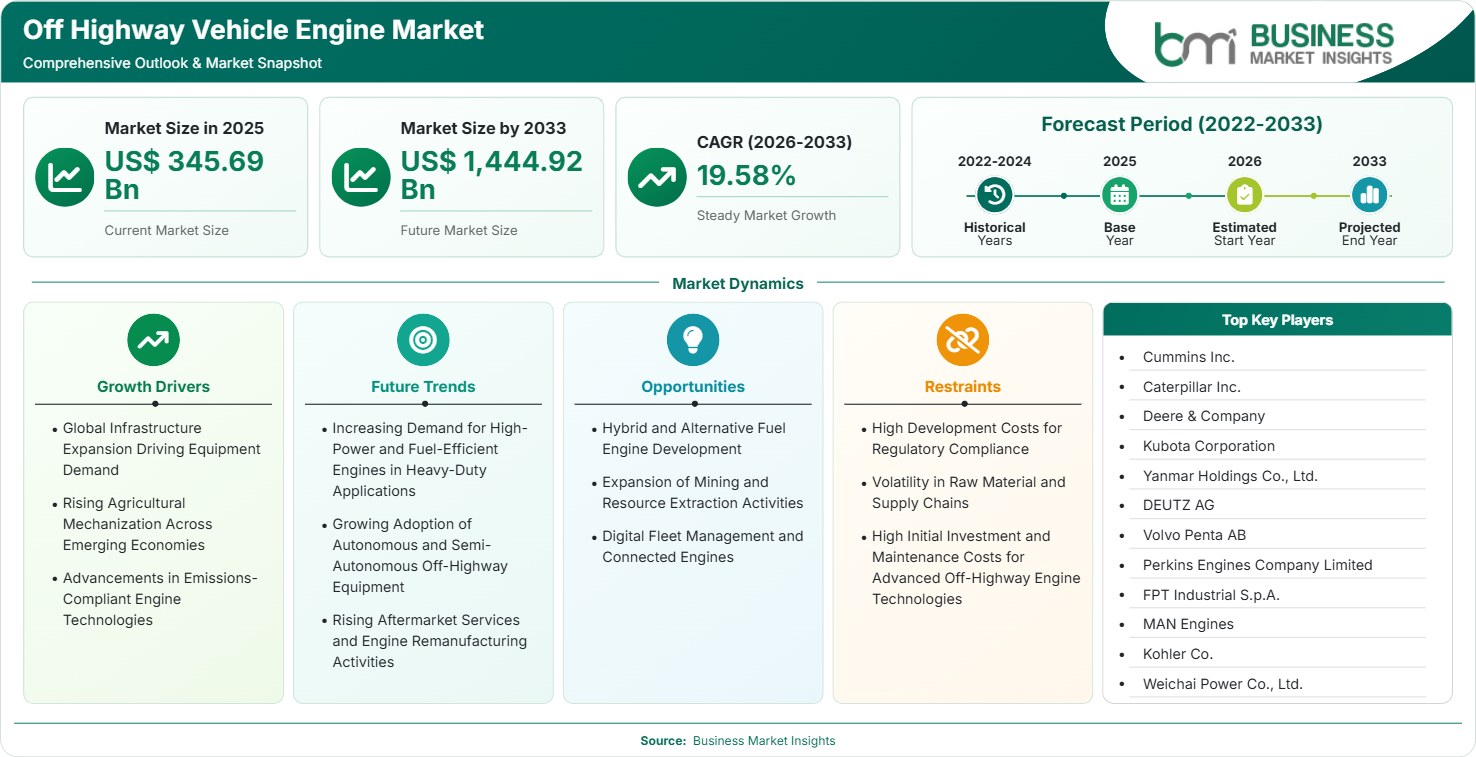
The Off Highway Vehicle Engine Market size was valued at US$ 345.69 Billion in 2025 and is projected to reach US$ 1444.92 Billion by 2033, growing at a CAGR of 19.58% during 2026–2033, driven by rising construction equipment demand, agricultural mechanization, engine efficiency advancements, hybrid powertrain integration, infrastructure investments, and expanding opportunities in emerging economies undertaking large-scale industrial and transportation development projects.

Report Coverage
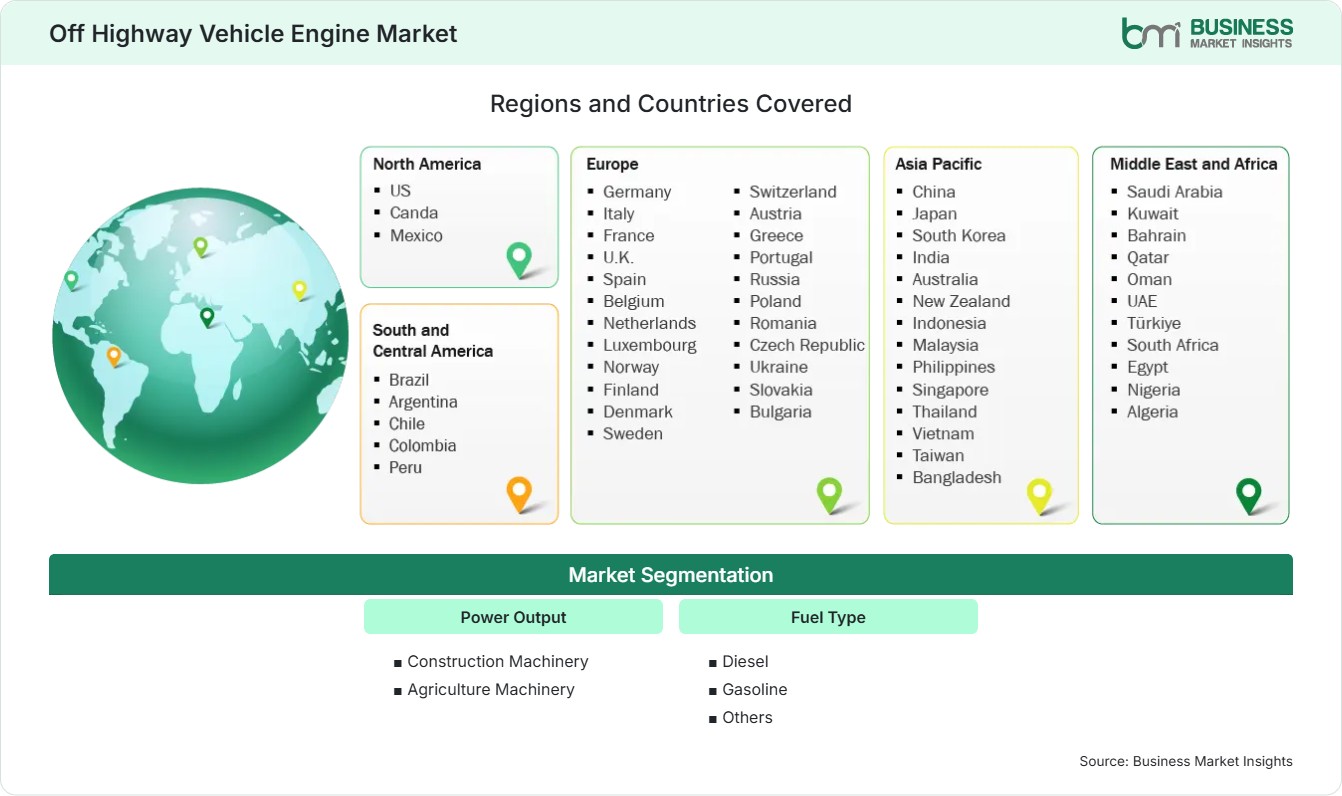
  • Power Output: Construction Machinery, Agriculture Machinery
  • Fuel Type: Diesel, Gasoline, Others
US$ 345.69 Bn Market size in 2025
US$ 1,444.92 Bn Market Size by 2033
19.58% CAGR, 2026 - 2033
2026-2033 Forecast Period

AI Overview

Off Highway Vehicle Engine Market Summary

  • North America Region: North America holds a market share of 33%–36% in 2025, growing at a CAGR of 18.2%–19.1% during 2026–2033. Demand is supported by infrastructure modernization, mining activity expansion, and increasing investments in autonomous heavy equipment platforms across industrial sectors. The U.S. remains the regional leader, supported by large equipment fleets and a CAGR of 18.5%–19.4%.
  • Fastest Growing Region: Asia Pacific holds a market share of 28%–31% in 2025, expanding at a CAGR of 21.0%–22.4% during 2026–2033. Industrialization, urban development projects, and accelerating equipment ownership continue generating strong demand for advanced engine technologies.
  • Leading Segment: Construction Machinery accounts for 58%–61% share in 2025 and advances at a CAGR of 19.0%–20.0%. Infrastructure spending, mining fleet modernization, efficiency gains from high utilization levels, fuel-efficiency considerations, and durability of power solutions support leadership in both advanced and developing economies.
  • High Growth Segment: More than 400 HP construction machinery engines represent a share of 14%–17% in 2025 and expand at a CAGR of 22.0%–23.5%. Large-scale mining operations, mega infrastructure projects, quarry applications, and productivity-focused fleet modernization continue accelerating adoption of high-output engine platforms.
  • Key Market Opportunity: Increase in hybrid and alternative fuel ready engine platforms in construction and agricultural equipment presents opportunities for manufacturers that need to comply with regulations, save on fuel, improve efficiency, and ensure fleet sustainability.
  • Major Market Players: Cummins Inc., Caterpillar Inc., Deere & Company, Kubota Corporation, Yanmar Holdings Co., Ltd., DEUTZ AG, Volvo Penta AB, Perkins Engines Company Limited, FPT Industrial S.p.A., MAN Engines, Kohler Co., Weichai Power Co., Ltd., HD Hyundai Infracore Co., Ltd., Isuzu Motors Limited, and Mitsubishi Heavy Industries Engine & Turbocharger, Ltd.
Strategic Insights

Off Highway Vehicle Engine Market: Strategic Insights

Off Highway Vehicle Engine Market Strategic Framework
FREE PDF
Request your free sample
Request free sample
Stakeholder View

Key Takeaways

  • The value chain is evolving into an integrated structure, with engine producers partnering with equipment OEMs, software providers and emission-control specialists to supply full solutions.
  • High horsepower engines that are utilized in mining operations and large infrastructure machines provide major opportunities as the emphasis of fleet owners lies in productivity improvements.
  • Electronic fuel injection, diagnostics, remote control and hybrid compatibility are redefining the direction of engine production.
  • Asia-Pacific region can be considered a profitable target for investments due to ongoing urbanization, expansion of agricultural mechanization and strong local equipment production facilities.
  • Strategic mergers and alliances are becoming centered on emission control technologies, fleet management and alternative fuel engines.
  • Aftermarket services, remanufacturing programs, and lifecycle maintenance offerings are becoming critical revenue streams as operators seek cost-efficient asset management solutions.
Geographic Outlook

Off Highway Vehicle Engine Market Regional Highlights

North America Off Highway Vehicle Engine Market

North America accounted for approximately 33%–36% of revenue in 2025 and is projected to expand at a CAGR of 18.2%–19.1% through 2033. Large construction equipment fleets, extensive mining activity, and strong agricultural mechanization underpin regional demand. The Off Highway Vehicle Engine Market share remains substantial due to ongoing infrastructure spending and replacement demand. Advanced emissions regulations continue encouraging adoption of efficient engine platforms with digital controls and predictive maintenance capabilities.

  • Federal infrastructure funding continues supporting demand for excavators, loaders, and heavy machinery requiring advanced engine technologies with enhanced fuel economy and reliability.
  • Mining investments in Canada and the United States are stimulating procurement of high-output equipment engines capable of operating in demanding environments.
  • Precision farming technology adoption drives the demand for electronically-controlled engines that enhance equipment productivity and efficiency in fuel consumption.
  • The modernization of fleets places increasing emphasis on engines that comply with emission regulations and include telematic and diagnostic features.

US Off Highway Vehicle Engine Market

The United States represents approximately 72%–76% of regional demand and is anticipated to register a CAGR of 18.5%–19.4% during the forecast period. Robust construction, mining, and agricultural machinery investments remain key drivers of engine demand. Local production capacity and well-established after-sales networks bolster competitiveness and hasten the adoption of advanced powertrain technologies.

  • Major equipment OEMs maintain strong production ecosystems that facilitate innovation and rapid commercialization of advanced engine technologies.
  • Expanding warehouse, logistics, and industrial construction activities increase utilization rates of heavy machinery nationwide.
  • Agricultural productivity initiatives encourage replacement of aging machinery with fuel-efficient and digitally connected equipment.
  • Demand for sustainable operations promotes adoption of biodiesel-compatible and lower-emission engine systems.

Europe Off Highway Vehicle Engine Market

Europe held approximately 24%–27% share in 2025 and is forecast to expand at a CAGR of 17.5%–18.5% through 2033. The area has the advantage of tough emissions standards, good equipment production, and wide acceptance of precise farming technology. Germany still leads in the market, but the Eastern European nations show quicker growth, owing to infrastructural and agricultural improvements.

  • Stage V emission regulations continue driving investments in cleaner and more efficient engine technologies.
  • Germany leads regional equipment manufacturing output and remains a key innovation center for advanced powertrains.
  • Poland and Romania exhibit strong equipment demand linked to infrastructure expansion and industrial development.
  • Agricultural modernization programs support adoption of high-performance engines across farming machinery categories.
  • Growing interest in alternative fuels encourages research into sustainable engine solutions.

Asia Pacific Off Highway Vehicle Engine Market

Asia Pacific accounted for 28%–31% share in 2025 and is projected to grow at a CAGR of 21.0%–22.4% through 2033, making it the fastest-growing region. China remains the largest market, while India demonstrates the highest expansion pace. Rapid industrialization, urban infrastructure projects, and mechanized farming investments continue strengthening Off Highway Vehicle Engine Market growth across diverse end-use industries.

  • China benefits from extensive equipment manufacturing capacity and substantial infrastructure investment programs.
  • India experiences rapid demand growth due to construction expansion and rising agricultural mechanization rates.
  • Southeast Asian economies continue increasing investments in transportation, industrial, and energy infrastructure projects.
  • Localized manufacturing initiatives improve supply chain resilience and reduce equipment procurement costs.
  • Mining activity growth in Australia supports demand for high-horsepower engine platforms.

Rest of World Off Highway Vehicle Engine Market

Rest of World represented approximately 10%–13% of demand in 2025 and is expected to expand at a CAGR of 19.0%–20.2% through 2033. South & Central America benefit from agricultural exports and mining investments, while Middle East & Africa markets are supported by construction activity, energy sector projects, and economic diversification initiatives.

  • Brazil leads regional agricultural equipment demand and supports engine sales through expanding mechanized farming operations.
  • Chile's mining industry continues driving adoption of high-performance engines for heavy-duty applications.
  • Saudi Arabia benefits from large infrastructure developments linked to economic diversification programs.
  • South Africa maintains steady demand associated with mining, agriculture, and industrial machinery utilization.
  • Equipment fleet modernization programs improve adoption of fuel-efficient and digitally enabled engine platforms.
Global Market Geography
FREE PDF
Request your free sample
Request free sample
Segment Analysis

Off Highway Vehicle Engine Market Segmentation

Power Output

Power Output represented approximately 67%–70% market share in 2025 and is anticipated to expand at a CAGR of 19.8%–20.6% through 2033. Factors that contribute to demand include performance specifications of individual machines in the fields of construction and agriculture. The Off Highway Vehicle Engine Market size keeps growing since OEMs continue to develop effective engines designed for different power ratings.

Construction Machinery:

  • Less than 100 HP: Widely used in compact excavators, skid steer loaders, and small construction equipment where fuel efficiency, maneuverability, and lower operating costs remain primary purchasing considerations.
  • 101–200 HP: Supports medium-duty machinery applications including backhoe loaders and compact wheel loaders, offering balanced performance, durability, and operational flexibility across infrastructure and urban construction projects.
  • 201–400 HP: Preferred for heavy-duty construction equipment requiring higher torque output, increased load handling capability, and reliable operation in demanding quarrying and earthmoving environments.
  • More than 400 HP: Utilized extensively in mining trucks, large excavators, and heavy earthmoving equipment where maximum productivity, continuous operation, and superior power delivery are essential.

Agriculture Machinery:

  • Less than 30 HP: Commonly deployed in compact tractors and utility farming equipment serving small agricultural operations, horticulture activities, and mechanization programs in developing markets.
  • 31–50 HP: Supports versatile agricultural applications including tilling, planting, spraying, and transport operations, offering affordability and dependable field performance.
  • 51–80 HP: Increasingly adopted by medium-scale farms requiring enhanced productivity, improved implement compatibility, and greater operational efficiency across diverse farming activities.
  • 81–140 HP: Serves large agricultural enterprises seeking high-performance machinery capable of handling intensive cultivation, harvesting, and field preparation operations.
  • More than 140 HP: Designed for large-scale farming operations requiring advanced power management, superior pulling capacity, and compatibility with sophisticated agricultural implements.

Fuel Type

Fuel Type accounted for approximately 30%–33% market share in 2025 and is expected to register a CAGR of 18.5%–19.4% through 2033. The segment is affected by the changing trend of fuel preference based on operating costs, regulation, and sustainable fuel goals. Off Highway Vehicle Engine Market trends show increasing preference for clean fuels and power alternatives despite diesel still holding the upper hand owing to torque characteristics and established infrastructure.

  • Diesel: Remains the preferred fuel choice for most off-highway applications because of high energy density, strong torque output, proven reliability, and suitability for heavy-duty operating conditions.
  • Gasoline: Primarily used in smaller equipment categories where lower upfront costs, simplified maintenance requirements, and lighter engine configurations provide operational advantages.
  • Others: Includes biodiesel, renewable fuels, natural gas, and emerging alternative energy solutions gaining attention due to emission reduction objectives and sustainability initiatives.
Market Forces

Off Highway Vehicle Engine Market Dynamics

Key Market Drivers

Global Infrastructure Expansion Driving Equipment Demand

Governments worldwide continue allocating significant funds to transport systems, industries, power utilities, and urban development. Multilateral development organizations believe that infrastructure expenditure needs are high for the coming decade, leading to consistent demand for construction equipment. Such a scenario acts as a direct boost for engine sales in several horsepower segments. Market growth is becoming more dependent on major investments in public and private sectors that need heavy machinery. The manufacturers get an advantage due to increased usage, more demands for replacement, and purchase of new equipment to increase efficiency.

Rising Agricultural Mechanization Across Emerging Economies

The need for improved productivity in agriculture is leading to investments in tractors, harvesters, and other machines. Shortage of labor, higher food needs, and efforts from the government for mechanization make farmers purchase machines that help increase efficiencies in their operations. There are clear signs that the Off Highway Vehicle Engine Market trend will continue to experience robust growth in the developing agricultural economies because of lower penetration of machinery than developed economies. Manufacturers are meeting this need by developing fuel-efficient models suitable for different sizes of farms. There is high demand for medium horsepower engines for agriculture equipment.

Advancements in Emissions-Compliant Engine Technologies

Stricter environmental regulations continue accelerating innovation in combustion efficiency, exhaust after-treatment systems, electronic engine management, and fuel injection technologies. Manufacturers are investing heavily in research and development to meet regulatory requirements without compromising performance. Enhanced durability, reduced fuel consumption, and digital diagnostics improve value propositions for fleet operators. Advanced engine platforms support compliance while maintaining operational productivity. Integration of telematics and predictive maintenance capabilities further enhances fleet performance. Growing customer emphasis on lifecycle cost optimization continues strengthening demand for technologically advanced engines across construction, agriculture, forestry, and mining applications.

Key Market Opportunities

Hybrid and Alternative Fuel Engine Development

Hybrid-ready engines and alternative-fuel platforms present a major opportunity as equipment operators pursue sustainability targets without sacrificing operational capability. Investments in biodiesel-compatible engines, renewable fuel technologies, and hybrid powertrain integration are expanding rapidly. Off Highway Vehicle Engine Market Forecasts increasingly highlight low-emission solutions as a strategic growth avenue. Manufacturers capable of balancing power output, fuel efficiency, and regulatory compliance are positioned to secure competitive advantages. Collaboration between engine producers, OEMs, and energy providers is expected to accelerate commercialization of innovative solutions supporting long-term decarbonization objectives while maintaining productivity requirements.

Expansion of Mining and Resource Extraction Activities

Global demand for critical minerals, industrial metals, and energy resources continues supporting mining sector investments. Large-scale extraction projects require high-performance equipment powered by durable engines capable of operating under extreme conditions. Increased spending on mining fleet modernization generates opportunities across high-horsepower engine categories. Equipment operators seek solutions offering superior reliability, fuel efficiency, and reduced maintenance requirements. Emerging mining projects across Latin America, Africa, Australia, and Asia create favorable conditions for engine suppliers. As resource development activities expand, demand for specialized heavy-duty engines is expected to rise substantially.

Digital Fleet Management and Connected Engines

Connected equipment ecosystems are creating opportunities for engine manufacturers to deliver value-added services beyond hardware sales. Telematics-enabled engines generate operational data supporting predictive maintenance, fuel optimization, and performance monitoring. Fleet operators increasingly prioritize technologies that reduce downtime and improve asset utilization. Integration of artificial intelligence, cloud-based analytics, and remote diagnostics enhances operational visibility. Engine suppliers can strengthen customer relationships through subscription-based services and aftermarket support offerings. Growing digitalization across construction, mining, and agriculture sectors supports continued investment in connected engine technologies.

Market Restraints and Challenges

High Development Costs for Regulatory Compliance

Factor: Compliance with increasingly stringent emissions regulations requires substantial investments in engine design, after-treatment technologies, testing procedures, and certification programs. Impact: Rising development expenditures increase production costs and place pressure on manufacturer margins, particularly for smaller suppliers with limited research budgets. Frequent regulatory updates also create complexity in product planning and global market deployment strategies. Balancing compliance requirements with affordability remains challenging as customers continue demanding competitive pricing, fuel efficiency, and operational reliability. These factors may slow commercialization timelines and increase barriers to entry for new market participants.

Volatility in Raw Material and Supply Chains

Factor: Engine production relies on complex supply chains involving metals, castings, semiconductors, electronic components, and specialized manufacturing inputs. Impact: Price fluctuations, geopolitical uncertainties, logistics disruptions, and component shortages can affect production schedules and profitability. Supply chain instability may increase lead times, elevate inventory costs, and delay equipment deliveries. Manufacturers must diversify sourcing strategies and strengthen supplier relationships to mitigate operational risks. Persistent volatility creates uncertainty for both OEMs and end users, influencing purchasing decisions and long-term investment planning across equipment-intensive industries.

Company Analysis

Competitive Landscape

The competitive environment is characterized by continuous innovation, emission-compliant engine development, strategic partnerships, and investments in digital technologies. Off Highway Vehicle Engine Market analysis indicates that leading manufacturers are focusing on fuel efficiency, alternative-fuel compatibility, predictive diagnostics, and high-performance powertrain solutions to strengthen their positions across construction, agriculture, mining, and industrial applications.

Company Name

Overview

Products and Services Relevant to This Market

Cummins Inc.

Global power solutions provider with extensive expertise in diesel, natural gas, hybrid, and advanced engine technologies serving industrial sectors.

High-performance off-highway engines, emission-control systems, connected diagnostics, powertrain integration, and aftermarket support services.

Caterpillar Inc.

Leading manufacturer of heavy equipment and industrial power systems with strong global distribution capabilities.

Construction and mining engines, integrated power solutions, digital fleet technologies, and equipment optimization services.

Deere & Company

Major agricultural and construction equipment producer emphasizing productivity and intelligent machine solutions.

Tractor engines, agricultural power systems, precision farming integration, and advanced equipment technologies.

Kubota Corporation

Japanese manufacturer recognized for compact and medium-duty engine technologies supporting agricultural and industrial equipment.

Diesel engines, agricultural machinery power systems, utility equipment engines, and related services.

Yanmar Holdings Co., Ltd.

Specialist in industrial diesel technologies serving agriculture, marine, and construction equipment markets.

Compact diesel engines, agricultural machinery powertrains, industrial engines, and energy-efficient solutions.

DEUTZ AG

German engine manufacturer focused on efficient and low-emission propulsion technologies for industrial applications.

Diesel, hydrogen-ready, and alternative-fuel engines for construction, agricultural, and industrial equipment.

Volvo Penta AB

Subsidiary of Volvo Group delivering advanced engine and power system technologies globally.

Industrial engines, connectivity solutions, powertrain systems, and lifecycle support services.

Perkins Engines Company Limited

Established supplier of industrial engines serving OEM customers across multiple heavy equipment sectors.

Diesel and gas engines, power generation solutions, and comprehensive aftermarket support.

FPT Industrial S.p.A.

Global powertrain company emphasizing innovation, efficiency, and sustainable propulsion technologies.

Off-highway engines, alternative-fuel solutions, drivetrain systems, and advanced powertrain technologies.

MAN Engines

Provides high-performance industrial and heavy-duty engine solutions for demanding applications worldwide.

Industrial diesel engines, customized propulsion systems, and engineering support services.

Kohler Co.

Diversified industrial manufacturer with a strong portfolio of engines and power equipment products.

Small and medium-duty engines, industrial power systems, and equipment support solutions.

Weichai Power Co., Ltd.

Chinese powertrain leader with extensive manufacturing capabilities and growing global market presence.

Heavy-duty diesel engines, industrial power solutions, and integrated engine technologies.

HD Hyundai Infracore Co., Ltd.

Equipment and engine manufacturer serving construction and industrial machinery customers globally.

Construction equipment engines, industrial power systems, and advanced machinery technologies.

Isuzu Motors Limited

Global producer of diesel engines and commercial vehicle technologies with strong reliability credentials.

Industrial diesel engines, emission-compliant power solutions, and equipment integration support.

Mitsubishi Heavy Industries Engine & Turbocharger, Ltd.

Engineering-focused company delivering advanced propulsion technologies for industrial applications.

Industrial engines, turbocharger systems, energy-efficient technologies, and maintenance services.

Industry Activity

Recent Developments

February, 2026 – DEUTZ AG — Expanded its alternative powertrain strategy through additional investments in hydrogen engine development and off-highway decarbonization technologies aimed at industrial equipment applications.

September, 2025 – Cummins Inc. — Advanced commercialization efforts for fuel-agnostic engine platforms designed to support diesel, natural gas, and lower-carbon fuel pathways across heavy-duty equipment sectors.

May, 2025 – Volvo Penta AB — Introduced enhanced connectivity and service solutions supporting predictive maintenance and fleet performance optimization for industrial equipment operators.

October, 2024 – FPT Industrial S.p.A. — Strengthened its sustainable propulsion portfolio with expanded renewable fuel compatibility initiatives targeting construction and agricultural machinery applications.

Trust & Transparency

Research Methodology

The market analysis combines proprietary research with secondary data from government agencies, company disclosures, regulatory filings, industry databases and expert interviews. Market estimates are validated through data triangulation, cross-market benchmarking and analyst review.

View Full Research Methodology

Questions Answered

Frequently Asked Questions

What insights does an Off Highway Vehicle Engine Market Report provide?

Market Report typically covers competitive positioning, technology developments, demand drivers, regulatory trends, regional opportunities, segmentation performance, investment outlook, and strategic recommendations for industry participants.

How does digital technology influence engine adoption?

Connected engines equipped with telematics, predictive diagnostics, and remote monitoring capabilities help operators reduce downtime, optimize fuel consumption, improve maintenance planning, and enhance overall equipment productivity across multiple industries.

Why are high-horsepower engines gaining traction?

Large-scale mining operations, mega infrastructure projects, and productivity-focused fleet investments require powerful engines capable of handling intensive workloads. These applications prioritize durability, high torque output, and continuous operation under challenging conditions.

Which fuel type dominates industry demand?

Diesel remains the dominant fuel type because it provides superior torque, durability, fuel efficiency, and operational reliability required for heavy-duty construction, mining, and agricultural applications. Established fueling infrastructure further supports widespread adoption.

What factors are increasing demand for off-highway vehicle engines?

Infrastructure development, agricultural mechanization, mining expansion, fleet modernization, and stricter efficiency requirements are driving engine demand. Increasing equipment utilization and replacement cycles also contribute significantly to market expansion across both developed and emerging economies.

Access the Full Off Highway Vehicle Engine Market Report

Get segment-level forecasts, regional estimates, competitive benchmarking, company profiles and downloadable Excel datasets.

Access the full Off Highway Vehicle Engine Market Report
350 pages PDF & Excel | 2026-08-27