
Air Freight Software Market Outlook: Size, Share, Trends, Growth Analysis, Competitive Landscape & Forecast, 2026-2033

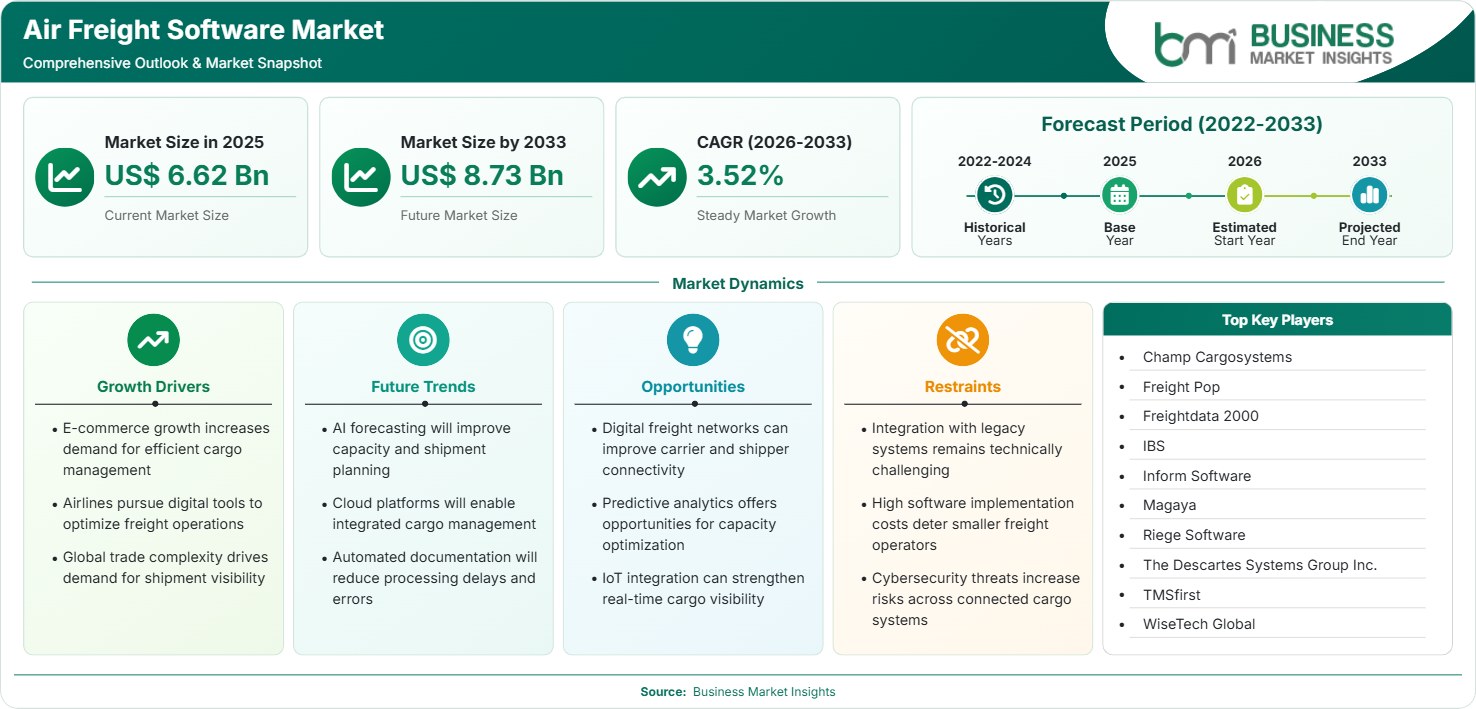
The Air Freight Software Market size was valued at USD 6.62 Billion in 2025 and is projected to reach USD 8.73 Billion by 2033, growing at a CAGR of 3.52% during 2026–2033. Rising e-commerce shipments, increasing digitalization of cargo operations, demand for end-to-end shipment visibility, and expanding cloud-based logistics platforms are supporting adoption. Opportunities are emerging from predictive analytics, IoT-enabled cargo tracking, and integrated freight management ecosystems.

Report Coverage
  • Deployment: On-Premise, Cloud Based
  • Air Freight Service: Expedited Service, Standard Service, Deferred Service
  • Application: Freight Handling, Freight Tracking and Monitoring, Warehouse Management, Price and Revenue Management, Freight Routing and Scheduling, Delivery Tracking
  • End User: Cargo Airlines, Commercial Airlines, E-Commerce Companies, Third Party Freight Service Providers
US$ 6.62 Bn Market size in 2025
US$ 8.73 Bn Market Size by 2033
3.52% CAGR, 2026 - 2033
2026-2033 Forecast Period

01 AI Overview

Air Freight Software Market Summary

  • North America Region: North America holds a market share of 35%–39% in 2025, growing with a CAGR of 3.1%–3.8% during 2026–2033. Advanced logistics infrastructure, high technology adoption, air cargo digitalization initiatives, and rising demand for shipment visibility support growth. The U.S. leads regional demand with a projected 3.2%–3.9% CAGR, supported by strong cargo volumes and logistics technology investments.
  • Fastest Growing Region: Asia Pacific holds a market share of 24%–28% in 2025, growing with a CAGR of 4.6%–5.3% during 2026–2033. Expanding e-commerce trade, airport modernization programs, and increasing cross-border exports accelerate software deployment.
  • Leading Segment: Cloud Based deployment accounts for 62%–66% share in 2025 and is expected to grow at 4.0%–4.7% CAGR. Scalability, lower infrastructure costs, and real-time access to operational data support adoption.
  • High Growth Segment: Freight Tracking and Monitoring represents 21%–25% share in 2025 while expanding at 4.8%–5.5% CAGR. Real-time visibility requirements, regulatory compliance demands, and customer expectations for shipment transparency drive implementation.
  • Key Market Opportunity: Integration of predictive analytics, artificial intelligence, and IoT-enabled cargo monitoring technologies can improve operational efficiency, optimize capacity utilization, and support proactive freight management decisions.
  • Major Market Players: CHAMP Cargosystems, FreightPOP, Freightdata 2000 GmbH, IBS Software, INFORM GmbH, Magaya Corporation, Riege Software International GmbH, The Descartes Systems Group Inc., TMSFirst, WiseTech Global Limited.
02 Strategic Insights

Air Freight Software Market: Strategic Insights

Air Freight Software Market Strategic Framework
FREE PDF
Request your free sample
Request free sample
03 Stakeholder View

Key Takeaways

  • The market ecosystem increasingly integrates cargo airlines, airport operators, freight forwarders, software developers, customs authorities, and third-party logistics providers through interconnected digital platforms.
  • Freight tracking and monitoring applications offer the strongest growth potential due to rising customer expectations for transparency and real-time shipment visibility.
  • Product innovation is increasingly focused on artificial intelligence, predictive analytics, automated documentation workflows, and IoT-enabled cargo intelligence technologies.
  • Asia Pacific provides the most compelling regional investment opportunity due to expanding international trade activities and logistics modernization initiatives.
  • Strategic technology partnerships, platform integration agreements, and cloud migration initiatives are reshaping competitive dynamics across the industry.
  • Demand for unified logistics management platforms is increasing as organizations seek greater operational visibility and efficiency across complex cargo networks.
04 Geographic Outlook

Air Freight Software Market Regional Highlights

North America Air Freight Software Market

North America accounted for 35%–39% Air Freight Software Market share in 2025 and is expected to expand at 3.1%–3.8% CAGR through 2033. The region benefits from mature logistics infrastructure, strong air cargo volumes, extensive technology adoption, and continuous supply chain modernization investments. Airlines and freight operators increasingly adopt software solutions to improve cargo visibility, optimize routing decisions, and streamline compliance procedures. Strong demand for digital logistics platforms continues supporting regional leadership.

  • Major cargo operators increasingly deploy cloud-based freight management systems to improve operational efficiency and shipment visibility across domestic and international routes.
  • Strong e-commerce activity encourages logistics providers to invest in advanced cargo management technologies capable of handling larger freight volumes.
  • Regulatory compliance requirements continue driving adoption of digital documentation and automated workflow platforms.
  • Artificial intelligence integration improves route optimization, resource allocation, and predictive cargo planning capabilities.
  • Investments in smart airport initiatives strengthen software demand throughout cargo handling operations.

US Air Freight Software Market

The United States represents 77%–81% of North American demand and is forecast to grow at 3.2%–3.9% CAGR through the assessment period. Extensive cargo operations, large logistics networks, and continued investment in transportation technology support software deployment across the country.

  • Cargo airlines increasingly invest in analytical software solutions to improve operational control and shipment management.
  • Digital logistics platforms are becoming essential for handling high-volume e-commerce and express freight operations.
  • Third-party logistics providers continue expanding technology spending to improve supply chain performance.
  • Growing automation initiatives support broader adoption of integrated freight management solutions.

Europe Air Freight Software Market

Europe held 27%–31% share in 2025 and is projected to grow at 3.3%–4.0% CAGR through 2033. Strong international trade activity, advanced transportation infrastructure, and regulatory support for digital logistics transformation are driving adoption. Germany remains the leading national market, while Poland demonstrates notable growth momentum.

  • Germany leads regional implementation due to extensive logistics activity and advanced cargo handling infrastructure.
  • Poland is expected to achieve 4.0%–4.8% CAGR, supported by transportation investment and expanding freight operations.
  • Digital customs modernization programs continue encouraging software adoption throughout cargo ecosystems.
  • Freight forwarders increasingly seek integrated platforms providing shipment management and performance analytics.
  • Supply chain resilience initiatives strengthen demand for cargo visibility technologies.

Asia Pacific Air Freight Software Market

Asia Pacific represented 24%–28% share in 2025 and is projected to advance at 4.6%–5.3% CAGR, making it the fastest-growing regional market. The strongest Air Freight Software Market growth is observed in countries investing heavily in logistics infrastructure, airport expansion, and trade facilitation programs. Rising international exports, growing digital commerce activity, and modern cargo handling requirements continue supporting software deployment. Expanding cloud adoption is further improving accessibility across small and large logistics organizations.

  • China remains the largest regional market due to substantial air cargo volumes and logistics technology investments.
  • India is projected to record 5.0%–5.8% CAGR supported by trade expansion and digital logistics transformation initiatives.
  • Airport modernization efforts are increasing demand for integrated cargo management technologies.
  • Cross-border e-commerce growth encourages investment in advanced shipment tracking and control systems.
  • Cloud-based deployment models improve technology adoption among small logistics providers.

Rest of World Air Freight Software Market

Rest of World accounted for 8%–12% share in 2025 and is expected to expand at 3.7%–4.4% CAGR through 2033. Growth is supported by logistics infrastructure development, air cargo expansion, and increasing digital transformation initiatives across Latin America, the Middle East, and Africa. Regional organizations continue investing in visibility solutions capable of improving operational efficiency and customer service performance.

  • Brazil remains the leading Latin American market supported by increasing freight modernization initiatives.
  • The UAE demonstrates strong momentum through airport expansion projects and logistics sector investments.
  • Cargo operators increasingly implement software systems to improve shipment monitoring and resource utilization.
  • Expanding trade corridors support greater demand for integrated freight management technologies.
  • Government-backed digitization programs encourage broader adoption of logistics software platforms.
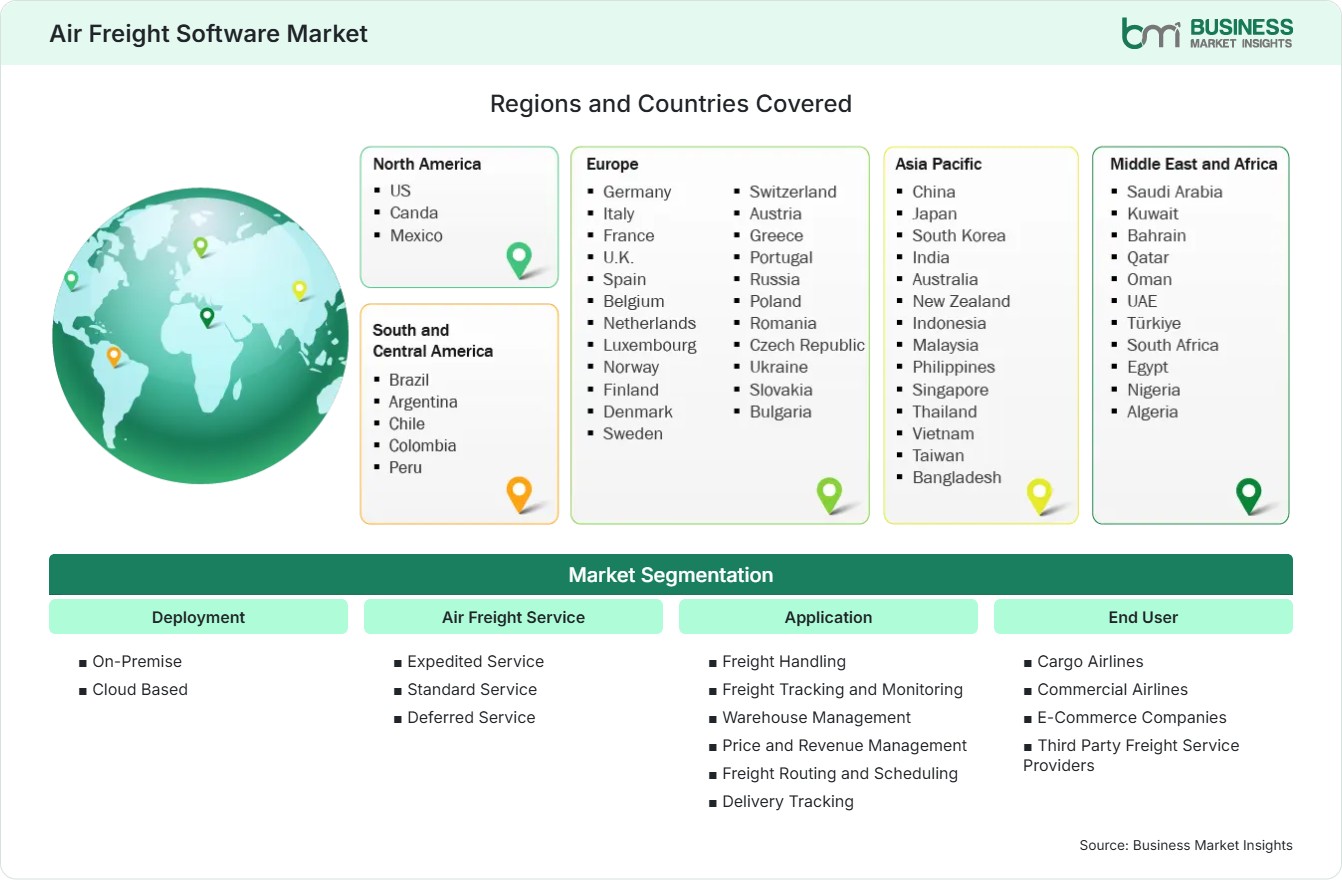
Global Market Geography
FREE PDF
Request your free sample
Request free sample
05 Segment Analysis

Air Freight Software Market Segmentation

Deployment 

The deployment segment remains central to software adoption strategies across cargo operators, freight forwarders, and airline logistics providers. Cloud Based solutions accounted for 62%–66% share in 2025 and are projected to expand at 4.0%–4.7% CAGR through 2034. The Air Freight Software Market scope continues broadening as organizations seek scalable platforms that support remote accessibility, API integrations, real-time data exchange, and reduced infrastructure management requirements.

  • On-Premise: Preferred by organizations requiring direct infrastructure control, enhanced customization capabilities, internal data governance, and compliance with company-specific operational policies.
  • Cloud Based: Enables real-time collaboration, lower upfront costs, simplified deployment, continuous updates, and seamless integration across freight management and supply chain ecosystems.

Air Freight Service

Service-specific software requirements continue driving specialized functionality development. Standard Service accounted for 46%–50% share in 2025 and is anticipated to grow at 3.3%–4.0% CAGR through the forecast period. Increasing shipment volumes and operational complexity are encouraging adoption of solutions that improve service-level management, visibility, and workflow automation.

  • Expedited Service: Requires advanced tracking, route optimization, and priority handling capabilities to ensure rapid delivery and service reliability.
  • Standard Service: Relies on software solutions that balance operational efficiency, shipment planning, capacity utilization, and cost management.
  • Deferred Service: Supports cost-sensitive freight operations by optimizing scheduling flexibility, resource allocation, and shipment consolidation opportunities.

Application

Application demand reflects the growing need for digital cargo management and operational visibility. Freight Tracking and Monitoring represented 21%–25% share in 2025 and is forecast to expand at 4.8%–5.5% CAGR. Emerging Air Freight Software Market trends indicate increasing preference for real-time intelligence solutions capable of supporting proactive freight management and customer communication.

  • Freight Handling: Software solutions streamline cargo processing, documentation workflows, resource allocation, and movement coordination throughout freight operations.
  • Freight Tracking and Monitoring: Enables real-time shipment visibility, operational transparency, exception management, and improved customer service capabilities.
  • Warehouse Management: Supports inventory visibility, storage optimization, cargo movement efficiency, and workflow automation across warehousing environments.
  • Price and Revenue Management: Enhances pricing strategies, capacity utilization, and revenue optimization through advanced analytical capabilities.
  • Freight Routing and Scheduling: Improves network efficiency through automated planning, route optimization, and resource allocation tools.
  • Delivery Tracking: Strengthens end-customer visibility through status updates, milestone tracking, and shipment confirmation capabilities.

End User

End-user adoption is increasingly influenced by digital transformation priorities and supply chain optimization initiatives. Third Party Freight Service Providers accounted for 34%–38% share in 2025 and are projected to grow at 3.9%–4.6% CAGR through the assessment period. Increasing shipment complexity and client expectations continue encouraging technology investments.

  • Cargo Airlines: Utilize software platforms to improve cargo operations, scheduling, capacity management, and service reliability.
  • Commercial Airlines: Adopt digital freight management tools to maximize belly cargo utilization and streamline logistics operations.
  • E-Commerce Companies: Depend on freight software to support shipment visibility, fulfillment efficiency, and customer experience objectives.
  • Third Party Freight Service Providers: Invest in integrated platforms that consolidate shipment management, operational analytics, and customer communication capabilities.
06 Market Forces

Air Freight Software Market Dynamics

Key Market Drivers

E-commerce growth increases demand for efficient cargo management

Rapid expansion of global e-commerce activity continues increasing pressure on air freight networks to handle greater shipment volumes with improved speed and accuracy. Freight operators need software that can provide real-time visibility, automate documentation, track shipments, and manage capacity. Online merchants need integrated logistics networks that enable them to process orders effectively and maintain customer satisfaction. Software solutions enable freight operators to make the right decisions regarding the increased complexity of cargo operations and delivery reliability. The increasing number of cross-border e-commerce transactions makes the use of digital freight management systems more crucial.

Airlines pursue digital tools to optimize freight operations

Cargo and commercial airlines increasingly invest in technology platforms that streamline operational processes and improve resource utilization. Technology solutions enable airlines to automate their processes for bookings, cargo planning, documentation, and performance tracking. Airlines need better visibility and decision-making tools to address changing demand patterns. Technology solutions will also allow for managing compliance issues and communicating between logistics parties. With increased competition, airlines will continue prioritizing their digital transformation efforts.

Global trade complexity drives demand for shipment visibility

Modern supply chains involve multiple stakeholders operating across international markets with varying regulatory requirements and logistics environments. Comprehensive shipment visibility is needed by companies to track the movement of their goods and predict potential disruptions, ensuring they can keep their promises. Modern software systems offer users live access to information, analysis features, and exception management. The more globalized the world becomes, the more there will be a need for such software products.

Key Market Opportunities

Digital freight networks can improve carrier and shipper connectivity

Digital freight ecosystems offer opportunities to improve collaboration among airlines, freight forwarders, logistics providers, and cargo owners. Integrated platforms facilitate real-time information sharing, transaction processing, and operational coordination. Improved connectivity enhances shipment planning accuracy while reducing communication delays and administrative burdens. Organizations increasingly recognize the value of unified freight networks that support efficient cargo management and market responsiveness. Investments in these ecosystems are expected to strengthen operational performance and create attractive opportunities for software providers serving the freight industry.

Predictive analytics offers opportunities for capacity optimization

Advanced analytics solutions are creating opportunities for organizations to improve forecasting accuracy, capacity utilization, and operational planning. Predictive models help freight operators anticipate demand patterns, reduce inefficiencies, and optimize resource allocation decisions. As data availability continues increasing, organizations can leverage analytics to drive measurable performance improvements. Air Freight Software Market Forecasts indicate growing demand for predictive tools capable of supporting proactive decision-making and greater supply chain resilience. Vendors emphasizing analytical innovation are expected to strengthen competitive positioning within the market.

IoT integration can strengthen real-time cargo visibility

Integration of IoT-enabled sensors and connected devices enhances monitoring capabilities throughout freight operations. Organizations can gain continuous visibility into cargo location, environmental conditions, handling status, and transportation performance. These capabilities improve risk management, compliance monitoring, and customer communication. Growing demand for high-value and temperature-sensitive cargo transportation further increases the relevance of IoT-enabled freight intelligence solutions. Technology providers that integrate IoT capabilities into existing software ecosystems are positioned to deliver enhanced operational value and differentiated service offerings.

Market Restraints and Challenges

Integration with legacy systems remains technically challenging

Factor: Many freight operators continue relying on legacy infrastructure and fragmented operational systems that were not designed for modern digital integration. Impact: Organizations may encounter implementation delays, interoperability constraints, increased deployment costs, and operational disruptions during modernization initiatives. Successful software implementation often requires extensive customization, migration planning, and stakeholder coordination. These complexities can slow adoption rates and increase project execution risk. Vendors must therefore develop flexible integration capabilities to support diverse technology environments while minimizing implementation challenges.

High software implementation costs deter smaller freight operators

Factor: Enterprise software deployments frequently involve licensing expenses, customization requirements, employee training, infrastructure upgrades, and ongoing maintenance costs. Impact: Smaller logistics providers may face budget constraints that limit technology investment capabilities. Cost considerations can delay purchasing decisions and encourage adoption of lower-cost alternatives. Economic uncertainty and competitive pressures further influence spending priorities. As a result, software vendors must balance advanced functionality with affordability to expand adoption among small and mid-sized freight organizations.

07 Company Analysis

Competitive Landscape

The Air Freight Software Market analysis reflects competition based on cloud deployment capabilities, shipment visibility technologies, automation functionality, cargo workflow optimization, API integration capabilities, and analytics-driven freight management solutions that improve operational efficiency across global air cargo networks.

Company Name

Overview

Products and Services Relevant to This Market

CHAMP Cargosystems

Specialized provider of air cargo technology solutions serving airlines, freight forwarders, and logistics operators globally.

Cargo management platforms, electronic messaging solutions, tracking systems, and operational automation software.

FreightPOP

Cloud-based transportation management technology provider supporting multi-carrier logistics operations.

Freight management software, shipment tracking, carrier integration tools, rating engines, and logistics analytics.

Freightdata 2000 GmbH

Logistics software specialist focused on air cargo and freight forwarding operations.

Cargo management systems, freight processing platforms, operational visibility solutions, and workflow automation tools.

IBS Software

Enterprise software company providing aviation and logistics technology solutions worldwide.

Cargo management software, planning tools, freight operations platforms, and digital logistics solutions.

INFORM GmbH

Software provider specializing in optimization and decision intelligence technologies.

Air cargo optimization systems, scheduling solutions, resource planning software, and operational analytics platforms.

Magaya Corporation

Logistics and supply chain technology provider serving freight and transportation companies.

Freight forwarding software, cargo tracking systems, warehouse management, and logistics automation solutions.

Riege Software International GmbH

Developer of freight forwarding and customs management software solutions.

Transportation management systems, customs processing tools, freight operations software, and visibility applications.

The Descartes Systems Group Inc.

Global logistics technology company delivering supply chain and transportation management solutions.

Shipment visibility tools, transportation management software, customs compliance platforms, and logistics analytics.

TMSFirst

Transportation technology provider supporting freight operations and workflow digitization.

Freight management applications, operational control tools, shipment monitoring, and logistics automation services.

WiseTech Global Limited

Global logistics software company recognized for integrated supply chain technology platforms.

Cargo execution systems, customs management, freight forwarding software, and end-to-end logistics visibility solutions.

10 Trust & Transparency

Research Methodology

The market analysis combines proprietary research with secondary data from government agencies, company disclosures, regulatory filings, industry databases and expert interviews. Market estimates are validated through data triangulation, cross-market benchmarking and analyst review.

View Full Research Methodology

11 Questions Answered

Frequently Asked Questions

What does an Air Freight Software Market Report include?

An Air Freight Software Market Report provides market sizing, segmentation insights, regional analysis, competitive benchmarking, technology developments, growth opportunities, industry challenges, and strategic investment trends.

Which end-user segment generates the highest demand?

Third-party freight service providers account for the largest share due to their need for integrated logistics management, customer communication tools, and operational visibility across multiple freight networks.

Why is freight tracking and monitoring the fastest-growing application?

Organizations increasingly require real-time shipment visibility, proactive exception management, customer transparency, and stronger compliance capabilities, making tracking technologies a critical operational requirement.

Which deployment model dominates the market?

Cloud-based deployment leads the market because it provides greater scalability, lower infrastructure costs, easier integration capabilities, and real-time accessibility across distributed logistics operations.

What is air freight software?

Air freight software is a digital platform used to manage cargo operations, shipment booking, documentation, routing, tracking, warehouse coordination, and freight analytics throughout the air cargo supply chain.

Access the Full Air Freight Software Market Report

Get segment-level forecasts, regional estimates, competitive benchmarking, company profiles and downloadable Excel datasets.

Access the full Air Freight Software Market Report
350 pages PDF & Excel | 2026-08-19