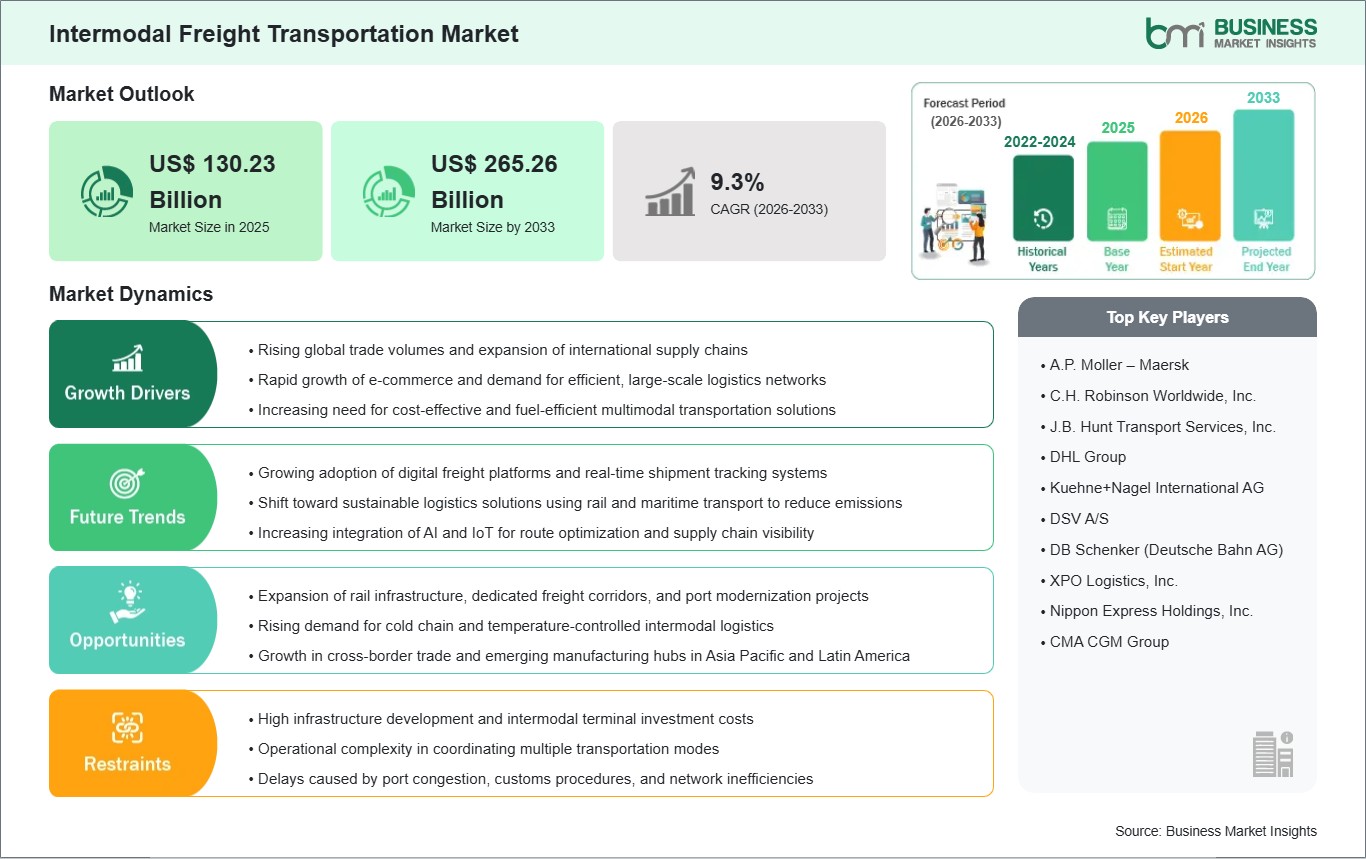
The intermodal freight transportation market size is expected to reach US$ 265.26 billion by 2033 from US$ 130.23 billion in 2025. The market is estimated to record a CAGR of 9.3% from 2026 to 2033.
The Intermodal Freight Transportation Market refers to the industry involved in the movement of goods using multiple modes of transportation—such as rail, road, sea, and air—within a single standardized shipping container without handling the freight itself when changing modes. This system relies heavily on containerization, intermodal terminals, rail networks, trucking services, and port infrastructure to ensure efficient, cost-effective, and secure movement of cargo across domestic and international supply chains. Intermodal transportation is widely used across industries including retail, automotive, manufacturing, consumer goods, chemicals, and e-commerce logistics.
The market is experiencing strong growth driven by increasing global trade, expansion of e-commerce, and rising demand for efficient and sustainable logistics solutions. Businesses are increasingly adopting intermodal freight systems to reduce transportation costs, improve delivery efficiency, and minimize environmental impact. Rail and maritime transport, in particular, offer lower emissions compared to long-haul trucking, making intermodal systems a preferred choice in regions focusing on carbon reduction and sustainable supply chains. Additionally, globalization of supply chains and increasing complexity of logistics networks are further supporting market expansion.
However, the market faces challenges such as infrastructure limitations, high initial investment requirements for intermodal terminals, and operational complexities associated with coordination between multiple transport modes. Delays caused by port congestion, rail network inefficiencies, and customs clearance issues can also impact supply chain reliability. Additionally, lack of standardized infrastructure across regions may restrict seamless intermodal connectivity in certain markets.
Despite these challenges, the intermodal freight transportation market holds strong long-term growth potential driven by digitalization of logistics, expansion of rail and port infrastructure, and increasing adoption of supply chain optimization technologies. Innovations such as real-time tracking systems, IoT-enabled freight monitoring, automated terminals, and AI-based route optimization are significantly improving efficiency and visibility across intermodal networks. Furthermore, government investments in rail connectivity, port modernization, and sustainable transport initiatives are expected to further accelerate market growth. Collectively, these factors position intermodal freight transportation as a critical backbone of global trade and modern logistics systems..

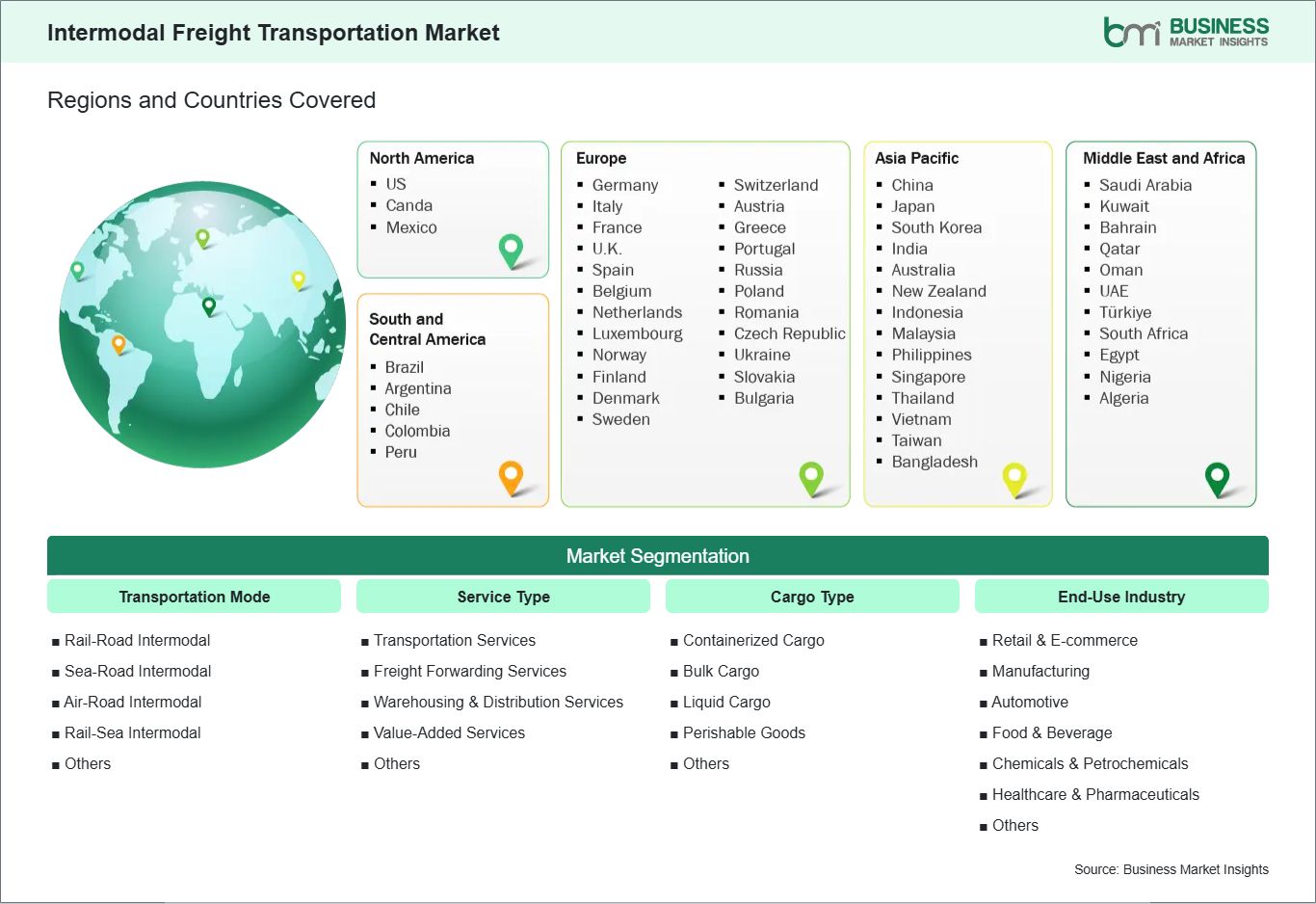
The Intermodal Freight Transportation Market is segmented based on transportation mode, service type, cargo type, and end-use industry, reflecting its role in enabling efficient, cost-effective, and multimodal logistics solutions across global supply chains.
The Intermodal Freight Transportation Market is primarily driven by the continuous expansion of global trade and the rapid growth of e-commerce logistics networks. Increasing cross-border trade activities have intensified the demand for efficient, cost-effective, and scalable freight transportation solutions capable of handling large cargo volumes across multiple regions. Intermodal transportation, which integrates rail, road, and maritime logistics, provides significant advantages in terms of cost reduction, fuel efficiency, and cargo safety, making it a preferred choice for global supply chain operators.
The rapid growth of e-commerce platforms has further accelerated demand for efficient last-mile and long-haul logistics integration. Companies are increasingly adopting intermodal systems to manage high shipment volumes, ensure timely deliveries, and optimize logistics costs. Additionally, the expansion of global manufacturing hubs, particularly in Asia Pacific, has increased the movement of raw materials and finished goods across continents, further supporting market growth.
Sustainability Initiatives, Infrastructure Expansion, and Digitalization Creating Strong Growth Opportunities
Opportunities in the Intermodal Freight Transportation Market are expanding significantly due to increasing emphasis on sustainability and carbon emission reduction in the logistics sector. Rail and maritime transport, which form the backbone of intermodal systems, offer significantly lower emissions compared to long-haul trucking and air freight. This is driving widespread adoption of intermodal solutions as companies work toward achieving ESG targets and complying with environmental regulations.
Large-scale investments in rail network expansion, port modernization, and intermodal terminal development are further enhancing connectivity and operational efficiency across regions. Governments across North America, Europe, and Asia Pacific are actively investing in logistics infrastructure to improve freight mobility and reduce transportation bottlenecks.
Additionally, digital transformation is creating substantial opportunities in the market. The integration of IoT-enabled tracking systems, real-time cargo monitoring, AI-based route optimization, and automated terminal operations is improving visibility, efficiency, and reliability across intermodal supply chains. The adoption of smart logistics platforms and cloud-based freight management systems is further enhancing coordination between multiple transportation modes.
Growing demand for temperature-controlled logistics in pharmaceuticals, food & beverage, and healthcare sectors is also creating new opportunities for specialized intermodal freight services. Collectively, these factors position the Intermodal Freight Transportation Market as a critical enabler of modern, sustainable, and globally integrated supply chain ecosystems.
The intermodal freight transportation marketis projected to grow from US$ 265.26 billion by 2033 from US$ 130.23 billion in 2025. The market is estimated to record a CAGR of 9.3% from 2026 to 2033.
By transportation mode, rail-road intermodal transport holds the largest market share due to its cost efficiency, scalability, and widespread use in long-haul domestic and cross-border freight movement. Sea-road intermodal transport also accounts for a significant share, driven by strong global maritime trade and port connectivity with inland distribution networks. Air-road intermodal transport represents a smaller but high-value segment, primarily used for time-sensitive and premium cargo shipments. Meanwhile, rail-sea intermodal systems are witnessing steady growth, particularly in regions with strong port-rail integration infrastructure.
By service type, transportation services dominate the market due to the core demand for freight movement across multiple transport modes. Freight forwarding services also hold a strong share, driven by increasing outsourcing of logistics coordination and supply chain management. Warehousing and distribution services are growing steadily due to the expansion of integrated logistics hubs and intermodal terminals. Additionally, value-added services such as tracking, packaging, and customs clearance are gaining importance as supply chains become more complex and digitally enabled.
| Report Attribute | Details |
|---|---|
| Market size in 2025 | US$ 130.23 Billion |
| Market Size by 2033 | US$ 265.26 Billion |
| Global CAGR (2026 - 2033) | 9.3% |
| Historical Data | 2022-2024 |
| Forecast period | 2026-2033 |
| Segments Covered | By Transportation Mode
|
|
Regions and Countries Covered
| |
| North America | US, Canada, Mexico |
| Europe | Germany, Italy, France, U.K., Spain, Belgium, Netherlands, Luxembourg, Norway, Finland, Denmark, Sweden, Switzerland, Austria, Greece, Portugal, Russia, Poland, Romania, Czech Republic, Ukraine, Slovakia, Bulgaria |
| Asia-Pacific | China, Japan, South Korea, India, Australia, New Zealand, Indonesia, Malaysia, Philippines, Singapore, Thailand, Vietnam, Taiwan, Bangladesh |
| South and Central America | Brazil, Argentina, Chile, Colombia, Peru |
| Middle East and Africa | Saudi Arabia, United Arab Emirates, Kuwait, Bahrain, Qatar, Oman, Turkiye, South Africa, Egypt, Nigeria, Algeria |
| Market leaders and key company profiles |
|
The "Intermodal Freight Transportation Market Size and Forecast (2022-2033)" report provides a detailed analysis of the market covering below areas:
The Intermodal Freight Transportation Market exhibits strong regional variation, driven by differences in trade intensity, logistics infrastructure development, rail and port connectivity, industrial output, and adoption of digital supply chain solutions across major global economies.
North America holds a significant share of the intermodal freight transportation market due to its well-developed rail-road logistics network, strong port infrastructure, and high volume of domestic and cross-border trade. The United States is the dominant market, supported by extensive intermodal terminal networks and strong integration between rail operators and trucking services. The region benefits from advanced logistics technologies, including real-time freight tracking, automated warehousing, and AI-based route optimization. Additionally, growing e-commerce activity and increasing emphasis on sustainable freight transport are further driving intermodal adoption.
Asia Pacific is the fastest-growing regional market, driven by rapid industrialization, expanding manufacturing output, and booming international trade. China, India, Japan, and South Korea are major contributors. China leads in port infrastructure development, rail freight expansion, and containerized cargo handling capacity. India is rapidly investing in dedicated freight corridors and logistics modernization initiatives. Japan and South Korea focus on high-efficiency logistics systems and advanced supply chain technologies. The region’s strong manufacturing base, rising e-commerce penetration, and increasing export-import activities are key growth drivers.
Overall, the Intermodal Freight Transportation Market is globally interconnected, with North America and Europe leading in infrastructure maturity, Asia Pacific driving growth momentum, and emerging regions gradually enhancing their multimodal logistics capabilities.

The intermodal freight transportation market is evaluated by gathering qualitative and quantitative data post primary and secondary research, which includes important corporate publications, association data, and databases. Recent developments and news in the market include:
The Intermodal Freight Transportation Market is valued at US$ 130.23 Billion in 2025, it is projected to reach US$ 265.26 Billion by 2033.
As per our report Intermodal Freight Transportation Market, the market size is valued at US$ 130.23 Billion in 2025, projecting it to reach US$ 265.26 Billion by 2033. This translates to a CAGR of approximately 9.3% during the forecast period.
The Intermodal Freight Transportation Market report typically cover these key segments-
The historic period, base year, and forecast period can vary slightly depending on the specific market research report. However, for the Intermodal Freight Transportation Market report:
The Intermodal Freight Transportation Market is populated by several key players, each contributing to its growth and innovation. Some of the major players include:
The Intermodal Freight Transportation Market report is valuable for diverse stakeholders, including:
Essentially, anyone involved in or considering involvement in the Intermodal Freight Transportation Market value chain can benefit from the information contained in a comprehensive market report.
Please tell us your area of interest
(Market Segments/ Regions and Countries/ Companies)