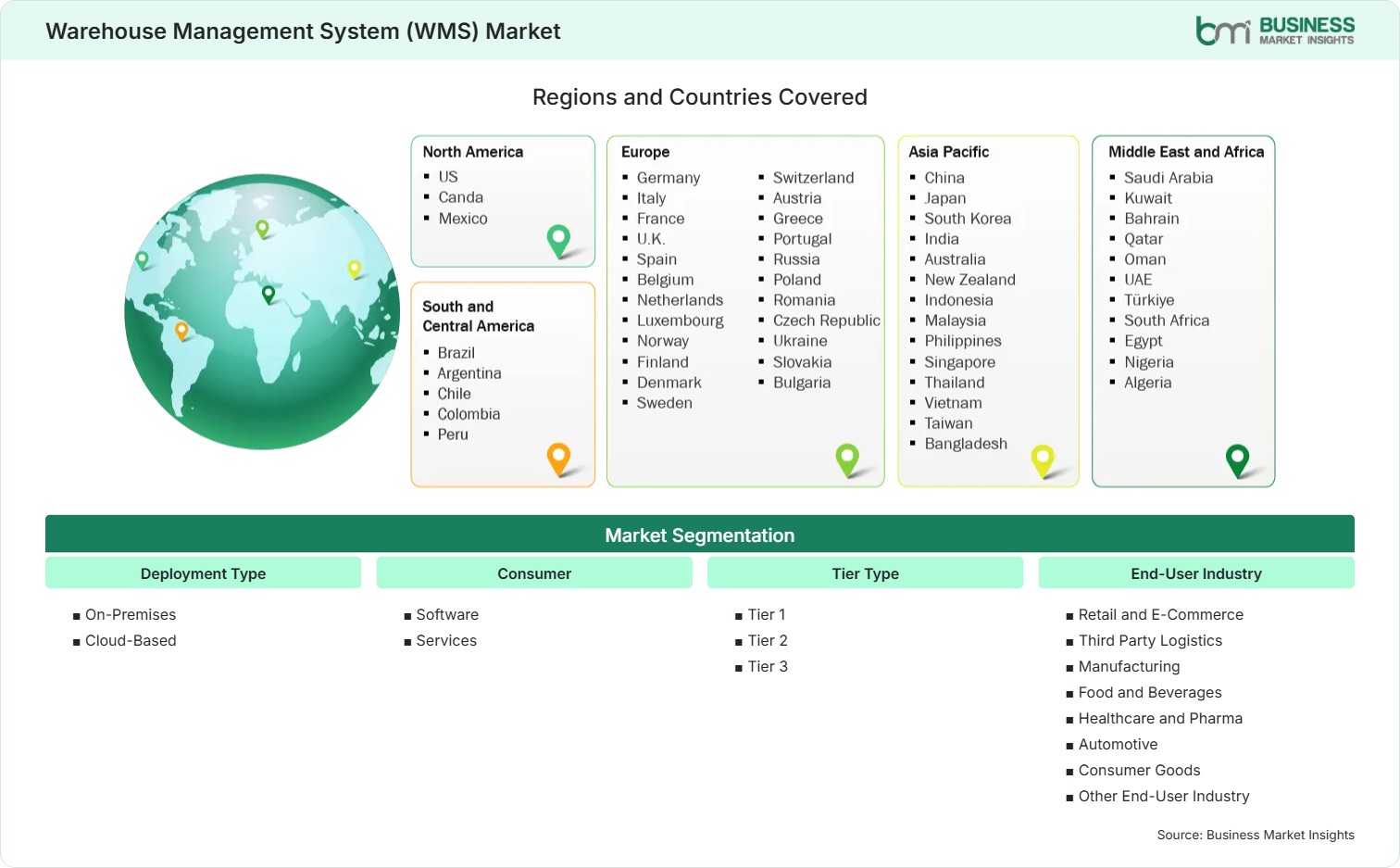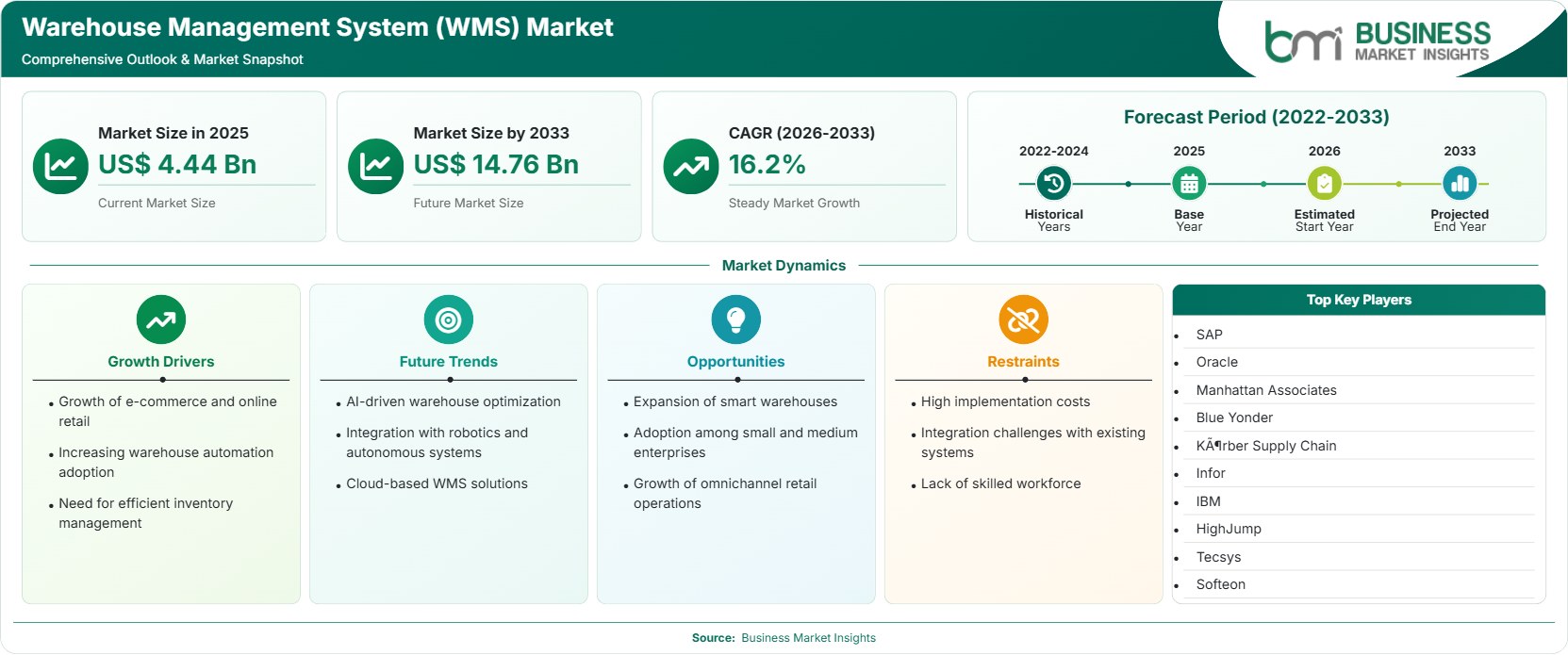
Warehouse Management System (WMS) Market Regional Highlights
North America Warehouse Management System (WMS) Market
North America accounts for 35%–39% share in 2025, expanding at a CAGR of 15.5%–16.2%. The Warehouse Management System (WMS) Market share in the region is supported by advanced logistics networks, strong e-commerce penetration, warehouse automation investments, and widespread enterprise software adoption. The United States remains the leading contributor due to increasing demand for intelligent fulfillment operations, cloud-based warehouse platforms, and supply chain optimization technologies across industries.
- The United States continues adopting advanced warehouse platforms as retailers and logistics providers improve fulfillment speed, inventory visibility, and operational efficiency through digital transformation.
- Large enterprises are investing in automated warehouses, robotics integration, and real-time analytics capabilities to manage increasing order volumes and complex distribution requirements.
- Cloud-based warehouse management solutions are gaining adoption due to scalability, lower infrastructure requirements, and improved accessibility for organizations with distributed operations.
- Retail, manufacturing, and third-party logistics companies are upgrading warehouse systems to support omnichannel fulfillment strategies and customer expectations.
US Warehouse Management System (WMS) Market
The US holds 29%–33% share in 2025, growing at a CAGR of 15.8%–16.4%. The Warehouse Management System (WMS) growth is supported by rapid e-commerce expansion, advanced logistics infrastructure, warehouse automation adoption, and increasing demand for real-time inventory control. Enterprises are implementing integrated warehouse platforms to improve productivity, reduce operational costs, and enhance supply chain resilience across retail, manufacturing, and logistics sectors.
- E-commerce companies are increasing investments in intelligent warehouse solutions to improve order processing speed, accuracy, and last-mile fulfillment efficiency.
- Manufacturing organizations are adopting warehouse management platforms to synchronize production workflows, inventory movement, and distribution activities.
- Third-party logistics providers are implementing scalable systems to manage multi-client warehouse operations and improve service performance.
- Cloud adoption is accelerating as businesses seek flexible warehouse technology solutions with reduced deployment complexity.
Europe Warehouse Management System (WMS) Market
Europe captures 24%–28% share in 2025, expanding at a CAGR of 15.9%–16.6%. The region is supported by mature logistics infrastructure, growing automation adoption, and increasing focus on efficient supply chain operations. Germany, the United Kingdom, and France represent major Warehouse Management System (WMS) market due to advanced manufacturing ecosystems, retail digitization, and logistics modernization. Growing investment in smart warehouses is strengthening adoption across European industries.
- Germany continues driving demand through advanced manufacturing operations, automotive production, logistics innovation, and warehouse automation initiatives.
- The United Kingdom is expanding adoption due to retail e-commerce growth, third-party logistics development, and increasing fulfillment technology investments.
- France is increasing warehouse technology deployment through retail modernization, industrial digitalization, and supply chain efficiency programs.
- European companies are integrating warehouse systems with enterprise resource planning and transportation management platforms to improve operational coordination.
- Regulatory focus on supply chain transparency and sustainability is encouraging investment in advanced warehouse management technologies.
Asia Pacific Warehouse Management System (WMS) Market
Asia Pacific accounts for 26%–30% share in 2025 and is projected to grow at a CAGR of 17.0%–17.8%. The region represents the fastest-growing Warehouse Management System (WMS) market due to expanding e-commerce activities, manufacturing growth, logistics infrastructure development, and increasing warehouse automation adoption. China, India, Japan, and Southeast Asian economies are accelerating investments in smart warehouses and digital supply chain technologies to support rising consumer demand.
- China continues expanding warehouse technology adoption through large-scale e-commerce operations, manufacturing growth, and logistics automation investments.
- India is witnessing increasing demand due to online retail expansion, industrial development, and modernization of supply chain infrastructure.
- Japan is adopting advanced warehouse solutions to address labor shortages, improve efficiency, and support automated logistics operations.
- Southeast Asian countries are investing in smart warehouses as digital commerce and regional trade networks expand.
- Manufacturing hubs across Asia Pacific are implementing warehouse platforms to improve inventory accuracy and production coordination.
Rest of World Warehouse Management System (WMS) Market
Rest of World represents 8%–12% share in 2025, growing at a CAGR of 15.8%–16.5%. South and Central America, along with the Middle East and Africa, are gradually adopting warehouse management technologies due to expanding retail networks, logistics modernization, and increasing investment in digital infrastructure. Growing adoption among emerging businesses is creating new opportunities for cloud-based warehouse solutions.
- Middle Eastern countries are investing in logistics infrastructure and smart warehouse projects to support trade expansion and economic diversification.
- Saudi Arabia and the UAE are adopting advanced warehouse systems through logistics hub development and retail transformation initiatives.
- Latin American markets are increasing technology adoption as businesses improve inventory management and distribution efficiency.
- Brazil is expanding warehouse digitization through e-commerce growth, manufacturing activity, and logistics modernization programs.
- African markets are gradually adopting cloud-based solutions to improve supply chain visibility and operational efficiency.