
Smart Mobility Market Outlook: Size, Share, Trends, Growth Analysis, Competitive Landscape & Forecast, 2026-2033

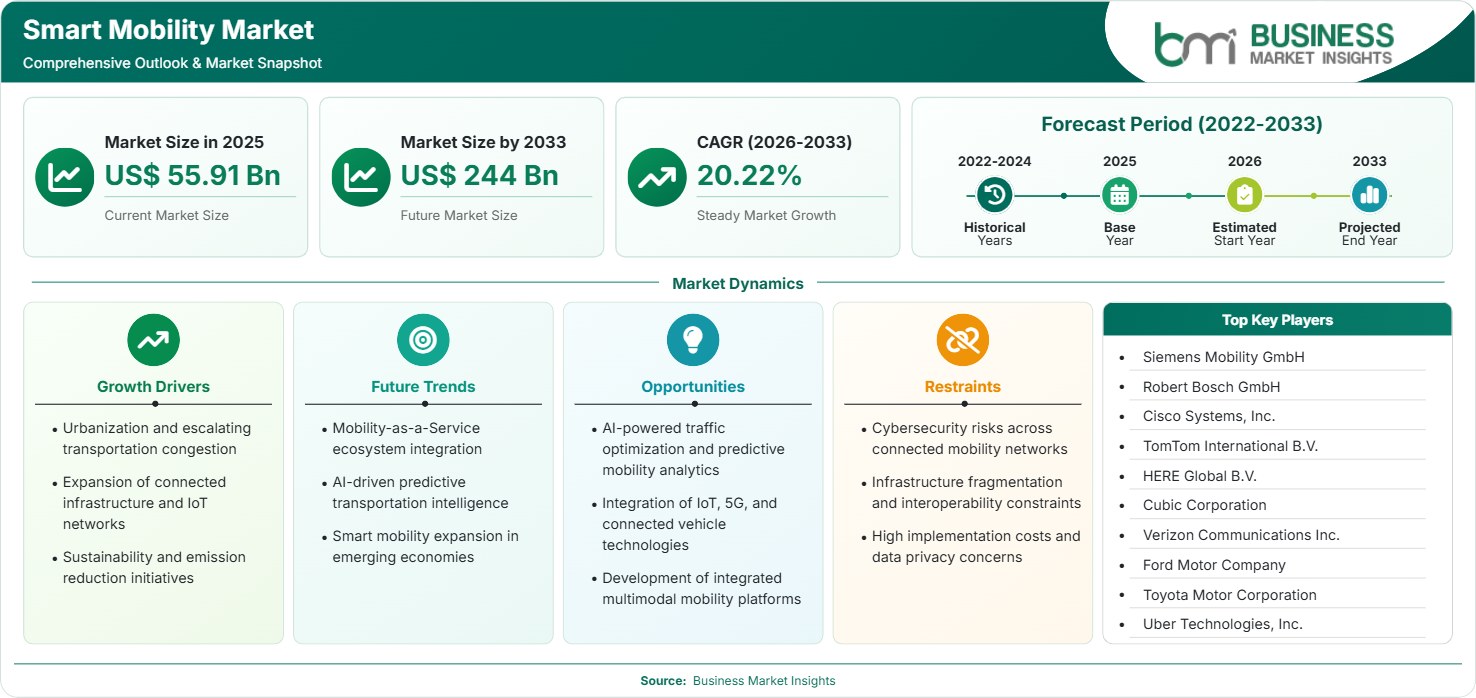
The Smart Mobility Market size was valued at US$ 55.91 Billion in 2025 and is projected to reach US$ 244 Billion by 2033, growing at a CAGR of 20.22% during 2026–2033, driven by connected transportation ecosystems, smart city investments, AI-enabled traffic optimization, sustainable mobility initiatives, and expanding Mobility-as-a-Service platforms worldwide.

Report Coverage
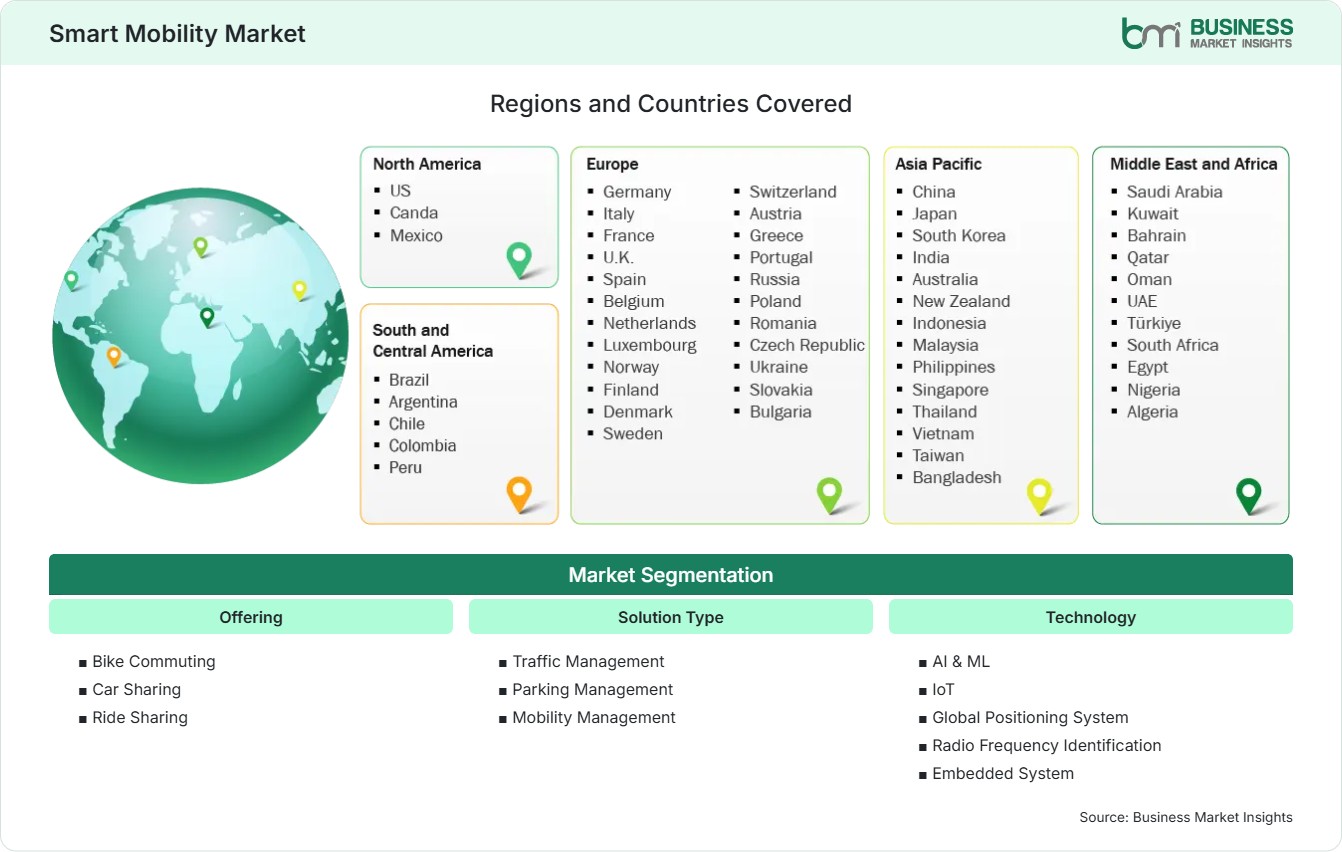
  • Offering: Bike Commuting, Car Sharing, Ride Sharing
  • Solution Type: Traffic Management, Parking Management, Mobility Management
  • Technology: AI & ML, IoT, Global Positioning System, Radio Frequency Identification, Embedded System
US$ 55.91 Bn Market size in 2025
US$ 244 Bn Market Size by 2033
20.22% CAGR, 2026 - 2033
2026-2033 Forecast Period

01 AI Overview

Smart Mobility Market Summary

  • North America Region: North America holds a market share of 34%–37% in 2025, growing at a CAGR of 18.5%–20.0% during 2026–2033. Growth is supported by intelligent transportation systems, connected vehicle deployment, smart infrastructure modernization, and municipal mobility digitization programs. US market benefits from advanced ITS adoption, public-private partnerships, and smart city projects, expanding at around 19.0%–20.5% CAGR.
  • Fastest Growing Region: Asia Pacific holds a market share of 26%–29% in 2025 and advances at a CAGR of 22.0%–24.5%. Urbanization, digital infrastructure investments, electric mobility expansion, and large-scale smart city programs support strong regional momentum and innovation.
  • Leading Segment: Ride Sharing accounts for 42%–45% market share in 2025 and grows at 19.0%–21.0% CAGR. Strong consumer acceptance, app-enabled booking ecosystems, lower ownership preference, and integrated mobility platforms continue supporting widespread adoption.
  • High Growth Segment: AI & ML holds 18%–21% market share in 2025 and expands at 24.0%–26.5% CAGR. Predictive analytics, traffic optimization, autonomous mobility development, and operational efficiency improvements accelerate enterprise and municipal investments.
  • Key Market Opportunity: Expansion of integrated Mobility-as-a-Service ecosystems enables transportation providers, municipalities, and technology firms to unify public transit, ride sharing, parking, and payment systems through connected digital platforms worldwide.
  • Major Market Players: Siemens Mobility GmbH, Robert Bosch GmbH, Cisco Systems, Inc., TomTom International B.V., HERE Global B.V., Cubic Corporation, Verizon Communications Inc., Ford Motor Company, Toyota Motor Corporation, Uber Technologies, Inc.
02 Strategic Insights

Smart Mobility Market: Strategic Insights

Smart Mobility Market Strategic Framework
FREE PDF
Request your free sample
Request free sample
03 Stakeholder View

Key Takeaways

  • The ecosystem is evolving from isolated transportation services toward integrated digital mobility networks connecting vehicles, infrastructure, operators, commuters, payment platforms, and analytics providers.
  • AI-powered traffic management and multimodal urban mobility solutions present the strongest commercial opportunities due to increasing congestion management requirements and public infrastructure modernization.
  • Innovation is moving toward predictive mobility intelligence, autonomous decision support, digital twins, and real-time route optimization enabled through machine learning and edge analytics.
  • Asia Pacific offers a compelling investment landscape as rapid urbanization, government funding, and smart city expansion accelerate deployment of advanced transportation technologies.
  • Strategic partnerships among automotive manufacturers, telecommunications providers, software companies, and municipalities continue shaping investment activity and ecosystem consolidation.
  • Long-term competitiveness increasingly depends on ownership of mobility data, interoperability capabilities, cybersecurity readiness, and scalable platform-based service architectures.
04 Geographic Outlook

Smart Mobility Market Regional Highlights

North America Smart Mobility Market

North America accounted for approximately 34%–37% Smart Mobility Market share in 2025 and is expected to record a CAGR of 18.5%–20.0% during 2026–2033. Strong regional positioning is supported by advanced smart city initiatives, widespread digital infrastructure, connected vehicle deployment, and transportation modernization programs. Municipal agencies increasingly use AI-driven traffic optimization and integrated commuter services. Public funding and technology partnerships continue accelerating adoption of mobility platforms, while transportation authorities prioritize sustainability, congestion reduction, and traveler experience improvements across major metropolitan areas.

  • Widespread deployment of intelligent transportation systems supports real-time congestion management and enhanced roadway efficiency.
  • Growing integration of connected vehicles with infrastructure strengthens data-driven mobility operations across urban environments.
  • Smart parking expansion reduces urban traffic burden while improving utilization of transportation assets.
  • Telecommunications investments enable reliable connectivity requirements necessary for advanced mobility platforms.
  • Climate objectives encourage adoption of shared transportation and electric mobility ecosystems.

US Smart Mobility Market

The United States represents approximately 78%–82% of regional demand within North America and advances at a CAGR of 19.0%–20.5%. Federal infrastructure spending, smart city initiatives, and advanced network deployment support nationwide mobility modernization. Transportation operators increasingly invest in AI-enabled planning systems, digital ticketing, multimodal journey platforms, and connected fleet technologies. Technology providers collaborate with municipalities to deploy scalable mobility ecosystems addressing congestion, sustainability objectives, and growing urban transportation complexity.

  • Smart corridor programs increasingly combine sensors, cameras, and analytics to improve transportation efficiency.
  • Expansion of connected mobility pilots strengthens innovation in vehicle-to-everything communication applications.
  • Ride-sharing and multimodal travel applications continue gaining acceptance among urban commuters.
  • Public transit digitization initiatives enhance passenger experience through integrated mobility platforms.

Europe Smart Mobility Market

Europe held an estimated 27%–30% share in 2025 and is projected to grow at 19.5%–21.5% CAGR through 2033. Strong regulatory emphasis on carbon reduction, sustainable transport, and urban mobility planning drives implementation. Germany remains the leading regional market, while Eastern European countries demonstrate accelerating adoption rates. Investments in intelligent transport infrastructure, EV ecosystems, and integrated mobility platforms create favorable conditions for expansion. Regional authorities continue prioritizing emissions reduction and multimodal transportation connectivity.

  • Germany leads adoption supported by industrial innovation and transportation digitalization initiatives.
  • France and the Netherlands continue investing heavily in integrated mobility and smart transit systems.
  • Poland emerges among faster-growing markets with adoption exceeding regional averages.
  • EU sustainability objectives stimulate deployment of shared and electric mobility solutions.
  • Cross-border transportation interoperability initiatives enhance digital mobility ecosystem development.

Asia Pacific Smart Mobility Market

Asia Pacific accounted for 26%–29% market share in 2025 and represents the fastest-growing region, expanding at a CAGR of 22.0%–24.5%. Rapid urbanization, large population concentrations, and significant smart city spending fuel adoption. China remains the largest regional market, while India records some of the fastest growth rates. Governments increasingly deploy intelligent transport systems, AI-assisted traffic management, and connected mobility services. Strong digital infrastructure investments continue supporting scalable mobility modernization projects across metropolitan centers.

  • China leads regional deployment through extensive smart city and connected transportation programs.
  • India records high-growth momentum supported by urban mobility modernization initiatives.
  • Japan continues advancing autonomous transportation and intelligent traffic technologies.
  • Southeast Asian cities increasingly adopt integrated mobility applications and digital transportation services.
  • Expansion of 5G connectivity strengthens foundations for next-generation mobility ecosystems.

Rest of World Smart Mobility Market

The Rest of World region represented 8%–11% share in 2025 and is projected to expand at 20.0%–22.0% CAGR. South and Central America increasingly adopt digital transportation management platforms to address urban congestion and transit efficiency concerns.

Meanwhile, Middle East and Africa markets benefit from smart city investments, transportation diversification strategies, and infrastructure modernization agendas. The UAE leads adoption in the Gulf region, while Saudi Arabia demonstrates strong growth prospects through major urban development programs and connected mobility investments.

  • Gulf countries continue integrating mobility solutions into large-scale smart city developments.
  • Brazil leads South American adoption through intelligent transport modernization initiatives.
  • Saudi Arabia benefits from significant infrastructure investments supporting transportation transformation.
  • Digital transit management systems increasingly gain traction across emerging metropolitan centers.
  • Mobility-as-a-Service adoption expands as smartphone penetration and digital payments increase.
Global Market Geography
FREE PDF
Request your free sample
Request free sample
05 Segment Analysis

Smart Mobility Market Segmentation

Offering

This segment accounted for approximately 44%–47% market share in 2025 and is projected to expand at 19.5%–21.5% CAGR. The Smart Mobility Market scope within offerings continues broadening as consumers seek flexible, digitally enabled transportation alternatives. Platform integration, sustainability objectives, and smartphone-based access continue supporting adoption across personal and commercial mobility applications.

  • Bike Commuting: Growing urban sustainability programs and dedicated cycling infrastructure encourage adoption, improving short-distance mobility efficiency and reducing congestion in densely populated metropolitan environments.
  • Car Sharing: Shared vehicle access models reduce ownership costs while providing flexible mobility alternatives, particularly across urban regions seeking transportation efficiency and lower environmental impact.
  • Ride Sharing: Strong digital platform penetration and convenience-driven demand continue accelerating adoption, supported by real-time booking, route optimization, and integrated payment capabilities.

Solution Type

Solution platforms account for nearly 30%–33% market participation and are advancing at 20.0%–22.0% CAGR. Governments and transportation authorities increasingly deploy digital management systems to improve efficiency, reduce congestion, and optimize commuter experiences through real-time data visibility and analytics.

  • Traffic Management: Advanced analytics and sensor networks enable dynamic traffic monitoring, congestion mitigation, and intelligent road utilization across urban transportation networks.
  • Parking Management: Smart parking technologies improve space visibility, utilization rates, and commuter convenience while helping cities optimize infrastructure resources.
  • Mobility Management: Integrated transportation platforms support multimodal travel coordination, routing efficiency, digital payments, and enhanced commuter accessibility.

Technology

Technology solutions contribute approximately 33%–36% share and are growing at 21.0%–23.0% CAGR. Smart Mobility Market trends increasingly highlight AI-driven intelligence, connectivity platforms, and real-time analytics as critical enablers for transportation modernization and operational optimization.

  • AI & ML: Predictive analytics, pattern recognition, and automation capabilities support intelligent transportation decision-making and network optimization.
  • IoT: Connected devices facilitate real-time monitoring, data collection, and communication across vehicles, infrastructure, and mobility platforms.
  • Global Positioning System (GPS): Location intelligence enables route optimization, navigation, fleet visibility, and commuter service improvements.
  • Radio Frequency Identification (RFID): RFID technologies assist automated identification, tolling operations, access control, and transportation asset tracking.
  • Embedded System: Embedded computing capabilities support vehicle intelligence, connectivity functions, operational control, and transportation management applications.
06 Market Forces

Smart Mobility Market Dynamics

Key Market Drivers

Urbanization and Escalating Transportation Congestion

The urban population growth keeps adding pressure to transport systems. The urbanization trends predicted by UN indicate that cities will be home to more people in the decades to come, which will only increase the problems caused by the congestion. Transport agencies resort to smart routing, smart parking, and traffic management systems. Smart Mobility Market growth is fueled by increasing demand for digital tools to help in mitigating travel delays and optimize transportation resources. Economic losses caused by traffic congestion in many cities drive investment into predictive transportation technology, mobility analysis, connected vehicles and transportation management capabilities.

Expansion of Connected Infrastructure and IoT Networks

Governments and private operators increasingly invest in connected infrastructure supporting intelligent transportation capabilities. Internet of Things (IoT) sensors, telecommunications network infrastructure, cloud computing technology, and edge computing technology help to improve the availability of information in the mobility ecosystem. This trend makes it possible to conduct monitoring in real time, gain visibility into operations, and carry out preventive maintenance and traffic management dynamically. The integration of digital technology with public transport helps improve the passenger experience and better resource allocation. It becomes essential to have seamless connectivity among all components of smart transportation environments.

Sustainability and Emission Reduction Initiatives

National governments and municipalities continue implementing policies focused on emissions reduction, transportation efficiency, and sustainable mobility outcomes. Ride-sharing, transit integration, and intelligent transport system planning through mobility platforms help achieve the goals set from an environmental perspective. Increased investments in infrastructure that enables the use of electric vehicles bolster the need for mobility management solutions. Firms are more frequently planning their transport-related operations based on sustainable development while maintaining efficiency. Increasing environmental consciousness in consumers and policymakers facilitates the use of smart mobility services that improve resource efficiency and reduce vehicle usage.

Key Market Opportunities

Mobility-as-a-Service Ecosystem Integration

Integrated Mobility as a Service systems present a good opportunity for growth for technology companies and transportation companies. They combine transit, ride share, ticketing, parking, navigation, and payments all together in one application. Smart Mobility Market Forecasts indicate there is an increased need for multimodal seamless transportation services from the part of urban commuters. Platform providers that can ensure interoperability, real-time information exchange, and personalized services are expected to be able to derive a lot of value from such opportunities. The adoption of digital identity systems, mobile payments, and smart infrastructure enables MaaS implementation in urban settings.

AI-Driven Predictive Transportation Intelligence

Artificial intelligence creates opportunities extending beyond traditional traffic optimization into predictive transportation orchestration. Congestion forecasts, fleet optimizations, demand predictions, and infrastructure planning become increasingly based on machine learning algorithms. City governments want to gain analytical capabilities that will enhance efficiency and decrease transportation expenses at the same time. Artificial intelligence-powered mobility systems can extract insights from large amounts of data collected in connected transportation systems. Companies that provide intelligent capabilities at scale will likely win, given the growing focus on data-driven approaches in the transportation domain.

Smart Mobility Expansion in Emerging Economies

Emerging markets continue presenting substantial long-term growth potential due to rapid urbanization and infrastructure development requirements. Governments across Asia, the Middle East, Africa, and Latin America increasingly integrate digital mobility solutions into national development agendas. Innovations in the areas of smart city, telecommunications, and transport systems have provided positive ground for implementation. Increasing use of smartphones and digital payments make the idea more feasible. Early-stage mobility ecosystems provide opportunities for technology providers, infrastructure operators, and investors seeking participation in large-scale transportation transformation initiatives.

Market Restraints and Challenges

Cybersecurity Risks Across Connected Mobility Networks

Factor: Connected transportation ecosystems generate large volumes of operational and user data across vehicles, applications, and infrastructure.

Impact: Higher levels of connectivity mean more susceptibility to cybersecurity attacks and data privacy compromises. Transport authorities and technology companies have to make substantial investments in terms of security frameworks, surveillance mechanisms, and compliance mechanisms. The more interwoven transport platforms are, the higher is the complexity associated with the management of threats. Issues related to potential threats to privacy can hamper adoption in some environments. Effective cybersecurity governance is crucial for maintaining the trust of users.

Infrastructure Fragmentation and Interoperability Constraints

Factor: Transportation networks frequently operate across fragmented legacy systems with inconsistent standards and technology architectures.

Impact: Integration problems raise deployment costs, implementation complexities, and inefficiencies. It is not uncommon for municipal officials to encounter problems matching upgrades with changing digital demands. Lack of interoperxability could limit the ability to share information and hence the possible gains from the intelligent transportation systems. There needs to be coordination among different technology vendors, government entities, and transportation firms to create compatible solutions.

07 Company Analysis

Competitive Landscape

The Smart Mobility Market analysis indicates competition is shaped by transportation technology providers, digital mobility platform operators, networking specialists, mapping companies, and infrastructure innovators.

Company Name

Overview

Products and Services relevant to this market

Siemens Mobility GmbH

Global transportation technology provider focused on intelligent infrastructure and rail mobility solutions.

Traffic management systems, digital mobility platforms, intelligent transportation software, smart infrastructure solutions.

Robert Bosch GmbH

Major engineering and technology company supporting connected mobility ecosystems worldwide.

IoT platforms, vehicle connectivity solutions, mobility software, intelligent transportation components.

Cisco Systems, Inc.

Networking and digital infrastructure leader serving smart city projects globally.

Connected transportation networks, IoT connectivity, cybersecurity, mobility data infrastructure.

TomTom International B.V.

Location technology specialist providing navigation and traffic intelligence solutions.

Digital maps, navigation systems, traffic analytics, mobility data services.

HERE Global B.V.

Provider of location intelligence and mapping platforms for mobility ecosystems.

Mapping services, routing analytics, positioning technologies, mobility software.

Cubic Corporation

Transportation technology company supporting transit modernization programs.

Fare collection, mobility management, transportation analytics, integrated commuter platforms.

Verizon Communications Inc.

Telecommunications provider enabling connected mobility and IoT deployments.

5G connectivity, fleet management, IoT platforms, mobility communications services.

Ford Motor Company

Automotive manufacturer investing in connected and intelligent mobility solutions.

Connected vehicles, fleet solutions, mobility services, transportation technologies.

Toyota Motor Corporation

Global automotive company advancing connected and sustainable transportation ecosystems.

Mobility services, connected vehicles, transportation platforms, smart mobility innovations.

Uber Technologies, Inc.

Digital mobility platform operator with global ride-sharing presence.

Ride-sharing services, multimodal mobility applications, transit integration platforms.

10 Trust & Transparency

Research Methodology

The market analysis combines proprietary research with secondary data from government agencies, company disclosures, regulatory filings, industry databases and expert interviews. Market estimates are validated through data triangulation, cross-market benchmarking and analyst review.

View Full Research Methodology

11 Questions Answered

Frequently Asked Questions

Why are Mobility-as-a-Service platforms important?

They integrate diverse transportation services into unified digital interfaces, improving commuter convenience, operational efficiency, multimodal coordination, and accessibility.

What is covered in a Smart Mobility Market Report?

A comprehensive report evaluates market size, growth drivers, regional performance, competitive landscape, technology adoption, segmentation trends, investment opportunities, and future industry developments.

How does AI contribute to transportation modernization?

AI enables traffic prediction, route optimization, infrastructure planning, traveler behavior analysis, and operational efficiency improvements through real-time and predictive intelligence.

Which region offers the strongest future growth potential?

Asia Pacific presents the strongest growth outlook due to extensive smart city investments, rapid urbanization, transportation modernization programs, and expanding digital connectivity infrastructure.

What factors are accelerating adoption of intelligent mobility solutions?

Urbanization, congestion management requirements, sustainability objectives, digital infrastructure expansion, connected vehicles, and AI-powered transportation optimization collectively support adoption across public and private transportation ecosystems.

Access the Full Smart Mobility Market Report

Get segment-level forecasts, regional estimates, competitive benchmarking, company profiles and downloadable Excel datasets.

Access the full Smart Mobility Market Report
350 pages PDF & Excel | 2026-08-26