
Electric Mobility Market Outlook: Size, Share, Trends, Growth Analysis, Competitive Landscape & Forecast, 2026-2033

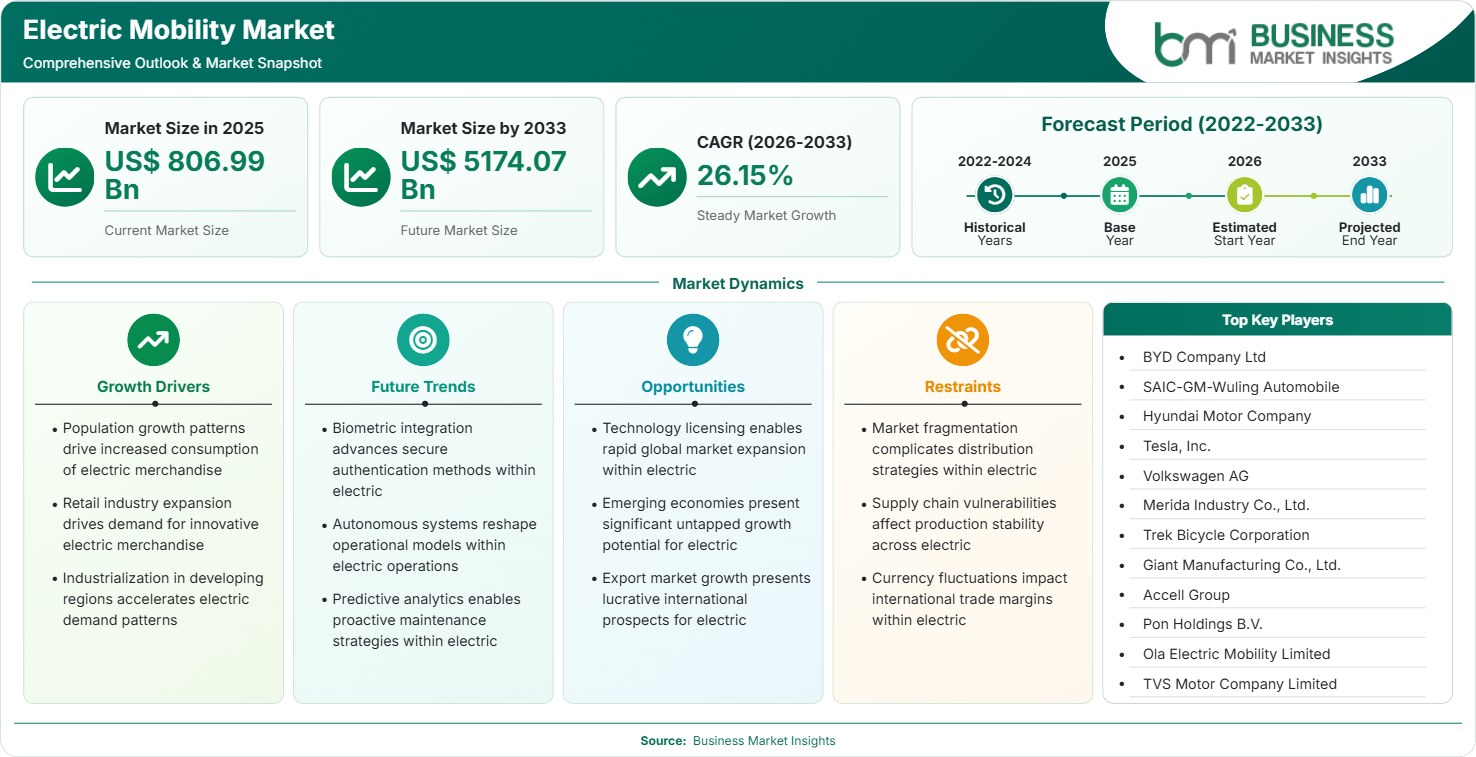
The Electric Mobility Market size was valued at US$ 806.99 Billion in 2025 and is projected to reach US$ 5174.07 Billion by 2033, growing at a CAGR of 26.15% during 2026–2033, driven by battery cost improvements, policy support, charging expansion, urban electrification, fleet adoption, and connected vehicle innovation.

Report Coverage
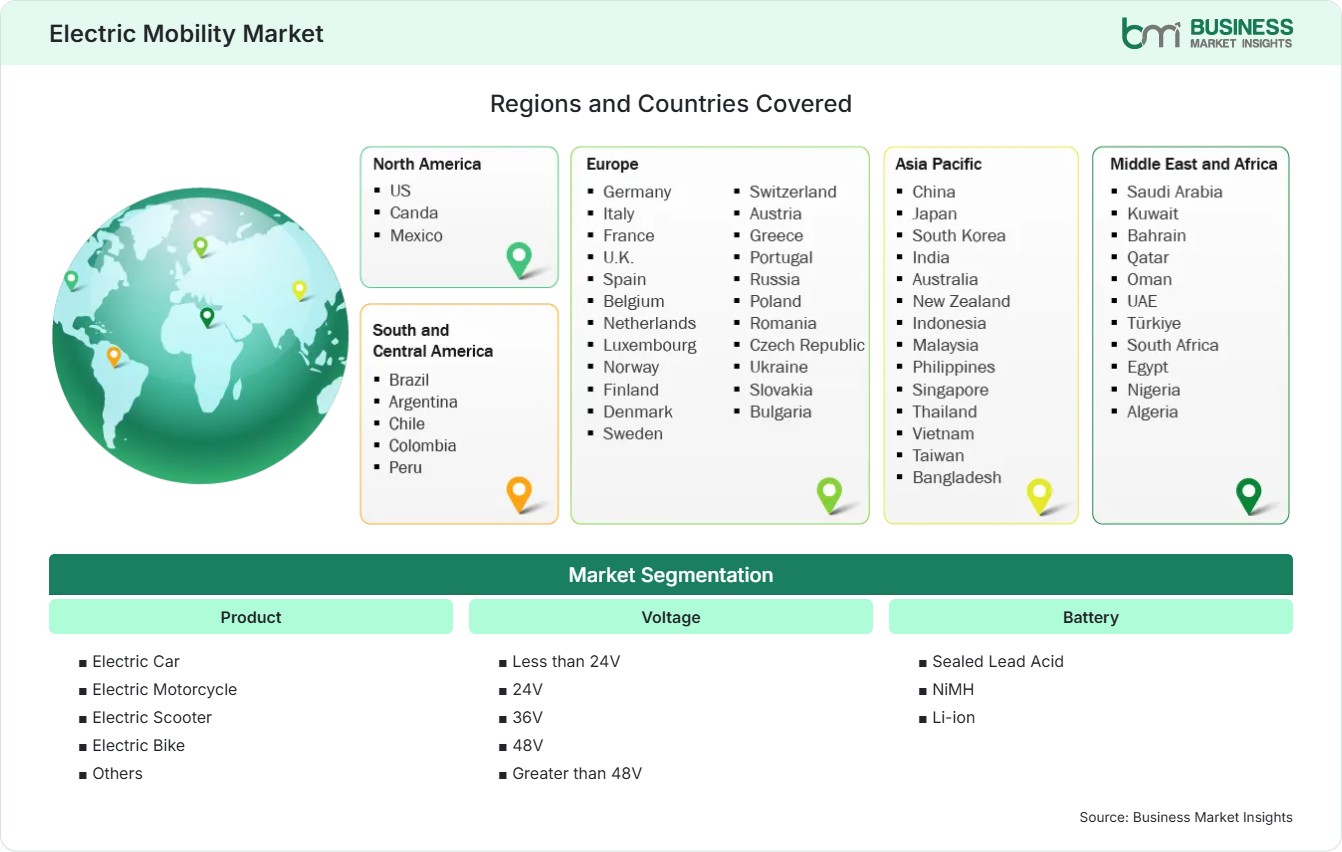
  • Product: Electric Car, Electric Motorcycle, Electric Scooter, Electric Bike, Others
  • Voltage: Less than 24V, 24V, 36V, 48V, Greater than 48V
  • Battery: Sealed Lead Acid, NiMH, Li-ion
US$ 806.99 Bn Market size in 2025
US$ 5174.07 Bn Market Size by 2033
26.15% CAGR, 2026 - 2033
2026-2033 Forecast Period

AI Overview

Electric Mobility Market Summary

  • North America Region: North America holds a electric mobility market share of 28%–31% in 2025, growing at a CAGR of 23%–26% during 2026–2033, influenced by premium EV adoption, charging investment, fleet electrification, battery localization, and expanding zero-emission mobility programs. The US market remains technology-intensive, with a 22%–25% CAGR, supported by established automakers, software ecosystems, and charging infrastructure.
  • Fastest Growing Region: Asia Pacific holds a market share of 42%–46% in 2025, expanding at a CAGR of 28%–31% during 2026–2033, supported by manufacturing scale, affordable electric two-wheelers, battery localization, urban congestion, government incentives, and rapidly expanding charging and swapping networks.
  • Leading Segment: Electric Car accounts for a 45%–49% share in 2025, with a CAGR of 24%–27% during 2026–2033, supported by falling battery costs, broader model availability, stricter emissions requirements, consumer adoption, charging expansion, fleet replacement, and improving vehicle economics.
  • High Growth Segment: Li-ion batteries represent an 88%–92% share in 2025, recording a CAGR of 28%–32% during 2026–2033, supported by superior energy density, declining pack costs, manufacturing scale, fast charging, longer driving ranges, recycling investments, and expanding electric vehicle applications.
  • Key Market Opportunity: Battery localization, charging interoperability, affordable electric two-wheelers, commercial fleets, software-defined vehicles, battery swapping, and second-life energy storage create substantial investment opportunities across emerging and mature mobility ecosystems.
  • Major Market Players: BYD Company Ltd, SAIC-GM-Wuling Automobile, Hyundai Motor Company, Tesla, Inc., Volkswagen AG, Merida Industry Co., Ltd., Trek Bicycle Corporation, Giant Manufacturing Co., Ltd., Accell Group, Pon Holdings B.V., Ola Electric Mobility Limited, TVS Motor Company Limited, Ather Energy Limited, Yadea Group Holdings Ltd., and Gogoro Inc.
Strategic Insights

Electric Mobility Market: Strategic Insights

Electric Mobility Market Strategic Framework
FREE PDF
Request your free sample
Request free sample
Stakeholder View

Key Takeaways

  • The competition has shifted from manufacturing cars to vertically integrated battery manufacturing, software, power electronics, charging, finance, and lifecycle. Companies that manage multiple layers in the value chain can better manage costs and shorten time-to-market.
  • Electric scooters and motorcycles have a relatively low entry price compared to electric cars and have higher penetration rates in Asian cities. India illustrates this, where electric two-wheelers are the biggest segment of electric vehicles under government schemes.
  • The cell chemistry, thermal management, charging rate, battery longevity, and software-driven energy management have become more important than before. While lithium-ion still dominates, improvements in LFP, high voltage, fast-charging batteries and cell technologies are being developed.
  • Multinational companies have an advantage in terms of manufacturing localization, extensive supply chains, urban population and high penetration rates of electric two-wheelers. China already accounts for more than half of all global electric vehicle sales, and India is developing its own.
  • Electric Mobility Market forecast suggest that investment opportunities increasingly extend beyond vehicle manufacturers into charging networks, battery swapping, fleet management, energy storage, recycling, and mobility software.
Geographic Outlook

Electric Mobility Market Regional Highlights

North America Electric Mobility Market

North America represented a 28%–31% electric mobility market share in 2025 and is projected to expand at a 23%–26% CAGR during 2026–2033. The region benefits from strong passenger-car electrification, established technology companies, charging investment, and premium EV demand. The United States accounts for most regional value, while Canada contributes through fleet electrification and zero-emission policies. Market share is supported by high vehicle ownership, substantial investment capacity, and increasing availability of electric SUVs, pickups, and commercial vehicles. The regional outlook remains dependent on incentives, charging economics, and consumer financing conditions.

  • Luxury electric vehicles will continue to be commercially significant because greater buying power within households allows for the purchase of advanced electric cars with bigger batteries, connectivity options, and better range.
  • The commercial fleet represents another source of demand since logistics firms compare the operating cost of their vehicles, savings from maintenance, predictability of routes, and carbon emissions targets.
  • The charging network is progressively transitioning to high-capacity public networks, workplace charging, depot charging, and energy management, making the use of electric vehicles easier.
  • Local manufacturing of batteries is a key strategic priority because the regional supply chains emphasize local production, recycling, and security of critical minerals.

US Electric Mobility Market

The US accounted for approximately 72%–76% of North America's 2025 value, with a projected 22%–25% CAGR during 2026–2033. Adoption is concentrated across passenger vehicles, commercial fleets, premium segments, and selected urban markets. The country's scale supports investments in charging networks, battery factories, software, autonomous driving integration, and vehicle platforms.

  • Electric trucks and SUVs create a valuable niche since they cater to high-volume segments of vehicles while increasing the use of electric vehicles beyond small cars.
  • Fleet electrification helps manage predictable electricity demand, as well as optimization of the vehicles through telematics, routing, depot charging, and energy cost management.

Europe Electric Mobility Market

Europe held a 24%–27% share in 2025, with a projected 24%–27% CAGR through 2033. The region's Electric Mobility Market share is supported by fleet standards, charging development, urban restrictions on emissions, and expanding consumer choice.

  • Germany is an important industrial base due to the country’s automotive industry and advanced engineering that serves as a foundation for electric vehicle manufacturing.
  • The UK and France provide promising growth opportunities due to fleets and urban customers who comply with emissions standards and expand their charging infrastructure.
  • High growth areas of Europe are increasingly focused on developing cost-effective compact electric cars, commercial vehicles, and local battery suppliers instead of premium passenger cars only.

Asia Pacific Electric Mobility Market

Asia Pacific held a 42%–46% share in 2025 and is forecast to record a 28%–31% CAGR through 2033, making it the fastest-growing major region. China leads regional volume, while India, Southeast Asia, Japan, South Korea, and Taiwan contribute through different mobility models.

  • Electric mobility market in China benefits from extensive battery production, integrated automotive supply chains, strong domestic demand, and broad availability of electric cars across price categories.
  • India provides substantial growth potential through electric scooters, motorcycles, three-wheelers, fleet applications, and government-backed charging and manufacturing programs.

Rest of World Electric Mobility Market

Rest of World represented a 5%–8% share in 2025, with a projected 25%–29% CAGR through 2033. South and Central America are developing electric mobility through buses, motorcycles, urban fleets, and passenger vehicles, while Brazil and Mexico provide important manufacturing and consumer markets.

  • Brazil electric mobility market offers potential through urban buses, compact passenger vehicles, motorcycles, and renewable electricity availability, creating opportunities for manufacturers and charging providers.
  • There is a major manufacturing opportunity offered by Mexico, as the existing auto manufacturing capabilities of the country can facilitate the supply chain development for EVs.
  • The UAE and Saudi Arabia are well-positioned in terms of premium EV sales, electric buses, electric public transportation, and smart city projects.
  • South Africa represents more of a long-term opportunity regarding electric buses, commercial vehicles, and motorcycles.
Global Market Geography
FREE PDF
Request your free sample
Request free sample
Segment Analysis

Electric Mobility Market Segmentation

Product

Product accounted for the largest structural share, with Electric Car estimated at 45%–49% of 2025 value and a 24%–27% CAGR during 2026–2034. The category benefits from expanding model availability, emissions regulation, fleet electrification, and improving battery economics. The Electric Mobility Market scope increasingly incorporates passenger, commercial, shared, and connected applications across vehicle platforms.

  • Electric Car: Passenger and commercial electrification is expanding through wider model availability, improving range, charging networks, regulatory pressure, and declining total ownership costs across mature and emerging markets.
  • Electric Motorcycle: Electric motorcycles address urban commuting, delivery services, and short-distance mobility, particularly where motorcycle ownership is established and fuel savings materially improve operating economics.
  • Electric Scooter: Scooters benefit from compact dimensions, lower acquisition costs, removable batteries, connected features, and suitability for dense cities, making them particularly attractive across Asian markets.
  • Electric Bike: Electric bicycles combine pedal assistance with low operating costs, supporting commuting, recreation, delivery, micromobility, and last-mile transportation where compact infrastructure improves practicality.

Voltage

Voltage segmentation is shaped by vehicle architecture, performance requirements, charging speed, and application intensity. Higher-voltage systems increasingly support passenger cars and performance-oriented platforms, while lower-voltage architectures remain relevant for compact mobility. The category is estimated to expand at a 23%–29% CAGR during 2026–2034, reflecting rising electrical loads and faster charging requirements.

  • Less than 24V: Lower-voltage systems remain relevant for accessories, compact mobility components, control systems, and specialized low-power applications where simplicity and cost remain important.
  • 24V: Twenty-four-volt architectures serve selected mobility applications and electrical subsystems, balancing power requirements, component availability, packaging considerations, and cost-sensitive deployment.
  • 36V: Thirty-six-volt systems remain important in electric bicycles and compact vehicles because they provide practical performance while retaining relatively manageable battery and electronics requirements.
  • 48V: Forty-eight-volt architectures offer an effective compromise between performance, efficiency, component cost, and packaging, supporting scooters, light mobility platforms, and selected commercial applications.
  • Greater than 48V: Higher-voltage systems enable greater power delivery, faster charging, reduced current losses, and more demanding vehicle performance, making them increasingly relevant to electric cars and premium platforms.

Battery

Li-ion batteries dominated battery architecture with an estimated 88%–92% share in 2025 and a projected 28%–32% CAGR during 2026–2034. The category benefits from energy density, manufacturing scale, improving thermal management, and expanding charging capabilities. Electric Mobility Market trends increasingly prioritize battery durability, safety, lifecycle economics, and recycling alongside capacity.

  • Sealed Lead Acid: Lead-acid batteries remain relevant in cost-sensitive and low-speed applications where established recycling infrastructure, low upfront costs, and simple maintenance can outweigh lower energy density.
  • NiMH: Nickel-metal hydride retains selective relevance in established hybrid platforms and applications where durability, mature supply chains, and proven thermal characteristics remain important.
  • Li-ion: Lithium-ion dominates modern electric mobility because of high energy density, scalable manufacturing, improving charging performance, falling costs, and compatibility with passenger, commercial, and two-wheeler platforms.
Market Forces

Electric Mobility Market Dynamics

Key Market Drivers

Rapid Expansion of Electric Vehicle Adoption

Electric vehicle sales make up the most compelling structurally driven demand factor. According to the IEA, sales of electric cars amounted to more than 17 million units in 2024, where sales increased by more than 25%, surpassing 20% of global car sales. China had the largest share of electric cars sold on a global level of nearly two-thirds. Such high numbers help drive up manufacturing efficiency, supplier economics, and customer awareness. Thus, the Electric Mobility Market growth is increasingly based on network effects rather than only on incentives.

Battery Technology and Manufacturing Scale

Battery technology is helping narrow the cost-performance difference between electric and traditional mobility technologies. Mass production of cells allows the suppliers to make improvements in materials use, automation, packaging, thermal management, and manufacturing efficiency. Lithium-ion cell structures have taken over as they offer high energy densities and packaging versatility on different types of vehicles. Battery management systems improve performance in terms of capacity, charging behavior, and thermal management. The combination of innovation at the cell level and integration into vehicles is enabling more widespread adoption of electric technologies. This is evident in the product range offered by BYD and other companies that are looking into producing localized cell supplies.

Government Emissions and Electrification Policies

The regulatory demands are still a major push factor due to the increasing requirement on the reduction of the emission levels in the automotive industry. In Europe, the CO2 emission levels of passenger cars and vans have become stricter over time, with a goal of reaching zero emissions for new cars and vans by 2035. According to the European Commission, the average emissions of new passenger cars in Europe dropped by 28% from 2019 to 2024. Zero-emission vehicles were 14.5% of new car registrations in the EU, Norway, and Iceland in 2024.

Key Market Opportunities

Battery Swapping and Energy-as-a-Service

Battery swapping creates an alternative to conventional charging for high-utilization two-wheelers, commercial fleets, and dense urban environments. The model can reduce waiting time, shift charging operations away from vehicle owners, and create recurring subscription revenue. Gogoro reported nearly 700,000 riders and more than 800 million battery swaps across its network by early 2026, demonstrating that swapping can develop into an ecosystem rather than a standalone service. Its first-quarter 2025 battery-swapping service revenue increased 6.2% year-on-year. This supports a broader Electric Mobility Market opportunity in standardized batteries, energy subscriptions, fleet services, and distributed storage.

Affordable Electric Two-Wheeler Platforms

Two-wheeled vehicles with reduced cost could be used to enable electrification among consumers who cannot afford the cost of passenger electric vehicles. This is evidenced by the FY2024-25 sale of electric two-wheelers that stood at 1.149 million units, up by 21% from the preceding fiscal year in India. This has prompted manufacturers to create low-cost electric vehicles, removable batteries, expand dealership networks, and locally developed electric vehicles platforms. An example of an electric vehicle with low cost is the Ola Electric Gig and S1 Z series that were created with personal and commercial use cases and will roll out from 2025.

Commercial Fleet Electrification and Charging

Fleet vehicles represent an appealing investment opportunity because their set routes facilitate the modeling of vehicle utilization, while centralized charging makes the infrastructure simpler. Fleets for deliveries, taxis, buses, municipal transportation, and corporate mobility have the potential to use their vehicles extensively throughout the year, making their cases economically more compelling for electrification. Fleet managers also increasingly combine telematics, software for charging, electricity procurement, and maintenance analytics. This can be stimulated by the government with procurement policies and charging regulations. The Indian PM E-DRIVE initiative, for instance, allocates Rs.4,391 crore for 14,028 electric buses.

Market Restraints and Challenges

Charging Infrastructure and Grid Constraints

Factor: Uneven charging availability remains a barrier, particularly outside major urban corridors and fleet depots. Public chargers may not provide adequate coverage for long-distance travel, while apartment residents can face limited access to private charging.

Impact: infrastructure gaps increase range anxiety, extend deployment timelines, and require manufacturers or fleet operators to finance additional charging assets. Grid constraints can also delay high-power charging projects where substations require upgrades. The challenge is more pronounced in emerging markets where electricity networks and vehicle financing are developing simultaneously.

Battery Supply Chain and Affordability Risks

Factor: Batteries require mineral processing, cell fabrication, chemical components, specialized machinery, and regional logistics. The price fluctuation or trade barriers may impact the cost of vehicles and profits of manufacturers.

Impact: Any abrupt fluctuations in material prices could hinder the progress in making them affordable and complicate procurement planning. Manufacturers are coping with this issue through chemistry flexibility, localization, recycling, long-term agreements, and vertical integration. Yet, some small-scale manufacturers might not have sufficient volume of purchase orders to buy affordable cells.

Company Analysis

Competitive Landscape

Electric Mobility Market analysis indicates competition is increasingly based on platform scale, battery integration, software capability, charging ecosystems, distribution reach, and manufacturing localization rather than vehicle specifications alone.

Company Name

Overview

Products and Services relevant to this market

BYD Company Ltd

Chinese electric mobility manufacturer with integrated vehicle and battery capabilities and broad international expansion.

Electric cars, plug-in hybrids, battery technology, vehicle platforms, energy solutions, and charging-related technologies.

SAIC-GM-Wuling Automobile

Chinese automotive joint venture known for high-volume affordable mobility and compact vehicle platforms.

Compact electric cars, affordable urban EVs, electric mobility platforms, and mass-market vehicle manufacturing.

Hyundai Motor Company

South Korean automotive manufacturer with global EV platforms and investments across connected mobility technologies.

Electric cars, dedicated EV platforms, batteries, connected vehicles, charging partnerships, and mobility solutions.

Tesla, Inc.

US electric vehicle and energy technology company focused on vertically integrated EV and software ecosystems.

Electric cars, battery systems, charging infrastructure, vehicle software, energy storage, and related services.

Volkswagen AG

German automotive group transitioning multiple global brands toward electrified vehicle platforms.

Electric cars, dedicated EV platforms, batteries, charging services, software, and fleet mobility solutions.

Merida Industry Co., Ltd.

Taiwan-based bicycle manufacturer with substantial expertise in performance and electric bicycle production.

Electric bicycles, bicycle systems, frames, components, and mobility-oriented cycling products.

Trek Bicycle Corporation

US bicycle company with extensive product development and distribution capabilities in electric cycling.

Electric bicycles, commuter e-bikes, mountain e-bikes, urban mobility products, and cycling services.

Giant Manufacturing Co., Ltd.

Taiwan-based bicycle manufacturer with global scale and vertically integrated production capabilities.

Electric bicycles, bicycle components, frames, mobility products, and integrated e-bike systems.

Accell Group

European bicycle group with brands spanning conventional and electric cycling applications.

Electric bicycles, urban e-bikes, commuter products, components, and bicycle mobility solutions.

Pon Holdings B.V.

Dutch mobility group active across bicycles, automotive distribution, and mobility services.

Electric bicycles, cycling brands, mobility services, automotive distribution, and sustainable transportation solutions.

Ola Electric Mobility Limited

Indian electric two-wheeler company focused on localized manufacturing, batteries, and software.

Electric scooters, electric motorcycles, battery technology, software, charging, and manufacturing platforms.

TVS Motor Company Limited

Indian two- and three-wheeler manufacturer expanding its connected electric mobility portfolio.

Electric scooters, connected EVs, three-wheelers, charging solutions, and mobility technology.

Ather Energy Limited

Indian electric two-wheeler specialist focused on scooters, software, charging, and retail infrastructure.

Electric scooters, charging networks, vehicle software, connected services, and battery platforms.

Yadea Group Holdings Ltd.

Chinese electric two-wheeler manufacturer with extensive international distribution and product scale.

Electric scooters, motorcycles, bicycles, batteries, charging products, and mobility accessories.

Gogoro Inc.

Taiwan-based battery-swapping technology company operating an integrated urban mobility ecosystem.

Electric scooters, battery swapping, smart batteries, subscription services, energy infrastructure, and connected mobility.

Trust & Transparency

Research Methodology

The market analysis combines proprietary research with secondary data from government agencies, company disclosures, regulatory filings, industry databases and expert interviews. Market estimates are validated through data triangulation, cross-market benchmarking and analyst review.

View Full Research Methodology

Questions Answered

Frequently Asked Questions

What should investors examine beyond vehicle sales?

Investors should assess battery supply, charging networks, software, fleet management, recycling, financing, and energy services. These adjacent markets can create recurring revenue streams and reduce dependence on vehicle-unit margins.

How will charging infrastructure influence vehicle purchasing decisions?

Charging availability affects range confidence, fleet utilization, residual values, and consumer convenience. High-power corridors, workplace charging, residential charging, depot infrastructure, and software-enabled payment systems will collectively determine how quickly adoption expands.

What is driving electric mobility adoption in India?

India combines government incentives, rising fuel costs, urban congestion, local manufacturing, and strong two-wheeler usage. FY2024-25 electric two-wheeler sales reached 1.149 million units, demonstrating the scale of demand emerging from affordable electrification.

How important is battery swapping to future electric mobility?

Battery swapping can become strategically important for high-utilization scooters and commercial fleets where charging downtime directly affects revenue. Standardized batteries and subscription models can also create recurring energy-service revenue beyond vehicle sales.

Which vehicle category is likely to create the strongest volume opportunity in Electric Mobility Market report?

Electric two-wheelers are positioned for strong volume growth because their acquisition costs, energy requirements, and charging needs are generally lower than passenger cars.

Access the Full Electric Mobility Market Report

Get segment-level forecasts, regional estimates, competitive benchmarking, company profiles and downloadable Excel datasets.

Access the full Electric Mobility Market Report
350 pages PDF & Excel | 2026-09-04