
Passenger Ferries Market Outlook: Size, Share, Trends, Growth Analysis, Competitive Landscape & Forecast, 2026-2033

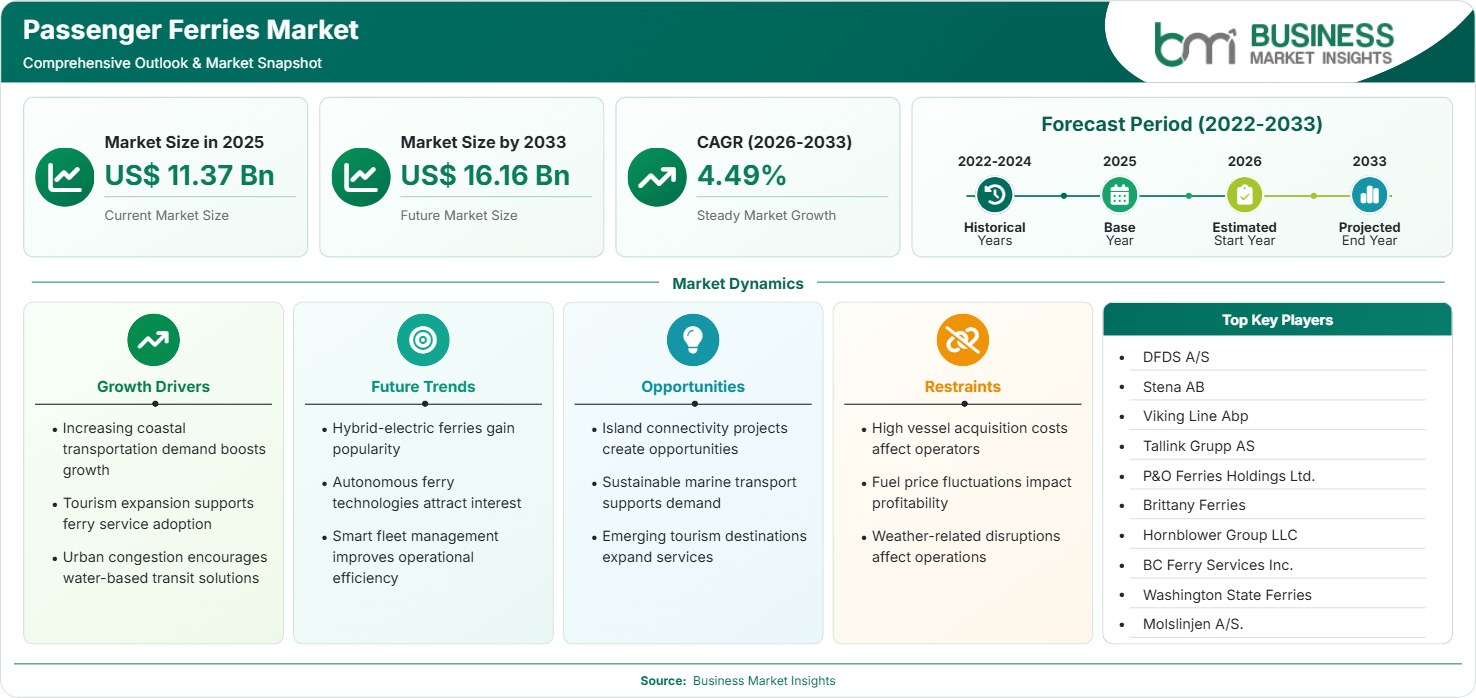
The Passenger Ferries Market size was valued at US$ 11.37 Billion in 2025 and is projected to reach US$ 16.16 Billion by 2033, growing at a CAGR of 4.49% during 2026–2033. Growth is supported by tourism recovery, coastal urbanization, fleet modernization, low-emission vessel adoption, island connectivity investments, and expanding digital ticketing ecosystems creating operational and passenger experience opportunities.

Report Coverage
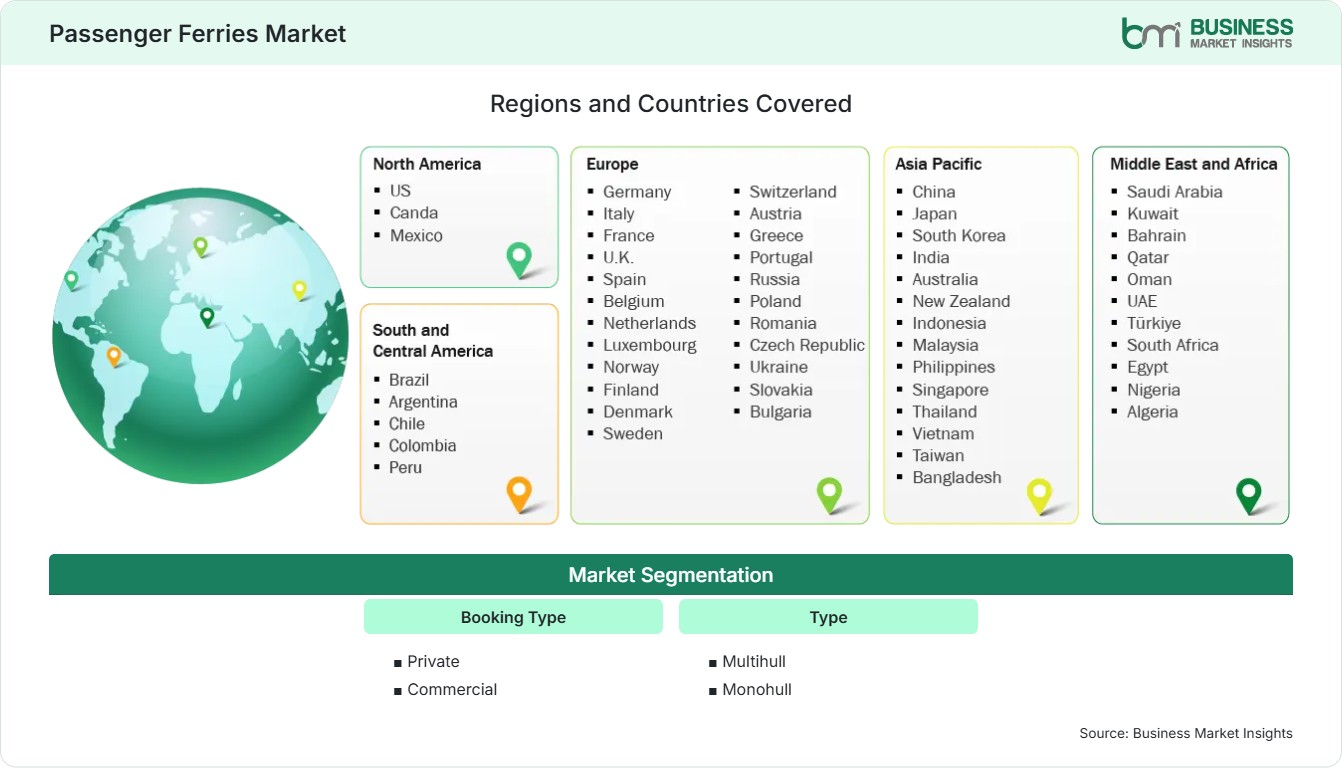
  • Booking Type: Private, Commercial
  • Type: Multihull, Monohull
US$ 11.37 Bn Market size in 2025
US$ 16.16 Bn Market Size by 2033
4.49% CAGR, 2026 - 2033
2026-2033 Forecast Period

AI Overview

Passenger Ferries Market Summary

  • North America Region: holds a 34%–37% share in 2025, growing at a CAGR of 4.0%–4.4% during 2026–2033. Demand is supported by waterfront commuting, fleet electrification programs, infrastructure grants, tourism expansion, and modernization of aging vessels across coastal routes and island transport networks. US market benefits from ferry electrification and transit integration, advancing at approximately 4.1%–4.5% CAGR.
  • Fastest Growing Region: Asia Pacific holds a 25%–28% share of the Passenger Ferries Market in 2025, growing at a CAGR of 5.4%–5.8% during 2026–2033. Rising domestic tourism, island mobility requirements, port upgrades, digital ticketing, and government maritime investments continue expanding regional passenger transportation demand.
  • Leading Segment: Commercial holds a 62%–66% share in 2025, growing at a CAGR of 4.3%–4.7% during 2026–2033. Growth is driven by public transportation integration, tourism services, high-frequency commuter routes, and increasing government support for maritime mobility infrastructure.
  • High Growth Segment: Multihull holds a 38%–42% share in 2025, growing at a CAGR of 5.1%–5.6% during 2026–2033. Demand is encouraged by higher fuel efficiency, greater passenger capacity, improved stability, and suitability for fast ferry operations.
  • Key Market Opportunity: Large-scale deployment of hybrid, battery-electric, and hydrogen-powered vessels enables operators to reduce emissions, qualify for public funding programs, lower lifecycle costs, and strengthen route competitiveness.
  • Major Market Players: DFDS A/S, Stena AB, Viking Line Abp, Tallink Grupp AS, P&O Ferries Holdings Ltd., Brittany Ferries, Hornblower Group LLC, BC Ferry Services Inc., Washington State Ferries, Molslinjen A/S.
Strategic Insights

Passenger Ferries Market: Strategic Insights

Passenger Ferries Market Strategic Framework
FREE PDF
Request your free sample
Request free sample
Stakeholder View

Key Takeaways

  • Ferry value chains are becoming increasingly digitized, integrating vessel operators, terminal authorities, ticketing providers, maintenance contractors, and mobility platforms into connected transportation ecosystems.
  • The highest upside remains concentrated in commercial transportation corridors serving islands, tourism destinations, and metropolitan waterfront commuter networks with recurring passenger demand.
  • Innovation efforts are shifting toward hybrid propulsion, battery-electric platforms, predictive maintenance systems, autonomous navigation assistance, and AI-supported fleet management capabilities.
  • Asia Pacific offers a compelling investment case owing to expanding domestic tourism, archipelagic populations, port modernization programs, and government-backed maritime infrastructure spending.
  • Consolidation activity increasingly focuses on route optimization, fleet modernization partnerships, vessel financing arrangements, and sustainability-focused capital deployment.
  • Operators capable of balancing environmental compliance with affordability are positioned to gain long-term competitive advantages across regulated coastal transportation markets.
Geographic Outlook

Passenger Ferries Market Regional Highlights

North America Passenger Ferries Market

North America accounts for approximately 34%–37% of the Passenger Ferries Market share in 2025 and is projected to expand at a CAGR of 4.0%–4.4% through 2033. Public transit integration, strong coastal tourism flows, and federal sustainability funding support adoption. Electrification programs in the United States and Canada are accelerating fleet renewal decisions. Major metropolitan corridors increasingly utilize ferry transportation to address congestion while supporting lower-emission mobility objectives across waterfront urban centers.

  • Extensive vessel replacement programs support modernization of fleets operating in Washington, California, British Columbia, and northeastern coastal transportation corridors.
  • Port electrification investments strengthen operational efficiency while supporting compliance with environmental regulations and decarbonization targets.
  • Tourism-oriented ferry services continue benefiting from growing demand for regional experiences and island destination access.
  • Integrated ticketing systems improve passenger convenience, multimodal connectivity, and service utilization rates across numerous commuter networks.

US Passenger Ferries Market

The United States represents roughly 73%–77% of North American demand and advances at a CAGR of 4.1%–4.5% during the forecast period. Ferry networks play a critical role in metropolitan transportation systems, particularly across the Pacific Northwest, California, New York, and New England. Infrastructure grants, electrification initiatives, and resilience investments continue supporting fleet modernization while improving service reliability and environmental performance.

  • State and federal funding mechanisms support procurement of electric and hybrid vessels for public transportation routes.
  • Increasing waterfront development projects generate sustained demand for commuter mobility services.
  • Climate resiliency investments encourage terminal upgrades and operational continuity improvements.
  • Growing tourism activity continues strengthening seasonal passenger volumes in coastal regions.

Europe Passenger Ferries Market

Europe maintains a 30%–33% share of the Passenger Ferries Market in 2025 and records a CAGR of 4.2%–4.6% through 2033. The region benefits from extensive maritime transport networks connecting islands and neighboring countries. Norway, Finland, Sweden, Greece, and the United Kingdom remain significant markets. Strong environmental regulations encourage alternative-fuel vessels and fleet modernization investments. Finland leads regional adoption of low-emission technologies, while Greece demonstrates higher route expansion activity with growth near regional averages.

  • Decarbonization regulations accelerate procurement of hybrid and alternative-fuel ferry vessels.
  • Cross-border passenger traffic supports demand across Northern and Baltic Sea corridors.
  • Tourism-intensive Mediterranean routes maintain stable passenger volumes and recurring investments.
  • Digital route management and smart-ticketing adoption improve operational efficiency and customer satisfaction.

Asia Pacific Passenger Ferries Market

The Asia-Pacific region accounts for 25% to 28% of worldwide revenues in 2025 and boasts the highest CAGR of 5.4% to 5.8% till 2033. A large number of islands, increased domestic tourism, and improved maritime infrastructure will fuel expansion within the region. Major economies in the region are Indonesia, Japan, the Philippines, China, and South Korea. Indonesia is a leader in demand due to its high demand for inter-island connectivity.

  • Island transportation necessity maintains consistently high utilization across domestic ferry networks.
  • Tourism development projects expand passenger traffic on established and emerging routes.
  • Government infrastructure programs improve terminal capacity and operational safety standards.
  • Digital booking platforms increase accessibility and improve route occupancy management.
  • Fleet modernization initiatives support adoption of efficient vessel designs and propulsion technologies.

Rest of World Passenger Ferries Market

The Rest of World Passenger Ferries Market shares around 8%–11% in 2025 and is expected to grow at a CAGR of 4.6%–5.0% during 2033. The markets in South and Central America are driven by demand for tourism-related coastal transportation services.

The Middle East and Africa markets are set to grow due to developments in waterfront cities, tourism diversification, and maritime infrastructure upgrades. Brazil is one of the key players in the market, while Saudi Arabia is seeing accelerated developments in tourism and coastal investments.

  • Coastal tourism projects support route development and fleet investment initiatives across multiple countries.
  • Urban waterfront redevelopment increases utilization of marine passenger transportation services.
  • Government investment programs improve maritime infrastructure and safety capabilities.
  • Island economies depend heavily on ferry connectivity for people movement and economic activity.
Global Market Geography
FREE PDF
Request your free sample
Request free sample
Segment Analysis

Passenger Ferries Market Segmentation

Booking Type

The segment section represents diverging modes of operations between public transport and personal transport services. The Passenger Ferries Market size by booking channel is steadily growing due to digitalization and platform integration. Commercial service holds a 62%-66% share in 2025 and grows at a 4.3%-4.7% CAGR, driven by regular customer demand. Private bookings maintain growth through tourism, leisure travel, and premium transportation experiences.

  • Private: Demand is supported by tourism excursions, luxury transportation services, destination travel packages, and personalized experiences. Digital reservations and premium onboard offerings continue enhancing traveler engagement and service differentiation.
  • Commercial: Commercial operations benefit from scheduled transportation networks, commuter mobility requirements, government transportation programs, and integration with urban transit systems, creating dependable passenger volumes and recurring revenue streams.

Type

The configuration of vessels is important for operational costs, passenger capacity, speed, and fuel efficiency. The monohulls continue to hold the largest market share, at 58%-62% in 2025, with a compound annual growth rate of 4.1%-4.5%. Passenger Ferries Market trends lean towards adopting multihulls due to improved fuel efficiency and performance.

  • Multihull: Adoption increases across fast-ferry applications due to enhanced stability, improved passenger comfort, reduced fuel intensity, and suitability for technologically advanced propulsion systems.
  • Monohull: Operators continue relying on monohull vessels for established routes, flexible operational capabilities, strong carrying capacity, and effective deployment across diverse maritime environments.
Market Forces

Passenger Ferries Market Dynamics

Key Market Drivers

Expansion of Coastal Tourism and Island Connectivity

Recovery in global tourism is expected to further boost demand for maritime transport solutions. In international tourism statistics, many coastal tourist destinations have managed to regain or even exceed pre-pandemic tourist numbers, thereby increasing passenger traffic along ferry routes. The Passenger Ferries Market growth will largely be determined by destinations where ferries act as a necessary means of access to island and coastal locations. Government authorities now understand the role of maritime transport in the regional mobility system. The rise in passenger numbers, route expansions, and improved tourism infrastructure together ensure high utilization ratios for vessels.

Electrification and Sustainable Fleet Modernization

Decarbonization policies are altering ferry operators' procurement priorities. Ferries that run on battery, hybrid, and hydrogen power will reduce their life-cycle emissions while helping ferry operators meet compliance goals. Various governments have launched funding mechanisms to support the electrification of vessels and port infrastructure. High expectations about fuel economy have driven ferry companies to upgrade their existing fleet with modern platforms. The objective of environmental sustainability is another factor that influences the procurement process of public transport enterprises. The energy management system and propulsion system help improve operational processes and minimize maintenance expenses. To put it differently, decarbonization policy becomes a part of the structural demand driver rather than an occasional compliance process.

Digitalization of Passenger Operations

Digital ticketing solutions, real-time fleet tracking, predictive maintenance systems, and passenger analytics tools have become more common among operators. All those innovations help to optimize routes, manage asset utilization, and engage customers. Adoption rates for mobile booking continue to rise across both leisure and commuter segments, generating efficiencies and reducing transaction costs. Market developments also indicate greater integration between ferry and multimodal transport systems. Analytics tools enable operators to make better forecasts and scheduling decisions to increase their profitability. Optimization of routes, asset utilization, and personalized services provides definite advantages for operators.

Key Market Opportunities

Deployment of Zero-Emission Ferry Networks

The move to battery-electric and hydrogen ships is one of the most promising areas of future investment. Ferry operations have a predictable distance, making it easier to implement alternative propulsion. Grants from governments, environmentally friendly finance, and carbon footprint reduction contribute positively to the economics of such projects. Passenger Ferries Market Forecasts predict higher investment in the purchase of green ships and the necessary infrastructure. Pioneers may see financial advantages due to lower fuel costs, regulatory alignment, and more favorable funding. Technological progress reduces the risk of scaling up the solution. With increasing pressure for decarbonization, companies with scalable zero-emission policies will be well-positioned to increase their market share and profitability.

Growth Across Emerging Maritime Tourism Corridors

The rapid development of tourism in South-East Asia, the Middle East, and certain coastal economies in Africa presents promising opportunities to expand routes. Extensive investments in port facilities, waterfront development, and tourist infrastructure have been made by local governments. The ferry mode usually offers cost-effective service between tourist areas and city centers. Rising needs for experiential tourism add to the increasing number of passengers. The relatively low degree of market saturation in the newly developed tourism corridors, coupled with rising government investment, makes these areas promising for the operators.

Integration with Smart Mobility Ecosystems

Urban transportation agencies today are seeking an integrated transportation network that combines buses, trains, shared mobility solutions, and maritime transportation. Maritime operators could join by creating integrated ticketing, planning, and payment options. This will improve usability and attract passengers to ferry services. The smart city concept offers additional opportunities to develop intelligent terminals and passenger information systems. Cooperation with technology companies allows for better route planning and an enhanced user experience. Maritime mobility is thus becoming strategically significant for cities as they aim to reduce congestion and develop a sustainable transport system.

Market Restraints and Challenges

High Capital Intensity and Infrastructure Requirements

Factor: Ferry operations require substantial capital commitments for vessel procurement, terminal development, maintenance infrastructure, and environmental compliance investments. Impact: These costs can delay expansion plans, limit market entry, and extend return-on-investment timelines for operators. Financing challenges become particularly significant when upgrading fleets with low-emission technologies that demand additional infrastructure spending. Smaller operators often face greater difficulty securing capital compared with established market participants. Economic volatility and interest-rate fluctuations may further affect project feasibility. Consequently, high upfront expenditure remains a structural challenge influencing fleet modernization pace and expansion strategies across multiple regional markets.

Weather Dependency and Operational Disruptions

Factor: Ferry transportation remains vulnerable to adverse weather conditions including storms, rough seas, heavy winds, and climate-related disruptions. Impact: Service interruptions can reduce passenger confidence, lower utilization rates, and create scheduling inefficiencies. Operators must allocate resources toward resilience planning, route management, and safety systems. Climate variability increases uncertainty surrounding operational continuity in exposed coastal regions. Delays and cancellations may also affect tourism-related revenues and commuter reliability. While technology improves forecasting capabilities, operators remain exposed to uncontrollable environmental conditions that influence performance metrics and service quality outcomes across ferry transportation networks.

Company Analysis

Competitive Landscape

Passenger Ferries Market analysis indicates competition is shaped by fleet quality, route networks, sustainability investments, digital booking capabilities, and service reliability.

Company Name

Overview

Products and Services relevant to this market

DFDS A/S

European ferry and logistics operator serving passenger and freight corridors across Northern Europe.

Passenger ferries, RoPax services, digital booking platforms, onboard passenger amenities.

Stena AB

Parent company of Stena Line, one of the world's largest ferry operators.

Passenger transport, ferry crossings, onboard hospitality, vehicle transportation services.

Viking Line Abp

Baltic Sea operator connecting Finland, Sweden, and Estonia routes.

Passenger ferry services, cruise-ferry operations, tourism travel experiences.

Tallink Grupp AS

Major Baltic maritime transportation company with integrated hospitality offerings.

Ferry transport, passenger mobility, cruise services, digital ticketing solutions.

P&O Ferries Holdings Ltd.

Long-established operator across UK and European maritime corridors.

Passenger crossings, vehicle transport, regional maritime connectivity services.

Brittany Ferries

Leading operator connecting France, Ireland, Spain, and the UK.

Passenger travel, tourism transportation, cruise-ferry services, onboard accommodation.

Hornblower Group LLC

North American transportation and tourism services provider.

Commuter ferries, sightseeing ferries, mobility and ticketing services.

BC Ferry Services Inc.

Largest ferry transportation network in Canada.

Scheduled passenger ferry routes, island connectivity, public transportation services.

Washington State Ferries

Major public ferry transportation operator in the United States.

Passenger and vehicle ferry transportation, commuter mobility solutions.

Molslinjen A/S

Danish ferry operator focused on domestic and regional routes.

High-speed ferries, passenger transportation, digital reservations and route services.

Trust & Transparency

Research Methodology

The market analysis combines proprietary research with secondary data from government agencies, company disclosures, regulatory filings, industry databases and expert interviews. Market estimates are validated through data triangulation, cross-market benchmarking and analyst review.

View Full Research Methodology

Questions Answered

Frequently Asked Questions

What does the Passenger Ferries Market Report typically evaluate?

A Market Report commonly examines demand trends, regional performance, fleet modernization, competitive positioning, regulations, technology adoption, and long-term growth prospects.

How does vessel type affect competitiveness?

Multihull designs often provide higher speed, fuel efficiency, and passenger comfort, while monohull vessels remain valued for versatility and established operational performance.

Which customer group drives the largest revenue contribution?

Commercial transportation users, including commuters and scheduled passenger services, contribute the largest revenue share because of recurring demand and network-based operations.

What technology is attracting the highest investment interest?

Battery-electric, hybrid-electric, and hydrogen propulsion systems currently attract substantial funding because they align with regulatory objectives and long-term emission reduction goals.

Which factor most influences operator profitability?

Route utilization, vessel occupancy levels, fuel efficiency, and schedule reliability have the greatest impact on profitability. Operators increasingly use analytics and digital platforms to optimize these variables.

Access the Full Passenger Ferries Market Report

Get segment-level forecasts, regional estimates, competitive benchmarking, company profiles and downloadable Excel datasets.

Access the full Passenger Ferries Market Report
350 pages PDF & Excel | 2026-08-31