
Articulated Bus Market Outlook: Size, Share, Trends, Growth Analysis, Competitive Landscape & Forecast, 2026–2033

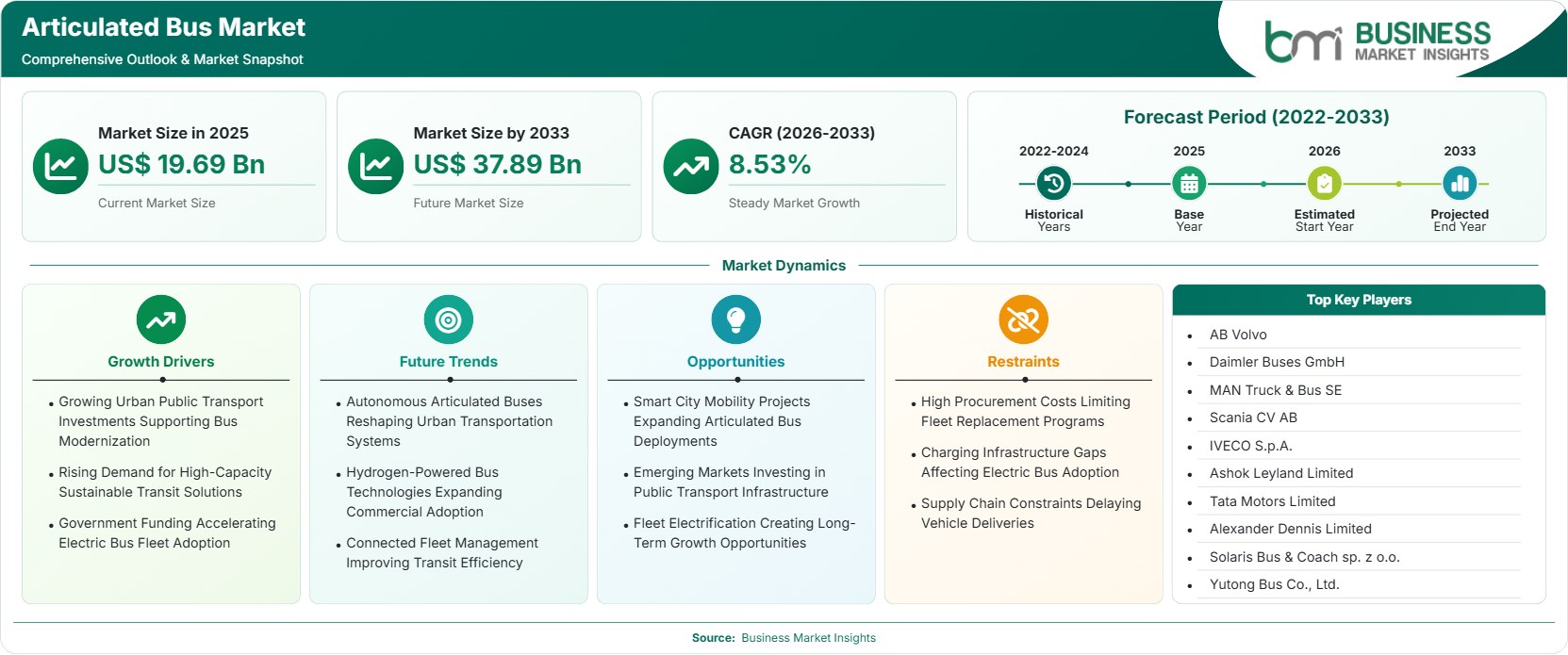
The Articulated Bus Market size was valued at US$ 19.69 Billion in 2025 and is projected to reach US$ 37.89 Billion by 2033, growing at a CAGR of 8.53% during 2026–2033. Rising investments in urban public transportation, fleet electrification initiatives, expanding bus rapid transit networks, and increasing demand for high-capacity sustainable mobility solutions continue driving global market expansion.

Report Coverage
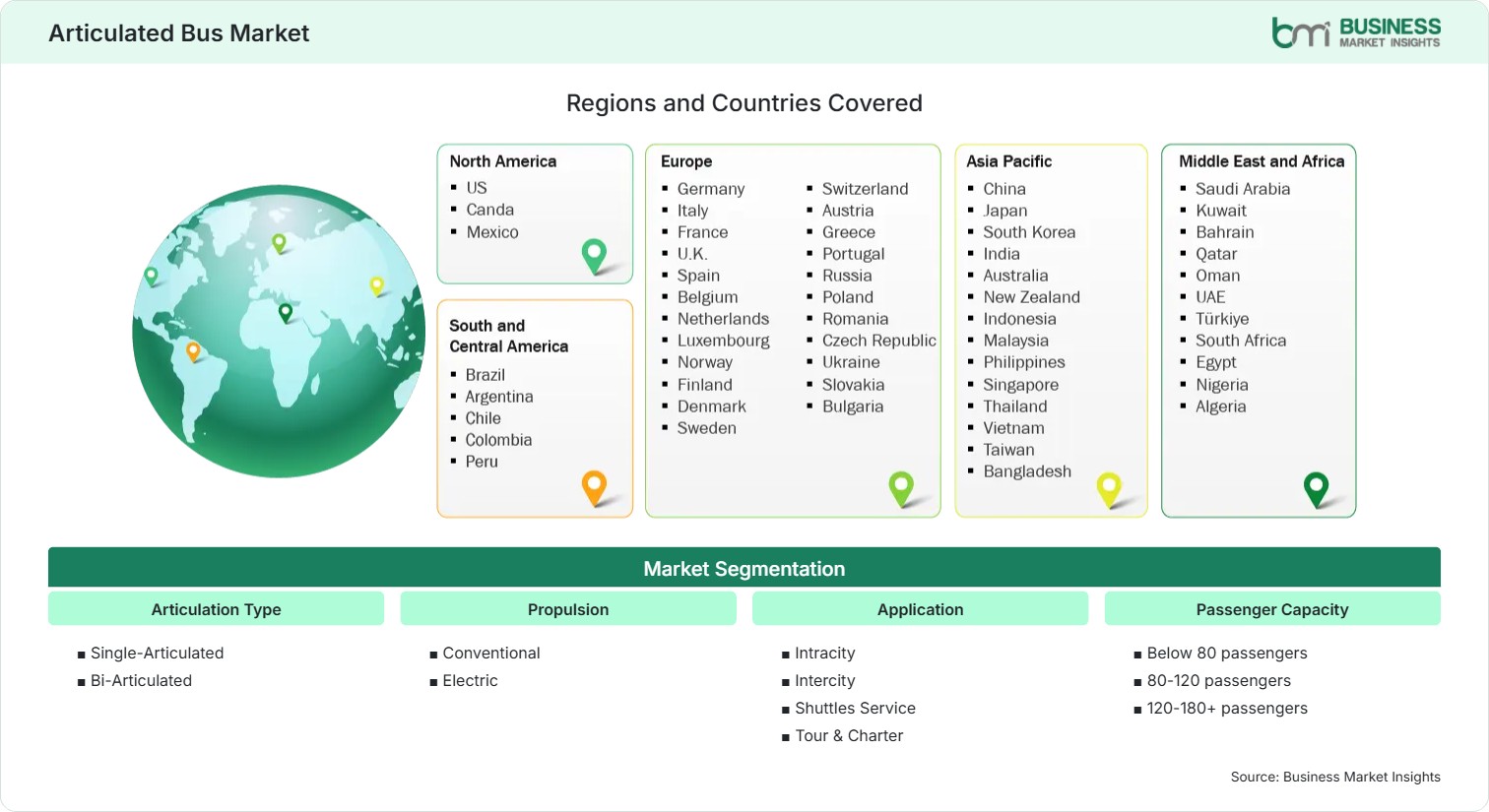
  • Articulation Type: Single-Articulated, Bi-Articulated
  • Propulsion: Conventional, Electric
  • Application: Intracity, Intercity, Shuttles Service, Tour & Charter
  • Passenger Capacity: Below 80 passengers, 80-120 passengers, 120-180+ passengers
US$ 19.69 Bn Market size in 2025
US$ 37.89 Bn Market Size by 2033
8.53% CAGR, 2026 - 2033
2026-2033 Forecast Period

01 AI Overview

Articulated Bus Market Summary

  • North America Region: North America holds 26%–29% market share in 2025 and is projected to grow at a 8.1%–8.7% CAGR during 2026–2033. Growing investments in public transit modernization, expanding bus rapid transit systems, increasing electric bus deployment, and government funding for low-emission transportation continue supporting regional growth. The U.S. dominates the regional market through fleet modernization programs, urban transit expansion, and increasing adoption of zero-emission buses, expanding at approximately 8.2%–8.8% CAGR during the forecast period.
  • Fastest Growing Region: Asia Pacific accounts for 39%–42% market share in 2025 and is expected to register a 9.1%–9.8% CAGR during 2026–2033. Rapid urbanization, expanding metropolitan transit systems, increasing electric bus manufacturing, supportive government policies, and large-scale investments in public transportation infrastructure continue accelerating regional demand.
  • Leading Segment: Intracity represents 48%–52% market share in 2025 while expanding at a 8.6%–9.2% CAGR through 2033. Rising urban population, congestion reduction initiatives, dedicated bus corridors, and expansion of municipal transportation services continue driving segment leadership.
  • High Growth Segment: Electric accounts for 28%–32% market share in 2025 and is anticipated to register a 10.4%–11.1% CAGR during 2026–2033. Government incentives, decarbonization targets, battery technology improvements, and growing investments in zero-emission public transport continue strengthening adoption.
  • Key Market Opportunity: Expansion of smart mobility ecosystems, battery-electric articulated buses, connected fleet management platforms, autonomous transit technologies, and sustainable urban transportation programs is creating substantial long-term growth opportunities.
  • Major Market Players: AB Volvo, Daimler Buses GmbH, MAN Truck & Bus SE, Scania CV AB, IVECO S.p.A., Ashok Leyland Limited, Tata Motors Limited, Alexander Dennis Limited, Solaris Bus & Coach sp. z o.o., and Yutong Bus Co., Ltd.
02 Strategic Insights

Articulated Bus Market: Strategic Insights

Articulated Bus Market Strategic Framework
FREE PDF
Request your free sample
Request free sample
03 Stakeholder View

Key Takeaways

  • The market ecosystem is evolving through stronger collaboration among bus manufacturers, battery suppliers, charging infrastructure providers, public transport authorities, and intelligent fleet management companies to develop efficient urban transit systems.
  • Intracity transportation continues offering the largest commercial opportunity as metropolitan authorities expand bus rapid transit (BRT) corridors, improve urban mobility, and replace aging fleets with high-capacity articulated buses.
  • Electrification, lightweight vehicle architecture, connected fleet management, advanced driver assistance systems (ADAS), predictive maintenance, and intelligent passenger information systems are reshaping next-generation articulated bus development.
  • Asia Pacific remains the most attractive investment destination owing to rapid urbanization, large-scale public transportation projects, expanding electric bus production, and strong government support for sustainable mobility.
  • Strategic partnerships between OEMs, battery manufacturers, public transit agencies, and charging infrastructure providers continue accelerating electric articulated bus deployment and long-term fleet modernization programs.
  • Future market competitiveness will increasingly depend on battery efficiency, charging infrastructure availability, lifecycle operating costs, digital fleet management capabilities, and compliance with evolving environmental regulations.
04 Geographic Outlook

Articulated Bus Market Regional Highlights

North America Articulated Bus Market

North America accounted for approximately 26%–29% of the Articulated Bus Market share in 2025 and is projected to expand at a CAGR of 8.1%–8.7% through 2033. Increasing investment in urban mobility, fleet modernization initiatives, and bus rapid transit expansion continues supporting market growth. Rising deployment of battery-electric buses, stronger sustainability commitments, and federal funding for public transportation infrastructure further strengthen long-term regional demand.

  • Transit agencies continue replacing aging diesel fleets with low-emission articulated buses to improve passenger capacity while meeting increasingly stringent environmental standards.
  • Bus rapid transit systems continue expanding across major metropolitan areas, increasing demand for high-capacity articulated buses supporting efficient urban mobility.
  • Transit operators increasingly deploy intelligent fleet management systems to optimize scheduling, maintenance, route planning, and operational efficiency.
  • Public infrastructure funding continues encouraging procurement of electric articulated buses and supporting charging infrastructure expansion across urban transportation networks.

US Articulated Bus Market

The United States represents the dominant contributor within North America, accounting for approximately 81%–84% of regional revenue while growing at a CAGR of 8.2%–8.8% during the forecast period. Continued investments in zero-emission transportation, metropolitan transit expansion, and federal infrastructure programs support sustained articulated bus deployment.

  • Municipal transit agencies increasingly invest in electric articulated buses to reduce emissions and improve long-term fleet operating efficiency.
  • Expansion of bus rapid transit corridors strengthens demand for high-capacity vehicles across densely populated metropolitan regions.
  • Smart fleet technologies improve maintenance scheduling, passenger information systems, and operational performance across public transportation networks.
  • Federal sustainability initiatives continue supporting procurement of zero-emission buses and associated charging infrastructure investments.

Europe Articulated Bus Market

Europe represented 28%–31% market share in 2025 and is anticipated to grow at a CAGR of 8.5%–9.1% through 2033. Strong environmental regulations, expanding electric public transport fleets, and government investments in sustainable mobility continue driving regional growth. Germany leads the regional market through large public transport investments, while Poland records one of the fastest growth rates supported by electric bus manufacturing and fleet modernization initiatives.

  • Germany continues expanding urban public transportation while investing in battery-electric articulated buses for metropolitan transit networks.
  • Poland records rapid market growth through increasing domestic manufacturing capacity and strong exports of advanced articulated buses.
  • European cities increasingly prioritize zero-emission mobility by replacing conventional diesel buses with electric articulated alternatives.
  • Digital fleet management platforms improve route optimization, predictive maintenance, and passenger service quality across urban transit operations.
  • Public transport decarbonization strategies continue supporting procurement of advanced articulated buses with improved energy efficiency.

Asia Pacific Articulated Bus Market

Asia Pacific accounted for 39%–42% of global revenue in 2025 and is projected to register the highest CAGR of 9.1%–9.8% during 2026–2033. Rapid urbanization, government-supported public transportation expansion, increasing electric bus production, and growing metropolitan populations continue driving regional market growth. China dominates regional deployment, while India demonstrates the fastest expansion due to large-scale investments in sustainable public transport infrastructure.

  • China continues leading articulated bus production through large domestic transit programs and strong electric bus manufacturing capabilities.
  • India records strong growth as metropolitan cities expand bus rapid transit systems and adopt cleaner public transportation technologies.
  • Japan and South Korea continue investing in intelligent transportation systems supporting efficient operation of modern articulated bus fleets.
  • Increasing urban congestion encourages governments to prioritize high-capacity buses over private vehicle expansion.
  • Smart city initiatives continue accelerating procurement of connected and environmentally sustainable articulated buses.

Rest of World Articulated Bus Market

The Rest of the World contributed 6%–8% of global revenue in 2025 and is expected to expand at a CAGR of 8.4%–9.0% through 2033. South & Central America continue strengthening public transportation through BRT expansion, while the Middle East & Africa invest in sustainable urban mobility projects supporting growing metropolitan populations.

  • Brazil continues expanding bus rapid transit infrastructure, increasing procurement of articulated buses for high-capacity passenger transportation.
  • The United Arab Emirates and Saudi Arabia invest in smart mobility projects integrating modern articulated buses into urban transportation systems.
  • Fleet modernization initiatives continue improving operational efficiency while reducing emissions across public transportation networks.
  • Growing urban populations increase demand for efficient, high-capacity transit systems capable of reducing road congestion.
  • International financing and public-private partnerships continue supporting large-scale procurement of advanced articulated bus fleets.
Global Market Geography
FREE PDF
Request your free sample
Request free sample
05 Segment Analysis

Articulated Bus Market Segmentation

Articulation Type

The articulation type segment determines vehicle capacity, operational flexibility, and route suitability across urban transit networks. This segment accounted for approximately 46%–50% market share in 2025 and is projected to register a CAGR of 8.6%–9.2% during 2026–2033. The Articulated Bus Market scope continues expanding as transit authorities prioritize high-capacity buses that improve passenger throughput while reducing fleet sizes, emissions, and operating costs across metropolitan transportation systems.

  • Single-Articulated: Represents the dominant configuration owing to widespread deployment across urban bus rapid transit routes, offering an optimal balance between passenger capacity, maneuverability, and operating efficiency.
  • Bi-Articulated: Experiences increasing adoption in densely populated metropolitan corridors where exceptionally high passenger volumes require greater carrying capacity and improved operational efficiency during peak travel periods.

Propulsion

The propulsion segment is undergoing significant transformation as governments promote low-emission public transportation and operators seek lower lifecycle operating costs. This segment represented approximately 58%–62% market share in 2025 while advancing at a CAGR of 8.5%–9.1% during the forecast period. Continuous fleet electrification initiatives and supportive environmental regulations continue shaping Articulated Bus Market trends across developed and emerging economies.

  • Conventional: Maintains a significant installed base due to established fueling infrastructure, lower upfront procurement costs, and continued deployment across regions with limited charging infrastructure.
  • Electric: Records the fastest expansion as battery technologies improve, charging infrastructure develops, government incentives increase, and cities accelerate zero-emission public transportation programs.

Application

Application requirements vary according to passenger demand, travel distance, and public transportation planning strategies. This segment accounted for approximately 48%–52% market share in 2025 and is projected to register a CAGR of 8.6%–9.2% throughout the forecast period.

  • Intracity: Leads market demand by supporting high-frequency urban transit services, bus rapid transit systems, and metropolitan transportation networks requiring maximum passenger capacity.
  • Intercity: Continues expanding as regional governments strengthen transportation connectivity between cities using comfortable and fuel-efficient high-capacity buses.
  • Shuttles Service: Gains adoption across airports, university campuses, industrial facilities, business parks, and event venues requiring continuous passenger movement over short distances.
  • Tour & Charter: Maintains stable demand by supporting sightseeing operations, tourism services, corporate transportation, and large group travel requiring enhanced passenger comfort.

Passenger Capacity

Passenger capacity remains a primary purchasing consideration for transit authorities seeking efficient utilization of urban transportation infrastructure. This segment represented approximately 33%–37% market share in 2025 while expanding at a CAGR of 8.7%–9.3% during 2026–2033.

  • Below 80 passengers: Primarily deployed on secondary urban routes and medium-demand corridors where operational flexibility is prioritized over maximum passenger capacity.
  • 80–120 passengers: Represents the most widely adopted configuration by balancing passenger throughput, route flexibility, vehicle maneuverability, and operational efficiency across municipal transit systems.
  • 120–180+ passengers: Experiences increasing deployment within dedicated bus rapid transit corridors serving densely populated metropolitan areas with exceptionally high commuter demand.
06 Market Forces

Articulated Bus Market Dynamics

Key Market Drivers

Growing Urban Public Transport Investments Supporting Bus Modernization

Urbanization and rising traffic have been driving the government's efforts to upgrade their public transportation facilities. Increased investment in bus rapid transit (BRT), bus lanes, and intelligent mobility infrastructure is creating demand for articulated buses which can accommodate more passengers through reduced vehicle numbers. Groups like the International Association of Public Transport (UITP) keep on advocating for sustainable mass transport to decrease congestion and pollution. These developments strengthen Articulated Bus Market growth by allowing for replacement of old buses and efficient operations in the cities.

Rising Demand for High-Capacity Sustainable Transit Solutions

The urban transport sector has now focused more on buses with higher capacity that help increase passenger mobility while emitting fewer pollutants and relying less on personal cars. The use of articulated buses offers increased capacity of seating and standing areas and makes them well suited to be used in heavily populated cities due to increasing commuters. Electric power supply, light vehicle structure, and smart fleet management systems have added more value to the efficiencies of such buses. These advancements continue shaping Articulated Bus Market trends, encouraging wider adoption across municipal transportation systems globally.

Government Funding Accelerating Electric Bus Fleet Adoption

National and regional governments continue allocating substantial funding toward zero-emission public transportation through subsidies, infrastructure investments, and clean mobility initiatives. Public transit agencies increasingly procure electric articulated buses to comply with environmental regulations while lowering long-term fuel and maintenance costs. Expansion of charging infrastructure, battery technology improvements, and favorable procurement policies continue creating a supportive environment for sustained market expansion.

Key Market Opportunities

Smart City Mobility Projects Expanding Articulated Bus Deployments

The smart city projects are presenting significant opportunities for manufacturers of articulated buses, due to their adoption of intelligent transportation systems, connected cars, and digital traffic management systems. Current urban transportation projects are more inclined towards public transit with high capacities in order to alleviate congestion and promote sustainable development. The Articulated Bus Market Forecasts indicate continued investment in advanced transit infrastructure across both developed and emerging economies.

Emerging Markets Investing in Public Transport Infrastructure

Rapid urban population growth across Asia, Latin America, the Middle East, and Africa is encouraging governments to expand public transportation infrastructure. Investments in new BRT corridors, metropolitan transit systems, and municipal bus fleets continue creating long-term demand for articulated buses. International development financing and public-private partnerships further support large-scale transportation modernization projects.

Fleet Electrification Creating Long-Term Growth Opportunities

Transit operators increasingly replace diesel fleets with battery-electric articulated buses to achieve emissions reduction targets and improve lifecycle operating efficiency. Advances in battery performance, charging technologies, and energy management systems continue improving commercial viability. These developments create attractive opportunities for manufacturers offering zero-emission articulated buses and integrated fleet management solutions.

Market Restraints and Challenges

High Procurement Costs Limiting Fleet Replacement Programs

Factor: Articulated buses, particularly battery-electric models, require significantly higher upfront investment than conventional buses due to advanced propulsion systems, batteries, and integrated electronic technologies. Impact: Budget limitations often delay procurement decisions, especially for municipal transit agencies in developing regions. Fleet replacement programs are frequently implemented in phases, slowing overall market penetration despite growing transportation demand.

Charging Infrastructure Gaps Affecting Electric Bus Adoption

Factor: Deployment of electric articulated buses depends on the availability of reliable charging infrastructure, grid capacity, and supporting electrical upgrades capable of handling large fleet operations. Impact: Insufficient charging networks increase operational planning complexity and limit large-scale fleet electrification. Transit agencies must invest in depot charging, route optimization, and power infrastructure before accelerating adoption of battery-electric articulated buses.

07 Company Analysis

Competitive Landscape

The competitive environment is characterized by continuous investments in electric propulsion, lightweight vehicle engineering, intelligent fleet connectivity, autonomous driving technologies, and sustainable manufacturing. The Articulated Bus Market analysis highlights that leading manufacturers are strengthening production capabilities, expanding electric bus portfolios, and forming strategic partnerships with transit authorities to support global fleet modernization initiatives.

Company Name

Overview (20–30 words)

Products and Services Relevant to this Market (20–30 words)

AB Volvo

Global commercial vehicle manufacturer providing advanced buses focused on sustainability, safety, and efficient public transportation solutions.

Electric articulated buses, hybrid buses, transit vehicles, fleet management systems, and connected mobility solutions.

Daimler Buses GmbH

Leading bus manufacturer delivering innovative public transportation vehicles with strong emphasis on electrification and operational efficiency.

Articulated buses, electric buses, mobility services, fleet connectivity, maintenance solutions, and urban transit vehicles.

MAN Truck & Bus SE

European manufacturer offering advanced public transportation vehicles supported by digital fleet technologies and sustainable mobility innovations.

Diesel and electric articulated buses, fleet management software, maintenance services, and urban mobility solutions.

Scania CV AB

Commercial vehicle manufacturer focused on efficient transport solutions with increasing investments in sustainable public transit technologies.

Electric buses, articulated buses, connected fleet solutions, powertrain technologies, and maintenance services.

IVECO S.p.A.

Global mobility company supplying commercial buses and sustainable transportation technologies for municipal transit operators.

Urban buses, articulated buses, electric mobility solutions, fleet support services, and passenger transport systems.

Ashok Leyland Limited

Major bus manufacturer serving domestic and international public transportation markets through innovative and fuel-efficient vehicle platforms.

City buses, electric buses, articulated transit vehicles, fleet solutions, and after-sales support services.

Tata Motors Limited

Global automotive manufacturer expanding sustainable public transportation through electric and advanced commercial vehicle technologies.

Electric buses, transit buses, connected vehicle platforms, fleet management systems, and mobility solutions.

Alexander Dennis Limited

Specialist bus manufacturer recognized for innovative public transportation vehicles across domestic and international transit markets.

Double-decker buses, articulated buses, electric mobility solutions, fleet maintenance, and engineering services.

Solaris Bus & Coach sp. z o.o.

European manufacturer specializing in low-emission and zero-emission buses supporting sustainable urban transportation.

Electric articulated buses, hydrogen buses, trolleybuses, urban transit vehicles, and fleet support services.

Yutong Bus Co., Ltd.

Leading global bus manufacturer with extensive expertise in large-scale production of electric and conventional public transport vehicles.

Electric articulated buses, intelligent buses, charging solutions, fleet technologies, and public transportation systems.

10 Trust & Transparency

Research Methodology

The market analysis combines proprietary research with secondary data from government agencies, company disclosures, regulatory filings, industry databases and expert interviews. Market estimates are validated through data triangulation, cross-market benchmarking and analyst review.

View Full Research Methodology

11 Questions Answered

Frequently Asked Questions

How does this Articulated Bus Market Report help industry participants?

The Market Report delivers comprehensive insights into market dynamics, technology developments, competitive benchmarking, regional opportunities, and future investment trends, enabling informed strategic planning and business decision-making.

Which region leads the Articulated Bus Market?

Asia Pacific leads the market due to rapid urbanization, expanding metropolitan transportation networks, strong electric bus manufacturing capabilities, and significant government investments in sustainable public transit infrastructure.

Why does the intracity application segment dominate the market?

Intracity transportation generates the highest demand because metropolitan transit systems require high-capacity buses to reduce congestion, improve passenger mobility, and support efficient urban public transportation services.

Which propulsion type is expected to witness the fastest growth?

Electric articulated buses are projected to register the highest growth owing to government incentives, lower operating emissions, advancements in battery technology, and expanding charging infrastructure worldwide.

What is driving the growth of the Market?

Growth is driven by increasing urbanization, investments in bus rapid transit systems, government support for electric public transportation, fleet modernization programs, and rising demand for high-capacity sustainable mobility solutions.

Access the Full Articulated Bus Market Report

Get segment-level forecasts, regional estimates, competitive benchmarking, company profiles and downloadable Excel datasets.

Access the full Articulated Bus Market Report
350 pages PDF & Excel | 2026-08-20