
Bus Rapid Transit (BRT) Market Outlook: Size, Share, Trends, Growth Analysis, Competitive Landscape & Forecast, 2026-2033

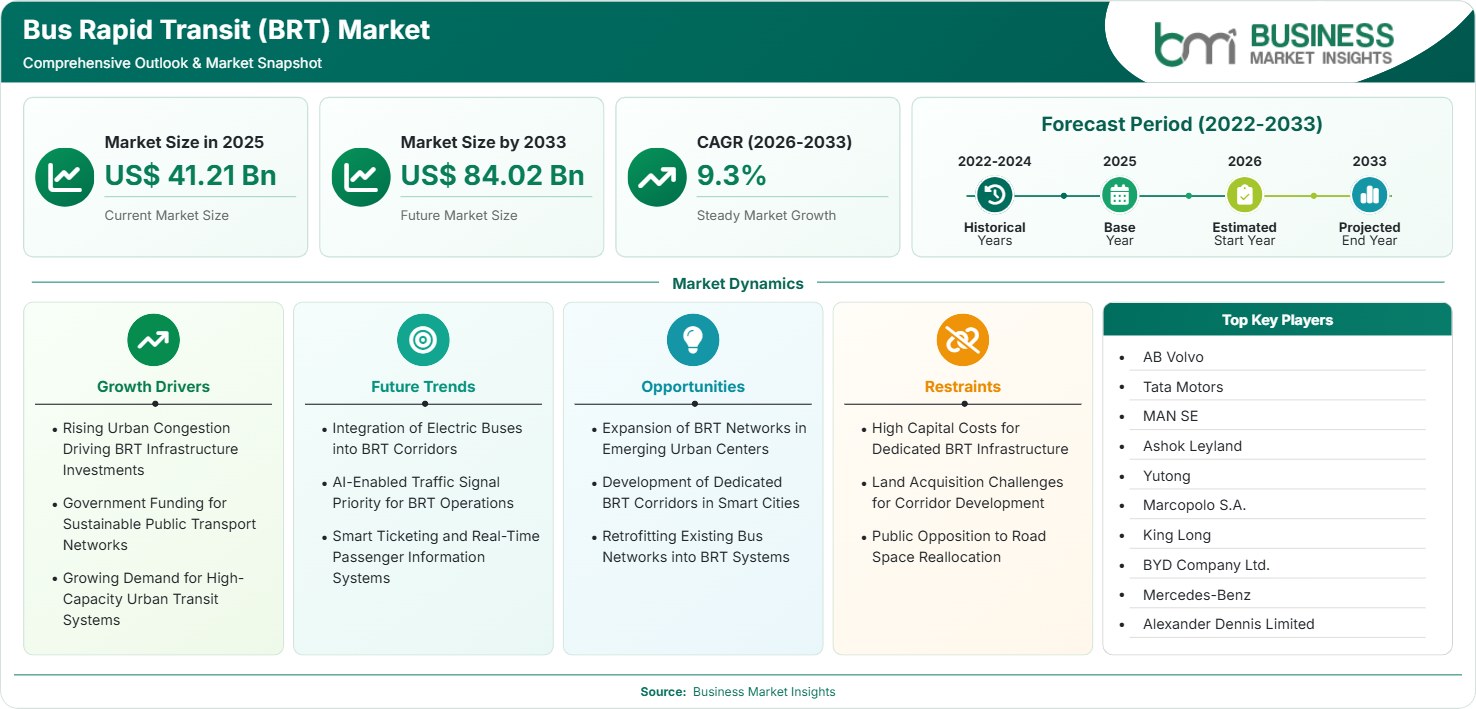
The Bus Rapid Transit (BRT) Market size was valued at US$ 41.21 Billion in 2025 and is projected to reach US$ 84.02 Billion by 2033, growing at a CAGR of 9.31% during 2026–2033. Increasing urbanization, rising investment in public transportation infrastructure, growing demand for sustainable mobility solutions, and government initiatives to reduce traffic congestion are driving market growth. Opportunities are emerging from electric BRT deployments, smart transit systems, and expansion of dedicated bus corridor networks across developing and developed economies.

Report Coverage
  • Bus Type: Standard, Articulated, Others
  • Propulsion: ICE, Electric
  • Application: Urban Areas, Others
US$ 41.21 Bn Market size in 2025
US$ 84.02 Bn Market Size by 2033
9.3% CAGR, 2026 - 2033
2026-2033 Forecast Period

01 AI Overview

Bus Rapid Transit (BRT) Market Summary

  • North America Region: North America holds a bus rapid transit (BRT) market share of 18%–21% in 2025 and is projected to grow at a CAGR of 8.5%–9.5% during 2026–2033. Investments in sustainable urban transportation systems, emission reduction policies, and modernization of public transit networks continue supporting regional growth. The US market is projected to grow at a CAGR of 8.8%–9.8% through 2033.
  • Fastest Growing Region: Asia Pacific accounts for 34%–37% share in 2025 and is expected to grow at a CAGR of 10.2%–11.2% during the forecast period. Rapid urbanization, increasing population density, and large-scale public transport investments are fueling demand across major metropolitan areas.
  • Leading Segment: Standard Buses represent 48%–51% share in 2025 and are projected to grow at a CAGR of 8.8%–9.8% through 2033. Their lower acquisition cost, operational flexibility, and suitability for most urban transit corridors continue supporting segment leadership.
  • High Growth Segment: Electric Propulsion holds 22%–25% share in 2025 and is projected to grow at a CAGR of 12.0%–13.0% during 2026–2033. Sustainability goals, decarbonization initiatives, and advancements in battery technology are accelerating adoption.
  • Key Market Opportunity: Expansion of electric BRT corridors, intelligent transport systems, and integrated urban mobility networks is creating substantial opportunities for vehicle manufacturers and infrastructure providers.
  • Major Market Players: AB Volvo, Tata Motors, MAN SE, Ashok Leyland, Yutong, Marcopolo S.A., King Long, BYD Company Ltd., Mercedes-Benz, and Alexander Dennis Limited.
02 Strategic Insights

Bus Rapid Transit (BRT) Market: Strategic Insights

bus-rapid-transit-brt-market-market-strategic-framework
FREE PDF
Request your free sample
Request free sample
03 Stakeholder View

Key Takeaways

  • Standard buses remain the largest segment due to widespread deployment across urban transit corridors and cost-effective operations.
  • Electric buses represent the strongest growth opportunity as cities increasingly pursue zero-emission public transportation strategies.
  • Asia Pacific continues leading market expansion due to rapid urbanization and large-scale public transportation investments.
  • Governments are increasingly promoting BRT systems as affordable alternatives to rail transit projects.
  • Integration of intelligent transportation technologies is improving route optimization, passenger management, and fleet efficiency.
  • Urban congestion reduction programs are supporting long-term investment in dedicated BRT infrastructure.
  • Expansion of smart city initiatives is accelerating deployment of advanced BRT networks worldwide.
  • Fleet electrification and digital transit management platforms are emerging as key Bus Rapid Transit (BRT) Market trends.
04 Geographic Outlook

Bus Rapid Transit (BRT) Market Regional Highlights

North America Bus Rapid Transit (BRT) Market

North America accounted for a 18%–21% share in 2025 and is projected to expand at a CAGR of 8.5%–9.5% during 2026–2033. The region benefits from increasing investments in sustainable urban transportation, modernization of public transit infrastructure, and growing adoption of low-emission mobility solutions. The Bus Rapid Transit (BRT) Market share is supported by the expansion of dedicated bus corridors, increasing transit funding, and efforts to reduce road congestion in major metropolitan areas.

  • Municipal authorities are investing in dedicated BRT lanes to improve transit reliability and reduce travel times across urban corridors.
  • Public transportation agencies are increasingly replacing conventional diesel fleets with cleaner and more efficient bus technologies.
  • Smart ticketing systems, passenger information platforms, and fleet management technologies are enhancing commuter experience and operational efficiency.
  • Rising focus on reducing private vehicle dependency is supporting long-term expansion of public transportation networks.
  • Urban mobility initiatives are encouraging greater integration between BRT systems and other modes of public transportation.

US Bus Rapid Transit (BRT) Market

The US represented a 15%–18% share in 2025 and is estimated to grow at a CAGR of 8.8%–9.8% through 2033. Growing investments in urban mobility infrastructure, increasing demand for sustainable transportation, and continuous modernization of city transit systems support market expansion. The Bus Rapid Transit (BRT) Market growth in the US is driven by transit-oriented development programs, congestion reduction strategies, and increasing adoption of advanced public transportation technologies.

  • Major cities continue implementing dedicated BRT corridors to improve transit accessibility and reduce commuter travel times.
  • Transit authorities are adopting electric and low-emission buses to align with sustainability and environmental objectives.
  • Smart transportation technologies are improving route optimization, fleet utilization, and passenger information services.
  • Federal and state transportation investments continue supporting modernization of urban transit infrastructure.

Europe Bus Rapid Transit (BRT) Market

Europe held a 25%–28% share in 2025 and is expected to grow at a CAGR of 8.7%–9.7% from 2026–2033. Germany, France, and the UK represent major markets due to advanced public transportation systems, sustainability initiatives, and smart city development programs. Germany is estimated to expand at 9.0%–10.0% CAGR, supported by investments in sustainable urban mobility and public transport modernization.

  • European cities are increasingly prioritizing low-emission public transportation systems to achieve climate and sustainability goals.
  • Germany is strengthening demand through smart mobility initiatives and expansion of integrated urban transit infrastructure.
  • The UK continues investing in efficient public transportation corridors to improve accessibility and reduce congestion.
  • France is adopting advanced transit technologies to improve passenger experience and optimize urban transportation performance.
  • Strong policy support for public transportation is encouraging wider adoption of BRT systems across metropolitan regions.

Asia Pacific Bus Rapid Transit (BRT) Market

Asia Pacific accounted for a 34%–37% share in 2025 and is projected to register a CAGR of 10.2%–11.2% during 2026–2033. China, India, Indonesia, and Thailand are leading markets due to rapid urbanization, population growth, and increasing investment in public transportation infrastructure. China is expected to grow at 10.5%–11.5% CAGR, while India demonstrates strong growth potential with a CAGR of 10.8%–11.8% during the forecast period.

  • Rapid urban population growth is increasing demand for high-capacity and cost-effective public transportation systems.
  • China continues expanding BRT networks as part of broader sustainable urban mobility development programs.
  • India is investing in dedicated BRT corridors to address urban congestion and improve public transportation accessibility.
  • Governments across Southeast Asia are prioritizing modern transit systems to support economic development and urban planning objectives.
  • Rising adoption of electric buses is supporting long-term growth of environmentally sustainable BRT operations.

Rest of World Bus Rapid Transit (BRT) Market

Rest of World accounted for a 15%–18% share in 2025 and is expected to grow at a CAGR of 8.5%–9.5% through 2033. Latin America, the Middle East, and Africa are witnessing increasing investments in public transportation infrastructure and urban mobility projects. Brazil, UAE, and South Africa represent important growth markets due to increasing focus on mass transit modernization and sustainable transportation initiatives.

  • Latin American cities continue expanding BRT systems as affordable and efficient alternatives to rail-based transportation networks.
  • Middle Eastern governments are investing in smart transportation infrastructure to accommodate urban growth and improve mobility.
  • South Africa is strengthening public transportation systems through dedicated transit corridor development projects.
  • Increasing urbanization across developing economies is generating demand for scalable and cost-effective transit solutions.
  • International funding and infrastructure development programs are supporting implementation of modern BRT networks across emerging markets.
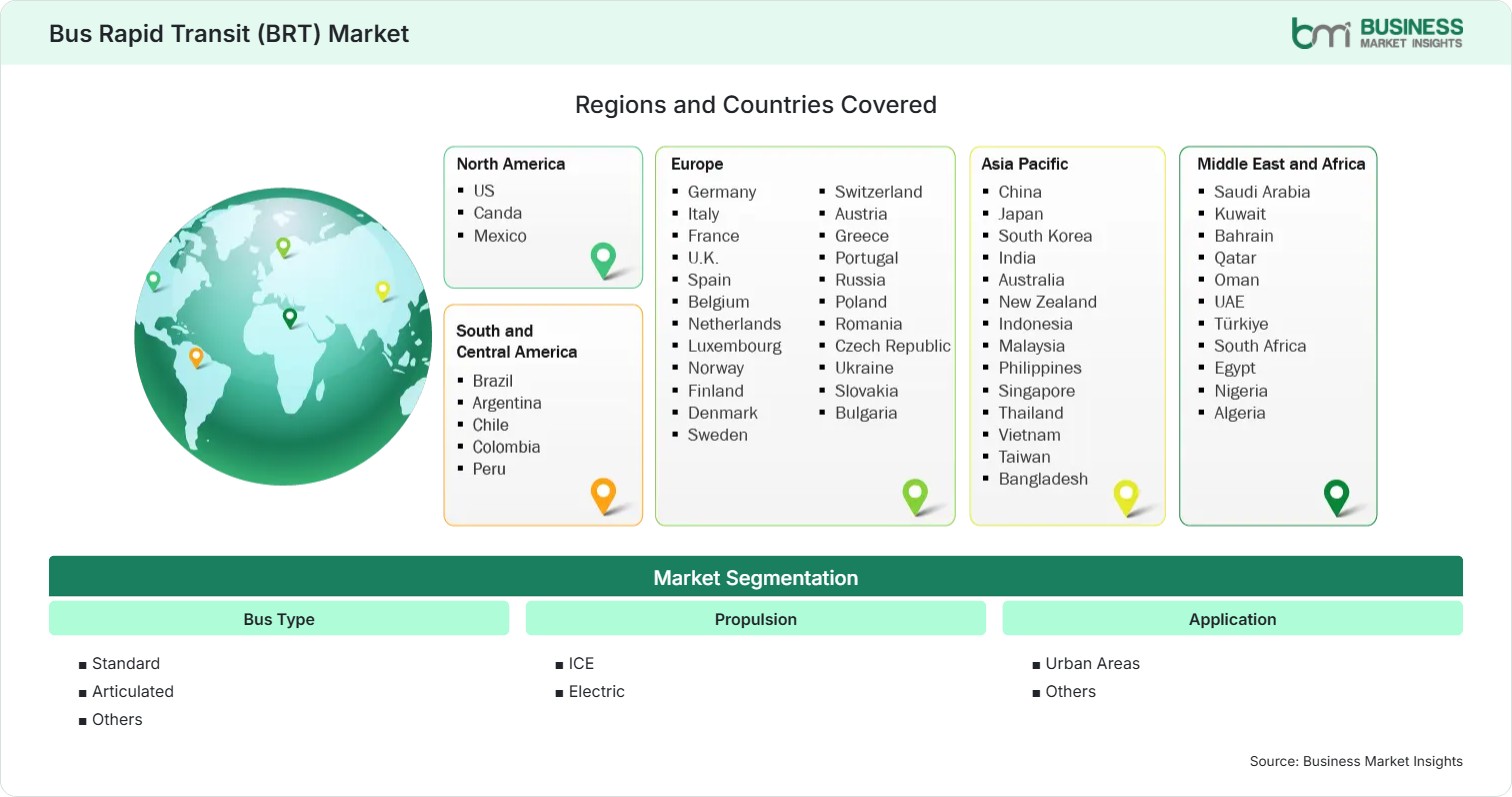
global-market-geography
FREE PDF
Request your free sample
Request free sample
05 Segment Analysis

Bus Rapid Transit (BRT) Market Segmentation

Bus Type

Bus type segmentation is influenced by passenger carrying capacity, route requirements, operational efficiency, and urban transportation planning objectives. Standard Buses accounted for 48%–51% share in 2025 and are projected to grow at a CAGR of 8.8%–9.8% through 2033 due to their cost-effectiveness, operational flexibility, and suitability for a wide range of urban transit corridors.

  • Standard: The leading segment owing to lower acquisition costs, ease of deployment, route flexibility, and widespread adoption across established and emerging BRT networks.
  • Articulated: Witnessing strong growth due to higher passenger-carrying capacity, suitability for high-density transit corridors, and ability to reduce congestion during peak travel periods.
  • Others: Includes bi-articulated and specialized BRT vehicles designed for ultra-high-capacity routes and advanced public transportation systems.

Propulsion

Propulsion technologies are evolving as transit authorities focus on operational efficiency, sustainability goals, and emissions reduction initiatives. ICE accounted for 75%–78% share in 2025 and is expected to grow at a CAGR of 7.5%–8.5% through 2033 due to its extensive installed fleet base and established fueling infrastructure.

  • ICE: The dominant segment supported by widespread deployment, lower upfront acquisition costs, established maintenance networks, and operational familiarity among transit operators.
  • Electric: The fastest-growing segment, holding 22%–25% share in 2025 and projected to expand at a CAGR of 12.0%–13.0% through 2033. Adoption is driven by decarbonization targets, government incentives, and increasing investments in sustainable public transportation systems.

Application

Application demand is primarily shaped by urbanization trends, public transportation investments, and efforts to improve mobility across densely populated areas. Urban Areas accounted for 82%–85% share in 2025 and are projected to grow at a CAGR of 9.5%–10.5% through 2033 due to increasing congestion management requirements and growing public transit usage.

  • Urban Areas: The dominant segment as major cities continue expanding dedicated BRT corridors, integrating smart transportation technologies, and improving mass transit accessibility.
  • Others: Includes suburban, intercity, satellite city, and regional transportation corridors where BRT systems are increasingly being deployed to improve connectivity and reduce reliance on private vehicles.
06 Market Forces

Bus Rapid Transit (BRT) Market Dynamics

Key Market Drivers

Rising Urban Congestion Driving BRT Infrastructure Investments

Rapid urbanization and increasing vehicle ownership are intensifying traffic congestion across major cities worldwide. Municipal governments are increasingly investing in Bus Rapid Transit systems as a cost-effective solution to improve mobility, reduce travel times, and enhance public transport accessibility. Dedicated bus lanes, priority signaling systems, and modern station infrastructure enable BRT networks to provide metro-like performance at significantly lower development costs. Bus Rapid Transit (BRT) Market growth is being supported by the need for efficient transportation solutions capable of serving growing urban populations while minimizing roadway congestion. As cities continue experiencing population growth and mobility challenges, investments in dedicated BRT infrastructure are expected to increase steadily throughout the forecast period.

Government Funding for Sustainable Public Transport Networks

Governments worldwide are prioritizing sustainable transportation investments to reduce emissions, improve urban mobility, and support long-term environmental objectives. Public funding programs, infrastructure development initiatives, and transportation modernization plans are encouraging widespread deployment of BRT systems. Bus Rapid Transit (BRT) Market trends indicate increasing financial support for electric buses, dedicated transit corridors, intelligent transportation systems, and integrated mobility solutions. Policymakers recognize BRT systems as an effective means of improving transportation accessibility while supporting sustainability goals. The combination of public investment, regulatory support, and urban development planning is creating a favorable environment for continued market expansion across developed and emerging economies.

Growing Demand for High-Capacity Urban Transit Systems

Growing urban populations are increasing pressure on existing transportation networks, creating demand for high-capacity public transit systems capable of transporting large passenger volumes efficiently. BRT systems offer an attractive alternative to rail projects by delivering significant capacity improvements with comparatively lower implementation costs and shorter construction timelines. The market is benefiting from increasing demand for scalable transportation infrastructure that can adapt to evolving urban mobility requirements. Cities are adopting high-capacity articulated and standard bus fleets supported by advanced traffic management systems to improve passenger throughput and service reliability. Rising demand for efficient and affordable urban mobility continues supporting long-term adoption of BRT solutions.

Key Market Opportunities

Expansion of BRT Networks in Emerging Urban Centers

Emerging economies are witnessing rapid urban growth and increasing transportation demand, creating substantial opportunities for BRT system development. Many cities require affordable and scalable public transport solutions capable of improving mobility without the substantial costs associated with rail infrastructure projects. Bus Rapid Transit (BRT) Market Forecast indicates strong growth potential across Asia Pacific, Latin America, Africa, and the Middle East, where urban populations continue expanding rapidly. Governments and municipal authorities are increasingly incorporating BRT systems into long-term transportation development plans. Companies involved in vehicle manufacturing, infrastructure development, ticketing technologies, and fleet management solutions are well positioned to benefit from growing project investments across emerging urban centers.

Development of Dedicated BRT Corridors in Smart Cities

Smart city initiatives are creating attractive opportunities for the deployment of advanced BRT corridors integrated with intelligent transportation technologies. Cities are increasingly utilizing digital traffic management systems, real-time passenger information platforms, smart ticketing solutions, and connected mobility services to improve transportation efficiency. The Bus Rapid Transit (BRT) Market analysis highlights growing demand for technologically advanced transit corridors capable of supporting sustainable urban development strategies. Dedicated BRT infrastructure forms an important component of many smart city mobility plans due to its ability to improve traffic flow and enhance accessibility. Continued global investment in smart city projects is expected to create significant opportunities for BRT stakeholders.

Retrofitting Existing Bus Networks into BRT Systems

Many cities are exploring opportunities to upgrade conventional bus networks into BRT-style systems without requiring entirely new transportation infrastructure. Retrofitting existing routes with dedicated lanes, enhanced stations, intelligent transportation technologies, and modern buses can significantly improve service quality and operational performance. The market scope continues expanding through network modernization projects aimed at increasing passenger capacity and transit efficiency. Transit authorities increasingly view retrofitting as a practical and cost-effective strategy for improving mobility outcomes while maximizing the value of existing transportation assets. This approach creates substantial opportunities for infrastructure developers, technology providers, and vehicle manufacturers.

Market Restraints and Challenges

High Capital Costs for Dedicated BRT Infrastructure

Factor: Although BRT systems generally require lower investment than rail networks, development of dedicated lanes, stations, terminals, intelligent transportation systems, and supporting infrastructure can still involve substantial capital expenditure.

Impact: Funding constraints may delay project approvals, reduce network expansion plans, or limit implementation in budget-sensitive municipalities. Securing financing for large-scale transportation infrastructure remains a major challenge, particularly in developing regions. Governments and transit authorities often need to balance competing infrastructure priorities while justifying long-term investment commitments. These financial considerations can slow deployment timelines and affect overall market growth.

Land Acquisition Challenges for Corridor Development

Factor: Development of dedicated BRT corridors frequently requires road widening, right-of-way adjustments, and infrastructure modifications in densely populated urban environments. Acquiring sufficient land for these projects can be a complex and time-consuming process.

Impact: Land acquisition issues can increase project costs, delay construction schedules, and create challenges for transportation planners. Urban development constraints, stakeholder concerns, and regulatory requirements may further complicate corridor implementation efforts. Successful project execution often depends on effective planning, stakeholder coordination, and long-term urban development strategies. These challenges remain important considerations for cities pursuing large-scale BRT expansion programs.

07 Company Analysis

Competitive Landscape

The Bus Rapid Transit (BRT) Market analysis is characterized by competition among global bus manufacturers, electric mobility providers, public transportation solution providers, and urban transit technology companies. Market participants are focused on fleet electrification, high-capacity transit buses, intelligent transportation systems, and sustainable mobility solutions to strengthen their market positions. The market trends indicate increasing investment in electric buses, smart fleet management platforms, connected transit systems, and low-emission mobility technologies. Strategic collaborations with transit authorities and municipal governments continue playing a critical role in securing long-term BRT infrastructure and fleet contracts.

Company Name

Overview

Products and Services Relevant to this Market

AB Volvo

Global commercial vehicle manufacturer with extensive public transportation portfolio.

BRT buses, electric buses, articulated buses, and fleet management solutions.

Tata Motors

Leading commercial vehicle manufacturer serving urban transit markets.

Standard buses, electric buses, transit solutions, and public transportation vehicles.

MAN SE

European commercial vehicle manufacturer with advanced mobility solutions.

Urban transit buses, articulated buses, fleet technologies, and sustainable mobility systems.

Ashok Leyland

Major bus manufacturer supplying public transportation fleets globally.

BRT buses, city buses, electric mobility solutions, and transit vehicle platforms.

Yutong

Global manufacturer specializing in public transportation and electric buses.

Electric buses, BRT buses, smart transportation solutions, and fleet technologies.

Marcopolo S.A.

Bus body and transportation solutions provider with strong urban mobility presence.

Transit buses, BRT systems, passenger transportation vehicles, and mobility solutions.

King Long

Commercial vehicle manufacturer focused on public transportation applications.

City buses, electric buses, BRT vehicles, and intelligent transport platforms.

BYD Company Ltd.

Global electric vehicle company with strong presence in public transport.

Electric BRT buses, battery systems, charging solutions, and sustainable transit technologies.

Mercedes-Benz

Premium commercial vehicle manufacturer serving urban transportation markets.

Urban transit buses, articulated buses, electric mobility solutions, and fleet services.

Alexander Dennis Limited

Bus manufacturer specializing in public transportation systems.

Double-decker buses, BRT buses, electric buses, and transit vehicle solutions.


10 Trust & Transparency

Research Methodology

The market analysis combines proprietary research with secondary data from government agencies, company disclosures, regulatory filings, industry databases and expert interviews. Market estimates are validated through data triangulation, cross-market benchmarking and analyst review.

View Full Research Methodology

11 Questions Answered

Frequently Asked Questions

What opportunities exist for BRT system providers?

Major opportunities include expansion of BRT networks in emerging cities, smart city transportation projects, electric bus adoption, intelligent transit systems, and modernization of existing bus networks.

Why does Asia Pacific lead the market?

Asia Pacific leads due to rapid urbanization, population growth, public infrastructure investments, increasing traffic congestion, and large-scale deployment of mass transit solutions.

Which propulsion segment is growing the fastest?

Electric propulsion is the fastest-growing segment due to emission reduction targets, fleet electrification programs, government incentives, and advancements in battery technologies.

Which bus type dominates the market?

Standard Buses dominate the market due to lower acquisition costs, operational flexibility, ease of deployment, and suitability for a wide range of urban transit corridors.

What is driving growth in the bus rapid transit (BRT) market report?

Growth is driven by increasing urban congestion, rising investment in public transportation infrastructure, government support for sustainable mobility, and growing demand for high-capacity urban transit systems.

Access the Full Bus Rapid Transit (BRT) Market Report

Get segment-level forecasts, regional estimates, competitive benchmarking, company profiles and downloadable Excel datasets.

Access the full Bus Rapid Transit (BRT) Market Report
350 pages PDF & Excel | 2026-08-04