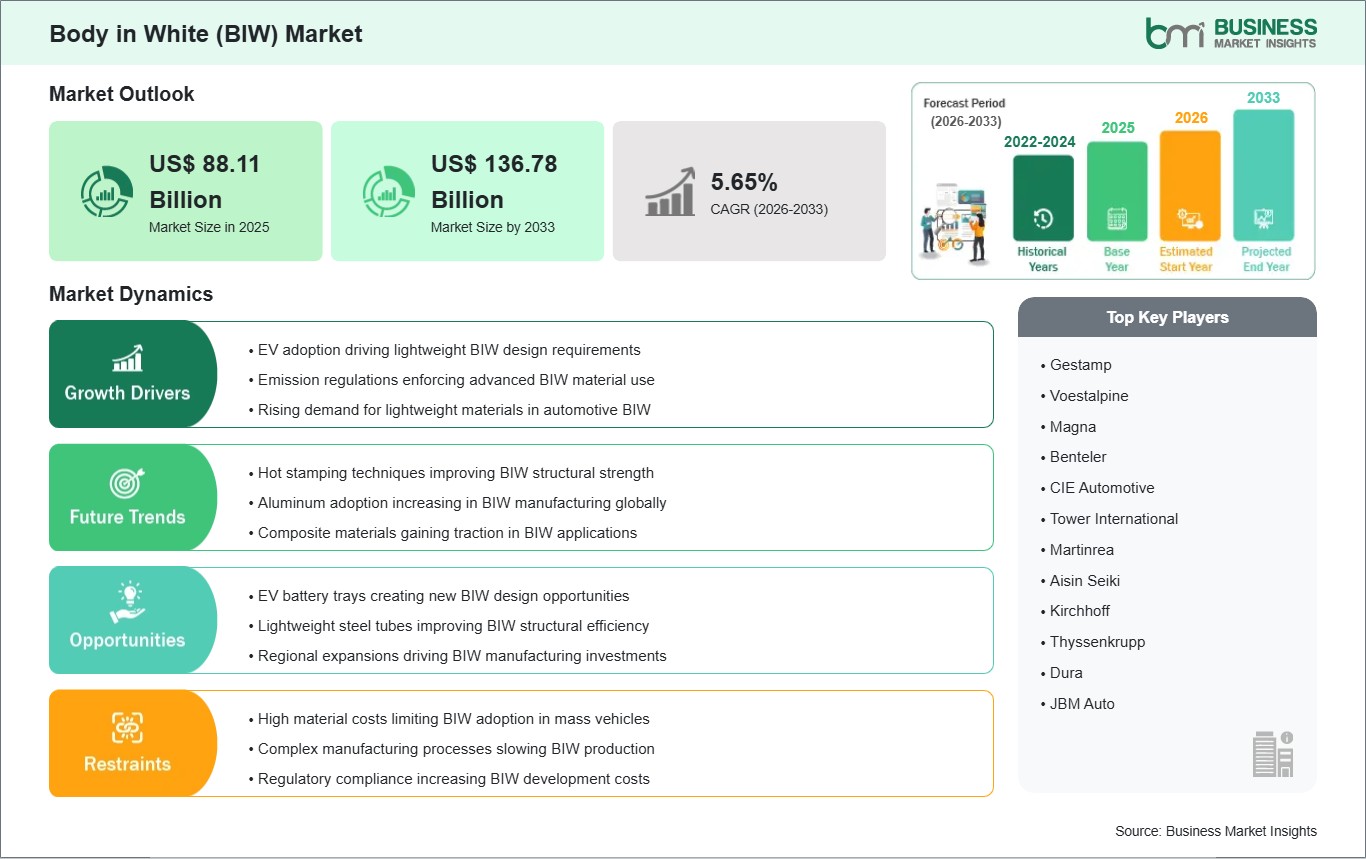
The Body in White (BIW) Market size is expected to reach US$ 136.78 Billion by 2033 from US$ 88.11 Billion in 2025.The market is estimated to record a CAGR of 5.65% from 2026 to 2033.
Body in White (BIW) stands for the stage of assembly where the vehicle's structural frame is made prior to painting and assembly operations. BIW is an important process influencing the vehicle stiffness and safety performance, as well as assembly efficiency. This process involves various forming and joining operations to produce a structurally cohesive unit. Production priorities are increasingly favoring lightweight designs and advanced structural performance. The automotive industry is focusing production operations on a modular platform that can accommodate a range of vehicles.
Market segmentation is based on the diversity of structural engineering requirements among different types of vehicles. Passenger car platforms prevail in mass production environments, while electrified models necessitate reinforcement of certain parts to accommodate the battery pack. Structural design differentiation underscores the conflict between vehicle stiffness and lightweight design. The trend in material selection is characterized by slow substitution with lightweight metals and composites.
The emergence of technology is driving changes in fabrication through innovations in stamping technologies and formation through automated lines. The trend in hot stamping is helping in embracing high-strength steels in areas where safety concerns exist. Simulation software helps achieve accuracy in dimensions, reducing the number of prototypes used for designing structures. The inclusion of robotics technology into welding and joining is increasing consistency in large-scale manufacturing. A competitive environment is marked by manufacturing efficiency and platform flexibility, with manufacturers concentrating on manufacturing systems that can accommodate multi-energy vehicles.

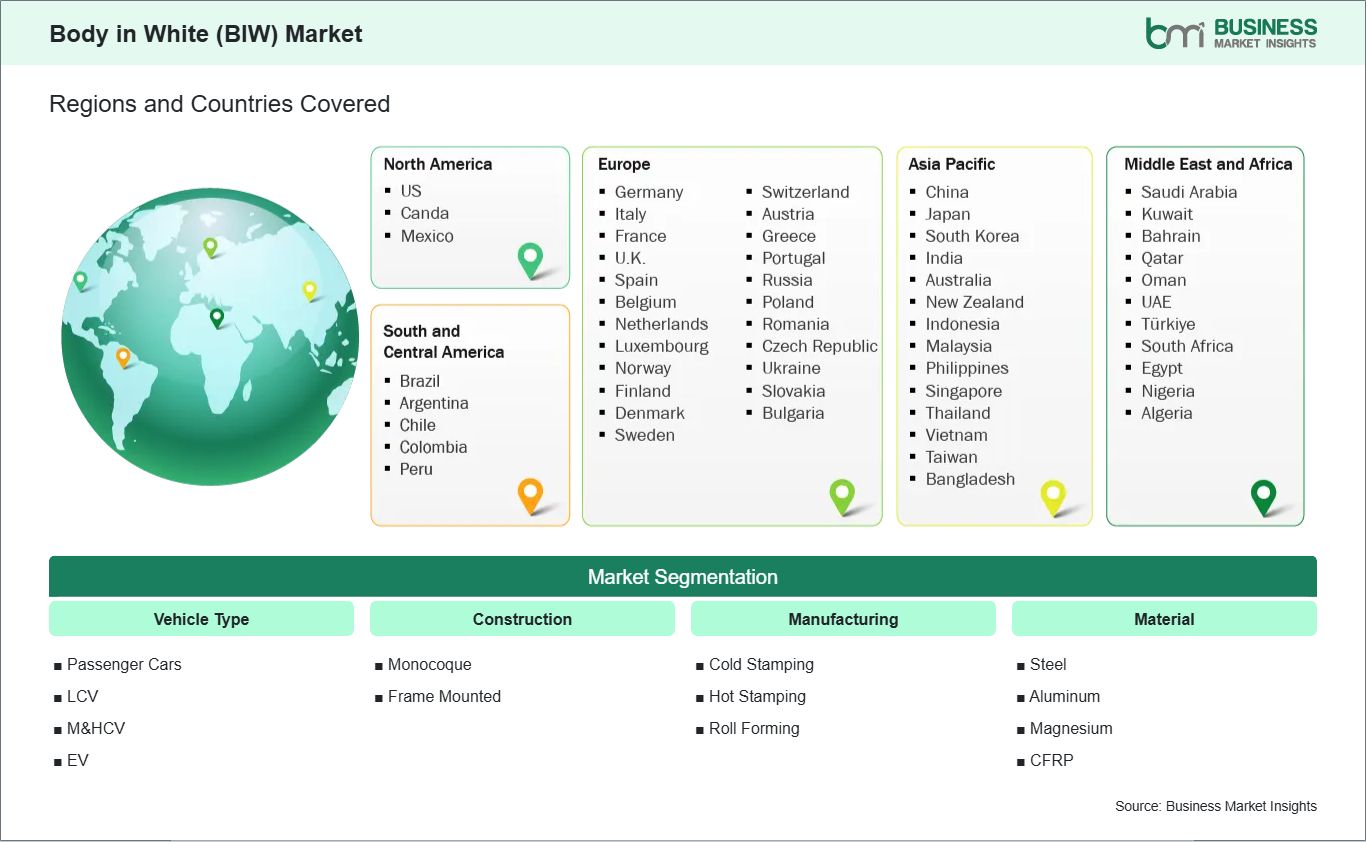
The BIW market is segmented by vehicle type, construction, manufacturing process, and material, reflecting its evolving role in improving vehicle safety, performance, and lightweight design.
The integration of electric vehicles is changing the emphasis on priorities in structural engineering. This change involves the development of new undercarriage designs, crash-proof designs, and efficient pathways for load distribution. Manufacturers are now adjusting their BIW systems to integrate heavier batteries while keeping vehicles stable and safe. This trend is pushing the importance of having modular design systems capable of supporting multiple drivetrains. Structural design will also involve optimizing torsional stiffness along with lightweight designs.
This new trend will affect the approach taken by manufacturers in terms of production systems and materials engineering. It is important for automotive plants to be able to align their BIW systems within flexible assembly lines. The importance of structural optimization will play an important role in ensuring the efficiency of energy use and the vehicle's compliance with regulations.
The incorporation of battery trays is contributing to new requirements for vehicle body designs. The trays serve as load-carrying containers that need to sustain heat, mechanical, and impact loads. Engineers have moved towards strengthening floor components in order to evenly distribute the weight of batteries. This has helped improve the safety aspect without losing any balance of structure in electric vehicles.
The future development of tray design systems is geared towards designing trays made from both metallic and composite materials. Designers have increased their capacity to design battery trays of various chemistries and capacities. This development has helped make scalability possible across the various vehicle segments.
The Body in White (BIW) Market is projected to grow from US$ 88.11 Billion in 2025 to US$ 136.78 Billion by 2033 , registering a CAGR of 5.65% from 2026 to 2033.
The body in white (BIW) market demonstrates steady growth, with size and share analysis highlighting evolving trends and competitive dynamics among key players. The report examines subsegments categorized within vehicle type, construction, manufacturing, material, offering insights into their contribution to overall market performance.
By vehicle type, passenger cars hold the dominant share in the Body-in-White (BIW) market, driven by large-scale production volumes and continuous demand for lightweight, fuel-efficient structures. Light commercial vehicles (LCVs) are also expanding steadily, supported by growth in e-commerce and last-mile delivery services. Medium and heavy commercial vehicles (MandHCVs) contribute a stable share, where durability and structural strength are critical design priorities. Electric vehicles (EVs) are emerging as a key growth segment, as BIW designs increasingly focus on lightweight construction and crash safety optimization to improve battery efficiency and range.
By construction, monocoque structures dominate the market, particularly in passenger cars, due to their superior rigidity, crash performance, and weight efficiency achieved by integrating the body and frame into a single structure. Frame-mounted (body-on-frame) architectures continue to be used primarily in commercial vehicles and utility-focused applications, where higher load-bearing capacity, easier repairability, and robustness are essential.
By manufacturing process, cold stamping remains the most widely used method, supported by its cost-effectiveness, high production speed, and suitability for mass automotive manufacturing. Hot stamping is witnessing rapid growth, especially in safety-critical components such as A- and B-pillars, as it enables the production of ultra-high-strength steel parts with improved crash resistance and weight reduction. Roll forming is increasingly adopted for producing long structural components such as rails and reinforcements, offering efficiency in continuous production and material utilization.
By material, steel continues to dominate the BIW market due to its strength, affordability, and well-established manufacturing ecosystem. Aluminum is gaining strong traction as automakers pursue lightweighting strategies to improve fuel efficiency and EV range. Magnesium is being explored for select structural and semi-structural applications because of its very low density, though its use remains limited due to cost and corrosion concerns. Carbon fiber reinforced polymer (CFRP) represents a high-growth premium segment, valued for its exceptional strength-to-weight ratio, but its adoption is still constrained by high production costs and longer manufacturing cycles.
| Report Attribute | Details |
|---|---|
| Market size in 2025 | US$ 88.11 Billion |
| Market Size by 2033 | US$ 136.78 Billion |
| Global CAGR (2026 - 2033) | 5.65% |
| Historical Data | 2022-2024 |
| Forecast period | 2026-2033 |
| Segments Covered | By Vehicle Type
|
|
Regions and Countries Covered
| |
| North America | US, Canada, Mexico |
| Europe | Germany, Italy, France, U.K., Spain, Belgium, Netherlands, Luxembourg, Norway, Finland, Denmark, Sweden, Switzerland, Austria, Greece, Portugal, Russia, Poland, Romania, Czech Republic, Ukraine, Slovakia, Bulgaria |
| Asia-Pacific | China, Japan, South Korea, India, Australia, New Zealand, Indonesia, Malaysia, Philippines, Singapore, Thailand, Vietnam, Taiwan, Bangladesh |
| South and Central America | Brazil, Argentina, Chile, Colombia, Peru |
| Middle East and Africa | Saudi Arabia, United Arab Emirates, Kuwait, Bahrain, Qatar, Oman, Turkiye, South Africa, Egypt, Nigeria, Algeria |
| Market leaders and key company profiles |
|
The "Body In White (BIW) Market Size and Forecast (2022 - 2033)" report provides a detailed analysis of the market covering below areas:
The market for BIWs shows various regional adoptions, which are driven by the evolution of lightweight constructions, a higher need for fuel-efficient and electric vehicles, and increased adoption of manufacturing processes that involve automation.
The regional adoption of the BIW market depends on the level of manufacturing sophistication, degree of electrification, and integration of supply chains. Different structural needs vary depending on the regions because of availability and regulations for the materials used. These parameters influence how OEMs and tier one manufacturers invest in their operations around the world.
North American manufacturers emphasize advanced manufacturing automation and rigorous structural safety standards. There are priorities for the development of modular construction of multi-energy vehicles. The investment in lightweight materials and digital twin technology results in improved structural performance and precision in manufacturing.
There is an increased focus on the assembly of automobiles in the Asia-Pacific region because of economies of scale. The cost-effective process of stamping and forming is widespread in this market segment because of high production volumes. Electrification drives structural design changes with government encouragement and industrial agglomeration. Increasing consumer preferences for battery-electric vehicles are affecting design criteria.
The European market segment concentrates on sustainability and weight-saving designs. This is aided by legislation encouraging low-emission manufacturing processes as well as using environmentally friendly materials. Emerging markets in the Middle East and South America are improving their capacities. The circular economy informs material selection and lifecycle decisions.

The body in white (BIW) market is evaluated by gathering qualitative and quantitative data post primary and secondary research, which includes important corporate publications, association data, and databases. A few of the key developments in the body in white (BIW) market are:
The Body in White (BIW) Market is valued at US$ 88.11 Billion in 2025, it is projected to reach US$ 136.78 Billion by 2033.
As per our report Body in White (BIW) Market, the market size is valued at US$ 88.11 Billion in 2025, projecting it to reach US$ 136.78 Billion by 2033. This translates to a CAGR of approximately 5.65% during the forecast period.
The Body in White (BIW) Market report typically cover these key segments-
The historic period, base year, and forecast period can vary slightly depending on the specific market research report. However, for the Body in White (BIW) Market report:
The Body in White (BIW) Market is populated by several key players, each contributing to its growth and innovation. Some of the major players include:
The Body in White (BIW) Market report is valuable for diverse stakeholders, including:
Essentially, anyone involved in or considering involvement in the Body in White (BIW) Market value chain can benefit from the information contained in a comprehensive market report.
Please tell us your area of interest
(Market Segments/ Regions and Countries/ Companies)