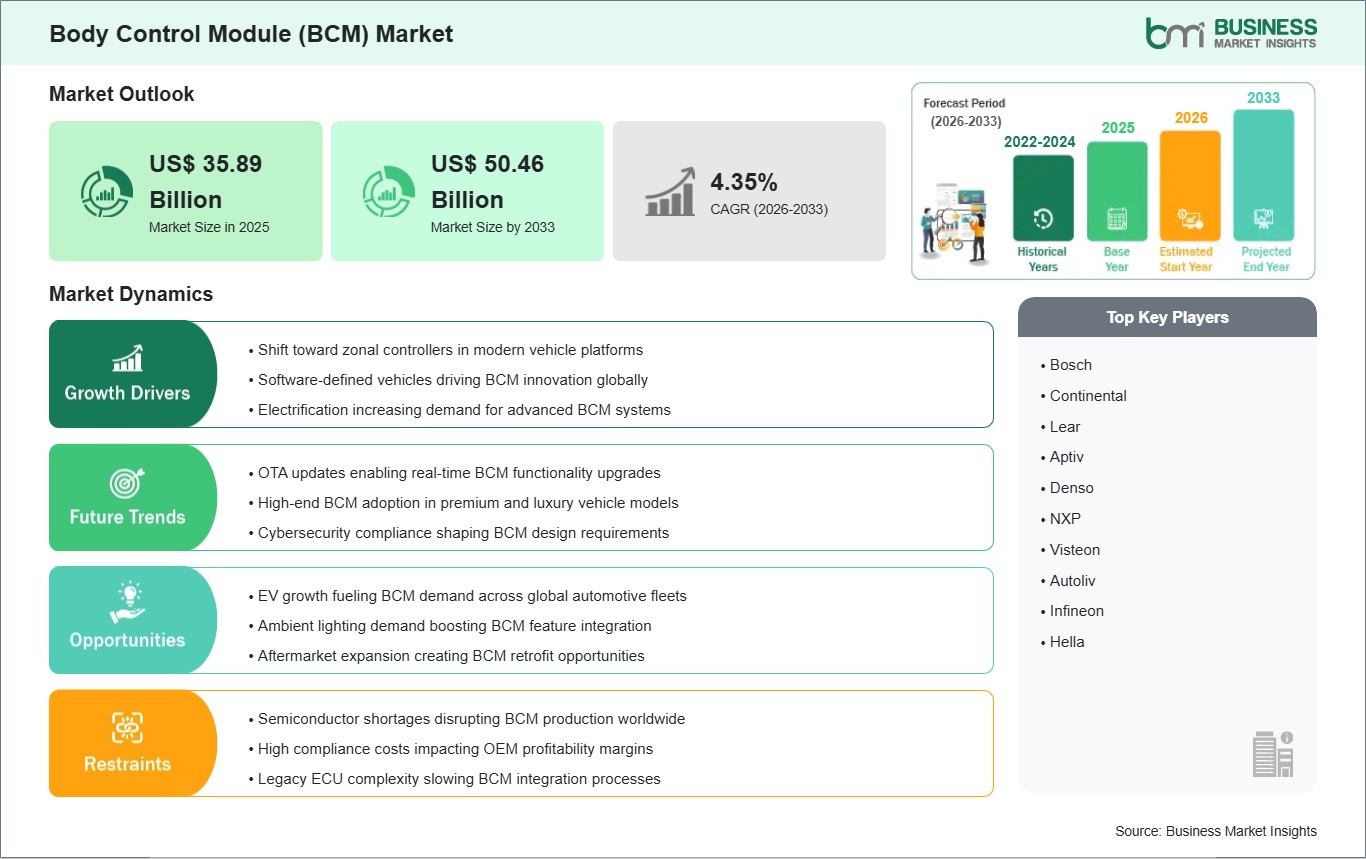
The Body Control Module (BCM) Market size is expected to reach US$ 50.46 Billion by 2033 from US$ 35.89 Billion in 2025.The market is estimated to record a CAGR of 4.35% from 2026 to 2033.
The body control module (BCM) market is an important industry segment in the automotive electronics industry, comprising specialized electronic control units that facilitate and synchronize various body functions of vehicles. Examples of these include lighting functions, power windows, door locks, windscreen wiper controls, air-conditioning panel interfaces, seat functions, and security operations. The use of a common electronic control unit for multiple electrical functions has helped streamline vehicle operation, minimize wiring complications, and increase reliability.
Factors driving the market are mainly increasing customer demands for comfort and safety features. Vehicle electrification and connectivity are making significant contributions to the market growth due to a growing number of electronic functions. Car manufacturers have been targeting lightweight and efficient cars with regard to fuel consumption. Centralized electronic architecture is therefore more desirable due to its benefits. In addition, increasing safety requirements in automotive manufacture together with consumers' high demands for sophisticated automobile functions are fueling market growth.
Regarding the factors that influence market segmentation in the BCM industry, they include passenger cars, light commercial vehicles, and heavy commercial vehicles, with passenger cars constituting the highest portion owing to their high level of integration. Additionally, the industry is segmented based on the communication protocol used, including wired systems and network-based architecture. The electrification level is becoming an important factor for segmentation, especially when it comes to electric and hybrid vehicles that require a highly sophisticated BCM.
The progress in technology has impacted the performance of the BCM sector. It is seen that this sector has adopted the integration of technologies like the use of high-speed car networks, reduction in size of semiconductors, and software-defined cars. Software integration and electronics miniaturization are just some of the investments that companies are making in order to enhance performance and cut costs. Strategic partnerships among various companies in the automotive supply chain are also growing due to efforts towards standardization and time-to-market reduction.

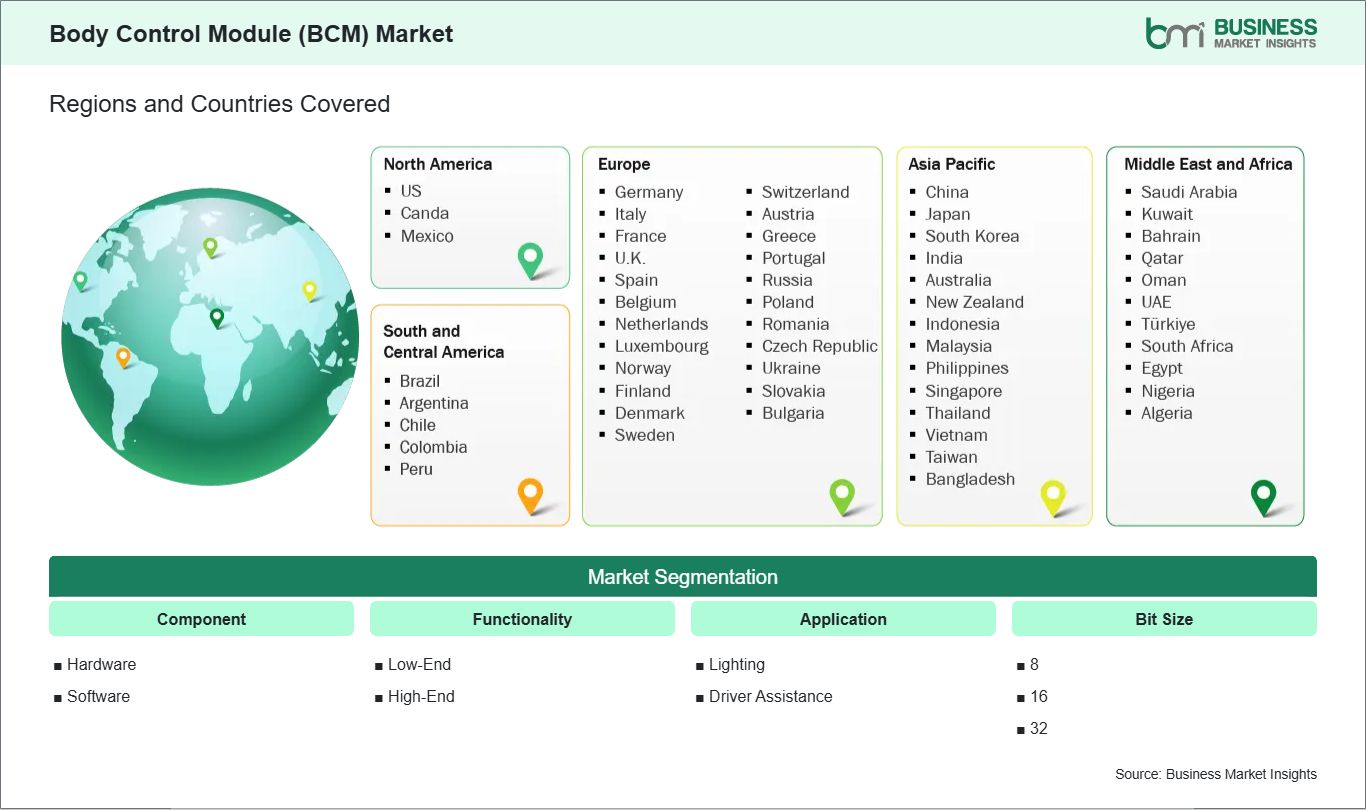
The BCM market is segmented based on component, functionality, application, bit size, communication protocol, vehicle type, and sales channel, this reflects the increasing demand for intelligent vehicle electronics that enhance safety, comfort, and efficiency.
The move towards a zonal architecture design in vehicles has been driven by an increase in the amount of data processing, as well as the desire for efficiency and lower levels of wiring. This has been brought about by an increase in infotainment, ADAS and connectivity requirements in today's vehicles. This has necessitated the need for body control modules combined with zonal controllers to help streamline processes, improve harness design and manage vehicles using software across different domains.
The shift to zonal controller architectures is helping change the nature of automotive electronics through a decrease in the weight of wires, increased diagnostic efficiency and also making software upgrades easier. On a larger scale, when discussing software-defined vehicles, BCMs serve as vital links to control lighting and comfort. The above scenario is very significant to the OEM industry due to a reduction in cost and the rapid development of platforms.
Rapid adoption of electric vehicles will create increased global demand for advanced body control modules due to the growing electronic complexities within the vehicles. Advanced technologies associated with semiconductor integration, as well as domain-based electrical architecture, have led to innovations associated with the BCMs, which offer improved efficiency and power performance. BCMs are extensively used in smart lighting, battery-connected auxiliary controls and other comfort functionalities that improve the user experience on electric vehicles.
Further evolution in the use of electric vehicles will increase the integration of body control modules in centralized and zonal electrical architecture systems. With the future advancements in the scalability of EV platforms, which will include both passenger and commercial vehicles, body control modules will gain additional capabilities, including over-the-air updates, predictive diagnosis, and cross-domain communications. This will revolutionize the efficiency of automobiles in relation to the elimination of redundancies in the systems and improvement in energy management.
The Body Control Module (BCM) Market is projected to grow from US$ 35.89 Billion in 2025 to US$ 50.46 Billion by 2033 , registering a CAGR of 4.35% from 2026 to 2033.
By component, hardware continues to account for a significant share, as it forms the backbone of bcm systems, enabling integration of sensors, relays, and microcontrollers for reliable performance in vehicles. software is witnessing rapid growth, driven by increasing demand for advanced features, customization, and over-the-air updates that enhance vehicle intelligence and connectivity.
By functionality, low-end BCMs dominate in cost-sensitive markets, offering essential control functions such as lighting and wiper systems. Meanwhile, High-End BCMs are expanding steadily, powered by advanced driver assistance systems (ADAS), smart diagnostics, and integration with infotainment, catering to premium and electric vehicles.
By application, lighting control remains a core application, ensuring safety and energy efficiency through adaptive and intelligent lighting systems. driver assistance is growing rapidly, as BCMs play a crucial role in coordinating sensors and actuators for features like lane-keeping, collision avoidance, and automated parking.
By bit size, 8-bit BCMs continue to serve basic automotive functions due to their cost-effectiveness. 16-bit BCMs are gaining traction in mid-range vehicles, balancing performance and affordability. 32-bit BCMs dominate advanced applications, enabling high-speed processing required for complex driver assistance and EV systems.
By communication protocol, CAN remains the most widely adopted protocol, ensuring robust communication across vehicle subsystems. LIN is expanding in simpler applications like window and seat controls due to its cost efficiency. FlexRay is gaining momentum in high-end vehicles, supporting real-time communication for safety-critical functions.
By vehicle type, passenger cars dominate BCM adoption, driven by the need for comfort, safety, and convenience features. Electric vehicles (EVs) are witnessing exponential growth, as BCMs are critical for managing advanced electronics, battery systems, and smart connectivity in next-generation mobility solutions.
By sales channel, OEMs account for the majority share, as BCMs are integrated during vehicle manufacturing to ensure seamless functionality and compliance with safety standards. The Aftermarket is growing steadily, driven by replacement demand, retrofitting, and customization in older vehicles.
| Report Attribute | Details |
|---|---|
| Market size in 2025 | US$ 35.89 Billion |
| Market Size by 2033 | US$ 50.46 Billion |
| Global CAGR (2026 - 2033) | 4.35% |
| Historical Data | 2022-2024 |
| Forecast period | 2026-2033 |
| Segments Covered | By Component
|
|
Regions and Countries Covered
| |
| North America | US, Canada, Mexico |
| Europe | Germany, Italy, France, U.K., Spain, Belgium, Netherlands, Luxembourg, Norway, Finland, Denmark, Sweden, Switzerland, Austria, Greece, Portugal, Russia, Poland, Romania, Czech Republic, Ukraine, Slovakia, Bulgaria |
| Asia-Pacific | China, Japan, South Korea, India, Australia, New Zealand, Indonesia, Malaysia, Philippines, Singapore, Thailand, Vietnam, Taiwan, Bangladesh |
| South and Central America | Brazil, Argentina, Chile, Colombia, Peru |
| Middle East and Africa | Saudi Arabia, United Arab Emirates, Kuwait, Bahrain, Qatar, Oman, Turkiye, South Africa, Egypt, Nigeria, Algeria |
| Market leaders and key company profiles |
|
The "Body Control Module (BCM) Market Size and Forecast (2022 - 2033)" report provides a detailed analysis of the market covering below areas:
The body control module (BCM) market shows diverse regional adoption patterns influenced by advancements in automotive electronics, increasing demand for vehicle safety and comfort systems, and rising adoption of electric, connected, and automated vehicles.
The body control module (BCM) market shows diverse regional adoption patterns influenced by advancements in automotive electronics, rising integration of connected vehicle technologies, and increasing consumer demand for enhanced safety, comfort, and convenience features. Across global markets, automakers are increasingly incorporating BCM systems to manage complex electrical functions such as lighting, climate control, power windows, and security systems. The transition toward electric and hybrid vehicles is also accelerating the deployment of advanced control modules capable of supporting sophisticated vehicle architectures and intelligent communication networks.
In North America, the market continues to benefit from strong adoption of premium vehicles and growing consumer preference for advanced driver assistance and infotainment systems. Automotive manufacturers in the region are focusing on integrating BCM solutions that improve vehicle efficiency, electronic coordination, and passenger comfort. The presence of established automotive technology providers and increasing investments in connected mobility solutions are further strengthening market expansion. Demand for highly integrated electronic systems in commercial and passenger vehicles also continues to create favorable opportunities for BCM suppliers.
Asia Pacific remains a major growth center for the body control module market due to rapid automotive production, expanding electric vehicle manufacturing, and rising disposable incomes in developing economies. Countries such as China, Japan, South Korea, and India are witnessing increased deployment of electronic control systems in both mass-market and luxury vehicles. Regional automakers are emphasizing smart mobility technologies and cost-effective electronic architectures, encouraging wider adoption of BCM platforms. Growing urbanization and consumer awareness regarding vehicle safety and convenience are also contributing to sustained market momentum.
Europe demonstrates steady growth supported by stringent vehicle safety regulations, strong penetration of electric vehicles, and continuous innovation in automotive electronics. Automakers across the region are increasingly integrating BCM systems to support energy-efficient vehicle operations and intelligent cabin management functions. Meanwhile, emerging markets in Latin America, the Middle East, and Africa are gradually adopting advanced automotive electronics as vehicle modernization efforts accelerate. Improving automotive infrastructure, expanding vehicle ownership, and increasing availability of technologically advanced vehicles are expected to support future market development in these regions.

The body control module (BCM) market is evaluated by gathering qualitative and quantitative data post primary and secondary research, which includes important corporate publications, association data, and databases. A few of the key developments in the body control module (BCM) market are:
The Body Control Module (BCM) Market is valued at US$ 35.89 Billion in 2025, it is projected to reach US$ 50.46 Billion by 2033.
As per our report Body Control Module (BCM) Market, the market size is valued at US$ 35.89 Billion in 2025, projecting it to reach US$ 50.46 Billion by 2033. This translates to a CAGR of approximately 4.35% during the forecast period.
The Body Control Module (BCM) Market report typically cover these key segments-
The historic period, base year, and forecast period can vary slightly depending on the specific market research report. However, for the Body Control Module (BCM) Market report:
The Body Control Module (BCM) Market is populated by several key players, each contributing to its growth and innovation. Some of the major players include:
The Body Control Module (BCM) Market report is valuable for diverse stakeholders, including:
Essentially, anyone involved in or considering involvement in the Body Control Module (BCM) Market value chain can benefit from the information contained in a comprehensive market report.
Please tell us your area of interest
(Market Segments/ Regions and Countries/ Companies)