
Automotive Electronic Control Unit (ECU) Market Outlook: Size, Share, Trends, Growth Analysis, Competitive Landscape & Forecast, 2026-2033

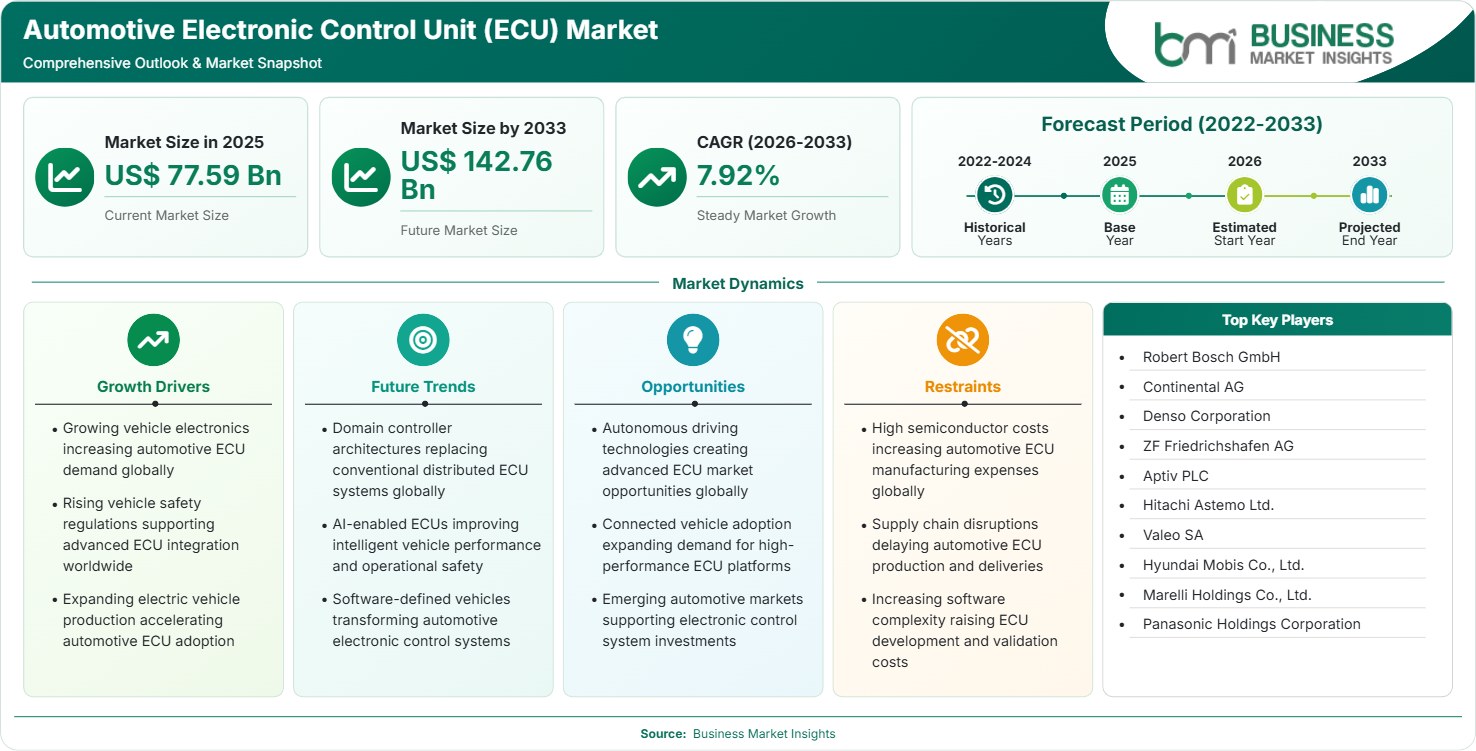
The Automotive Electronic Control Unit (ECU) Market size was valued at US$ 77.59 billion in 2025 and is projected to reach US$ 142.76 billion by 2033, growing at a CAGR of 7.92% during 2026–2033. The market expansion is driven by vehicle electrification, advanced safety systems, autonomous technologies, connected mobility, and increasing electronic complexity across modern vehicles.

Report Coverage
  • Vehicle Type: Passenger Car, Light Commercial Vehicle, Heavy Commercial Vehicle, Electric Vehicle
  • Application: Powertrain, Braking System, Body Electronics, ADAS, Infotainment
US$ 77.59 Bn Market size in 2025
US$ 142.76 Bn Market Size by 2033
7.92% CAGR, 2026 - 2033
2026-2033 Forecast Period

AI Overview

Automotive Electronic Control Unit (ECU) Market Summary

  • North America Region: North America holds a market share of 24%–27% in 2025, growing at a CAGR of 7.5%–8.2% during 2026–2033. Growth is supported by connected vehicle adoption, autonomous driving investments, regulatory safety requirements, and electric vehicle expansion. The United States market is developing through advanced vehicle electronics integration, software-defined vehicle programs, and automotive technology investments, with a CAGR of 7.8%–8.5% during 2026–2033.
  • Fastest Growing Region: Asia Pacific accounts for 42%–45% market share in 2025 and is projected to grow at a CAGR of 8.0%–8.8% during 2026–2033. Growth is influenced by electric vehicle production, automotive manufacturing expansion, increasing electronic content per vehicle, and investments in intelligent transportation technologies across China, Japan, South Korea, and India.
  • Leading Segment: Passenger Car represents 55%–58% market share in 2025 and is expected to grow at a CAGR of 7.4%–8.1% during 2026–2033. Growth is supported by increasing adoption of advanced safety features, infotainment systems, driver assistance technologies, and electronic vehicle architectures.
  • High Growth Segment: Electric Vehicle accounts for 18%–22% market share in 2025 and is projected to expand at a CAGR of 9.0%–10.0% during 2026–2033. Growth is driven by battery management systems, power electronics, autonomous capabilities, and increasing electronic control requirements in electric mobility platforms.
  • Key Market Opportunity: Autonomous driving development, connected vehicle platforms, electric mobility expansion, and software-defined vehicle architectures are creating opportunities for advanced ECU manufacturers and technology providers globally.
  • Major Market Players: Robert Bosch GmbH, Continental AG, Denso Corporation, ZF Friedrichshafen AG, Aptiv PLC, Hitachi Astemo Ltd., Valeo SA, Hyundai Mobis Co., Ltd., Marelli Holdings Co., Ltd., Panasonic Holdings Corporation.
Strategic Insights

Automotive Electronic Control Unit (ECU) Market: Strategic Insights

Automotive Electronic Control Unit (ECU) Market Strategic Framework
FREE PDF
Request your free sample
Request free sample
Stakeholder View

Key Takeaways

  • The ECU ecosystem is evolving from multiple independent controllers toward integrated electronic architectures combining hardware, software, connectivity, and cybersecurity capabilities across vehicle platforms.
  • Electric vehicles and autonomous driving systems represent major growth opportunities as they require higher numbers of electronic control units for power management, safety, and intelligent vehicle functions.
  • Innovation is shifting toward centralized computing platforms, over-the-air software updates, artificial intelligence integration, and cybersecurity-enabled ECU solutions supporting software-defined vehicles.
  • Asia Pacific provides strong investment potential due to large automotive manufacturing bases, expanding electric vehicle production, and increasing adoption of advanced vehicle technologies.
  • Strategic partnerships between automotive suppliers, semiconductor manufacturers, and technology companies are increasing as industry participants seek expertise in electronics and software development.
  • The transition toward connected mobility is encouraging manufacturers to develop scalable ECU platforms capable of supporting future autonomous and intelligent transportation requirements.
Geographic Outlook

Automotive Electronic Control Unit (ECU) Market Regional Highlights

North America Automotive Electronic Control Unit (ECU) Market

North America accounted for 24%–27% of global demand in 2025 and is expected to expand at a CAGR of 7.5%–8.2% during 2026–2033. The region benefits from advanced automotive technology adoption, electric vehicle investments, autonomous driving development, and strong regulatory focus on vehicle safety. The Automotive Electronic Control Unit (ECU) Market share in North America is influenced by increasing demand for connected vehicles, advanced driver assistance systems, and software-driven automotive architectures.

  • The United States is driving regional demand through autonomous vehicle testing, electric vehicle production, and advanced automotive electronics investments.
  • Canada is supporting automotive technology development through manufacturing capabilities, research programs, and connected mobility initiatives.
  • Regulatory requirements for safety systems are increasing ECU integration across passenger and commercial vehicle platforms.
  • Technology partnerships between automotive manufacturers and electronics suppliers are accelerating development of advanced control systems.

US Automotive Electronic Control Unit (ECU) Market

The United States represented approximately 85%–88% of North America's ECU demand in 2025 and is projected to grow at a CAGR of 7.8%–8.5% during 2026–2033. The country benefits from automotive innovation, electric vehicle expansion, autonomous technology investments, and strong demand for connected vehicle solutions. Increasing adoption of advanced driver assistance systems and software-defined vehicle platforms is encouraging manufacturers to integrate more sophisticated electronic control units.

  • Electric vehicle production growth is increasing demand for battery management, powertrain, and energy control electronic systems.
  • Autonomous driving investments are accelerating development of advanced computing and vehicle control platforms.
  • Automotive safety regulations are encouraging wider adoption of electronic braking and driver assistance systems.
  • Collaboration between technology companies and automotive manufacturers is strengthening domestic ECU innovation capabilities.

Europe Automotive Electronic Control Unit (ECU) Market

Europe accounted for approximately 20%–23% of global demand in 2025 and is forecast to grow at a CAGR of 7.2%–7.9% through 2033. The region benefits from automotive engineering expertise, premium vehicle production, electrification initiatives, and strict vehicle safety standards. Germany, France, the United Kingdom, and Italy remain important markets due to established automotive industries and increasing investments in intelligent vehicle technologies.

  • Germany leads European ECU demand through premium vehicle manufacturing, automotive innovation, and advanced electronics integration in automotive electronic control unit (ECU) market.
  • France is expanding electric vehicle production and supporting automotive technology development through industrial initiatives.
  • The United Kingdom is investing in connected mobility solutions and autonomous vehicle technologies.
  • European vehicle emission regulations are encouraging manufacturers to adopt advanced electronic control systems.
  • Automotive suppliers are developing software-enabled ECU platforms to support future mobility requirements.

Asia Pacific Automotive Electronic Control Unit (ECU) Market

Asia Pacific accounted for approximately 42%–45% of global demand in 2025 and is projected to register a CAGR of 8.0%–8.8% during 2026–2033. The region remains the largest automotive production hub, supported by expanding vehicle manufacturing, electric vehicle adoption, growing electronics integration, and increasing investments in intelligent transportation systems. China, Japan, South Korea, and India are key contributors due to their automotive manufacturing capabilities and technology development initiatives.

  • China is increasing ECU demand through electric vehicle production, smart vehicle development, and expansion of domestic automotive electronics capabilities.
  • Japan continues supporting ECU innovation through advanced automotive engineering, semiconductor expertise, and established vehicle technology ecosystems.
  • South Korea is expanding electronic control system adoption through electric vehicles, connected mobility solutions, and automotive technology investments in automotive electronic control unit (ECU) market.
  • India is emerging as a growth market due to increasing vehicle production, electrification initiatives, and rising adoption of advanced safety features.
  • Regional manufacturers are investing in localized ECU production to support growing automotive electronics requirements and reduce supply chain dependencies.

Rest of World Automotive Electronic Control Unit (ECU) Market

The Rest of World region accounted for approximately 6%–9% of global demand in 2025 and is expected to grow at a CAGR of 7.0%–7.7% during 2026–2033. Latin America, the Middle East, and Africa are gradually increasing automotive electronics adoption through vehicle modernization, manufacturing investments, and connected mobility initiatives. Growing demand for safety systems, electric vehicles, and advanced vehicle technologies is supporting regional ECU market development.

Latin America is benefiting from automotive manufacturing expansion, while Middle Eastern countries are investing in smart transportation infrastructure and electric mobility projects. African markets are gradually adopting modern vehicle technologies through improving automotive distribution networks and infrastructure development.

  • Brazil and Mexico are strengthening automotive electronics demand through vehicle production growth and manufacturing ecosystem development.
  • Middle Eastern countries are supporting intelligent transportation systems through technology investments and mobility modernization programs in automotive electronic control unit (ECU) market.
  • South Africa is developing automotive technology adoption through manufacturing activities and increasing demand for advanced vehicle systems.
  • Regional vehicle modernization initiatives are encouraging adoption of safety-focused electronic control solutions.
  • Global ECU suppliers are exploring emerging markets through partnerships with local automotive manufacturers and technology providers.
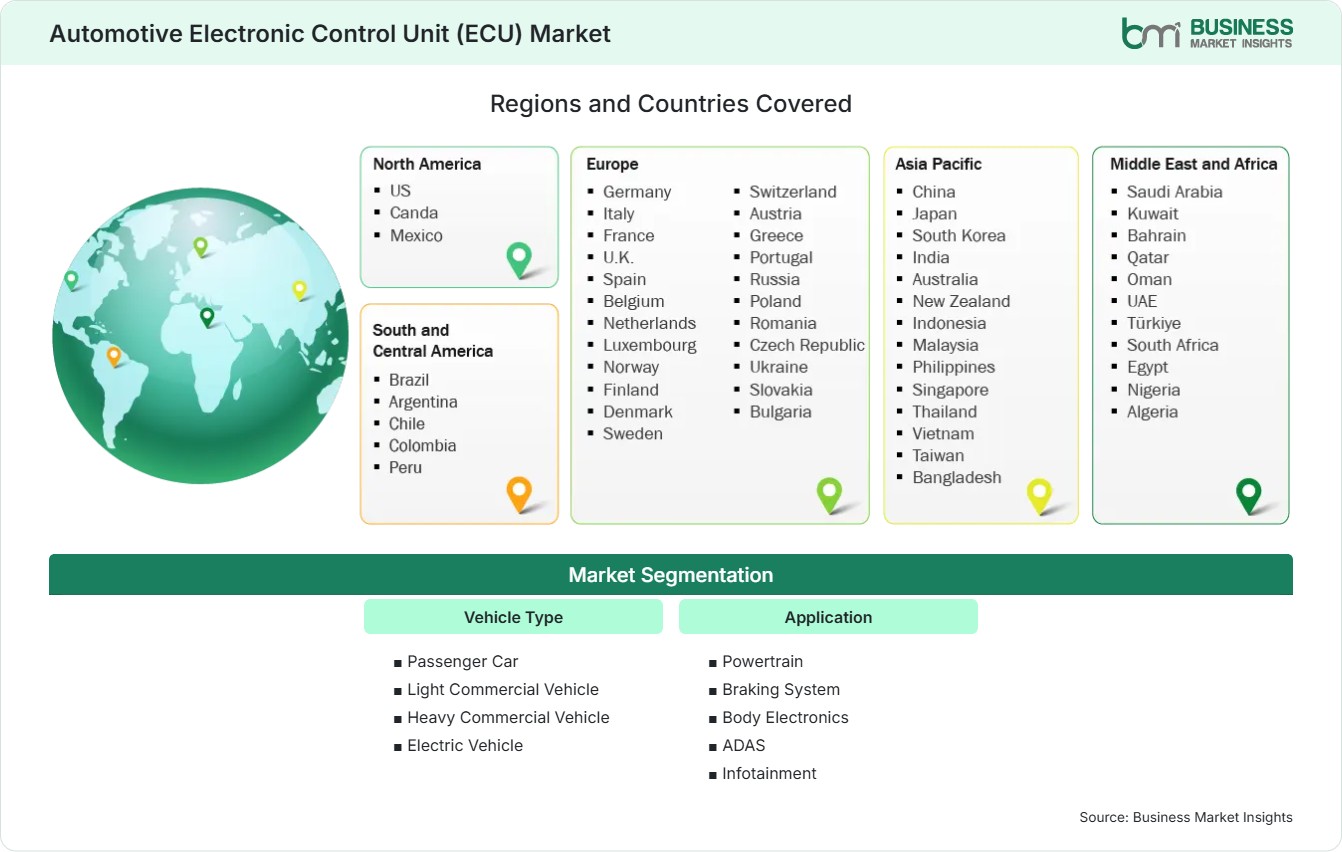
Global Market Geography
FREE PDF
Request your free sample
Request free sample
Segment Analysis

Automotive Electronic Control Unit (ECU) Market Segmentation

Vehicle Type

The Vehicle Type segment includes Passenger Car, Light Commercial Vehicle, Heavy Commercial Vehicle, and Electric Vehicle. Passenger Car accounted for the leading position with 55%–58% share in 2025 and is expected to grow at a CAGR of 7.4%–8.1% during 2026–2033. Increasing electronic content, safety requirements, infotainment adoption, and advanced assistance features are strengthening demand across passenger vehicles. The Automotive Electronic Control Unit (ECU) Market scope continues expanding as manufacturers integrate more intelligent control systems.

  • Passenger Car: Passenger cars dominate ECU demand due to increasing adoption of infotainment, safety systems, connectivity features, and advanced driver assistance technologies.
  • Light Commercial Vehicle: Light commercial vehicles are adopting more ECUs for fleet management, fuel efficiency improvement, safety enhancement, and connected transportation solutions.
  • Heavy Commercial Vehicle: Heavy commercial vehicles require advanced ECUs for powertrain management, emissions control, braking systems, and operational efficiency improvements.
  • Electric Vehicle: Electric vehicles are experiencing rapid ECU adoption due to battery management systems, electric powertrain controls, charging systems, and autonomous technologies.

By Application

The Application segment includes Powertrain, Braking System, Body Electronics, ADAS, and Infotainment. Powertrain applications represented a major share in 2025 due to their essential role in vehicle performance and efficiency management. The segment is expected to grow at a CAGR of 7.5%–8.2% during 2026–2033 as vehicles adopt advanced electronic architectures. Current Automotive Electronic Control Unit (ECU) Market trends indicate increasing demand for integrated control platforms across multiple vehicle functions.

  • Powertrain: Powertrain ECUs manage engine, transmission, and electric propulsion functions, improving efficiency, performance, and emission control across vehicle platforms.
  • Braking System: Braking system ECUs support electronic braking, stability control, and safety technologies designed to improve vehicle control and passenger protection.
  • Body Electronics: Body electronics applications include lighting, climate control, access systems, and comfort features requiring efficient electronic management.
  • ADAS: ADAS applications are expanding through autonomous driving development, sensor integration, collision prevention systems, and intelligent vehicle safety technologies.
  • Infotainment: Infotainment ECUs are growing due to connected vehicle features, digital displays, navigation systems, and integrated communication technologies.
Market Forces

Automotive Electronic Control Unit (ECU) Market Dynamics

Key Market Drivers

Growing vehicle electronics increasing automotive ECU demand globally

The increasing integration of electronic systems in modern vehicles is accelerating demand for automotive ECUs across global markets. Vehicles are incorporating advanced features including digital cockpits, connectivity platforms, safety systems, and automated functions that require sophisticated electronic control solutions. The rising number of ECUs per vehicle is increasing demand for reliable hardware and software platforms capable of managing complex automotive operations. Automakers are investing in advanced architectures to support improved efficiency, safety, and user experience. These developments are strengthening market growth by expanding applications across passenger vehicles, commercial vehicles, and electric mobility platforms. Continuous innovation in automotive electronics is further influencing Automotive Electronic Control Unit (ECU) Market trends.

Rising vehicle safety regulations supporting advanced ECU integration worldwide

Improving safety standards worldwide have been driving manufacturers towards incorporating more sophisticated electronic control units within their vehicles. Regulatory issues associated with accident prevention, breaking, stability control, and driver monitoring have led to increased demand for sophisticated ECU systems. Manufacturers are utilizing advanced technology in order to meet regulatory needs and improve vehicle performance. The need to incorporate ADAS systems will necessitate the use of sophisticated and capable ECUs that will process information from sensors and control safety features in real time. This is fueling the development of reliable and powerful electronic control units by suppliers.

Expanding electric vehicle production accelerating automotive ECU adoption

The rise in electric vehicle manufacturing has led to the creation of a greater need for electronic control units that are dedicated to the control of electric power trains, batteries, and energy management. Electric vehicles are characterized by advanced control systems which can be used in order to control the battery performance, the charge and discharge process, the thermal management of the vehicle and efficiency of the same. There is an increase in investment by automotive manufacturers on platforms for electric mobility which opens up room for the development of tailor-made ECU solutions.

Key Market Opportunities

Autonomous driving technologies creating advanced ECU market opportunities globally

The development of autonomous driving technologies is creating significant opportunities for ECU manufacturers by increasing demand for high-performance computing, sensor integration, and real-time vehicle control systems. Autonomous vehicles require advanced electronic architectures capable of processing large volumes of data from cameras, radar, lidar, and communication systems. Automotive suppliers are investing in centralized ECU platforms and domain controllers to support higher levels of vehicle automation. The expansion of autonomous mobility initiatives, testing programs, and intelligent transportation projects is encouraging collaboration between automakers, technology companies, and electronics providers. These developments are expected to create strong opportunities across the value chain. Automotive Electronic Control Unit (ECU) Market Forecasts indicate continued investment potential as autonomous technologies advance globally.

Connected vehicle adoption expanding demand for high-performance ECU platforms

Growth in the use of connected cars is giving rise to the creation of sophisticated ECU systems that can provide functionalities like communication, computing, cybersecurity, and software update through the air. Today’s automobiles are transforming into digital ecosystems that need electronic control systems to integrate multiple vehicle operations as well as the network external to the vehicle. Carmakers are making investments in the area of connected mobility systems to enhance their user experience, operational efficiency, and capabilities of predicting vehicle maintenance needs. ECU providers are coming up with scalable ECU platforms that allow software-based functionalities in vehicles and continuous enhancements in its functionality.

Emerging automotive markets supporting electronic control system investments

The growth in vehicle production and the need for enhanced features like safety, connectivity, and comfort from end users have opened up new opportunities in emerging automotive markets. Developing nations across Asia-Pacific, Latin America, and elsewhere are stepping up their automotive manufacturing capacities and vehicle technologies. The rise in disposable incomes, urbanization trends, and government policies backing electric mobility is making manufacturers develop cars that feature more electronics. ECU manufacturers are forming stronger ties and distribution channels in order to benefit from this trend. Investment in local manufacturing, technological infrastructures, and automotive supply chain is creating a positive environment for ECU adoption.

Market Restraints and Challenges

High semiconductor costs increasing automotive ECU manufacturing expenses globally

Factor: Automotive ECUs depend on advanced semiconductor components, microcontrollers, processors, and memory technologies that experience cost fluctuations due to manufacturing complexity and supply constraints.

Impact: Increasing semiconductor prices can raise ECU production costs, reduce supplier margins, and create pricing challenges for automotive manufacturers. Higher component expenses may affect vehicle affordability and increase pressure on suppliers to optimize production processes. Companies must invest in supply chain management, alternative sourcing strategies, and long-term semiconductor partnerships to maintain stable production. The growing electronic complexity of vehicles further increases dependence on advanced semiconductor technologies. Managing semiconductor costs remains essential for maintaining competitive ECU manufacturing while supporting innovation in electric vehicles, autonomous systems, and connected mobility platforms.

Supply chain disruptions delaying automotive ECU production and deliveries

Factor: Automotive ECU production relies on globally distributed supply chains involving semiconductor manufacturers, electronic component suppliers, software providers, and specialized manufacturing facilities.

Impact: Supply chain disruptions can delay ECU availability, affect vehicle production schedules, and increase inventory management challenges for automotive manufacturers. Shortages of critical components may slow deployment of advanced vehicle technologies and increase operational uncertainty across the automotive ecosystem. Companies are responding by diversifying suppliers, increasing regional manufacturing capabilities, and improving supply chain visibility. Building resilient supply networks is becoming increasingly important as vehicles require more electronic systems and software integration. Maintaining consistent ECU supply will remain a key priority for manufacturers seeking to support growing demand for advanced automotive technologies.

Company Analysis

Competitive Landscape

The Automotive Electronic Control Unit (ECU) Market analysis highlights a competitive landscape driven by automotive electronics innovation, software integration, electrification, and advanced vehicle technology development. Leading companies are focusing on ECU architecture advancement, strategic collaborations, manufacturing expansion, and intelligent mobility solutions to strengthen their market positions.

Company Name

Overview

Products and Services relevant to this market

Robert Bosch GmbH

Global automotive technology supplier providing electronic systems and mobility solutions for vehicle manufacturers worldwide.

Engine control units, body electronics, ADAS ECUs, powertrain controllers, and vehicle software solutions.

Continental AG

Automotive technology company specializing in electronics, safety systems, and intelligent mobility technologies.

Vehicle control units, ADAS systems, powertrain electronics, connectivity solutions, and electronic components.

Denso Corporation

Japanese automotive supplier developing advanced electronic systems and mobility technologies for global automakers.

Engine ECUs, hybrid vehicle controllers, safety electronics, thermal management systems, and vehicle control solutions.

ZF Friedrichshafen AG

Technology company focused on automotive systems, electrification, and intelligent vehicle solutions.

Electronic control units, braking system controllers, ADAS technologies, and vehicle electronics platforms.

Aptiv PLC

Automotive technology company specializing in software-enabled mobility and advanced electronic architectures.

Vehicle computing platforms, connectivity systems, ADAS controllers, and electronic control solutions.

Hitachi Astemo Ltd.

Automotive supplier providing advanced mobility solutions combining electronics, software, and vehicle systems.

Powertrain ECUs, chassis control systems, safety electronics, and mobility technology solutions.

Valeo SA

Global automotive supplier developing innovative systems for electrification, safety, and vehicle automation.

Body electronics, ADAS ECUs, lighting controls, powertrain electronics, and vehicle control technologies.

Hyundai Mobis Co., Ltd.

Automotive component manufacturer supplying advanced systems to global vehicle manufacturers.

Electronic control systems, autonomous driving components, infotainment electronics, and vehicle modules.

Marelli Holdings Co., Ltd.

Automotive technology company specializing in electronics, lighting, and mobility solutions.

Vehicle control units, electronic systems, cockpit electronics, and powertrain control technologies.

Panasonic Holdings Corporation

Technology company developing automotive electronics and mobility solutions for connected vehicles.

Vehicle infotainment systems, electronic components, battery control technologies, and automotive electronics.

Trust & Transparency

Research Methodology

The market analysis combines proprietary research with secondary data from government agencies, company disclosures, regulatory filings, industry databases and expert interviews. Market estimates are validated through data triangulation, cross-market benchmarking and analyst review.

View Full Research Methodology

Questions Answered

Frequently Asked Questions

What information is included in an Automotive Electronic Control Unit (ECU) Market Report?

An Automotive Electronic Control Unit (ECU) Market Report includes market size, growth analysis, segmentation insights, regional assessment, competitive landscape, technological developments, investment trends, and future industry opportunities.

What challenges affect automotive ECU manufacturing?

High semiconductor costs, component supply disruptions, increasing system complexity, and requirements for advanced software capabilities create challenges for ECU manufacturers and automotive suppliers.

Which application segment is important for automotive ECU adoption?

Powertrain, ADAS, braking systems, body electronics, and infotainment applications are important areas for ECU adoption as manufacturers integrate more intelligent and connected vehicle functions.

How are electric vehicles influencing ECU development?

Electric vehicles require specialized ECUs for battery management, power distribution, thermal control, charging systems, and electric powertrain operations, increasing demand for advanced electronic control platforms.

What factors are increasing demand for automotive ECUs?

Increasing vehicle electrification, advanced safety regulations, autonomous driving development, connected vehicle adoption, and growing electronic content per vehicle are driving demand for automotive electronic control units globally.

Access the Full Automotive Electronic Control Unit (ECU) Market Report

Get segment-level forecasts, regional estimates, competitive benchmarking, company profiles and downloadable Excel datasets.

Access the full Automotive Electronic Control Unit (ECU) Market Report
350 pages PDF & Excel | 2026-08-10