
Automotive Electronic Expansion Valve Market Outlook: Size, Share, Trends, Growth Analysis, Competitive Landscape & Forecast, 2026–2033

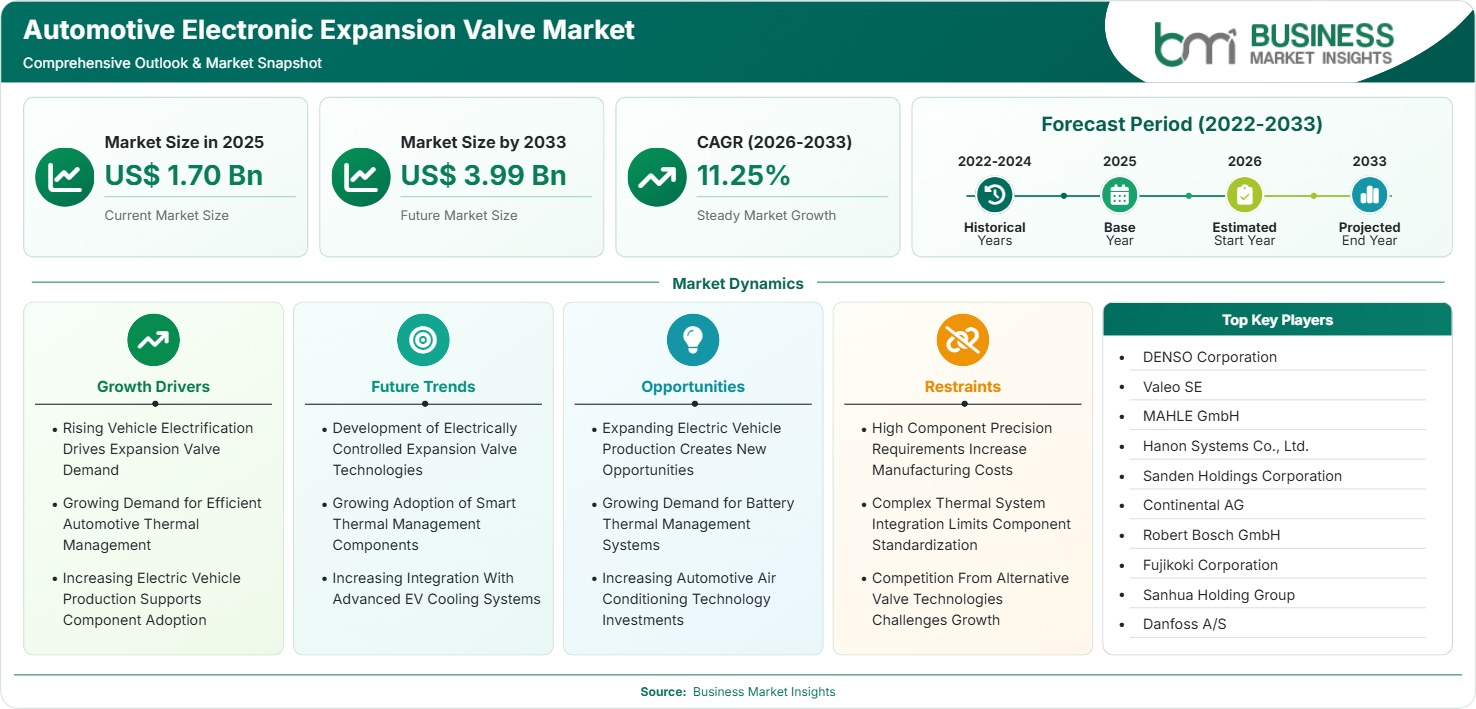
The Automotive Electronic Expansion Valve Market size was valued at US$ 1.70 billion in 2025 and is projected to reach US$ 3.99 billion by 2033, growing at a CAGR of 11.25% during 2026–2033, driven by vehicle electrification, thermal efficiency requirements, battery cooling, heat pumps, and advanced cabin climate control.

Report Coverage
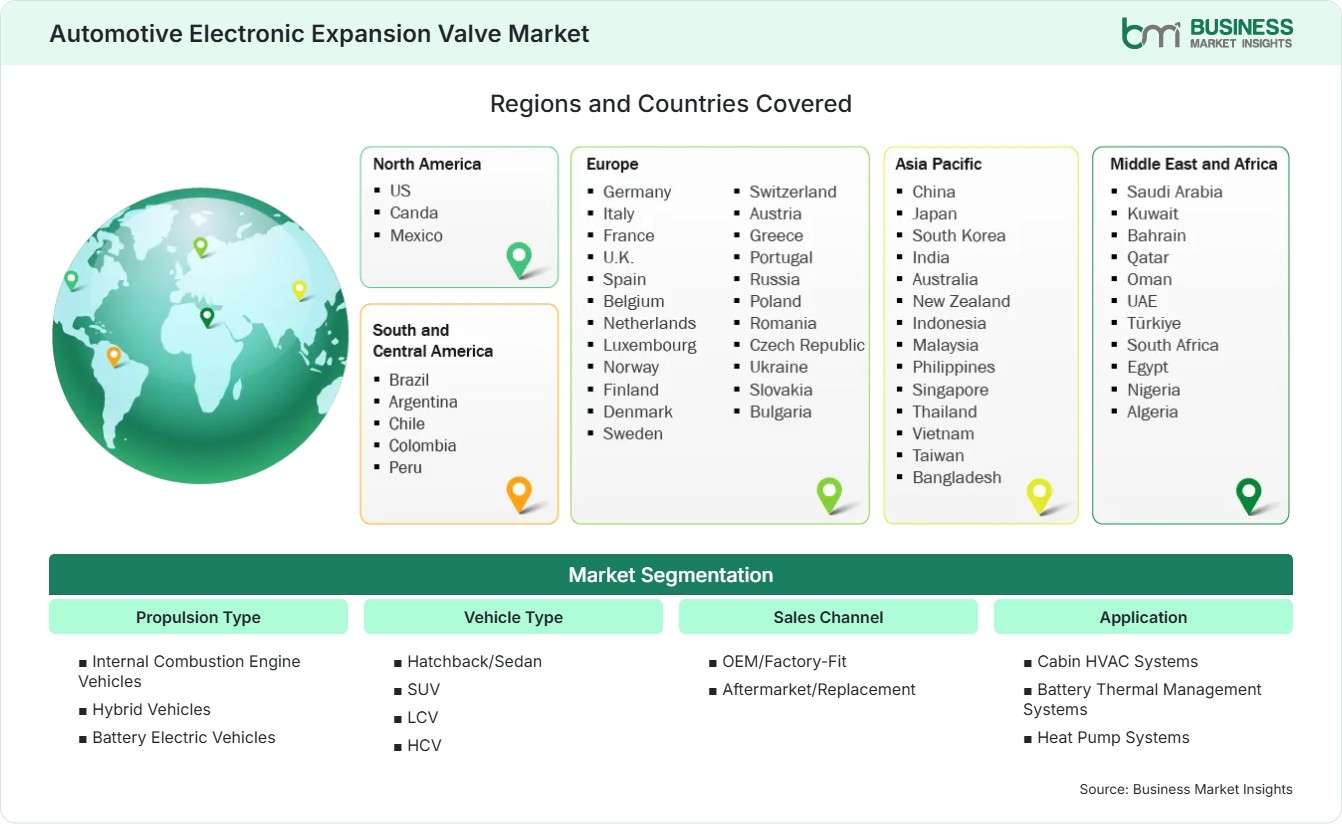
  • Propulsion Type: Internal Combustion Engine Vehicles, Hybrid Vehicles, Battery Electric Vehicles
  • Vehicle Type: Hatchback/Sedan, SUV, LCV, HCV
  • Sales Channel: OEM/Factory-Fit, Aftermarket/Replacement
  • Application: Cabin HVAC Systems, Battery Thermal Management Systems, Heat Pump Systems
US$ 1.70 Bn Market size in 2025
US$ 3.99 Bn Market Size by 2033
11.25% CAGR, 2026 - 2033
2026-2033 Forecast Period

AI Overview

Automotive Electronic Expansion Valve Market Summary

  • North America Region: North America holds a 20%–23% share in 2025, growing at a 9.2%–10.0% CAGR, supported by electric vehicle adoption, stringent efficiency expectations, battery thermal management, advanced HVAC systems, and expanding heat pump integration across passenger vehicles.
  • Fastest Growing Region: Asia Pacific holds a 43%–46% share in 2025, advancing at a 12.5%–13.5% CAGR, supported by electric vehicle manufacturing, battery production, climate-control demand, localized component supply, vehicle electrification policies, and expanding automotive electronics capabilities.
  • Leading Segment: Battery Electric Vehicles hold a 36%–39% share in 2025, expanding at a 13.0%–14.0% CAGR, supported by battery cooling, heat pump adoption, energy efficiency, cabin conditioning, thermal optimization, and increasing electric vehicle production.
  • High Growth Segment: Battery Thermal Management Systems hold a 25%–28% share in 2025, advancing at a 14.0%–15.0% CAGR, driven by battery safety, charging performance, thermal uniformity, range optimization, fast charging, and increasingly sophisticated vehicle architectures.
  • Key Market Opportunity: Integrated thermal systems combining cabin HVAC, battery cooling, and heat pumps create opportunities for intelligent valves capable of precise refrigerant control across multiple operating conditions.
  • Major Market Players: DENSO Corporation, Valeo SE, MAHLE GmbH, Hanon Systems Co., Ltd., Sanden Holdings Corporation, Continental AG, Robert Bosch GmbH, Fujikoki Corporation, Sanhua Holding Group, Danfoss A/S
Strategic Insights

Automotive Electronic Expansion Valve Market: Strategic Insights

Automotive Electronic Expansion Valve Market Strategic Framework
FREE PDF
Request your free sample
Request free sample
Stakeholder View

Key Takeaways

  • Thermal management is becoming an integrated vehicle function rather than an isolated HVAC activity, increasing the importance of valves that can operate across multiple thermal circuits.
  • Battery electric platforms provide the strongest structural demand opportunity because efficient heating and cooling directly influence battery performance, passenger comfort, charging behavior, and driving range.
  • Suppliers are moving toward electronically controlled valves with faster response, improved sensing, compact designs, and greater compatibility with software-managed thermal strategies.
  • Asia Pacific provides the strongest manufacturing opportunity because electric vehicle production, battery manufacturing, automotive electronics, and localized component ecosystems are developing simultaneously.
  • Investment priorities are shifting toward production automation, precision machining, electronic actuation, validation capabilities, and engineering partnerships supporting next-generation thermal architectures.
  • OEM sourcing decisions increasingly emphasize lifecycle reliability, refrigerant compatibility, response accuracy, integration flexibility, and the ability to support platform-specific thermal-control strategies.
Geographic Outlook

Automotive Electronic Expansion Valve Market Regional Highlights

North America Automotive Electronic Expansion Valve Market

North America accounts for a 20%–23% share in 2025 and is projected to grow at a 9.2%–10.0% CAGR through 2033. The region benefits from expanding electric vehicle programs, established automotive engineering capabilities, and demand for efficient cabin conditioning. The US represents the principal regional opportunity, while Canada contributes through vehicle and component manufacturing.

  • Electric vehicle platforms are increasing demand for thermal architectures that manage battery temperature, cabin comfort, charging loads, and power electronics within coordinated systems.
  • Automakers are evaluating heat pump technologies to improve cold-weather efficiency and reduce energy consumption, increasing requirements for precise refrigerant flow control.
  • Component suppliers with electronics and thermal-control expertise can gain from platform programs requiring tighter integration between sensors, actuators, control software, and refrigerant circuits.
  • Commercial electrification provides another avenue because electric delivery vehicles and fleets require dependable thermal management under intensive operating and charging cycles.

US Automotive Electronic Expansion Valve Market

The US represents approximately 78%–81% of North American demand and is expected to expand at a 9.5%–10.2% CAGR through 2033. Electrification investment, domestic battery manufacturing, vehicle efficiency requirements, and advanced climate-control systems support component adoption across passenger and commercial vehicle platforms.

  • Battery electric vehicle programs require thermal systems capable of managing temperature across batteries, motors, power electronics, and passenger compartments under changing operating conditions.
  • Heat pump integration creates demand for valves with accurate bidirectional or variable refrigerant-flow management across heating and cooling modes.
  • Domestic automotive supply-chain investment encourages localized production and qualification of precision thermal-management components for new electric vehicle platforms.

Europe Automotive Electronic Expansion Valve Market

Europe holds a 27%–30% Automotive Electronic Expansion Valve Market share in 2025 and is forecast to grow at a 9.5%–10.5% CAGR. Germany remains the leading market, while France, Italy, and the UK provide additional demand. Germany is estimated at a 10.0%–10.8% CAGR, supported by electrified vehicle production and advanced automotive engineering.

  • European vehicle efficiency requirements encourage manufacturers to optimize HVAC energy consumption, particularly in battery electric vehicles where auxiliary loads affect driving range.
  • Germany benefits from a strong automotive manufacturing ecosystem and extensive engineering capabilities supporting advanced thermal-management architectures.
  • Heat pump systems are gaining importance in electric vehicles because efficient heating can reduce dependence on energy-intensive resistive heating.
  • France and the UK provide additional opportunities through electric vehicle deployment, component localization, and investment in lower-emission mobility technologies.

Asia Pacific Automotive Electronic Expansion Valve Market

Asia Pacific represents a 43%–46% share in 2025 and is the fastest-growing region, advancing at a 12.5%–13.5% CAGR. China remains the dominant regional Automotive Electronic Expansion Valve Market, while Japan, South Korea, and India offer significant opportunities. China is positioned at a 13.0%–14.0% CAGR.

  • China combines extensive electric vehicle manufacturing with large battery production capacity, creating strong demand for electronically controlled thermal-management components.
  • Japan maintains sophisticated automotive electronics and thermal engineering capabilities, supporting adoption of compact and highly reliable valve technologies.
  • South Korea benefits from battery manufacturing and electric vehicle development, increasing demand for thermal systems that maintain battery operating conditions.
  • India offers emerging upside as domestic electric vehicle production expands and manufacturers increasingly localize automotive electronic and thermal-management components.

Rest of World Automotive Electronic Expansion Valve Market

Rest of World accounts for an 8%–10% share in 2025 and is projected to grow at a 7.8%–9.0% CAGR. South America is supported by gradual vehicle electrification, while the Middle East and Africa offer longer-term opportunities as electric mobility infrastructure develops.

South America provides opportunities through Brazil and Mexico-linked automotive supply chains, although adoption remains more gradual than in Asia Pacific and Europe. Brazil is expected to represent the principal regional opportunity as electrified vehicle availability expands.

  • Brazil offers opportunities as automakers expand electrified vehicle portfolios and suppliers strengthen local capabilities for advanced vehicle thermal systems.
  • Mexico benefits from established automotive manufacturing and integration with North American vehicle supply chains, creating opportunities for thermal-component localization.
  • Gulf countries are developing electric mobility infrastructure and premium vehicle markets, supporting gradual adoption of advanced climate-control technologies.
  • South Africa provides an established automotive manufacturing base that can support future thermal-component opportunities as vehicle electrification progresses.
Global Market Geography
FREE PDF
Request your free sample
Request free sample
Segment Analysis

Automotive Electronic Expansion Valve Market Segmentation

Propulsion Type

Battery Electric Vehicles lead with a 36%–39% share in 2025 and a 13.0%–14.0% CAGR. Automotive Electronic Expansion Valve Market scope is expanding as electrified platforms require coordinated thermal control for batteries, cabins, motors, power electronics, and heat pumps.

  • Internal Combustion Engine (ICE) Vehicles: ICE vehicles continue using electronic expansion valves for precise refrigerant management, improved cabin comfort, compressor efficiency, and increasingly sophisticated HVAC architectures.
  • Hybrid Vehicles (HEV & PHEV): Hybrid platforms require thermal management across combustion engines, electric motors, batteries, and passenger cabins, creating demand for valves supporting changing operating modes.
  • Battery Electric Vehicles (BEV): BEVs require advanced thermal control for batteries, cabins, motors, and electronics, making precise refrigerant regulation increasingly important for efficiency and driving-range management.

Vehicle Type

SUVs represent a 39%–42% share in 2025 and are expected to grow at a 10.8%–11.8% CAGR. Larger cabin volumes and expanding electrified SUV portfolios increase thermal-management requirements, while LCV electrification creates additional demand.

  • Hatchback/Sedan: These vehicles require compact HVAC architectures where electronically controlled refrigerant flow can improve cabin conditioning, packaging flexibility, and energy efficiency.
  • SUV: SUVs require greater thermal capacity because of larger cabins and increasing electrification, creating demand for precise valves compatible with sophisticated HVAC and heat pump systems.
  • LCV: Electric light commercial vehicles require dependable thermal management across intensive operating cycles, making efficient cabin conditioning and battery temperature control important component requirements.
  • HCV: Heavy commercial vehicles require robust thermal systems capable of supporting long operating periods, large cabins, battery systems, and demanding environmental conditions.

Sales Channel

OEM/Factory-Fit commands a 76%–80% share in 2025 and is projected to grow at a 10.8%–11.6% CAGR. Factory integration dominates because valve performance must be matched closely with vehicle thermal architectures, refrigerant circuits, and electronic controls.

  • OEM/Factory-Fit: Factory-installed valves benefit from platform-level engineering, validated refrigerant circuits, integrated electronic controls, and vehicle-specific calibration requirements.
  • Aftermarket/Replacement: Replacement demand is supported by vehicle maintenance and HVAC repairs, with opportunities depending on installed vehicle populations, service practices, component availability, and compatibility.

Application

Cabin HVAC Systems represent a 48%–52% share in 2025 and a 9.8%–10.6% CAGR. Battery Thermal Management Systems are expanding faster as electrification increases the need for temperature control, while heat pumps gain importance for efficient electric vehicle heating.

  • Cabin HVAC Systems: Electronic expansion valves regulate refrigerant flow to maintain cabin comfort while supporting efficient compressor operation across changing temperatures and cooling loads.
  • Battery Thermal Management Systems: Battery systems require controlled thermal conditions to support safety, performance, charging, and service life, creating strong demand for precise refrigerant-flow regulation.
  • Heat Pump Systems: Heat pumps use controlled refrigerant circulation for heating and cooling, supporting energy-efficient climate control and reducing thermal loads on electric vehicle batteries.
Market Forces

Automotive Electronic Expansion Valve Market Dynamics

Key Market Drivers

Rising Vehicle Electrification Drives Expansion Valve Demand

Thermal system design is evolving due to the fact that battery packs and electric motors are designed to operate at temperatures that are different from those required by standard combustion engines. Electronically controlled expansion valves allow for controlled distribution of refrigerant through the cooling and heating loops, enabling automotive OEMs to balance several thermal loads. The development of the battery electric vehicle market has particular significance because it is directly related to the ability to heat the cabin without having an impact on the driving range. Consequently, the Automotive Electronic Expansion Valve Market growth can be considered evidence of a transition towards electronically controlled thermal systems. Those suppliers who can offer technologies such as accurate flow control, smaller size, and electronic compatibility will stand to gain from the change in the thermal architecture of the vehicles.

Growing Demand for Efficient Automotive Thermal Management

The vehicle industry needs to have thermal systems that provide passenger comfort without causing any energy wastage. Better control of refrigerants can lead to efficient operations of compressors, evaporators, condensers, battery-cooling loops, and heat pumps. Electronic valves are used to control the flow rate instead of using mechanical features, which makes the thermal system adaptive to varying conditions. This will become very critical as the vehicle runs in varying temperatures and with varying loads. Energy management through thermal systems can also be used to manage battery conditioning while charging and running the vehicle. The ultimate focus of the engineering community should be not only higher cooling capacity but better energy management of various subsystems in a vehicle. It results in continuous demand for reliable and accurate valve mechanisms.

Increasing Electric Vehicle Production Supports Component Adoption

The manufacture of electric vehicles is setting new demands on components, due to the fact that the thermal management process is interlinked with the battery technology, the charging process, passenger compartment climate control, and even the efficiency of the propulsion system. There are integrated systems used in electric vehicle platforms where the heat generated by the battery is transferred into the passenger cabin, power electronics, and the driveline. This refrigerant is controlled using an electronic expansion valve in such integrated systems. With the increasing use of platforms among car manufacturers, the suppliers of the valves need to ensure that the valves are configurable for multiple platforms. Automotive Electronic Expansion Valve market trends are thus affected by the move towards modularity within the field of engineering. Manufacturing possibilities go further than production of the valves themselves, to include sensors, actuators, control systems, and thermal management systems.

Key Market Opportunities

Expanding Electric Vehicle Production Creates New Opportunities

An increase in production volumes of electric vehicles will raise the need for components that are designed according to integrated thermal architectures rather than those that are modified based on conventional HVAC designs. There are opportunities for growth in compact valves, fast-acting actuators, electronic valve control devices, and devices that can operate in more than one refrigerant circuit. Suppliers may also develop platform-based development relationships where valves are designed along with compressors, heat exchangers, pumps, and sensors. It is thus advisable that the Automotive Electronic Expansion Valve Market Forecasts consider the growing value of integrated thermal architectures rather than unit replacement alone. Supply chain responsiveness may be increased by locating production in close proximity to electric vehicle and battery manufacturing plants.

Growing Demand for Battery Thermal Management Systems

Temperature management of the batteries constitutes a key area because temperature management impacts safety, charging, energy transfer, and efficiencies of the batteries. Modern thermal management systems need to control the flow of the refrigerant/coolant depending on the battery load, ambient temperature, and charging conditions. Valve technologies can offer the requisite control over the flow of the refrigerant/coolant to meet these needs of modern thermal management circuits. Valves can be designed to suit the design of compact battery packs, fast charging, high-voltage battery, and heat pump systems. There is a great opportunity in commercial EVs due to their longer operating cycles requiring thermal systems. Working with battery manufacturers and automakers is another way for valve suppliers to make sure that valve properties match up with different battery chemistries and operating methods.

Increasing Automotive Air Conditioning Technology Investments

As automotive HVAC becomes increasingly complex due to the demand for increased comfort and control of energy usage, investment will be made in heat pumps, variable speed compressors, electronic valves, sensors, and thermal management systems. This provides a chance for manufacturers who have the ability to integrate mechanics with electronics in their designs. The future designs could even be integrated with both battery and powertrain heating, and would thus require quick reaction and a wide range of operation. Development should target compactness, minimal leakage, durability, and compatibility with new refrigerants. Such investments have opened up possibilities in passenger cars, commercial platforms, premium cars, and specialized electric mobility applications.

Market Restraints and Challenges

High Component Precision Requirements Increase Manufacturing Costs

Factor: Electronic expansion valves require precise internal clearances, reliable actuation, accurate flow characteristics, and consistent sealing to maintain refrigerant-control performance. Impact: Manufacturing can require specialized machining, inspection, calibration, electronics integration, and quality-control processes, increasing production complexity and qualification costs. Tighter specifications become particularly important in electric vehicle applications where thermal performance can influence battery behavior and energy consumption. Suppliers must maintain repeatable manufacturing quality across high-volume programs while meeting vehicle durability expectations. Additional testing may be required for pressure cycling, temperature variation, vibration, refrigerant compatibility, and electronic reliability. These requirements can raise barriers for smaller manufacturers and increase the investment needed to develop competitive products for global automotive platforms.

Complex Thermal System Integration Limits Component Standardization

Factor: Vehicle thermal architectures differ according to propulsion system, battery design, refrigerant circuit, heat pump configuration, cabin requirements, and control strategy. Impact: Expansion valves often require application-specific calibration, communication interfaces, mounting arrangements, and flow characteristics, limiting complete component standardization. A valve suitable for one vehicle platform may require modification for another because thermal loads and operating conditions differ. This increases engineering effort and can extend validation timelines. Suppliers must therefore balance platform customization with modular product architectures that allow common components to serve multiple applications. Greater integration with vehicle software and sensors may also increase development requirements. Companies capable of offering configurable platforms can reduce customization costs while meeting increasingly specialized OEM requirements.

Company Analysis

Competitive Landscape

The Automotive Electronic Expansion Valve Market analysis indicates competition is centered on valve precision, durability, electronic control, refrigerant compatibility, OEM qualification, and thermal-system integration. Established automotive suppliers benefit from engineering relationships and manufacturing scale, while specialist valve producers compete through application-specific designs and responsive development capabilities.

Company Name

Overview

Products and Services relevant to this market

DENSO Corporation

Global automotive technology supplier with extensive climate-control and thermal-management capabilities.

Automotive air-conditioning components, thermal-management technologies, electronic refrigerant-control components, and HVAC systems.

Valeo SE

Automotive technology company providing thermal systems for conventional and electrified vehicles.

HVAC systems, thermal management, heat pumps, air-conditioning components, and electrified vehicle thermal solutions.

MAHLE GmbH

Automotive supplier specializing in powertrain and thermal-management technologies across vehicle platforms.

Vehicle thermal management, air-conditioning systems, heat pumps, cooling technologies, and thermal components.

Hanon Systems Co., Ltd.

Thermal-management specialist serving automotive manufacturers globally.

HVAC modules, heat pumps, compressors, thermal-management systems, and climate-control technologies.

Sanden Holdings Corporation

Automotive thermal-system specialist with expertise in vehicle air-conditioning technologies.

Automotive compressors, air-conditioning systems, thermal-management components, and climate-control technologies.

Continental AG

Automotive technology supplier providing electronic and thermal solutions for modern vehicle architectures.

Vehicle climate control, thermal-management electronics, sensors, control systems, and integrated automotive technologies.

Robert Bosch GmbH

Diversified automotive technology supplier with extensive electronics and vehicle-system expertise.

HVAC controls, thermal-management electronics, sensors, actuators, and electrified vehicle technologies.

Fujikoki Corporation

Specialist manufacturer focused on automotive air-conditioning and refrigerant-control technologies.

Expansion valves, automotive air-conditioning components, refrigerant-control products, and thermal-management solutions.

Sanhua Holding Group

Thermal-control component manufacturer serving automotive and refrigeration applications.

Electronic expansion valves, thermal-control components, heat pump components, and automotive thermal-management products.

Danfoss A/S

Engineering company with broad expertise in electronic valves, refrigeration, and thermal-control technologies.

Electronic expansion valves, refrigerant controls, thermal-management components, and electronically controlled HVAC technologies.

Trust & Transparency

Research Methodology

The market analysis combines proprietary research with secondary data from government agencies, company disclosures, regulatory filings, industry databases and expert interviews. Market estimates are validated through data triangulation, cross-market benchmarking and analyst review.

View Full Research Methodology

Questions Answered

Frequently Asked Questions

How can suppliers strengthen their competitive position?

According to the Automotive Electronic Expansion Valve Market report, suppliers can strengthen their position through precision manufacturing, faster electronic response, modular product platforms, application engineering, localized production, rigorous validation, and closer collaboration with automakers developing electrified thermal-management architectures.

What factors influence electronic expansion valve selection?

Selection depends on refrigerant compatibility, pressure range, flow capacity, response time, leakage performance, operating temperature, mounting configuration, electronic communication, durability, and compatibility with the vehicle's thermal-control architecture.

Which vehicle applications offer the strongest long-term opportunity?

Battery electric vehicles, electrified SUVs, electric commercial vehicles, and platforms using integrated heat pumps offer strong opportunities. These applications require thermal management across multiple systems rather than cabin cooling alone.

How does a heat pump affect expansion valve requirements?

Heat pump systems can operate in both heating and cooling modes, requiring controlled refrigerant flow under changing pressure and temperature conditions. This increases the importance of responsive electronic regulation and application-specific calibration.

Why are electronic expansion valves important in electric vehicles?

They provide precise refrigerant-flow control across changing thermal loads. This is particularly valuable in electric vehicles because battery cooling, cabin conditioning, heat pumps, and power-electronics thermal management can operate within coordinated circuits.

Access the Full Automotive Electronic Expansion Valve Market Report

Get segment-level forecasts, regional estimates, competitive benchmarking, company profiles and downloadable Excel datasets.

Access the full Automotive Electronic Expansion Valve Market Report
350 pages PDF & Excel | 2026-09-15
Similar Research

Related Market Reports